Portfolio Photography Awards: 6 Options for Work Beyond One Image

The strongest moves for photographers chasing recognition right now are the World Press Photo Contest, the Aperture Portfolio Prize, the MUSE Photography Awards, 35AWARDS, and portfolio-review programs at SIPF and Photo NOLA. Each one evaluates a full body of work rather than a single frame, and each opens doors to exhibition, publication, or meaningful cash prizes. We profile each below, explain how juries actually judge portfolios, and share how to sequence your submission for the best possible outcome.
TL;DR:
World Press Photo favors narrative sequences; finalists need matching original files, and missing RAW files or altered people or objects can disqualify entries.
Aperture suits fine art and conceptual series: its winner receives $5,000 and an editorial feature, while shortlisted artists receive exhibition inclusion and $1,000 each.
Limit entries to two or three deliberate submissions each year: pair a high exposure award with a genre fit and a niche or regional opportunity.
Build one thematic sequence with clear English captions, follow each contest’s file rules, organize matching RAW files, and track deadlines for possible early entry discounts.
SIPF and Photo NOLA offer individual portfolio reviews with curators, editors, gallerists, and publishers, prioritizing direct feedback and professional connections over contest rankings.
Table of Contents
1. Where to submit your portfolio for maximum exposure
These programs share one trait: they reward a coherent body of work, not an isolated image. We’ve grouped them by what they offer and who they suit best.
World Press Photo Contest: this remains the benchmark for documentary and photojournalism portfolios, with regional juries feeding into a global panel. Winners gain inclusion in the traveling exhibition, which appears in more than 80 cities worldwide, plus yearbook publication and prize money, and the contest distributes 42 winners across its regions each year. Entries typically open in early winter with a late-winter deadline, and the tactical tip here is simple: submit only story-driven sequences, since single strong frames rarely survive the narrative-focused judging.
Aperture Portfolio Prize: aimed at fine art and conceptual photographers with a resolved, thematic series. The Aperture Portfolio Prize awards its winner $5,000 plus an editorial feature, and shortlisted artists receive exhibition inclusion and $1,000 each. The call opens annually, and the prospectus is explicit about what judges want: a theme carried consistently across every image, not a greatest-hits selection.
MUSE Photography Awards: a juried international award recognizing excellence across genres, with particular strength in fine art and conceptual categories. It fits photographers building a cohesive personal project who want recognition alongside a global peer group rather than a narrow regional pool.
35AWARDS: a large-scale international competition built around categories and curated series, popular with photographers who want broad visibility across a sizable community of working professionals and enthusiasts. It suits photographers testing how a new body of work resonates before committing it to a more selective prize.
Singapore International Photography Festival (SIPF) portfolio reviews: a direct, face-to-face (or virtual) portfolio review model rather than a traditional contest. Selected photographers present bodies of work to an international panel of curators and editors, which often leads to festival exhibition slots and curator relationships that outlast any single award cycle.
Photo NOLA portfolio reviews: a long-running American review event drawing curators, gallerists, and publishers who meet one-on-one with photographers. It fits photographers who want candid, specific feedback on sequencing and presentation alongside the chance at exhibition or publication leads.
None of these programs reward disconnected single images. If your current focus leans more toward photojournalism specifically, our photojournalism competitions guide and the Photojournalism Prize (PJP) call go deeper into that category.
2. How juries evaluate portfolios and what disqualifies finalists
Jurors across these programs look for similar qualities, even when the categories differ:
Narrative coherence: does the portfolio read as one body of work with intentional sequencing, not a collection of favorites.
Editorial or artistic strength: each image needs to be strong individually, but the portfolio prize goes to whichever set demonstrates a theme carried consistently throughout.
Technical execution: consistent exposure, color, and printing or file quality across the set.
Relevance to category: a documentary portfolio judged against photojournalism standards, a fine art series judged against conceptual depth.
Originality: a fresh angle on a familiar subject tends to outperform technically flawless but predictable work.
World Press Photo distributes 42 winners across its regions each year, selected through a multi-stage process where regional juries pick regional winners before a global jury selects the Photo of the Year through secret ballots and multiple voting rounds.
Verification matters as much as composition. World Press Photo’s entry rules require finalists to supply original camera files, and manipulation rules strictly prohibit adding or removing people and objects from a frame. Photographers who cannot produce matching RAW files on request risk disqualification regardless of how strong the final edit looks. For a deeper breakdown of how judges weigh these factors across different contest types, our judging criteria rubric walks through the full evaluation process.
3. How to prepare and sequence a portfolio for awards
A portfolio built around a theme consistently outperforms a technical sampler, and the preparation work matters as much as the images themselves.
Choose one narrative arc. Pick a single theme or story and let every image in the set refer back to it, since jurors consistently prioritize a resolved body of work over a mix of strong but unrelated frames.
Sequence deliberately. Order images so they build on one another, opening with a frame that sets context and closing with one that resolves the story.
Caption in English. Even for international competitions, clear English captions help jurors who review hundreds of entries quickly understand context.
Standardize filenames and specs. Follow each contest’s resolution, file format, and naming conventions exactly, and confirm you can supply RAW files if requested.
Build a submission calendar. Track deadlines well ahead of time and prioritize early-bird windows, since several of these programs offer reduced entry fees for early submissions.
Pro Tip: Keep your RAW files organized and matched to final filenames from the start of a project, so you’re never scrambling to locate originals if a jury asks for verification.
For more on what separates a shortlisted entry from a rejected one, our photo awards benefits and checklist guide covers additional preparation steps worth reviewing before you submit.
4. Why a curated contest directory saves time and widens your options
Tracking deadlines across dozens of portfolio-focused programs eats into the time you could spend shooting or editing. We maintain a single, continuously updated directory of more than 320 to 330 active international photography competitions, including over 100 that are completely free to enter, refreshed every week so listings stay current.
Filter by what matters: genre, deadline, and entry cost, so you spend time only on programs that fit your current body of work.
Spot free opportunities: more than 100 listed competitions carry no entry fee, which matters when you’re submitting strategically rather than broadly.
Monitor portfolio-review cycles: festival review programs like SIPF and Photo NOLA run on seasonal schedules that are easy to miss without a single tracking source.
Save research time: rather than checking dozens of individual contest sites, one updated page covers the field.
This approach reflects what we believe matters most: fewer wasted hours searching, more informed decisions about where your work belongs.
5. What portfolio awards are actually worth to your career
The honest value of a portfolio award is not the trophy. It’s the door it opens afterward: the curator who remembers your name, the editor who requests a follow-up story, the gallery that circles back a year later. That only happens when the portfolio itself is strong enough to be remembered, which is why a scattershot approach to entries rarely pays off.

A better heuristic: pick two to three strategic submissions a year rather than entering everything available. Choose one high-exposure award for visibility, one contest that fits your specific genre or category, and one niche or regional opportunity where your work has a genuine edge. Spreading effort across twenty contests dilutes both your preparation and your odds. Spreading it across three, each chosen deliberately, tends to produce better results and more lasting connections.
Staying organized matters as much as choosing well, since missed deadlines eliminate otherwise strong candidates before judging even begins.
— DARIO
PhotoContestsClub: start tracking the right contests today
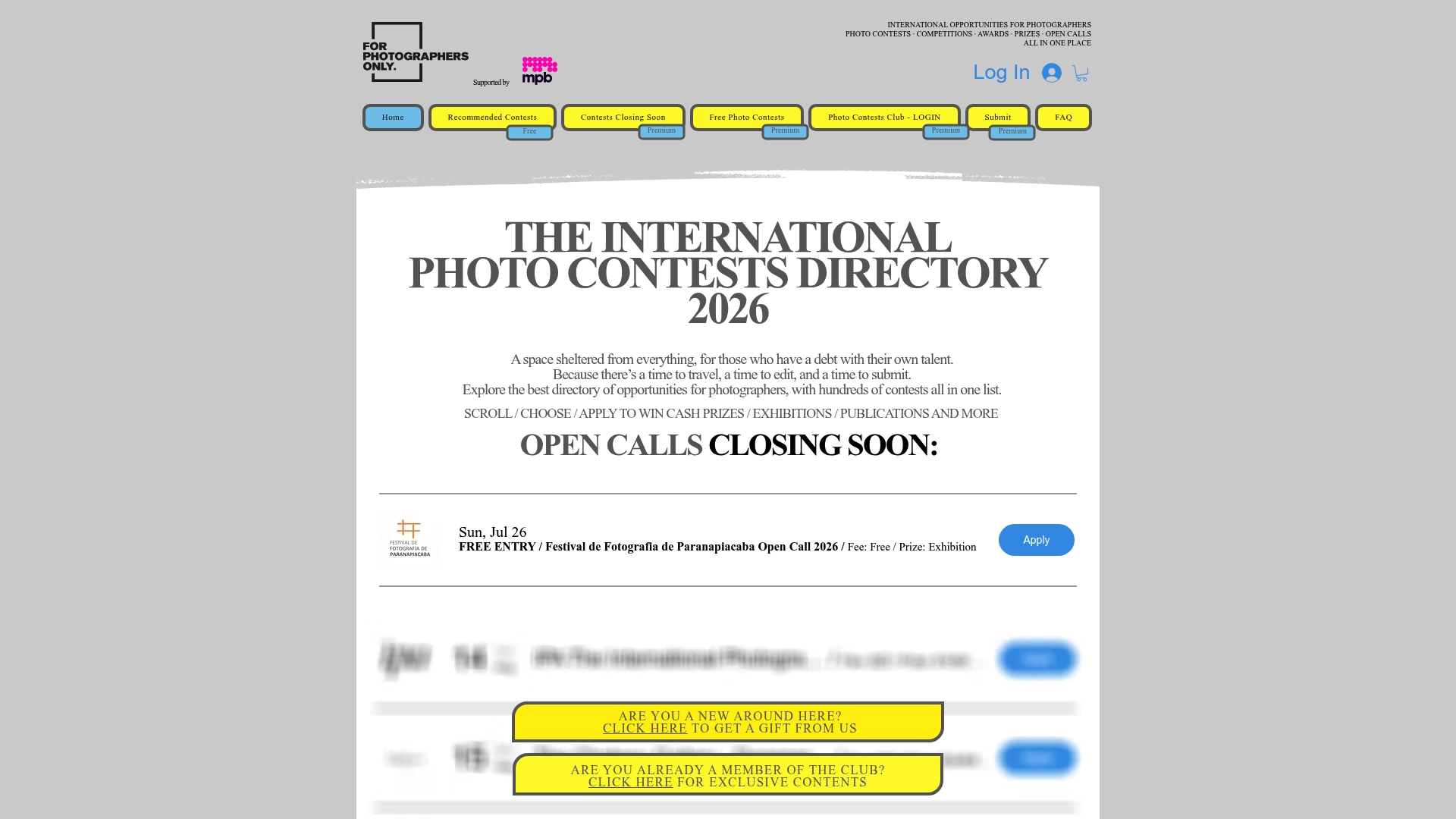
Once you know which portfolio awards fit your work, the next challenge is staying on top of deadlines, fees, and eligibility rules across every program on your shortlist. Our subscription service gives you access to a continuously updated page covering a large directory of international competitions, including portfolio-focused awards and review programs. For photographers preparing for event-related exhibitions, considering how venue choice shapes your event photo ops is essential.
Weekly updates: new calls and deadline reminders added regularly.
Curated selection: competitions organized by known institutions alongside quality niche opportunities.
Member-only extras: access to a photographer community and a monthly internal competition.
Flexible access: subscription options available, with sample free listings visible before committing.
Visit our contests directory to filter by genre and deadline, and see where your next portfolio submission belongs. If you’re also refining your public presentation, our pieces on photography life storytelling and practical photography technique are worth a look as you prepare.
FAQ
What should a photography portfolio look like?
A strong award portfolio centers on a single theme or narrative arc, with every image contributing to that story rather than standing alone. Captions should be clear and in English, file specs should match the contest’s technical requirements exactly, and the sequence should guide a juror from context to resolution.
What is the most prestigious photography contest?
Prestige depends on genre: for documentary and photojournalism work, the World Press Photo Contest is widely regarded as the benchmark, with regional juries and a global panel selecting winners each year. For fine art and conceptual portfolios, the Aperture Portfolio Prize carries comparable weight within that specific field.
What is the 20 60 20 rule in photography?
Definitions of this rule vary across photography education sources, and no official award body we reference defines it as a judging standard. We’d recommend focusing portfolio preparation on narrative coherence and sequencing rather than any single formula, since that’s what the jury criteria for programs like Aperture and World Press Photo actually emphasize.
How do portfolio awards differ from single-image contests?
Portfolio awards judge a connected body of work for narrative strength and consistency, while single-image contests reward one standout frame in isolation. Programs like the Aperture Portfolio Prize specifically look for a theme carried throughout the set, which means a portfolio of unrelated strong images typically underperforms a cohesive, intentional series.
Where can I find reliable listings of upcoming portfolio awards?
Official contest and festival sites remain the most reliable source for rules and deadlines, and a curated directory like our contests page consolidates hundreds of active opportunities, including portfolio-focused awards, in one continuously updated location. We also cover additional curated shortlists in our prestigious photography awards guide.
Sources
Recommended