Top Photojournalism Competitions for Photographers: 2026 Guide
The photojournalism competitions worth your time right now are World Press Photo, Sony World Photography Awards, Pictures of the Year International (POYi), Bayeux Calvados-Normandy Award, International Photography Awards (IPA), NPPA Best of Photojournalism, Hearst Journalism Awards Program, and the Siena Photo Awards. Your single best next step: identify your strongest single image or assemble a 5–10 image series, then check each contest’s official rules page before the next deadline window opens.
Here is why each belongs on your shortlist:
World Press Photo — the most globally recognized photojournalism award, with 57,376 entries from 3,747 photographers across 141 countries in 2026 alone. Winning or being shortlisted here generates international exhibition and editorial attention at a scale few other contests match.
Sony World Photography Awards — free to enter for most tracks, open to professionals and amateurs, with prizes that have included cash, equipment, and international exhibitions.
Pictures of the Year International (POYi) — one of the oldest and most respected U.S. journalism contests, judged by working editors and photographers.
Bayeux Calvados-Normandy Award — awards €7,000 per main reportage category, with strict story date windows that reward current, field-produced work.
International Photography Awards (IPA) — a discovery-focused competition that serves both established professionals and emerging talent through annual awards and festival events.
NPPA Best of Photojournalism — the core national-level contest for U.S. visual journalists, with multiple recurring categories.
Hearst Journalism Awards Program — a major photojournalism scholarship opportunity for college students enrolled in accredited U.S. journalism programs.
Siena Photo Awards — an internationally recognized Italian festival with a dedicated sports and documentary category that draws entries from across the globe.
Key Takeaways
The most effective approach to photojournalism competitions is selective entry, thorough preparation, and careful attention to rights clauses before you submit.
Point | Details |
Prioritize eight core contests | World Press Photo, Sony, POYi, Bayeux, IPA, NPPA, Hearst, and Siena cover the full range of international and U.S. opportunities. |
Prepare RAW originals | Keep original files organized; World Press Photo and TPOTY both request them for verification during judging. |
Read rights clauses carefully | Search contest rules for “perpetual,” “exclusive,” and “sublicense” before entering; legitimate major contests use nonexclusive terms. |
Caption every image accurately | Juries treat captions as part of the editorial package; inaccurate or missing data can disqualify strong work. |
Track deadlines with a curated directory | Forphotographersonly updates 320–330 active contests weekly, saving hours of manual deadline tracking. |
Table of Contents
Which photojournalism competitions should you enter first?
The contests below vary significantly in scope, eligibility, and what they offer beyond a trophy. Read each card carefully before committing entry fees or time.
World Press Photo
Open to professional and freelance photojournalists worldwide. Accepts single images and stories (series). The 2026 contest uses regional juries for initial vetting, then a global jury selects winners from that curated pool. No entry fee for most categories. Winners receive international exhibition, publication in the annual book, and career-defining editorial visibility. With nearly 57,400 entries in 2026, the competition is fierce, but the prestige is unmatched.
Sony World Photography Awards
The Sony World Photography Awards run four parallel tracks: Professional/Series, Single Image, Student, and Youth. The Professional Series track has awarded substantial cash prizes plus equipment and exhibition opportunities; the Single Image top prize has included significant cash awards and equipment. Entry is free for most tracks. Both staff photographers and independent documentary photographers compete here, making it one of the most accessible top-tier international photography awards.
Pictures of the Year International (POYi)
POYi is one of the longest-running journalism contests in the world, administered through the Missouri School of Journalism. It accepts single images, picture stories, and multimedia work. Judged by working photojournalists and editors, POYi carries particular weight with U.S. newspaper and magazine photo editors. Entry fees apply and vary by category.
Bayeux Calvados-Normandy Award
This French award focuses exclusively on war correspondents and conflict reporters. The Bayeux Calvados-Normandy Award grants €7,000 in each principal reportage category, including photography. Eligibility depends on story production date windows specified in the official rules, so timing your submission to match a recently covered conflict story is critical.
International Photography Awards (IPA)
The IPA runs annual competitions and festival events, explicitly positioning itself as a platform that celebrates established photographers while discovering emerging talent. Categories span news, documentary, sports, and fine art. Entry fees apply per image or series. Winners gain exhibition opportunities and broad industry exposure.
Siena Photo Awards
Based in Italy, the Siena International Photo Awards draws entries from photojournalists and documentary photographers globally. The sports and documentary categories are particularly competitive and offer exhibition at the Siena festival, one of the notable meeting points in the contemporary photography calendar.
Pro Tip: For World Press Photo and TPOTY, keep your original RAW files organized and accessible. Both contests request RAW originals or high-resolution files for verification during later judging stages. Submitting a JPEG-only archive when a jury asks for originals will disqualify your entry at the worst possible moment.
U.S. contests and associations that matter for photojournalists
American photojournalists have a strong domestic circuit that complements the international awards calendar. The three pillars are NPPA, Hearst, and POYi.
NPPA runs the most active recurring contest calendar for U.S. visual journalists. The NPPA contest program includes the Best of Photojournalism (annual, multi-category), the Monthly News Clip Contest, and the Quarterly Multimedia Contest. Best of Photojournalism covers news, sports, features, portraits, and multimedia, making it the broadest single-organization contest available to working U.S. photographers. Entry fees are modest, and NPPA membership often reduces costs further.
[

Hearst Journalism Awards Program targets undergraduate students enrolled in accredited U.S. journalism programs. The photo categories require work published or produced during the academic year, and submission limits are set per category. Winning Hearst is one of the most recognized photojournalism scholarship opportunities available to students, and it carries real weight with hiring editors at major publications.
POYi, while administered from Missouri, draws entries from photojournalists across the country and internationally. Its judging panel of working editors gives it a distinctly editorial credibility that resonates with newsroom hiring decisions.
U.S. contests tend to run on academic-year or calendar-year cycles, with most deadlines falling between January and April. International contests like World Press Photo and Bayeux operate on their own schedules, often with earlier submission windows. Fees for U.S. contests are generally denominated in USD and tend to be lower than some European festival entry costs.
What are the typical entry rules and technical specs?
Most photojournalism competitions share a core set of technical requirements, though the specifics vary enough that reading the official rules page for each contest is non-negotiable.
Single image vs. series submissions. Single-image categories accept one photograph per entry. Series or story categories typically require 5–10 images, though some contests accept up to 15. POYi and World Press Photo both accept picture stories in the 5–10 image range. Sequencing matters: judges evaluate narrative arc, not just individual frames.
File format. JPEG is the universal submission format. Some contests accept TIFF for high-resolution categories. RAW files are generally not submitted upfront but must be retained for verification if requested.
File size and resolution. Most contests require a minimum of 2 MB per image, with many specifying at least 3,000 pixels on the long edge. Check whether the contest requires sRGB or Adobe RGB color profiles; sRGB is the most common requirement.
Captions and metadata. Every image must carry an accurate caption embedded in the IPTC metadata fields (caption, location, date, photographer name, and copyright). Contests that emphasize news value, such as the Photojournalism Prize, treat caption accuracy as a judging criterion, not just an administrative requirement.
Previously published work. Most photojournalism competitions require that submitted work was published or produced within a specified date window, often the preceding calendar year. Some contests, like Bayeux, enforce strict story production date windows.
Submission limits. Limits vary from one entry per category to unlimited entries at a per-image fee. Budget accordingly.
Ethical clearance and release forms. Contests covering conflict, minors, or sensitive subjects may require signed release forms or a statement of ethical compliance.
Pro Tip: Name your files systematically before uploading: LastName_FirstName_CategoryCode_ImageNumber.jpg (e.g., Smith_Jane_NEWS_01.jpg). Many contest upload portals sort entries by file name, and a clear naming convention prevents mismatched captions and lost entries in multi-image series.
What do photojournalism judges actually look for?
Jury criteria across the major contests converge on five axes, though the weighting shifts depending on whether the contest prioritizes breaking news or long-form documentary work.
News value. Does the image or story document an event or condition of genuine public significance? The Photojournalism Prize lists news value as a primary judging criterion alongside human interest and visual storytelling. Judges ask whether the work would matter to an informed reader who had not seen it before.
Human interest and emotional resonance. Images that connect a global story to an individual human experience consistently outperform technically superior but emotionally distant work.
Visual storytelling and editing. For series entries, the sequence must carry a narrative arc. Judges evaluate whether the opening image draws the viewer in, whether the middle frames develop the story, and whether the closing image resolves or opens a question.
Photographic quality. Sharpness, exposure, and composition still matter, but judges at top contests understand the constraints of field work. A technically imperfect image from inside a conflict zone will not be penalized the way a studio image with the same flaws would be.
Ethical standards. Manipulation beyond standard tonal adjustments is grounds for disqualification at every major contest. World Press Photo uses a multi-stage judging process that includes technical verification of submitted files.
Captions are not supplementary. Juries at contests like World Press Photo and POYi read captions as part of the editorial package. An inaccurate caption, a missing date, or an unverified location can disqualify otherwise exceptional work.
Fees, prizes, and rights clauses you need to read carefully
Entry costs across the major photojournalism competitions range from free to roughly $50 per entry for professional categories. World Press Photo and Sony World Photography Awards charge no entry fee for most tracks. The Photojournalism Prize charges €25 for professional entries and €20 for amateur entries. IPA fees vary by category and number of images submitted.
Prize types fall into four categories: cash, equipment, exhibition, and publication. The Bayeux Calvados-Normandy Award offers €7,000 per main reportage category. Sony’s Professional Series has awarded up to $25,000 plus equipment. World Press Photo winners receive international exhibition and publication in the annual book. IPA winners gain festival exposure and industry recognition.
Rights clauses deserve as much attention as prize amounts. Common terms to watch:
One-time use rights — the contest may reproduce your image in its exhibition materials and annual publication, but retains no ongoing license.
Perpetual, nonexclusive rights — the contest can use your image indefinitely in promotional materials. This is standard and generally acceptable.
Perpetual, exclusive rights — a red flag. This would prevent you from licensing the image to publications or agencies. Legitimate major contests do not require this.
Resale or sublicensing clauses — some smaller contests include language allowing them to sublicense your work to third parties. Read this carefully before entering.
Required credit lines — most contests require a specific credit format (e.g., “© Photographer Name / Contest Name”). This is standard and protects your attribution.
Pro Tip: If a rights clause is ambiguous, email the contest organizer before entering. Reputable contests will clarify in writing. Keep that correspondence. If an organizer is evasive about rights terms, treat that as a signal about how they will handle your work after the contest.
How to prepare a competitive entry, step by step
A strong submission is the product of deliberate preparation, not a last-minute upload. Follow this workflow for every contest you enter seriously.
Audit your archive against the contest’s date window. Pull only images produced within the eligible period. Submitting out-of-window work is an automatic disqualification.
Select your strongest single image or series. For single-image categories, choose the frame that communicates the story in isolation. For series, select 5–10 images that together tell a complete narrative, not just your ten favorite frames from a shoot.
Sequence the series for narrative arc. Open with an establishing or contextual image. Build through the middle with detail, action, and human connection. Close with a frame that resolves, questions, or opens the story forward.
Write accurate captions for every image. Use this template: [Location, Date] — [Who is pictured and what they are doing], [brief context sentence], [your name/agency credit]. Every field in the IPTC metadata should match the caption text.
Prepare your files. Export JPEGs at the contest’s specified resolution and color profile. Retain your RAW originals in a clearly labeled folder. Name files according to the convention described in the technical section above.
Verify ethical compliance. Confirm that no image has been manipulated beyond standard tonal adjustments. If the story involves minors or sensitive subjects, confirm you have the required documentation.
Complete the submission form carefully. Double-check category selection, image order for series entries, and payment confirmation. Screenshot or save your submission receipt.
For series entries, the editing step is where most photographers lose ground. Judges at World Press Photo and POYi evaluate sequencing as a distinct skill. A series of ten individually strong images that lack narrative coherence will consistently underperform a tighter series of seven that builds and resolves.
Pro Tip: Ask a colleague who was not present at the shoot to look at your series before you submit. If they cannot follow the story without reading the captions, the sequence needs work. The images should carry the narrative; captions should confirm and deepen it.
Where can you find updated listings and deadlines?
Tracking deadlines across a dozen annual contests manually is a reliable way to miss the ones that matter most. A practical system combines official contest pages with a curated directory and a personal calendar.
Official contest pages are the binding source for rules, fees, and deadlines. Bookmark the entry portals for World Press Photo, Sony World Photography Awards, POYi, Bayeux, NPPA, and IPA directly.
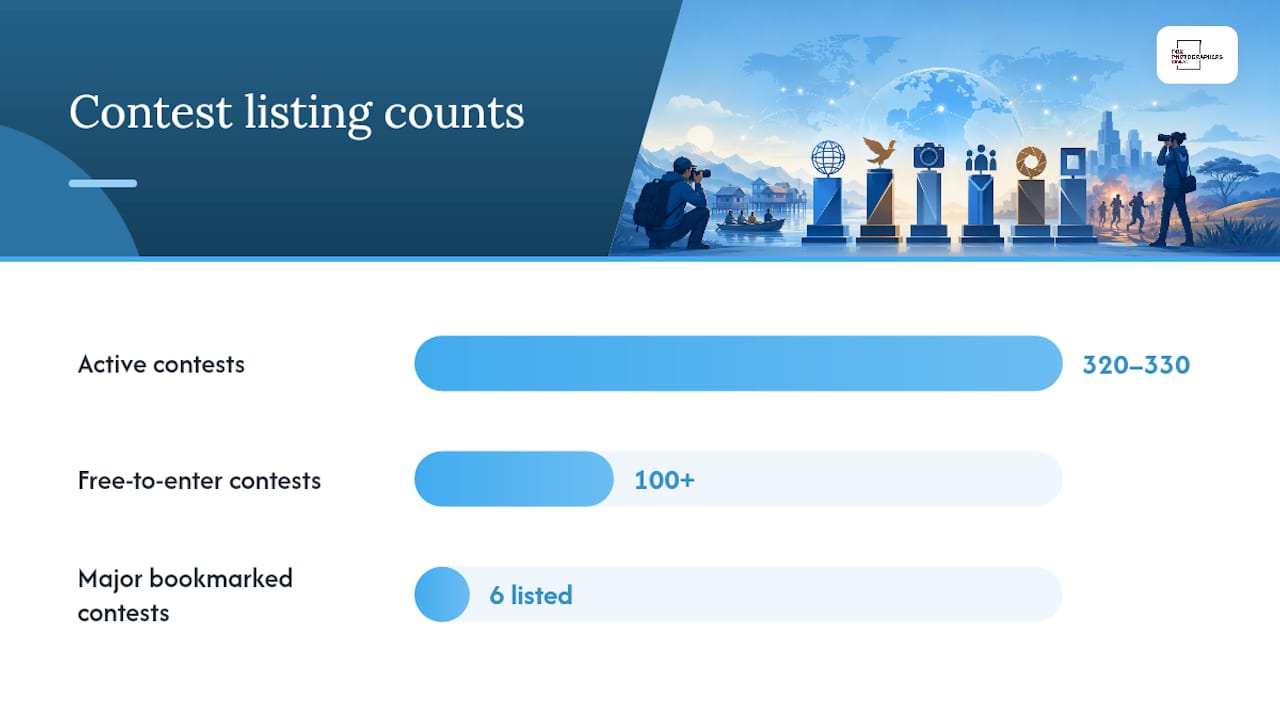
Forphotographersonly maintains a curated, continuously updated directory of 320–330 active photography contests, including over 100 free-to-enter opportunities. The directory is updated weekly and presents contests in chronological order, so you can see what is opening and closing at a glance without visiting a dozen separate sites.
Contest newsletters and social channels are the fastest way to catch deadline extensions, rule changes, and early-bird fee windows. Subscribe to the mailing list for every contest you plan to enter.
A practical tracking workflow:
At the start of each quarter, check Forphotographersonly’s curated contest listings for new openings and updated deadlines.
Add every relevant deadline to your calendar with two reminders: one four weeks out (preparation time) and one one week out (final check).
When a deadline appears on the directory, verify the exact date and fee on the official contest page before entering it in your calendar.
Set a recurring monthly review to catch contests that open mid-cycle.
Pro Tip: Maintain a simple spreadsheet with columns for contest name, category, deadline, fee, prize, rights summary, and submission status. After each cycle, note what you submitted and the outcome. Over two or three years, this tracker becomes a clear picture of which contests are worth your time and budget.
After a win or shortlisting, your work’s discoverability matters as much as the recognition itself. SEO for photographers can help you ensure that editors and clients searching for your specialty find your award-winning portfolio.
Why entering contests still matters for your photojournalism career
The debate about whether photojournalism competitions are worth the effort tends to miss the point. The question is not whether to enter, but which contests to enter and how selectively.
The career value of a top-tier win is concrete: international exhibition, publication in widely distributed books and catalogs, and the kind of editorial attention that is difficult to generate through self-promotion alone. TPOTY winners report that competition prestige depends heavily on the judges’ credentials and the organizer’s capacity to generate media exposure, sometimes reaching audiences of more than two million. That reach is not something a photographer’s own website or social channels can replicate.
The trade-offs are real, though. Entry fees accumulate quickly if you enter indiscriminately. Rights clauses at smaller or less reputable contests can compromise future licensing. And the time required to prepare a genuinely competitive entry, selecting, sequencing, captioning, and verifying, is not trivial.
Selective entry is the answer. Prioritize the contests where the jury is composed of working editors and photographers, where the prize includes exhibition or publication rather than just cash, and where the rights terms are clearly nonexclusive. Enter two or three contests per year with full preparation rather than ten with minimal effort.
The photographers who build careers through contest recognition are not the ones who enter everything. They are the ones who enter the right contests with work that was prepared specifically for that jury’s criteria.
Sources
Official contest pages and curated directories to consult for current rules, deadlines, and entry portals:
Recommended