Photo Contest Judging Criteria: A Practical Rubric for Photographers

Judges evaluate five pillars: impact, composition, technical quality, creativity, and theme relevance. Most credible juries score with a 100-point weighted rubric or a comparable point breakdown, then rank by total score once outlier votes are reviewed. Before you build or sit on a jury, know what an experienced judge scans for in the first few seconds.
Does the image stop the scroll before the caption is even read?
Is there one clear subject, or is attention fighting itself?
Are highlights blown or shadows crushed beyond recovery?
Does the composition guide the eye somewhere intentional?
Does it look like anything else already crowned this year?
Does it actually answer the contest’s stated theme?
Would it survive being printed large, not just viewed as a thumbnail?
Statistic Callout: A 100-point rubric split across impact, composition, technical quality, creativity, and theme relevance (20 points each) gives judges a defensible, repeatable scoring recommendation that works for club competitions and international calls alike.
Key Takeaways
Fair photo contest judging depends on a published, weighted rubric and a staged procedure that separates technical screening from artistic scoring.
Point | Details |
Use five weighted pillars | Score impact, composition, technical quality, creativity, and theme relevance, typically 20 points each. |
Run a silent first pass | Eliminate obvious technical faults before spending discussion time on artistic merit. |
Flag outlier scores | Trigger a challenge or review when one judge’s score diverges sharply from the panel. |
Verify eligibility before judging | Check theme fit, image origin, and category placement in pre-screening, not mid-vote. |
Benchmark against real contests | Forphotographersonly’s curated directory lets you compare rubrics and rules across 320-plus active competitions. |
Table of Contents
What Are the Core Photography Contest Evaluation Standards?
Every established rubric, from camera club score sheets to international calls, breaks down into the same handful of measurable qualities. Understanding what each one actually asks of an image separates a fair jury from a subjective free-for-all.
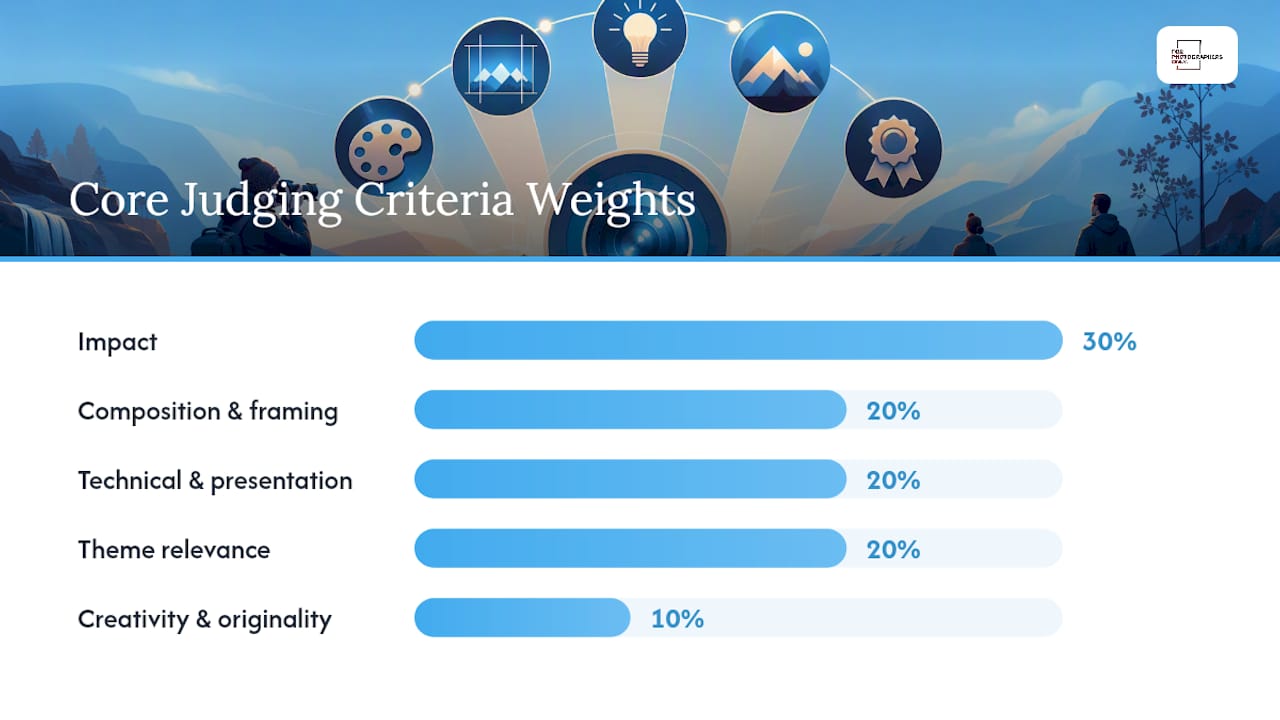
Impact is the gut reaction, the image’s ability to hold attention before the brain analyzes anything else. Judges ask: Where does the eye land first? Does the photo provoke a reaction, or does it need a caption to work? ViewBug’s judging research describes this as a two-phase process: a quick scan for visceral pull, followed by a closer read for story and craft.
Composition and framing get scrutinized next. Is the frame free of distracting edges? Does negative space serve the subject or just waste it? Are lines and shapes organized, or fighting for dominance?
Technical quality covers exposure, focus, and color. Are highlights recoverable or genuinely blown? Is the focal point sharp where it needs to be? Does color grading feel intentional rather than accidental? BetterPhoto’s contest guidelines note that camera shake and blown highlights are among the fastest ways an otherwise strong image gets cut in an early round.
Creativity and originality ask whether the photographer found a fresh angle on a familiar subject, or simply repeated a formula judges have seen a hundred times that season.
Theme relevance matters more than entrants often assume. The IVI International Photo Contest terms specify that jurors weigh technical quality, narrative impact, and relevance to theme together, not in isolation. A technically flawless image that ignores the brief still loses to a rougher one that nails it.
Presentation, finish, and ethical compliance round out the list: clean cropping, honest captions, and no manipulation that violates the entry rules.
Pro Tip: When giving feedback, name the specific pixel-level or compositional issue instead of a vague label. “The highlights on the left third are clipped and unrecoverable” teaches something. “Needs better exposure” does not.
How Do Judges Run a Fair Photography Contest Evaluation?
A defensible jury follows a sequence, not a free-for-all vote. Most established competitions structure the process in stages:
Pre-screening for rules and eligibility, catching wrong categories, missing metadata, or theme mismatches before a single artistic score is assigned.
First run, a fast, largely silent pass where judges eliminate images with obvious technical faults. The NMRA’s National Photo Contest Judging Guidelines recommend this quiet elimination round specifically so debate time gets saved for images that deserve it.
Second run, where surviving entries get scored or slotted into placement tiers.
Challenge and discussion rounds, where a judge can call an image back if they believe it was cut or scored unfairly.
Final selection and announcement, once scores are locked and any outlier votes have been reviewed.
Voting mechanics vary, but most panels use a majority-agreement rule to advance an image, with an automatic challenge triggered when one judge’s score diverges sharply from the panel average. World Press Photo’s 2026 judging procedures go further, keeping Round 1 fully anonymous and visual-quality-only, then releasing progressively more context in later rounds while applying representation criteria to the final winners.
A moderator keeps the session honest:
Confirms anonymity rules are actually being followed, not just assumed.
Tracks timing so debate doesn’t swallow the whole session.
Documents every challenge and its resolution.
Applies tie-break rules consistently, not case by case.
When combining scores from multiple judges, use the median rather than the average if one juror’s scoring pattern runs consistently high or low. It blunts the effect of a single outlier without discarding their vote entirely.
Sample Photo Contest Score Sheet and Point Breakdown
A workable rubric needs weighted categories and a scale everyone interprets the same way. The AFGC’s photo contest score sheet splits scoring into clean categories like Photo Quality and Photo Composition at 25 points each, which is a reasonable template to adapt.
Statistic Callout: PPAM’s 12 Elements of a Merit Image framework uses a 100-point scale with defined thresholds, where scores in the 95 to 100 range signal an exceptional image and 85 to 94 signals a superior one, and includes a formal challenge process when a judge’s score falls well outside that band.
To calculate final placement, some juries drop the highest and lowest score per image before averaging the remainder, which limits the influence of one enthusiastic or harsh juror. Others simply use the median. Either method converts raw scores into a rank-order list without letting a single vote decide an outcome.
Rules, Eligibility, and Ethical Disqualifiers
Every image needs a pre-screening pass before it reaches artistic judging. The most common disqualification grounds:
Theme mismatch, where the image technically fits a category but ignores the actual brief.
Non-original elements, such as unauthorized composites or stock elements passed off as the photographer’s own capture.
Wrong category entry, submitted either by mistake or as a workaround for tougher competition elsewhere.
Credit or rights failures, including missing model releases or unclear authorship.
Manipulated metadata that contradicts the caption or capture claims.
Well-run contests, including IVI’s 2026 terms, ask entrants to supply captions, location, and author declarations upfront, which gives judges something concrete to verify against rather than guessing at authenticity.
When manipulation is suspected, escalate to a small review panel rather than one juror making a unilateral call. Request RAW or uncropped files if the entry rules allow it, and document the review before any decision is final.
Pro Tip: Word disqualification notices around the rule, not the person. “This entry does not meet the theme requirement stated in Section 3” lands better than any language implying bad faith.
Best Practices for Reducing Bias in Photography Judging
Consistency between judges doesn’t happen by accident. It gets built through calibration.
Run a short calibration session with example images before live judging starts, so every juror anchors their scoring scale the same way.
Anonymize entries wherever the contest format allows it, particularly in early rounds.
Rotate judges across categories rather than letting one juror own a genre for the entire event.
Use averaged or median scores instead of a single decisive vote, and document the reasoning whenever a challenge overturns an outlier.
Adopt a judging platform that enforces blind review and timestamps every score for an audit trail.
Astronomy.com’s contest rules note that panels built from subject-matter experts alongside working photographers tend to produce more defensible decisions, and that public voting, when used at all, should be treated as advisory rather than binding.
Pro Tip: A 20-minute calibration exercise, five sample images scored independently and then compared aloud, exposes scoring gaps before they cost anyone a fair result.
What Running a Photo Jury Actually Feels Like
Running a jury session rarely goes exactly to schedule. Late entries slip through screening, format problems surface mid-review, and a single contested image can eat twenty minutes that were budgeted for the whole first run.
Budget more time for the challenge round than you think you need.
Expect at least one image where judges split hard on theme relevance.
Late-arriving corrupted files or wrong-aspect-ratio submissions are the most common last-minute snag.
Pro Tip: Set a hard time cap per discussion, then let the moderator call a vote once it’s hit. Open-ended debate is where sessions run long, not the scoring itself.
Where to Benchmark Your Rubric
Building a rubric from scratch is one thing. Knowing whether it holds up against contests that draw thousands of entries is another. Forphotographersonly curates more than 320 active international photography competitions, including over 100 free-to-enter opportunities, updated weekly, so photographers and organizers alike can see how real contests structure their rules, deadlines, and judging language before they publish their own.
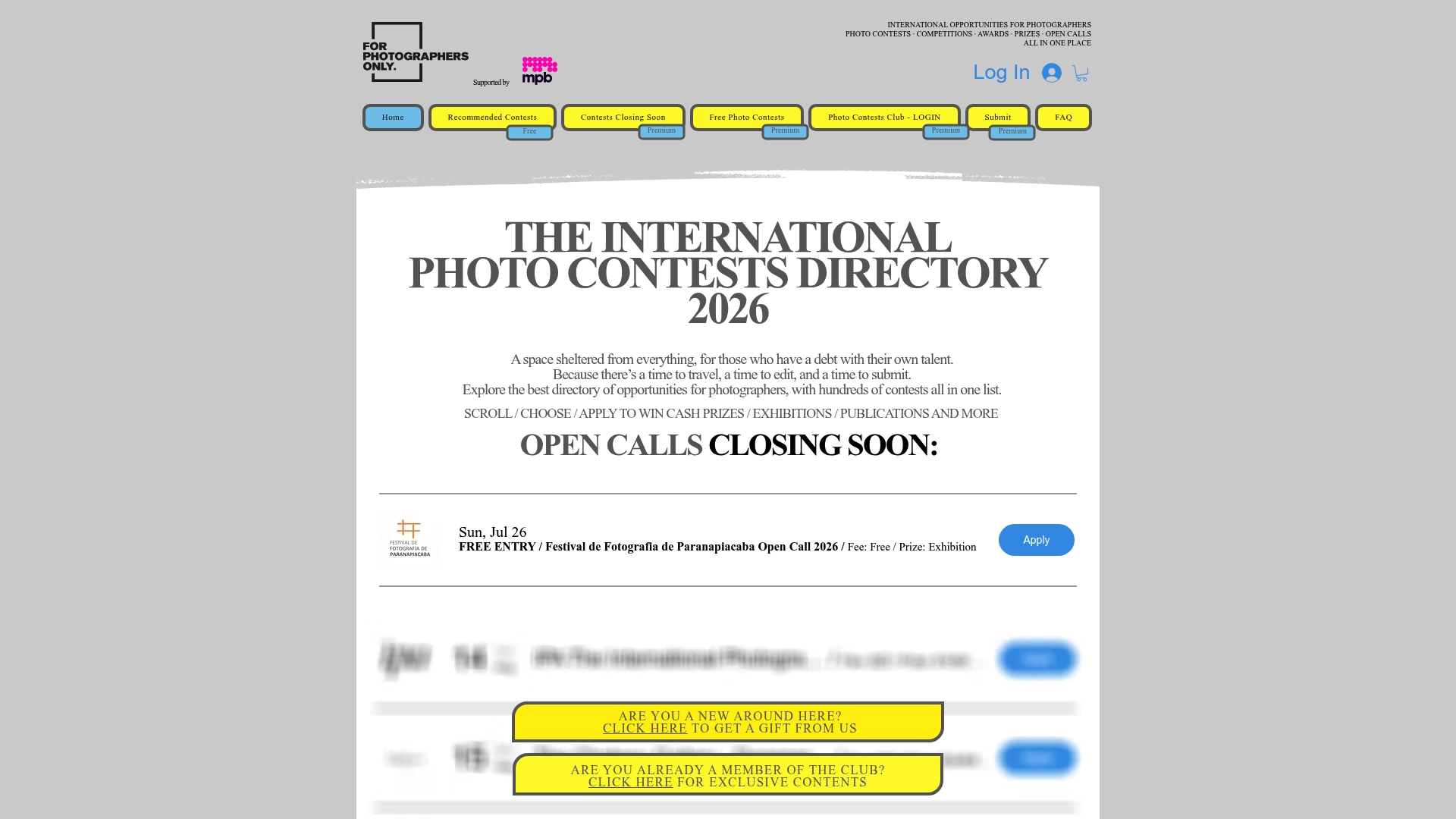
Browsing listings like the Creative Quarterly Competition or The Nature Photography Contest gives you a direct look at how established competitions phrase eligibility rules, category definitions, and judging criteria, and photographers can also improve their contest success by exploring specialized Photography SEO Services that help make winning images more discoverable, without you having to dig through dozens of separate contest websites. If you’re a photographer trying to figure out where your work fits, or an organizer refining a rubric before launch, the full contest directory is the fastest way to compare real, currently open opportunities side by side. Subscribing gets you the continuously updated list at a glance, so you spend your time shooting and entering, not searching.
Frequently Asked Questions
What are the most important photo contest judging criteria? Impact, composition, technical quality, creativity, and theme relevance form the backbone of nearly every credible rubric, weighted roughly equally in most 100-point systems.
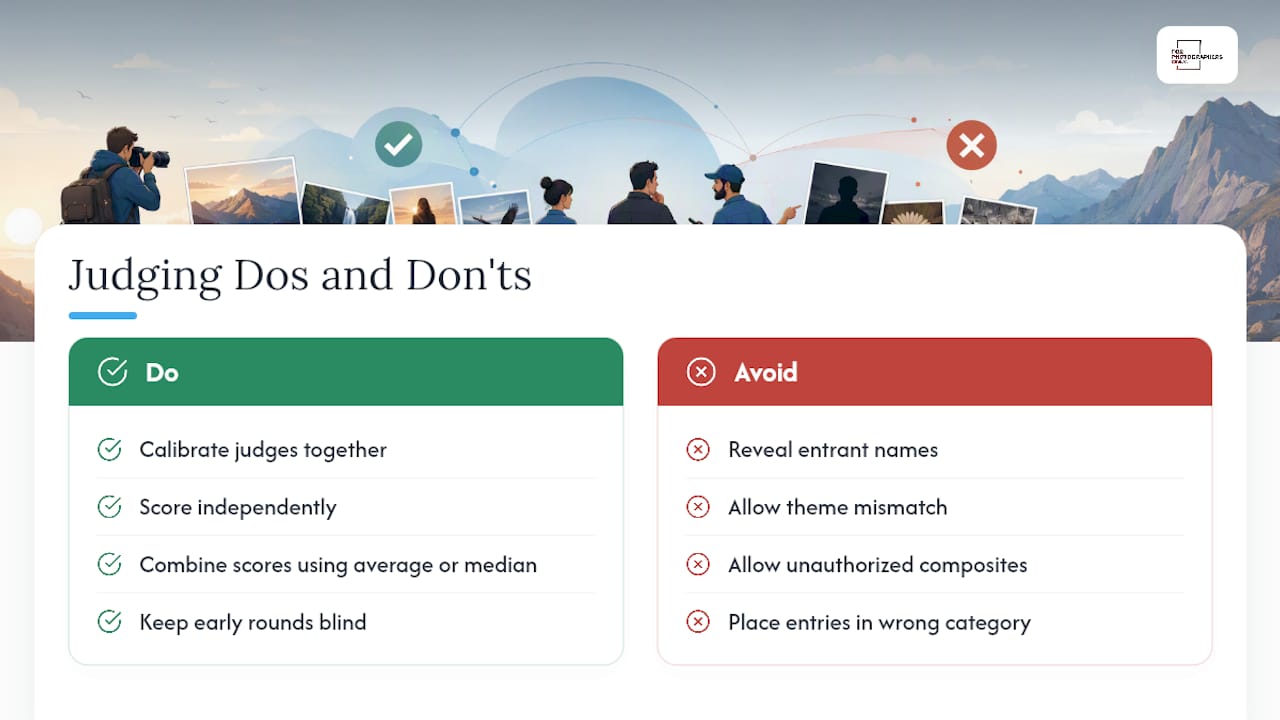
How do judges score photo contests fairly across multiple jurors? They calibrate together before judging starts, score independently, then combine results using an average or median while flagging any score that diverges sharply from the panel.
What usually disqualifies a photo contest entry? Theme mismatch, unauthorized composites, wrong category placement, missing credit or rights information, and metadata that contradicts the entrant’s captured claims.
Should judges see entrant names while scoring? Blind review during early rounds reduces bias significantly, which is why competitions like World Press Photo keep the first round fully anonymous before adding context later.
How many judges should a photo contest panel have? Panels vary by contest scale, but most credible juries use an odd number of three to five judges, often mixing working photographers with subject-matter experts, to avoid tie votes and diversify perspective.
Sources
Recommended