Nude Photography Competitions: 320+ Calls, US Entry Checklist

The strongest starting points among nude photography competitions this year are the 4th Eros Awards, THE ARTISTIC NUDE Photo Contest, RAWART Glamour and Fine Art Nude Competition, NUDE AWARDS 2025, and Nude Geographies at Praxis Photo Arts Center. Before submitting anywhere, confirm the deadline, have signed model releases on hand, and read the usage-rights clause twice. We built PhotoContestsClub to make checking those three things fast.
TL;DR:
Nude photography contests often require signed model releases, with some demanding broad promotional licenses that limit future sales or licensing.
Series submissions with cohesive themes typically outperform scattered images, especially when fee structures favor multi-image entries.
Past winners’ galleries reveal aesthetic preferences, such as favoring high-contrast black-and-white or close-cropped bodyscapes, guiding better submission choices.
Reputable contests are hosted by established institutions, have clear judging criteria, and provide transparent fee structures, reducing the risk of disqualification or scams.
Using curated directories like PhotoContestsClub saves time by filtering active calls and highlighting usage rights, deadlines, and entry costs in one glance.
Table of Contents
Comparing the leading nude photography contests
Fine art nude competitions vary enormously in prize structure, fee logic, and what they ask you to give up in exchange for entering. Here is how the leading international calls stack up against each other on the dimensions that matter most before you submit.
A few patterns separate the reputable calls from the riskier ones. THE ARTISTIC NUDE contest draws an explicit line around tasteful, composition-driven work and screens out anything that reads as pornography, a distinction the Association of International Boudoir Photographers enforces just as strictly in its own category rules. Nude Geographies accepts up to ten images per entrant but caps the base fee tier at five, so a full submission costs more than the headline fee suggests. The Eros Awards and RAWART both sit in the fine art and glamour space rather than editorial erotica, which matters if your portfolio leans toward classical figure work rather than contemporary boudoir.
Contests that explicitly exclude sexually explicit content will disqualify borderline entries rather than return them for revision.
Multi-image entries, like Praxis Gallery’s ten-image allowance, reward a cohesive series over a single strong frame.
Online-only formats get you visibility faster; physical exhibitions like Nude Geographies take longer but carry more weight on a CV.
How to choose contests that match your actual goals
Not every contest serves the same purpose, so the first step is naming what you actually want: cash, a line on your exhibition history, a magazine credit, or simply proof that a panel of strangers rated your work well. Once that is clear, the rest of the decision gets mechanical.
Match the prize type to your goal. Cash-prize contests like the 4th Eros Awards suit photographers who want direct return; catalog and exhibition-based calls like Nude Geographies suit photographers building a curatorial résumé.
Study past winners before you submit. A panel’s published history tells you more about its taste than its category description does, since “fine art nude” covers everything from classical elegance to anatomical abstraction.
Run the fee math. A $35 base fee for five images at Nude Geographies is a stronger per-image rate than most single-image entry fees elsewhere, so series-based entries often beat one-off submissions on cost.
Check for exclusivity clauses before you enter work you intend to sell as prints or license commercially later.
Entry-fee math deserves a second look. If a contest charges per image with no volume discount, submitting your three strongest frames usually beats submitting ten mediocre ones, since judging panels reward cohesion over volume in most fine art nude calls. When a contest does offer a bundled rate, like Praxis Gallery’s five-image tier, a tighter, well-edited series tends to outperform a scattershot one anyway.
Pro Tip: Before paying any entry fee, search the organizer’s name alongside “model release” and “usage rights” to see whether past entrants have flagged concerns.
Your entry checklist: releases, copyright, and file specs
Model releases are not optional paperwork. The ASMP’s model terms and conditions for photo contests make clear that contests routinely require a signed release for any recognizable person, and failure to produce one on demand can mean disqualification and forfeiture of a prize you have already won.
A signed release you can produce within 24 hours of a win request is often the difference between collecting a prize and losing it on a technicality.
Keep a standing folder of signed releases, organized by model and shoot date, before you ever submit an image.
Read every “perpetual,” “irrevocable,” or “exclusive use” clause closely. Many organizers ask for a broad promotional license, and the ASMP guidance recommends questioning any clause that limits your ability to sell or license the image elsewhere.
Confirm file specs and any AI-generation disclosure rules before upload, and label files exactly as the call requests.
Screenshot the rules page as it existed at submission time, since organizers may modify or cancel competitions after you have already entered.
Our model release workflow guide walks through building this folder system in five steps if you do not already have one.
How a curated directory cuts your research time
Checking each organizer’s rules, fee structure, and usage clause individually eats hours you could spend shooting. A curated directory tracks hundreds of active contests at any given time, updated weekly, specifically so you do not have to rebuild that research from scratch every month.
Filtering by theme, entry fee, deadline, and exhibition type lets you shortlist nude and fine art calls in minutes rather than digging through a dozen individual contest sites. Because every listing is researched before it is published rather than submitted by organizers themselves, you are less likely to land on a call with a buried exclusivity clause or a vague judging process. That matters more in the nude and boudoir space than almost anywhere else, where usage-rights language varies widely between otherwise similar-sounding contests.

What “fine art nude,” “boudoir,” and “bodyscape” actually mean
These three terms get used loosely, but judging panels treat them as distinct categories. Fine art nude generally refers to the human form treated as a compositional and sculptural subject, often in black and white or with deliberate, painterly lighting. Boudoir leans toward intimate, personal portraiture, typically clothed or partially clothed, and shot with a warmer, more narrative tone. Bodyscape treats the body as landscape or abstraction, using close cropping and lighting to turn skin and form into something closer to a topographic study than a portrait.
The AIBP’s contest rules draw a hard line specifically around boudoir, excluding sexually explicit portraiture and erotica from that category regardless of artistic intent. That distinction trips up more entrants than any technical requirement, since a boudoir image that reads as too explicit for one panel can be rejected outright rather than simply scored lower. If your work sits at the edge of two categories, read the organizer’s stated definition before you pick where to submit it, rather than assuming your own label will match theirs, as definitions and exclusions vary.

What judging panels actually look for
Most nude photography contests publish a judging panel of working photographers, curators, or gallery directors, and that panel’s own aesthetic shapes what wins far more than the official category description does. A panel weighted toward gallery curators tends to reward composition and conceptual coherence; a panel of working commercial photographers may lean toward technical polish and lighting craft.
The AIBP’s own FAQ notes that judges often read a broad label like “fine art nude” through a narrower lens, favoring classical elegance or anatomical abstraction over entries that merely satisfy the category name. Reviewing a contest’s past winners before submitting is the single clearest way to reverse-engineer what a panel actually rewards, since the stated judging criteria rarely spell out specific aesthetic preferences in detail.
What past winners can tell you before you submit
Few organizers publish detailed scoring breakdowns, but almost all of them publish a gallery or catalog of past winners, and that gallery is more useful than the entry form itself. A pattern across winning images, whether it is a preference for high-contrast black and white, close-cropped bodyscapes, or narrative boudoir staging, tells you what a panel rewards in practice.
Treat the winners’ gallery as a diagnostic tool rather than a style to copy. If your strongest work does not resemble anything in a contest’s recent winner history, that is a signal to either adapt your selection for that specific call or look for a contest whose past choices already align with your aesthetic. Submitting work that technically fits a category but stylistically contradicts everything a panel has rewarded before is one of the most common reasons strong photographers get passed over.
Weighing a contest’s reputation before you pay to enter
Reputation in this space comes down to a handful of concrete signals rather than general buzz. Institutional hosting matters: a contest run through a university gallery, an established photo arts center, or a named publication carries more weight than one run through an anonymous contest-aggregator site with no physical affiliation. Clear, published judging criteria and a visible panel of named judges are another strong signal, as is a track record of actually delivering the exhibition, catalog, or publication it promises rather than just a certificate.
Fee transparency matters too. A contest that clearly states its base fee, per-image pricing, and what accepted artists receive in return, the way Praxis Gallery’s Nude Geographies does, is easier to trust than one with vague or shifting pricing. Our guide to juried photography exhibitions covers more of these trust signals if you want a fuller framework for vetting a call before you commit an entry fee to it.
Staying compliant and ethical as you enter
Rule compliance in nude photography contests is less forgiving than in most other genres, because the subject matter itself invites extra scrutiny from organizers. Read the category definitions before you submit rather than after, since a contest that excludes sexually explicit content will disqualify a borderline image rather than return it for revision.
Treat your models as stakeholders in the outcome, not just subjects. Let them know before the shoot that the images may be submitted to contests, and confirm in writing what happens if an image wins, including whether their name or image appears publicly. Our copy-paste contest rules template is written for organizers, but reading it from the entrant’s side is a quick way to see exactly what kind of fine print you should be looking for in any call you are considering.
A photographer’s take on building a submission habit
After a few submission cycles, the pattern becomes obvious: the photographers who place consistently are the ones with a release folder already built, not the ones scrambling after a win notification. Batch-preparing a few image variants ahead of each category’s specs saves the panic later.
The bigger mistake is forcing work that does not fit a panel’s taste just because the category name seems to apply. Enter what matches a contest’s actual curatorial history, and get usage terms confirmed in writing before any print or sale moves forward.
— DARIO
Finding and tracking nude photography calls with PhotoContestsClub
Once you know what to look for, the slower part is finding it. Our PhotoContestsClub directory lists 320 to 330 active contests at a time, including more than 100 free-to-enter calls, in one chronological page updated weekly, so you spend your time shooting instead of searching.
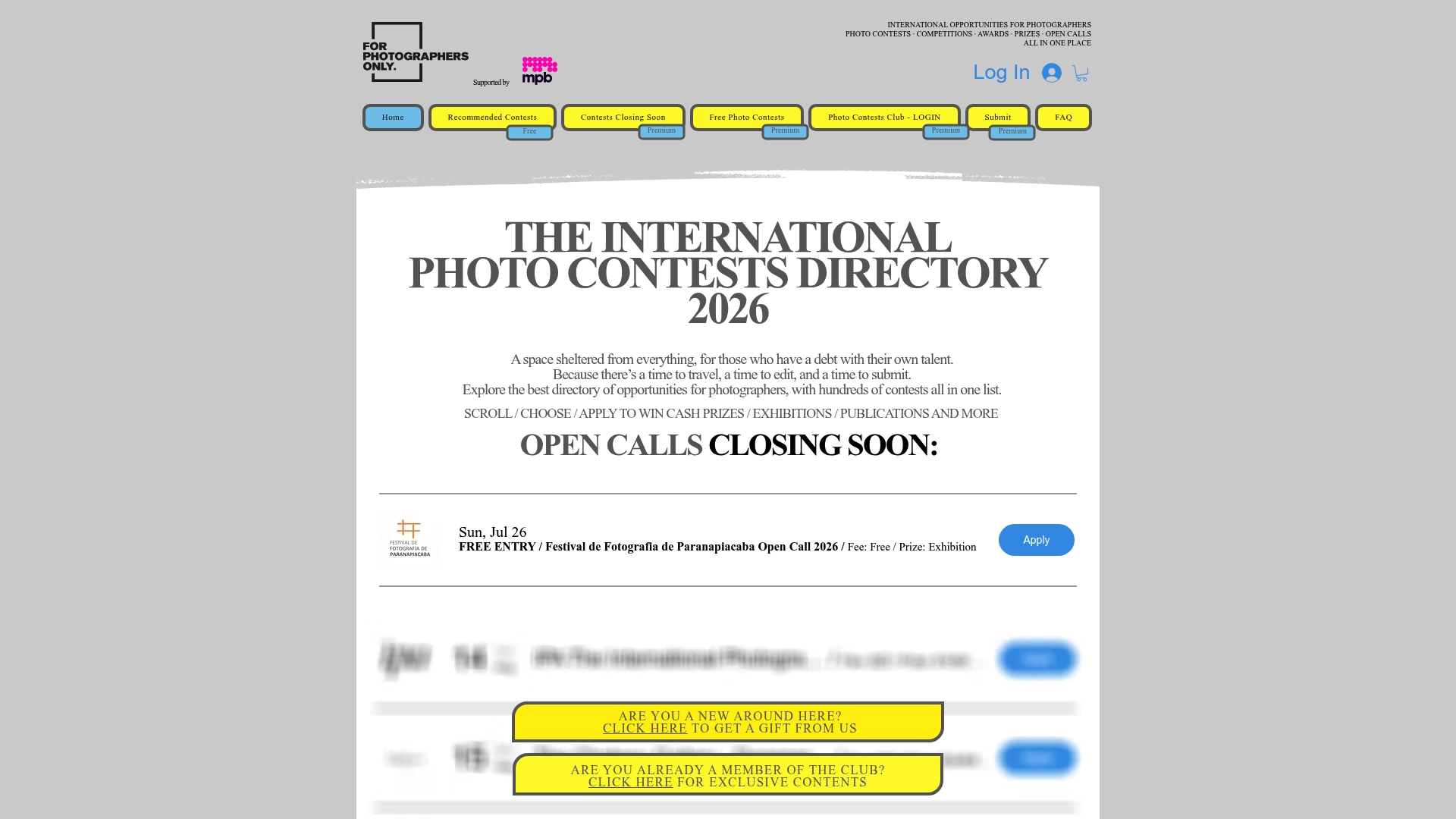
Filter by theme, fee, and deadline to surface nude and fine art calls that match your work.
Spot usage-rights and exhibition notes at a glance before committing an entry fee.
Access the full list for €6 per month or €40 per year through the contests page.
If promoting an accepted entry is part of your next step, photography-focused SEO support can help your win reach more people after the fact.
FAQ
What is a fine art nude photography contest?
A fine art nude contest judges the human body as a compositional or sculptural subject rather than as erotica, often emphasizing lighting, form, and abstraction. Panels like the one behind THE ARTISTIC NUDE Photo Contest screen explicitly for tasteful, non-explicit work.
Do I need a model release to enter a nude photography contest?
Yes. Organizers following standard practice, including the terms outlined by ASMP, typically require a signed release for any recognizable person and can disqualify a winning entry if you cannot produce one on request.
Are boudoir and fine art nude the same category?
No. Boudoir contests, as defined in the AIBP’s own rules, focus on intimate portraiture and explicitly exclude sexually explicit or erotic content, while fine art nude treats the body more abstractly as form and composition.
How much does it cost to enter these contests?
Entry fees are typically charged per image or per small batch, such as Praxis Gallery’s Nude Geographies base fee of $35 for up to five images with additional per-image charges beyond that tier. Fees vary by organizer, so check each call’s current published rate before submitting.
How can I find reputable nude photography contests without checking dozens of sites?
Our curated PhotoContestsClub directory tracks 320 to 330 active contests with weekly updates, letting you filter by theme, fee, and deadline from one page. Subscriptions start at €6 per month or €40 per year.
Sources
Nude Geographies by Praxis Gallery — Deartline contest listing
Recommended