Juried Photography Exhibitions: A Photographer's Guide

The best places to find juried photography exhibitions are curated contest directories, museum and gallery open call pages, festival prospectuses, professional societies, and regional arts centers. Your three-step action checklist: find an open call through a trusted channel, read the prospectus in full before paying any fee, and submit files that meet every technical specification exactly. Three quick wins to build into your practice now:
Set calendar alerts for recurring annual calls you respect (many open the same month each year).
Prepare export presets in your editing software for the most common spec combinations: sRGB JPEG at 3000px on the long edge, and AdobeRGB TIFF at 300 DPI.
Keep a submission pack ready: a formatted artist statement, standardized captions, and pre-named image files you can adapt in under an hour.
Table of Contents
How to read a call-for-entry prospectus without missing a disqualifying rule
Practical submission tips that genuinely improve your selection odds
What entry fees, timelines, and outcomes typically look like
How juried selection actually works and what jurors prioritize
How to communicate with jurors and organizers professionally
Why the long game in juried exhibitions pays off differently than you expect
Useful sources to bookmark for juried calls and prospectus examples
Where to find juried photography exhibitions worth entering
Knowing which channels to monitor separates photographers who submit consistently from those who discover calls the day they close. The most reliable sources in the United States fall into six categories:
Curated contest directories. Platforms that aggregate open calls across institutions save hours of manual searching. Forphotographersonly, for instance, maintains a directory of 320–330 active photography contests, updated weekly, including over 100 free-to-enter opportunities.
Museum and gallery open call pages. Institutions like the Griffin Museum of Photography post calls for entry directly on their websites. These tend to carry strong prestige and often include catalog publication.
Festival open calls. Photography festivals frequently anchor their programming around a juried component. Check festival websites in January through March, when many publish their annual prospectuses.
Professional societies. Organizations such as the Royal Photographic Society run long-standing open calls, including the RPS International Photography Exhibition, which draws submissions from photographers in dozens of countries.
Regional arts centers. State arts councils and community arts centers post calls that are less competitive than national shows, making them strong starting points for building an exhibition record.
Specialized online platforms. CaFÉ (Call for Entry) and similar submission platforms host hundreds of juried calls simultaneously and allow you to manage multiple applications from a single account.
When prioritizing listings, look for four signals: a named juror with verifiable credentials, listed awards or prizes, publication or catalog opportunities, and a clear touring or venue schedule. Those details reliably indicate an exhibition with genuine career value.
How to read a call-for-entry prospectus without missing a disqualifying rule
A prospectus is a legal document as much as an invitation. Reading it carelessly costs you the entry fee and the opportunity. Scan every prospectus for these mandatory sections before you pay:
Eligibility. Age, residency, membership, and professional status restrictions appear here. Some calls are open to U.S. residents only; others exclude current students or require society membership.
Entry categories. Confirm your work fits the stated genre, process, or theme. Submitting a color photograph to a black-and-white category is an automatic disqualification at most venues.
Image specifications. The CPA 2026 International Juried Exhibition prospectus, for example, lists file format, pixel dimensions, color profile, and DPI as mandatory requirements. Missing any one of them can trigger administrative rejection before a juror ever sees your work.
File naming conventions. Many calls require a specific naming structure (LastName_FirstName_Title_01.jpg). Deviating from it is a common, avoidable disqualification.
Entry limits and fees. Note whether the fee covers one image or a series, and whether refunds are issued if work is not selected.
Deadlines. Distinguish between the online submission deadline and any postmark deadline for physical entries. They are often different dates.
Shipping, insurance, and returns. For physical exhibitions, confirm who covers shipping costs in both directions and what insurance the venue carries.
Licensing and usage rights. Understand what “non-exclusive right to reproduce” means: the venue can use your image in catalogs and promotional materials without paying additional fees, but you retain copyright. Flag any clause that grants exclusive rights or asks for rights beyond promotional use.
One hidden trap appears in eligibility clauses: many juried exhibitions require that submitted work has not been previously exhibited at that venue, and some extend that restriction to a defined timeframe or geographic region. Check this before submitting work you have shown locally.
Pro Tip: Use the PhotoSpiva prospectus as a benchmark. It lists entry dates, the juror’s name and credentials, exhibition timeline, and award amounts in a single document. If a call you are considering omits any of those elements, treat that as a signal to research the organizer further before paying.
Practical submission tips that genuinely improve your selection odds
Selection is not random, and preparation is the variable most photographers underestimate. Gallery curators consistently favor coherent bodies of work over a collection of individually strong but unrelated images. Anonymous juries reward the same quality: a series with a clear visual voice reads as intentional, while a mixed portfolio reads as indecision.
Technical checklist:
Export files to the exact format, color profile, and pixel dimensions stated in the prospectus.
Name files precisely as instructed. A single character deviation can trigger rejection.
Embed metadata: title, copyright notice, and contact information in the EXIF/IPTC fields.
Submit the highest-quality file the platform accepts, within the stated size ceiling.
Presentation checklist for physical work:
Confirm mounting and framing specifications (float mount, museum glass, no frame, etc.).
Check weight and size limits for shipped work.
Verify required hanging hardware (D-rings, wire, French cleat) before you frame.
Package work to survive transit: corner protectors, foam wrap, and a return shipping label inside the crate.
Artist statement guidance: Keep it to 150–250 words. Open with the project’s central question or observation, not your biography. Connect each image to the series narrative so a juror reading the statement while viewing your files understands the intent immediately.
“The work that stays with me after a jury session is the work that poses a question I cannot answer in the room. Mystery, coherence, and a sense that the photographer had something specific to say — those are the qualities that survive the final cut.”— Ann M. Jastrab, juror, March LENS 2026
Pro Tip: Build a master submission pack: a folder containing your artist statement in three lengths (100, 200, and 400 words), pre-exported image files at the three most common spec combinations, and a caption template. Adapting this pack for a new call takes 20 minutes instead of two hours.
What entry fees, timelines, and outcomes typically look like

Planning your submission calendar requires understanding both the financial and temporal commitments involved.
Exhibition type | Typical entry fee | Submission to notification | Shipping/installation | Exhibition duration |
Small/regional juried show | — | 4–8 weeks | 1–2 weeks before opening | 3–6 weeks |
National juried exhibition | — | 8 weeks | 2–4 weeks before opening | 4–8 weeks |
International open call | Free | 10–20 weeks | Varies by venue | 4 weeks |
A typical timeline runs: entry period opens → submission deadline → juror review → notification to accepted artists → shipping/delivery window → installation → opening reception → exhibition run → deinstallation and returns. Budget for return shipping costs on physical work; many venues require the artist to cover both directions.
Outcomes beyond the exhibition itself carry real career weight. The CPA International Juried Exhibition offers cash awards, online exhibition, and catalog publication. Touring shows extend your work’s visibility across multiple venues and audiences. Being selected, even without winning a prize, yields catalog credits, exhibition history for grant applications, and the kind of international recognition that professional organizations identify as a measurable career marker.
How juried selection actually works and what jurors prioritize
Most major juried exhibitions use anonymous initial review, meaning jurors evaluate images without knowing the submitter’s name or reputation. The RPS International Photography Exhibition 167 received over 10,000 images and shortlisted 318 photographers from 41 countries, a selection ratio that illustrates how competitive major open calls are. Anonymous review levels the field: a technically strong, coherent series from an unknown photographer competes on equal terms with work from established names.
Jurors narrow thousands of submissions using a consistent set of signals:
Visual coherence. A series that reads as a unified body of work advances further than a set of unrelated strong images.
Technical excellence. Print quality, tonal range, and sharpness matter at the final selection stage, particularly for physical exhibitions.
Narrative fit. Jurors consider how selected work will hang together in the exhibition space. An excellent image can be excluded because it disrupts the visual flow of the curated sequence.
Originality. Work that offers a perspective the juror has not encountered recently stands out in a large pool.
Submitting images from the same series across multiple calls, rather than mixing unrelated work, increases the likelihood that jurors perceive a deliberate, developed body of work.
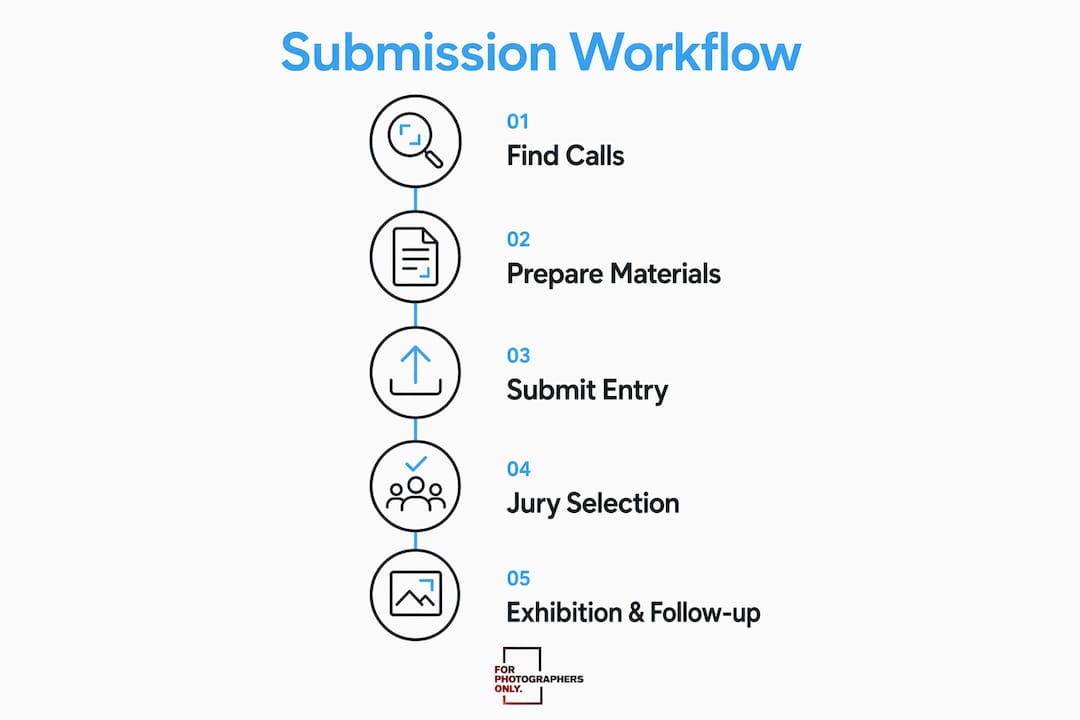
Your step-by-step submission workflow for any juried call
Follow this sequence for every call you enter to avoid last-minute errors:
Choose the call. Confirm it aligns with your work’s genre, process, and career goals before investing time.
Confirm eligibility. Read the full prospectus and verify residency, membership, completion date, and previous exhibition restrictions.
Format and export images. Match every technical specification: file format, pixel dimensions, color profile, DPI, and file naming convention.
Prepare paperwork. Write or adapt your artist statement, complete the entry form, and gather any required supporting documents (CV, project description).
Pay the entry fee. Use the platform’s required payment method. Screenshot or save the confirmation.
Submit via the required platform. Upload files and complete all required fields. Do not leave optional fields blank if they give context to your work.
Confirm receipt. Most platforms send an automated confirmation email. If you do not receive one within 24 hours, contact the organizer.
Track the notification date. Add it to your calendar. If the date passes without communication, a brief, polite inquiry to the organizer is appropriate.
Arrange shipping for accepted work. Once notified of selection, confirm the delivery window, packaging requirements, and return shipping instructions immediately.
Troubleshooting common last-minute problems: If a payment fails, try a different browser or payment method before contacting support. If a required field is missing from your submission form, take a screenshot and email the organizer with your entry details. For physical work, use a trackable shipping service and keep the tracking number until the work is returned.
How to communicate with jurors and organizers professionally
Most juried exhibitions maintain a strict separation between applicants and jurors during the selection process. Direct contact with jurors before or during review is generally prohibited and can disqualify your entry. Respect that boundary completely.

Organizers, however, are accessible and expect reasonable questions. Contact them when you need clarification on a technical specification, a deadline, or a shipping requirement. Keep every inquiry brief and specific: state your question in one sentence, include your submission reference number if you have one, and avoid asking for feedback on your work before results are announced.
After notification, accepted artists may receive direct communication from the organizing team regarding installation details, artist talks, or catalog contributions. Respond promptly and professionally. If the exhibition includes an opening reception or artist panel, attend when possible. These events are where professional relationships with curators, fellow exhibitors, and collectors begin.
What to do after the exhibition closes
The exhibition’s closing date is not the end of the opportunity. A structured follow-up extends the value of every accepted submission.
Documentation and portfolio updates: Photograph your work installed in the gallery space. These installation images carry more weight in grant applications and future submissions than digital mockups. Update your artist CV and website immediately to reflect the exhibition credit, including the venue name, exhibition title, juror name, and dates.
Marketing and visibility: Share installation images and catalog pages across your professional channels. Post-exhibition visibility can attract gallery interest, editorial assignments, and collector inquiries. Photographers who invest in SEO for their photography website after an exhibition credit often see measurable increases in organic search traffic to their portfolio.
Networking: Connect with fellow exhibitors, the juror (if they are publicly accessible), and the organizing curator on professional networks. A shared exhibition credit is a natural, low-pressure opening for a professional relationship.
Catalog and publication credits: If the exhibition produced a catalog, request your complimentary copies promptly and note the publication in your CV. Catalog credits are recognized by grant panels and residency committees as evidence of sustained exhibition activity.
Prepare for the next cycle. Many strong juried shows recur annually. Note the call’s typical opening date and set a reminder for the following year.
Key Takeaways
Entering juried photography exhibitions consistently, with technically correct submissions and a coherent body of work, is the most direct path to building an exhibition record and gaining professional recognition.
Point | Details |
Find calls through reliable channels | Curated directories, museum open call pages, festival prospectuses, and professional societies are the most consistent sources. |
Read the full prospectus before paying | Check eligibility, image specs, file naming, and licensing clauses to avoid disqualifying errors. |
Submit a coherent series, not a mixed set | Jurors and gallery curators consistently favor a unified body of work over unrelated strong images. |
Budget time and money realistically | National juried exhibitions typically take 8 weeks from submission deadline to notification; entry fees commonly run $35–$65. |
Use Forphotographersonly as your starting point | The directory lists 320–330 active contests with deadlines, fees, and eligibility details updated weekly, including over 100 free-to-enter opportunities. |
Why the long game in juried exhibitions pays off differently than you expect
The conventional wisdom tells photographers to aim for prizes. That framing misses the more durable value of juried exhibition participation. Selection itself, regardless of award outcome, generates catalog credits, exhibition history, and the kind of institutional recognition that grant panels and residency committees actually weigh. The RPS IPE 167 shortlisted 318 photographers from over 10,000 submissions. Every one of those 318 photographers earned a verifiable international exhibition credit, not just the two who received awards.
The photographers who build the strongest exhibition records are not necessarily the most talented. They are the most systematic. They maintain a submission pack, track deadlines across multiple calls simultaneously, and treat each submission as a data point rather than a verdict on their work. Rejection from a highly competitive national call tells you almost nothing about the quality of your photography; it tells you about fit, timing, and the specific curatorial vision of that jury.
My honest advice: balance your submission calendar between one or two ambitious national or international calls and two or three regional or thematic shows where your work is a strong conceptual fit. The regional credits build momentum; the national calls build aspiration. Both belong in a serious practice. Forphotographersonly’s directory, with its weekly updates and free-to-enter filters, makes it practical to maintain that balance without spending hours searching across dozens of individual venue websites.
Forphotographersonly: one place to track every open call
Searching for juried calls across museum websites, festival pages, and society newsletters is time-consuming work that pulls you away from making photographs. Forphotographersonly consolidates that research into a single, continuously updated directory of 320–330 active photography contests, including over 100 free-to-enter opportunities, all organized chronologically so you see what is closing soonest.
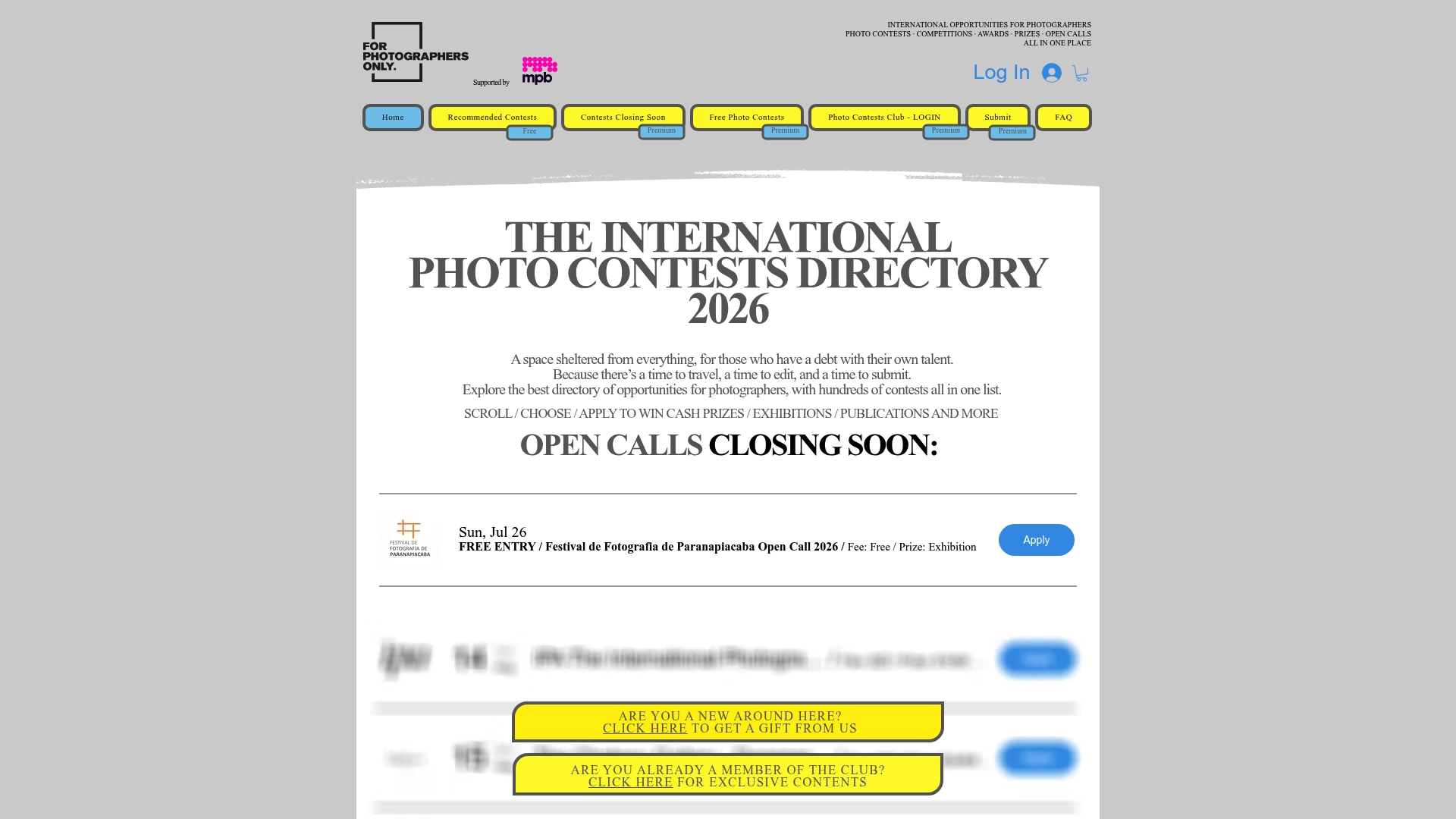
Every listing includes the deadline, entry fee, eligibility criteria, prize details, and a direct link to the official prospectus or submission platform. Weekly updates mean you will not miss a call that opens mid-cycle. The free-to-enter filter alone surfaces more than 100 opportunities with no financial barrier. Members also gain access to a monthly internal competition and a community of photographers navigating the same submission process.
For €6 per month, you get a curated, organized view of the global photography competition calendar. Browse the current photo contest directory and start your next submission with the right call already identified.
Useful sources to bookmark for juried calls and prospectus examples
These are the kinds of official pages worth checking regularly for open calls, prospectus examples, and submission guidelines:
RPS International Photography Exhibition — one of the world’s longest-running open calls, with full prospectus details, juror credentials, and award information published each edition.
CPA International Juried Exhibition — a strong example of a prospectus that lists technical specifications, naming conventions, awards, and catalog publication details explicitly.
Academy Center 2026 National Juried Photography Exhibition — useful for understanding eligibility clauses, including previous exhibition restrictions and completion date requirements.
PhotoSpiva 2026 Prospectus — a model prospectus from a long-running competition that clearly presents entry dates, juror name, exhibition timeline, and award amounts in one document.
Griffin Museum of Photography — Calls for Entry — a gallery-based open call page that reflects the format and detail level you should expect from reputable institutional calls.
Bookmark the official pages of organizations whose aesthetic and mission align with your work, and check them at the start of each quarter. Most recurring annual calls open within the same two-to-four-week window each year.
Recommended