Photo Contest Rules: Copy-Paste Template for Organizers

A complete set of photo contest rules must address fourteen essential elements: eligibility, entry method and limits, fees and no-purchase-necessary language, entry period with time zone, technical file specifications, originality and copyright ownership, image manipulation and AI policy, judging criteria and process, prizes and winner notification, rights and releases, disqualification grounds and appeals, liability and indemnity, privacy and data handling, and accessibility accommodations.
Miss even one of these, and you risk disqualifying a deserving entrant on a technicality, exposing your organization to legal challenge, or watching a dispute spiral into reputational damage. The checklist below lets you assess any ruleset at a glance.
Essential rule elements checklist:
Eligibility (age, residency, employee/affiliate exclusions, youth guardian consent)
Entry method, per-entrant limits, submission platform or mail option
Fee disclosure and no-purchase-necessary or free alternate entry method
Entry period with exact close time and time zone (e.g., 11:59 PM ET)
Technical file specs (format, color space, pixel dimensions, file size, metadata)
Originality, copyright ownership, and prohibition on third-party material
Image manipulation policy and explicit AI/generative content prohibition
Judging panel composition, scoring criteria, and conflict-of-interest rules
Prize description, winner notification timeline, tax responsibility, and prize delivery
License grant, model releases, property releases, and publicity consent
Disqualification grounds, appeals process, and finality clause
Liability limitation, indemnity, governing law, and void-where-prohibited language
Privacy notice: data collected, retention period, and contact for requests
Accessibility accommodations and alternative entry formats
Authoritative model rulesets from World Press Photo, the Smithsonian Photo Contest, and Audubon Photography Awards collectively cover all fourteen elements. The template and guidance throughout this article align with those industry-leading standards while adapting them for U.S.-based organizers.
Key Takeaways
A complete set of photo contest rules covers fourteen mandatory elements, from eligibility and technical specs to AI policy and governing law, and every clause should be written to answer the question an entrant or judge will actually ask.
Point | Details |
Require RAW for finalists | Request original or out-of-camera files only from finalists, transferred via secure expiring links. |
Spell out AI policy explicitly | Name permitted tools (denoise, auto-adjust) and prohibited workflows (generative fill, AI upscalers) in the rules. |
Include no-purchase-necessary language | Any fee-based U.S. contest must provide a free alternate entry method to avoid illegal-lottery classification. |
Embed sRGB for web judging | Require sRGB with an embedded ICC profile for all upload submissions; request Adobe RGB only for print-output categories. |
Run a test submission before launch | Complete a full end-to-end test, including EXIF extraction and confirmation email, before opening entries to the public. |
Table of Contents
What do photo contest rules need to include in every clause?
What are the technical file requirements for photo submissions?
How do you write eligibility, entry limits, and deadline language correctly?
How should judging criteria and prize administration be structured?
What grounds justify disqualification, and how should ethics rules work?
How do you publish rules and run a contest without procedural errors?
Why clear rules are the foundation of every great competition
What do photo contest rules need to include in every clause?
Strong rules are not just legal protection. They are a promise to every entrant that the competition is fair, transparent, and worth their creative investment. Each clause below carries both a legal purpose and a trust-building function.
Eligibility
State the minimum age (commonly 18, or 13 with guardian consent for youth divisions), any residency restrictions, and a clear list of excluded parties. Employees of the sponsoring organization, their immediate family members, and members of the same household are typically excluded. For youth divisions, include guardian consent language such as: “Entrants under 18 must have a parent or legal guardian complete and sign the consent form included in the entry portal before the submission is accepted.”
Audubon’s 2026 Photography Awards model this well, maintaining separate Adult and Youth eligibility divisions with distinct entry instructions and prize categories for each.
Entry method and limits
Specify the submission platform (e.g., Submittable, a branded upload portal, or postal mail), the maximum number of images per entrant per category, and whether an entrant may enter multiple categories. Include a confirmation-of-receipt statement: “Entrants will receive an automated email confirmation within 24 hours of a successful submission. If no confirmation is received, the entry should be considered incomplete.”
Fees and no-purchase-necessary language
Disclose the entry fee amount, accepted payment processors, and consequences for promo-code misuse. Where a fee is charged, U.S. contest law in many states requires an alternate free method of entry. A standard phrase reads: “No purchase is necessary to enter or win. To enter without paying the entry fee, mail a 3x5 card with your name, address, phone number, and category to [address] by [deadline]. Mail entries receive one entry per envelope.”
Entry period and deadlines
Give the exact open and close dates, the precise close time, and the time zone. Specify whether the deadline applies to the timestamp of upload or the postmark date for mail entries. A clear phrase: “Entries must be submitted by 11:59 PM Eastern Time (ET) on [date]. The organizer’s server timestamp is the official record for online entries. Mail entries must be postmarked by [date] and received by [date + 7 days].”
Originality, copyright, and ownership
The entrant must certify that they are the sole author and copyright holder of every submitted image, that no third-party material (stock images, composites from others’ work) is included, and that the image has not been created by or with AI generative tools. For group or agency entries, specify what documentary proof of authorship is required. A sample certification: “By submitting, entrant warrants that the image is their own original work, that they hold all rights necessary to grant the license below, and that the image does not infringe any third party’s intellectual property rights.”
License grant
Specify whether the license is non-exclusive or exclusive, its duration (commonly one to three years for promotional use), geographic territory (worldwide is standard for international contests), and permitted uses such as promotion, archival, and exhibition. Include a compensation statement: “No additional compensation beyond the stated prize will be paid for use of the image under this license.”
Model and property releases
Require signed model releases for any identifiable person in a submitted image, and property releases for privately owned locations where required by law. Provide a simple checkbox during online submission: “I confirm that I hold signed model and/or property releases for all identifiable individuals and private properties depicted, and I will supply these releases upon request.” Exceptions apply for images taken in public places where incidental bystanders appear, but organizers should still note that exception explicitly. For images featuring minors, require a guardian-signed release.
Privacy and publicity consent
State what personal data is collected (name, email, location, payment information), how long it is retained, whether it is shared with third-party sponsors or judges, and how entrants can request deletion. Include a publicity consent clause: “Winners and finalists consent to the use of their name, general location, and submitted image for promotional purposes by the organizer, without additional compensation.” Offer an opt-out path for anonymous or pseudonymous entrants where the contest structure permits.
Pro Tip: Add a single-sentence privacy contact line at the bottom of your rules: “For privacy requests, contact [email] with the subject line ‘Privacy Request.’” This small addition signals compliance awareness and reduces support inquiries.
What are the technical file requirements for photo submissions?
Procedural errors cause disqualification even for technically excellent photographs. Wrong color space, incorrect file naming, or a missed file-size limit can eliminate a strong image before a judge ever sees it. Publish your technical requirements as a standalone section with a copy-ready table, and link to it from your Photography SEO Services to be discovered by more entrants through optimized online visibility.
Accepted formats and resolution
Accept JPEG for initial upload submissions. Request 16-bit TIFFs or high-resolution JPEGs only from finalists and winners, not at the entry stage. Requesting master-resolution originals from all entrants creates unnecessary IP risk and storage burden. World Press Photo’s technical requirements specify single-frame, single-exposure uploads at original pixel size (unless cropped), with JPEG high-quality for the upload stage and 16-bit TIFFs requested from winners.
Color space and ICC profiles
Embed an ICC profile in every submitted file. For web-judged contests, require sRGB. Where print reproduction is expected for exhibition or publication, Adobe RGB is appropriate. World Press Photo recommends embedding either sRGB or Adobe RGB depending on intended output. Untagged files render inconsistently across judging panels and monitors, which can unfairly disadvantage an entrant.
Metadata and file naming
Retain EXIF data in submitted files. Stripping metadata removes capture date, camera model, and GPS coordinates, all of which may be needed for authenticity verification. Require a specific file naming convention if your platform does not auto-rename: “Files must be named as: LastName_FirstName_CategoryCode_ImageNumber.jpg (e.g., Smith_Jane_WILD_01.jpg).”
Pro Tip: Test your submission portal’s EXIF extraction before launch. Some platforms strip metadata on upload. If yours does, instruct entrants to embed caption and copyright data in the IPTC fields before uploading, since that information survives more processing pipelines than raw EXIF.
Secure high-res file transfer for finalists
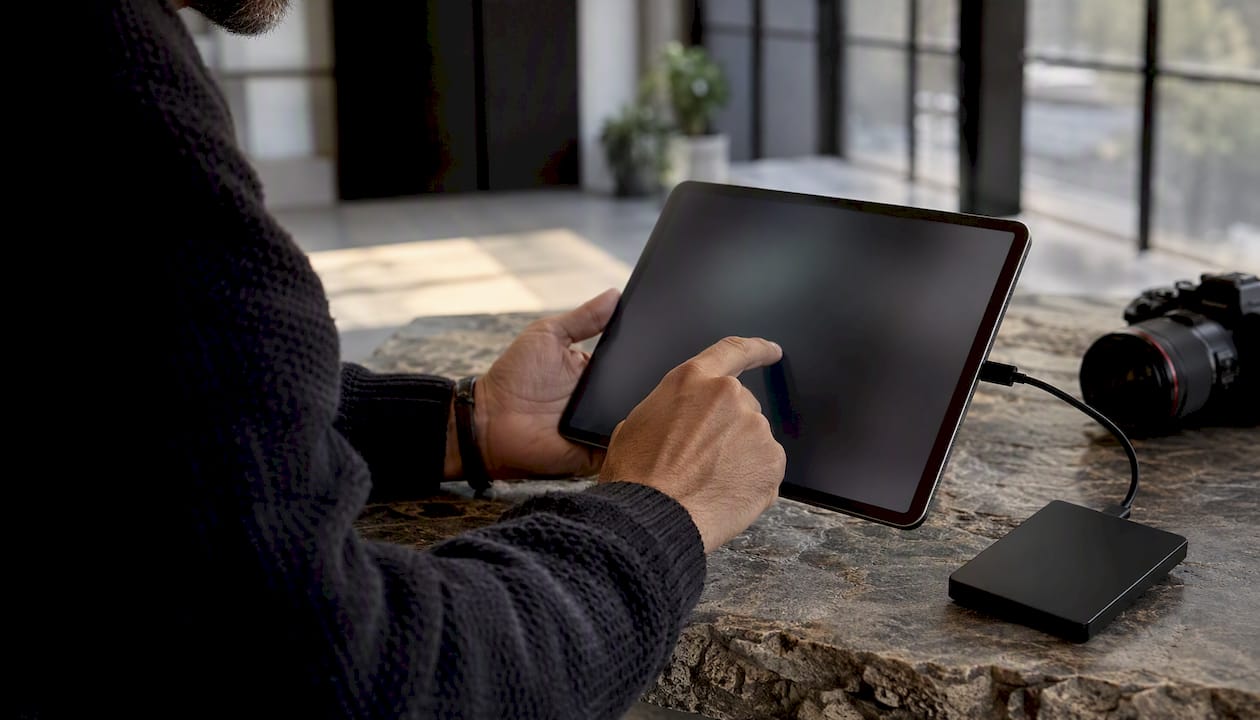
When requesting finalist originals, use expiring download links or password-protected transfer services rather than open email attachments. Document who has access to those files and delete them once the judging cycle closes. Unique Photo’s competition guidance recommends requesting high-res originals only from finalists and storing them securely with documented access controls.
Technical specifications reference
Field | Recommended standard |
Upload format | JPEG, high quality (quality 10–12 in Photoshop) |
Finalist/winner format | 16-bit TIFF or maximum-quality JPEG |
Color space (web judging) | sRGB with embedded ICC profile |
Color space (print/exhibition) | Adobe RGB with embedded ICC profile |
Minimum long edge (upload) | 2,000 pixels |
Maximum file size (upload) | 25 MB |
Finalist minimum long edge | original capture size |
EXIF/metadata | Retained; do not strip before submission |
Watermarks | Not permitted on submitted images |
File naming | LastName_FirstName_Category_Number.jpg |
How should your rules address image manipulation and AI?
The clearest dividing line in modern photography competition rules is between correction and creation. Acceptable post-processing corrects what the camera recorded. Prohibited manipulation creates content that was not present in front of the lens.
What counts as acceptable editing
Standard adjustments that do not alter the factual content of an image are generally permitted across leading competitions:
Exposure, brightness, contrast, and shadow/highlight recovery
Color balance, white balance correction, and saturation adjustments
Cropping and straightening
Sharpening and noise reduction (including AI-powered denoise tools that do not introduce new detail)
Dodging and burning
Conversion to black and white
Smithsonian’s contest rules permit minor adjustments including sharpening, dodging and burning, and color toning, but explicitly disallow adding or removing objects outside the Artistic Images category.
What is prohibited
Adding, removing, or moving any element within the frame
Compositing from multiple exposures (unless the category explicitly permits it, e.g., astrophotography star trails)
AI-generated or synthetic image content, including generative fill
AI-powered enlargers or upscalers that invent pixel detail not captured by the sensor
Frequency separation or skin-retouching techniques that alter documentary accuracy
World Press Photo prohibits synthetic or AI-generated images and disallows generative fill or AI-powered enlarging tools that introduce new image information. Limited AI tools such as denoise or automatic adjustments may be permitted only when they do not add new image information.
Sample AI policy wording
This language aligns with World Press Photo’s entry rules and can be adapted directly into your official rules.
Disclosure and verification
Require a disclosure field during upload where entrants list the software and AI tools used. A simple checkbox (“I confirm no generative AI tools were used in creating or processing this image”) combined with a free-text field for tool disclosure reduces disputes at the finalist stage. When authenticity is questioned, request RAW files or out-of-camera JPEGs and give entrants a defined window (commonly 72 hours) to respond before disqualification is confirmed.
Pro Tip: Define “new information” explicitly in your rules. A useful phrase: “A tool introduces new information if it generates, synthesizes, or inpaints pixels that were not recorded by the camera sensor during the original exposure.” This single sentence eliminates the most common gray-area disputes.
How do you write eligibility, entry limits, and deadline language correctly?
Eligibility and deadline clauses are where most organizers introduce unintentional ambiguity. Precision here protects both the entrant and the organizer.
Eligibility language
A model eligibility clause for a U.S.-based open contest:
“The contest is open to photographers aged 18 and older who are legal residents of the fifty United States and the District of Columbia at the time of entry. Employees, contractors, officers, and directors of [Organizer Name], its parent companies, subsidiaries, affiliates, advertising and promotion agencies, and the immediate family members (spouse, parent, child, sibling) and household members of each are not eligible to enter or win.”
For youth divisions, add: “Photographers aged 13–17 may enter the Youth Category with a parent or legal guardian’s written consent. Entrants under 13 are not eligible.”
Entry limits and duplicate handling
Specify the maximum number of images per entrant per category. State how duplicate or cross-method submissions are handled: “Each entrant may submit up to five images per category. Submitting the same image in multiple categories is not permitted and will result in disqualification of all affected entries.”
Audubon’s Photography Awards demonstrate clear entry-limit language alongside dual online and mail entry methods, making their structure a reliable model for organizers who need to accommodate both digital and postal submissions.
Fee and free-entry wording
Deadline language
“The contest opens at 12:00 AM Eastern Time (ET) on [start date] and closes at 11:59 PM ET on [close date]. Online entries must be received by the organizer’s server by the close time. Mail entries must be postmarked by [date] and received by [date + 7 days]. The organizer’s server timestamp is the sole determinant for online entry timing. Entries received after the deadline will not be considered regardless of postmark.”
Specifying the time zone is not optional. Entrants in Hawaii, Alaska, and international participants all interpret “midnight” differently without a stated zone.
What rights and releases should photo contests require?
Copyright remains with the photographer. What organizers need is a license, not an assignment. The distinction matters enormously to entrants and should be stated plainly.
Non-exclusive promotional license
A standard, entrant-friendly license clause:
“By entering, entrant grants [Organizer] a non-exclusive, royalty-free, worldwide license to reproduce, display, distribute, and promote the submitted image in connection with the contest, including on the organizer’s website, social media channels, printed materials, and exhibition displays, for a period of [two years / three years] from the date of entry.”
“This license does not transfer copyright ownership. Entrant retains all copyright in the submitted image.”
“For winning and finalist images, organizer may additionally request a separate, compensated license for commercial use. Acceptance of such a license is voluntary and will be negotiated separately.”
Model and property releases
Require a signed model release for any identifiable person depicted in a submitted image.
Require a property release for privately owned locations where the owner’s permission is legally necessary.
Provide a checkbox on the submission form: “I confirm that I hold all required model and/or property releases and will supply them within 48 hours of a request from the organizer.”
For images of minors, require a guardian-signed release before the image may be used in any promotional context.
Incidental bystanders in public spaces generally do not require individual releases under U.S. law, but organizers should note this exception explicitly to avoid confusion.
For guidance on consent and disclosure issues specific to street and public-space photography, the street photography contests guide on Forphotographersonly covers category-specific considerations in detail.
Publicity and moral rights
Include a publicity consent clause for winners and finalists: “Winners and finalists consent to the use of their name, general location, and submitted image for promotional purposes by the organizer without additional compensation.” For anonymous or pseudonymous entrants, state whether they may participate under a pen name and how prize delivery will be handled if they win.
How should judging criteria and prize administration be structured?
Judges need a scoring framework. Entrants deserve to know how decisions are made. Transparency in both areas reduces disputes and builds the competition’s reputation over time.
Judging panel and conflict-of-interest rules
Define the panel composition: number of judges, whether they are named publicly, and how conflicts of interest are managed. A standard clause: “Judging will be conducted by a panel of [number] independent photography professionals selected by the organizer. Judges with a personal or professional relationship to any entrant must recuse themselves from scoring that entrant’s images. The organizer’s decision is final and binding.”
Where public voting is incorporated, specify how votes are moderated, how abuse (bot voting, coordinated campaigns) is handled, and what weight public votes carry relative to jury scores.
Scoring rubric
A sample percentage breakdown for a general photography contest:
Technical quality (sharpness, exposure, color accuracy): 30%
Artistic merit (composition, use of light, visual impact): 40%
Originality and creativity (uniqueness of subject or approach): 20%
Relevance to theme (where a theme is specified): 10%
Organizers may adjust these weights by category. Nature and documentary categories often weight ethical compliance as a prerequisite rather than a scored criterion.
Prize administration and winner notification
Field | Recommended language |
Prize description | State cash amount, physical prizes, publication, or exhibition opportunity in full |
Number of winners | Specify first, second, third, and honorable mentions per category |
Notification method | Email to address provided at entry; allow 14 days for response |
Claiming deadline | Winner must respond within 14 days or prize is forfeited |
Tax responsibility | Winner is solely responsible for all applicable federal, state, and local taxes |
Prize delivery | Digital prizes within 30 days of acceptance; physical prize delivery timeline varies |
Alternate winner | If winner does not respond, next eligible entrant is selected |
What grounds justify disqualification, and how should ethics rules work?
Disqualification is not punitive by nature. It is the mechanism that keeps competition fair. State the grounds clearly so entrants can self-screen before submitting.
Common disqualification grounds
Entrant does not meet eligibility requirements at the time of entry
Image contains AI-generated or synthetically produced content
Image has been manipulated beyond the permitted adjustments stated in the rules
Required model, property, or guardian release cannot be produced on request
Entry was received after the stated deadline
Entrant submitted more images than the stated per-entrant limit
Entrant provided materially false information about capture circumstances
Image was previously published in a context that violates the contest’s exclusivity requirements (where stated)
Smithsonian, World Press Photo, and Audubon all reserve the right to disqualify entries that violate rules, with final decisions vested in the organizer or jury.
Appeals process
A fair appeals clause: “Entrants who believe their image was disqualified in error may submit a written appeal to [email] within seven calendar days of receiving the disqualification notice. Appeals must include the entrant’s name, entry reference number, and a clear statement of the grounds for appeal. The organizer will respond within 14 days. All decisions following the appeals review are final.”
Ethics rules for wildlife, documentary, and drone photography
Special categories carry stricter ethical obligations. For wildlife and nature entries, NPOTY 2026 rules require images to be taken in unrestricted natural environments and prohibit AI-generated or computer-rendered content. Standard ethical requirements across leading competitions include:
No baiting, feeding, or luring of wildlife to obtain a shot
No trespass on private or restricted land to capture an image
No staging or posing of wild animals
Disclosure of drone, camera trap, or remote-trigger equipment used
“Do no harm” principle: the welfare of the subject takes precedence over the photograph
For documentary categories, require disclosure of any staging, reconstruction, or editorial direction of subjects. For drone photography, require confirmation that the entrant holds any applicable FAA authorization and that the flight complied with local airspace regulations.
Pro Tip: Ask wildlife and nature entrants to retain GPS logs, capture sequences, and field notes for the duration of the judging cycle. If authenticity is questioned, this documentation resolves disputes faster than any other verification method.
For a deeper look at how leading wildlife competitions structure their ethics requirements, the wildlife photography competitions guide on Forphotographersonly is a practical starting point.
What legal boilerplate does a U.S. photo contest need?
Legal clauses are not filler. Each one addresses a specific risk that has materialized in real contests. Use the sample language below as a starting point and have legal counsel review it before publishing.
Liability and indemnity
“The organizer is not responsible for lost, late, misdirected, incomplete, or illegible entries, or for any technical failures in the submission platform. By entering, each entrant agrees to indemnify, defend, and hold harmless the organizer and its officers, directors, employees, and agents from any claim, damage, or liability arising from the entrant’s participation, the submitted image, or any breach of the entrant’s representations in these rules.”
Governing law and void-where-prohibited
“This contest is governed by the laws of the State of [State], without regard to conflict-of-law principles. All disputes will be resolved in the state or federal courts located in [County, State]. This contest is void where prohibited by law. Prizes will not be awarded to residents of countries subject to U.S. Office of Foreign Assets Control (OFAC) sanctions or where the award of the prize would violate applicable law.”
Astronomy Magazine’s contest rules demonstrate how to handle OFAC/sanctions carveouts and jurisdictional voids in a published ruleset, making them a useful reference for organizers running international or open-residency competitions.
Privacy and data handling
Social media and public voting rules
Where public voting is part of the judging process, state: “Votes obtained through automated means, purchased vote packages, or coordinated inauthentic activity will be disqualified. The organizer reserves the right to remove entries and disqualify entrants who engage in voting abuse. Organizer-shared images on social media remain the copyright of the entrant; the organizer’s use is limited to the license granted in these rules.”
How do you publish rules and run a contest without procedural errors?
Publishing rules is step one. Running the contest without procedural failures requires an operational sequence that most organizers underestimate.
Step sequence from draft to live
Draft all fourteen rule elements using the template in the next section.
Have legal counsel review the draft, particularly eligibility, liability, and no-purchase-necessary language.
Run a test submission through your platform to confirm file upload, EXIF extraction, confirmation email delivery, and payment processing.
Publish the rules with an effective date and the time zone stated in the header.
Announce the contest across your channels with a direct link to the published rules page.
Archive the published rules page as a PDF immediately after publishing so you have a timestamped record.
Operational items during the entry period
Send automated confirmation emails within 24 hours of each submission.
Maintain a support contact (email or form) with a stated response time.
Track entry counts and fees in a secure spreadsheet or contest management platform such as Submittable.
Collect conflict-of-interest statements from all judges before judging begins.
Request finalist high-res files via expiring, password-protected transfer links, not open email.
Store finalist files in an access-controlled environment and document who has access.
Accessibility and accommodations
State how entrants with disabilities may request alternative entry formats or reasonable accommodations: “Entrants who require an alternative entry method or other accommodation due to a disability may contact [email] at least [14 days] before the entry deadline. The organizer will make reasonable efforts to provide an accessible entry path.” This language signals good faith and reduces the risk of ADA-related complaints.
Copy-paste rules template for U.S. photo contests
The clauses below are modular. Replace bracketed placeholders with your contest’s specifics. For high-value prizes or complex eligibility structures, have an attorney review the final document.
[LEGAL DISCLAIMER: This template is a general guide for informational purposes only. It does not constitute legal advice. Organizers should consult qualified legal counsel before publishing rules for any contest, particularly those involving significant prize values, international entrants, or fee-based entry.]
Eligibility. Open to legal residents of the fifty United States and D.C., aged 18 and older (or 13 and older with guardian consent for the Youth Category). Employees and immediate family members of [Organizer] are not eligible.
Entry method and limits. Submit via [platform URL]. Maximum [number] images per entrant per category. One entrant per submission. Confirmation email will be sent within 24 hours.
Entry fees. Entry fee: $[amount] per image. No purchase is necessary to enter. Free entry by mail: send a 3x5 card with name, address, and category to [address] by [deadline].
Entry period. Open: [date], 12:00 AM ET. Close: [date], 11:59 PM ET. Late entries will not be considered.
Technical requirements. JPEG, minimum 2,000 pixels on the long edge, maximum 25 MB, sRGB color space with embedded ICC profile. No watermarks. EXIF data must be retained. File naming: LastName_FirstName_Category_Number.jpg.
Originality and copyright. Entrant must be the sole author and copyright holder. No AI-generated content. No third-party material. Entrant certifies compliance by submitting.
Manipulation and AI policy. Minor adjustments (exposure, color, crop, noise reduction) are permitted. Adding, removing, or synthesizing image elements is prohibited. AI generative tools are prohibited. Entrant must disclose all software used at submission.
Judging. A panel of [number] independent judges will score entries on technical quality (30%), artistic merit (40%), originality (20%), and theme relevance (10%). Judges with conflicts of interest will recuse themselves. Organizer’s decision is final.
Prizes. [Prize description]. Winners notified by email within [number] days of judging. Winners must respond within 14 days. Winner is responsible for all applicable taxes.
Rights and releases. Entrant grants organizer a non-exclusive, royalty-free, worldwide license to display and promote the image for [duration]. Copyright remains with entrant. Signed model and property releases must be provided on request.
Liability. Organizer is not responsible for technical failures or lost entries. Entrant agrees to indemnify organizer against third-party claims arising from the submitted image.
Privacy. Entry data is used solely to administer the contest and notify winners. Data retained for [period]. Contact [email] for privacy requests.
Appeals. Written appeals must be submitted to [email] within seven days of disqualification notice. Decisions following appeal review are final.
Governing law. Governed by the laws of [State]. Void where prohibited. Prizes not awarded where prohibited by OFAC or applicable law.
Where to customize: jurisdiction (clause 14), fee amounts (clause 3), prize specifics (clause 9), license duration (clause 10), and data retention period (clause 12). Youth-division organizers should also expand clause 1 with guardian consent language and add a separate youth-prize description to clause 9. For guidance on structuring youth divisions, the student photography competitions guide on Forphotographersonly offers practical examples.
Pre-launch checklist: what to verify before entries open
Run through this list before your submission portal goes live. Each item corresponds to a disqualification or legal risk that surfaces regularly in real contests.
Rules and legal review
Confirm eligibility language names all excluded parties, including household members.
Verify no-purchase-necessary language is present if a fee is charged.
Confirm the entry deadline includes an exact time and time zone.
Confirm governing law and void-where-prohibited language is in the published rules.
Confirm the privacy notice states data use, retention period, and contact for requests.
Technical and operational checks
Test the submission portal end-to-end with a real file upload, including EXIF extraction.
Confirm the automated confirmation email fires within 24 hours of a test submission.
Test the file-size and format validation to confirm oversized or wrong-format files are rejected with a clear error message.
Confirm the RAW-file request workflow for finalists is in place and tested.
Verify that the judging platform is ready and that all judges have submitted conflict-of-interest statements.
Prize and fulfillment readiness
Confirm prize fulfillment logistics (cash transfer method, physical shipping, digital delivery) are in place before the contest opens.
Verify that tax reporting procedures are ready for prize values that trigger IRS Form 1099 requirements (prizes valued at $600 or more in the U.S.).
Confirm that an alternate winner selection process is documented in case a winner does not respond within the stated window.
Why clear rules are the foundation of every great competition
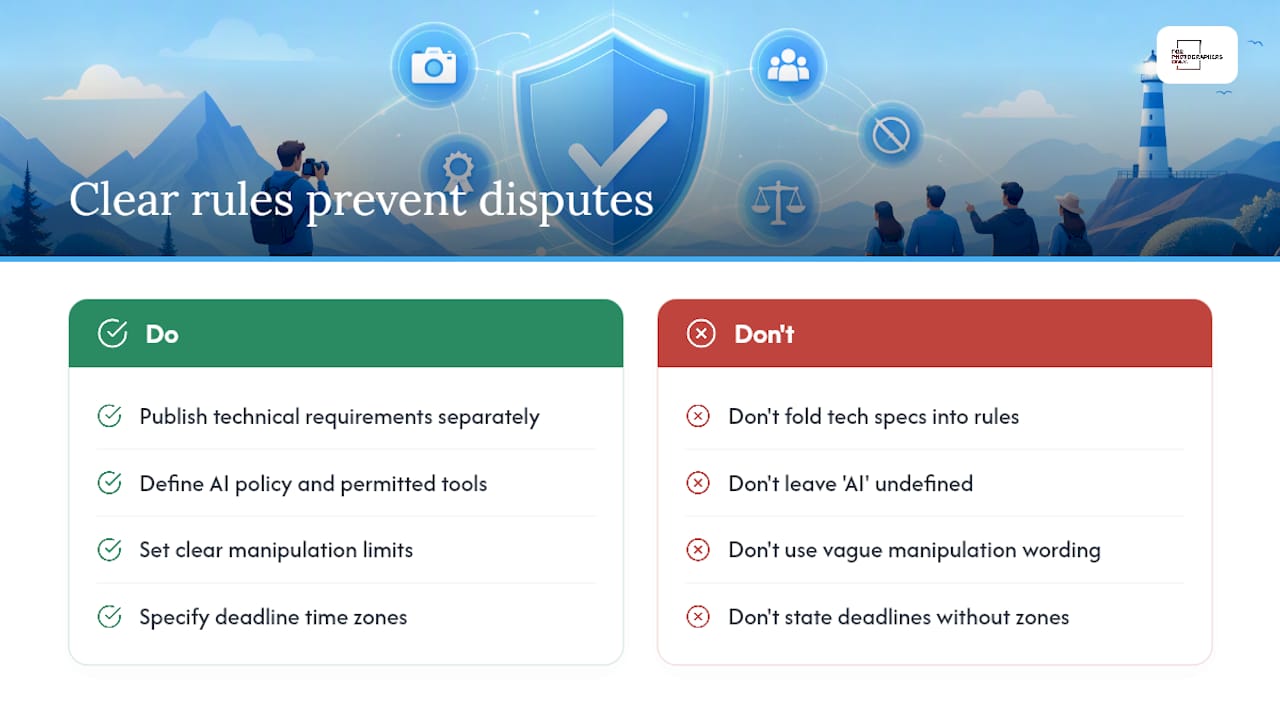
The most common failure mode in photography competitions is not bad judging. It is ambiguous rules that create disputes no one anticipated when the contest was designed. After reviewing hundreds of competition rulesets through Forphotographersonly’s curation process, a pattern becomes clear: the contests that generate the most entrant complaints are almost never the ones with the smallest prizes. They are the ones where the rules left room for interpretation on the questions that matter most, specifically AI policy, manipulation limits, and deadline time zones.
There is a practical reason why World Press Photo publishes its technical requirements as a separate, detailed document rather than folding them into a single paragraph of general rules. Entrants need to be able to check compliance before they submit, not discover a violation after disqualification. The same logic applies to AI policy. Organizers who leave the term “AI” undefined face higher dispute rates, because what one entrant considers a minor denoise adjustment, another considers a prohibited synthetic enhancement. Naming the permitted tools and the prohibited workflows removes that ambiguity entirely.
The copy-paste template in this guide is built around that principle. Every clause is written to answer the question an entrant or a judge will actually ask, not the question the organizer hopes no one raises. That specificity is what separates a ruleset that protects everyone from one that protects no one.
Sources
The rulesets below represent the clearest, most detailed examples of photography competition guidelines currently published. Each is worth reading in full before drafting your own rules.
When adapting international rulesets (World Press Photo is Netherlands-based; NPOTY is European) to a U.S. context, replace governing law with your chosen U.S. state, add no-purchase-necessary language, confirm that prize tax language references IRS reporting thresholds, and verify that OFAC carveouts reflect current U.S. Treasury sanctions lists.
This article is provided for general informational purposes only and does not constitute legal advice. Contest organizers should consult qualified legal counsel before publishing official rules, particularly for fee-based contests, high-value prizes, or competitions open to international entrants.
This article is general information, not a substitute for advice from a qualified lawyer. Consult a qualified legal professional about your own circumstances before acting on anything here.
Recommended