Photo Contest Eligibility: 5 Checks to Avoid Disqualification

Eligibility for a photography competition rests on five checkpoints: who you are (professional, amateur, or student), how old you are, where you live or where the image was taken, whether you own the copyright, and whether the file itself meets the format and authenticity rules. Every contest weights these differently, so the only safe approach is to read the official rules before you prepare a single submission.
TL;DR:
Entrants aged 13 to 17 may need a youth category and signed guardian consent; check whether age is measured at entry or deadline.
Many contests cap JPEGs at about 10 MB, recommend 8 to 20 megapixels, and may reject finalists unable to provide original files.
A contest’s location rules may restrict residency, the image’s capture site, or both; themed and genre entries can also require date, ethics, or metadata proof.
Keep the matching RAW file and a brief edit log; finalists may face verification, and prohibited or undisclosed AI use can disqualify an entry.
Work assigned by an employer or created collaboratively can complicate copyright; secure contributor permissions and required model or property releases before submitting.
Table of Contents
1. Who can enter: professionals, amateurs, and affiliation exclusions
6. AI, editing, and authenticity: what counts as a permitted edit
How For Photographers Only helps you check eligibility and find contests that fit
Eligibility distinctions across open, themed, and genre-specific contests
PhotoContestsClub: check eligibility details before you enter
1. Who can enter: professionals, amateurs, and affiliation exclusions
Organizers typically sort entrants into categories such as professional, amateur, student, and youth, each with its own judging pool and sometimes its own prize structure. Within those categories, most institutional contests exclude anyone connected to running the event.
Staff members, board members, and contest judges are almost universally barred from entering.
Immediate family and household members of staff or judges are often excluded too, as confirmed in the Capture The Dark contest FAQ, which lists this near-universal conflict-of-interest policy.
Some contests ask for a signed disclosure form confirming you have no employment or sponsorship ties to the organizing body.
Verification varies: some organizers check entries against employer lists, others simply trust the disclosure you sign at submission. Either way, have your professional status and any potential conflicts documented before you apply.
2. Age limits and category rules
Age thresholds shape which category you belong in, and misreading them is one of the fastest routes to disqualification. The National Wildlife Photo Contest rules show a common pattern: entrants aged 13 to 17 must compete in a youth category, while those 18 and older enter the general pool, and minors typically need a parent or guardian’s consent to participate.
Youth entrants usually need signed parental or guardian consent attached to the entry.
A birthdate near a cutoff should be checked against the contest’s specific definition, since “as of entry date” and “as of deadline” are not always the same.
Entering the wrong age category, even by accident, is grounds for removal from judging in most rule sets.
3. Location and residency rules
Geographic rules fall into a few recognizable patterns, and each affects eligibility differently. Some contests are open worldwide with no residency restriction at all. Others limit entry to citizens or legal residents of specific countries. A smaller group cares less about where you live and more about where the photograph itself was taken, sometimes requiring the image to depict a particular region or have been captured since a stated date.
Confirm whether the rule restricts the entrant’s residency, the image’s location, or both, since these are frequently separate clauses.
Contests with a location window, as seen in some Smithsonian-affiliated and Scenic America listings, may require proof the photo was taken within the stated timeframe or area.
Keep an independent note of date and location alongside your files, since metadata can be altered or stripped during editing.
When a rule’s wording feels ambiguous, contacting the organizer directly resolves more disputes than guessing ever will.
4. Ownership and copyright: who must own the image
Copyright eligibility starts with a simple rule: under U.S. Copyright Office guidance for photographers, the person who shoots the photograph is generally considered the author and initial copyright owner, and that ownership exists the moment the image is created, whether or not it is formally registered.
Contests require entrants to warrant that they own the copyright to what they submit, and submitting someone else’s work is disqualifying in virtually every rule set. Commissioned shoots, work-for-hire arrangements, and employer-assigned projects can complicate that ownership, since copyright sometimes transfers away from the person who pressed the shutter. If you shoot under any of those arrangements, confirm you hold the rights before entering. Photographers who want added legal protection and plan to submit multiple images can use the group registration option the Copyright Office offers for photographs, which batches several works under one filing.
5. Image specs and submission limits
Most contests enforce the same technical baseline: JPEG files, a maximum file size often capped around 10 MB, and a recommended resolution range, with some asking for 8 to 20 megapixels so prints and exhibitions reproduce cleanly. Entry limits per category are common too, and many rules specify whether the same photograph can be entered into more than one category or must be unique to each.
Check the stated file format and size cap before you compress or export your final image.
Confirm how many entries are allowed per category and whether duplicate submissions across categories are permitted.
Expect finalists to be asked for original RAW or high-resolution files; failure to produce them can void an award entirely.
Pro Tip: Export your contest-ready JPEG, but keep the matching RAW file named identically so you can locate it in seconds if a verification request arrives. Our RAW vs. JPEG guide breaks down which format wins for different submission stages.
6. AI, editing, and authenticity: what counts as a permitted edit
Generative AI has forced most major contests to spell out their editing policy in detail, and the range runs from an outright ban to conditional use with mandatory disclosure. The 2026 World Press Photo entry rules state that undisclosed or prohibited AI use is grounds for disqualification, and several institutional contests now follow that same standard.
Spotting, sharpening, color correction, and HDR blending are generally accepted as standard post-processing.
Synthetic generation of image content, meaning elements that were not captured by the camera, is frequently prohibited outright or allowed only with explicit disclosure.
Keep your original files and a short edit log, since some organizers request a RAW file specifically to confirm what was captured versus what was added.
Our breakdown of AI photo contest rules walks through how different organizers define acceptable versus prohibited AI use.
7. Permissions and releases: when you need signed consent
Identifiable people in your frame generally require a model release, and private property, interiors, or branded goods photographed for a contest with commercial use can require a property release. Previously published work is sometimes still eligible, provided you retain the rights or can grant the license the contest requires.
Confirm whether anyone identifiable in the frame needs a signed model release before you submit.
Check whether the property, structure, or trademarked item in the shot requires a separate property release.
Keep each release filed under the exact filename of the corresponding image so reviewers can match them instantly.
Store contact information for every person who signed a release in case the organizer follows up months later.
8. Entry process, fees, deadlines, and common disqualifiers
A typical entry path looks the same across most contests: read the official rules, prepare your files and any required releases, choose the correct category, complete the entry form, pay the fee if one applies, and submit ahead of the deadline. Our contest application checklist walks through each of those steps in more detail.
After judging, many organizers circle back to request RAW files, proof of prior publication, or identification, and failing to produce them can void a win even after it’s announced.
Entering under the wrong category, such as amateur status when you qualify as professional, is a frequent disqualifier.
Submitting non-original work or work you don’t hold the rights to ends your entry immediately.
Missing a required model or property release removes otherwise strong images from consideration.
Undisclosed or prohibited AI use, as outlined above, is treated the same as any other rules violation.
Late submissions are rejected regardless of how strong the image is.
How For Photographers Only helps you check eligibility and find contests that fit
Reading twenty different rule pages to compare age limits, residency clauses, and fees eats up hours you could spend shooting. Our directory gathers many active international photography competitions, including numerous free-to-enter opportunities, updated regularly, so eligibility details sit in one place instead of twenty browser tabs.
Use the listing to scan each organizer’s rules at a glance, set your own reminders ahead of deadlines, and filter toward free-to-enter contests if entry fees matter to your budget. We research and curate; we don’t run the contests ourselves, which keeps our listings neutral and current.
Eligibility distinctions across open, themed, and genre-specific contests
An open contest, sometimes called an “all genres” competition, usually applies the broadest eligibility rules: any entrant type, few subject restrictions, and categories split mainly by skill level rather than subject matter. Themed contests narrow that scope considerably, requiring the image to match a stated concept, season, or cause, which means an otherwise excellent photograph can be disqualified simply for falling outside the theme’s definition.
Genre-specific competitions, such as wildlife, astrophotography, or street photography contests, layer additional eligibility rules on top of the standard checklist. Wildlife contests frequently add ethical-practice clauses covering baiting or disturbing animals. Astrophotography contests often require specific metadata proving exposure settings or stacking methods used. Street photography contests lean harder on model release requirements, since identifiable strangers appear far more often in that genre than in landscape or studio work.

The practical takeaway is that genre and theme change what counts as eligible far more than they change who counts as eligible. A professional photographer meets the entrant-type bar in nearly every contest, but the image itself still has to satisfy the theme’s wording, the genre’s ethical standards, and any technical metadata the category demands. Before submitting to a themed or genre-specific competition, reread the category description twice, and consider using Photography SEO Services to be discovered online, since organizers tend to disqualify technically excellent images that simply answered the wrong brief.
Rules on previously published or award-winning images
Whether a previously published photograph can be entered depends entirely on the individual contest’s wording, and the variation here is wide enough that assumptions are risky. Some organizers welcome previously published work as long as the entrant still holds the copyright and can document where and when it was first published. Others restrict entry to unpublished images exclusively, treating any prior appearance, including personal blog posts or social media, as disqualifying.
Images that have already won a prize in another competition face even stricter scrutiny. Many contests explicitly bar previous award winners from re-entering the same or a similar image, reasoning that recognition should circulate rather than repeat. A handful allow it but require you to disclose the earlier win in your entry notes, letting judges decide with full context.
If you’re unsure whether a specific publication counts, for example an appearance in a personal portfolio versus a paid editorial placement, the safest move is checking the rule’s exact definition of “published” rather than assuming a casual posting doesn’t count. Organizers who distinguish between these cases usually spell it out, and organizers who don’t typically mean “published anywhere, in any form.”
Documentation helps here too. If you do enter previously published work under a contest that allows it, keep the original publication date, the outlet’s name, and proof you retained your rights, since a request for this evidence can arrive well after you’ve submitted.

Collaborative works versus individual submissions
Most photography contests are built around single authorship, and the eligibility language reflects that assumption by default. When a photograph involves more than one contributor, such as a shot planned by one photographer and edited by another, or a composite built from multiple photographers’ frames, the entry rules often require clarification that a typical solo submission never triggers.
Some contests simply prohibit collaborative entries outright, reasoning that a single accountable author keeps judging and copyright warranties straightforward. Others permit collaboration but require every contributor’s name listed on the entry, with each contributor independently agreeing to the contest’s terms, since the copyright warranty effectively covers multiple people rather than one.
Composite images raise a related question: if the base photograph and a secondary element come from two different photographers, the entry typically needs explicit permission or a release from the second photographer, separate from any model or property release the subject itself might require. Treating a borrowed element as your own, even with minor editing, risks the same disqualification that applies to non-original work generally.
If your project involved any shared contribution, whether a second shooter, a co-editor, or borrowed source material, check the specific contest’s definition of “author” before entering. When the rules are silent on collaboration, it’s reasonable to assume a solo-authorship standard applies, since that remains the default across the large majority of photography competitions.
Common traps and habits that prevent eligibility problems
Photographers lose otherwise strong entries most often to forgotten releases, undisclosed AI use, or a missing RAW file when a verification request lands. Keep a running contest checklist, store RAW files and release documents in one organized folder per submission, and bookmark each official rules page the moment you decide to enter.
— DARIO
PhotoContestsClub: check eligibility details before you enter
Comparing fees, deadlines, age brackets, and residency clauses across dozens of competitions takes real time, and that time adds up fast when you’re trying to enter more than a handful of contests each year. Our PhotoContestsClub membership gathers those eligibility details into one continuously updated page, so you can scan what matters before committing to any entry fee.
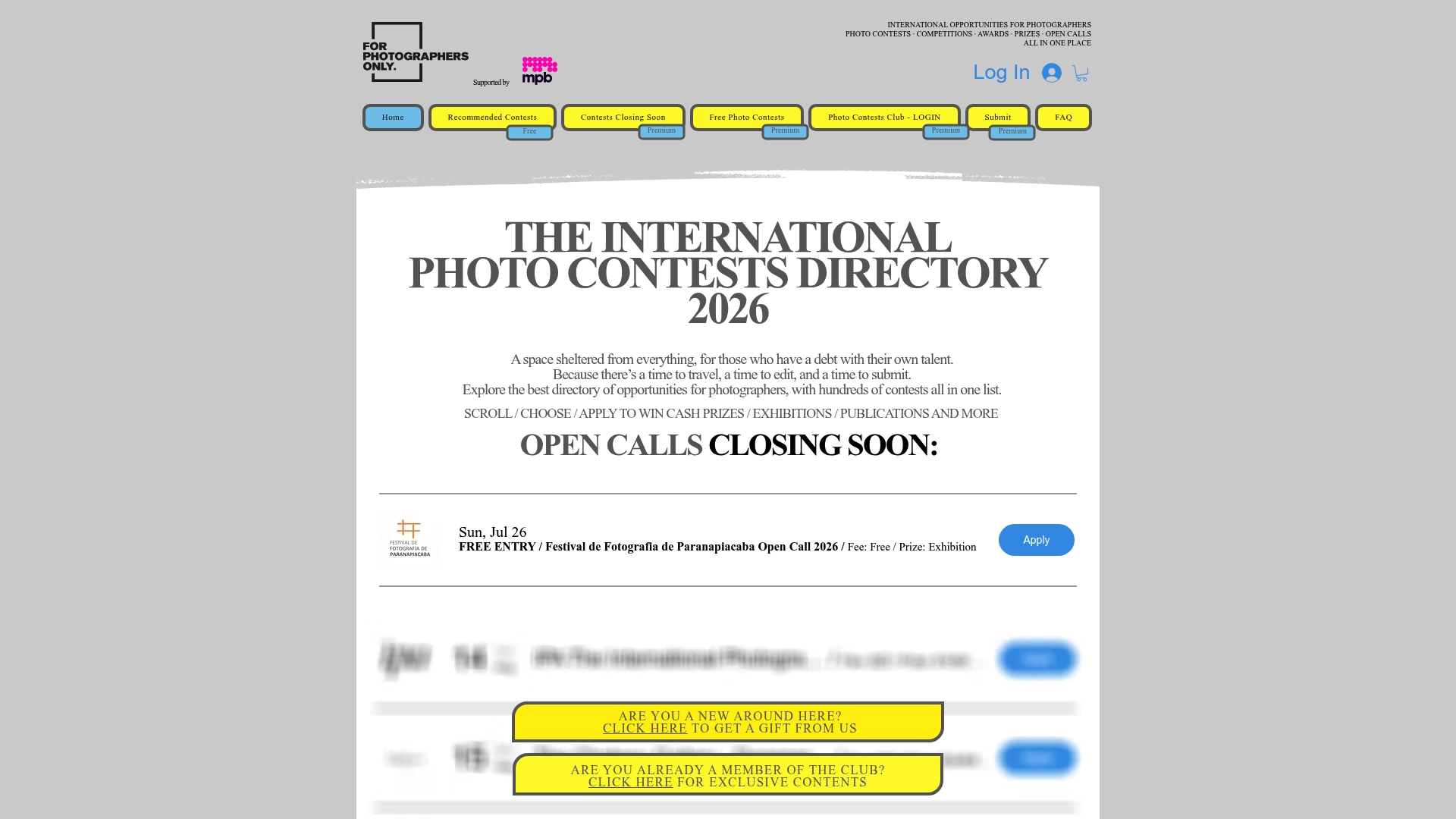
Browse more than 320 curated contests with deadlines, fees, and entry rules listed together.
Filter toward free-to-enter opportunities or ones matching your category and location.
Check this week’s additions rather than hunting across dozens of separate organizer sites.
Subscribing costs €6 per month or €40 per year, and the time saved checking eligibility across competitions tends to pay for itself after the first contest you enter with confidence. Browse the current contest directory to see what fits your next submission.
FAQ
What are the criteria used to judge a photo contest?
Judging criteria vary by contest but commonly include technical quality, composition, originality, and how well the image fits its category or theme. Our judging criteria breakdown explains how these standards typically apply and why organizers sometimes request original files to confirm authenticity before finalizing results.
Are photo contests worth entering?
Photo contests can build a portfolio, earn publication credit, and occasionally deliver cash prizes or gallery exposure, though the value depends on the specific contest’s prestige and prize structure. Checking eligibility carefully before entering avoids wasted fees and disqualification after the fact.
What photo contests are happening in 2026?
Hundreds of international photography competitions run throughout 2026 across genres from wildlife to street photography, with new listings added weekly. Our continuously updated contest directory tracks current and upcoming opportunities in one place.
What are the rules for a 365-day photo challenge?
A photo challenge typically asks participants to shoot one image daily for an extended period, though specific submission and eligibility rules depend on the individual organizer running the challenge. Since these challenges aren’t standardized the way institutional contests are, always confirm the exact entry requirements with whoever hosts the specific challenge you’re considering.
Sources
Recommended