Avoid Disqualification: Photographers, Read AI Photo Contest Rules First
AI in photo contests now sits somewhere between judge and gatekeeper: most major competitions restrict generative AI outright while permitting conditional edits like denoise, and a growing number demand RAW files or a signed attestation from finalists. Before you submit anything, preserve your original RAWs and read that specific contest’s AI policy line by line. Disqualification is the real cost of skipping this, and it has already happened to a finalist at a major competition in 2026.
TL;DR:
Most major contests ban generative AI in core categories but permit certain AI-assisted edits like denoise and sharpening, with specific RAW or attestation requirements.
Maintaining an unedited RAW file chain and documenting software and plugin versions is your best defense against disqualification if flagged for AI content.
AI detection methods rely on metadata, watermarks, and noise patterns, but false positives are common, so prompt, thorough responses are essential when challenged.
Disclosure of AI-assisted edits is recommended where allowed, and matching your category to your actual manipulation level helps maintain honesty and integrity.
Using a contest tracking service reduces time spent researching rules and highlights compliance requirements, lowering the risk of accidental disqualification.
Table of Contents
How Contests Are Actually Using AI Right Now
Automated judging has moved past novelty status. Excire ran a “People in Focus” competition where an AI engine delivered instant scoring and a live top-20 leaderboard, letting entrants watch their rank shift in real time as new submissions arrived. That same contest banned AI-generated entries and required finalists to submit original files, a pairing you’ll see repeated across the industry: AI judges the work, but humans verify it was made honestly.
Behind the scenes, machine learning also handles less glamorous tasks. Image-recognition tools have helped judges at ENR’s photo contest by flagging specific content like missing safety gear, acting as a second set of eyes rather than a replacement for the jury. Contests use similar systems for:
Automated tagging and metadata parsing to sort thousands of entries by subject or genre
Forensic screening that flags likely generative content before a human ever opens the file
Instant aesthetic scoring that ranks entries the moment they’re uploaded
The next wave looks more sophisticated. Research behind JoPPO, a CVPR 2026 paper, shows vision language models moving toward attribute-aware judging that scores composition, lighting, and geometry separately instead of collapsing everything into one number.
What Do Contest Rules Actually Say About AI?
Entry terms fall into three rough camps, and Lumethic’s database tracking AI policies across 87 competitions shows most organizers have already picked a lane. Here’s how to read that spectrum before you enter anything:
Full bans cover the core categories at most major contests. Generative fill, AI-created subjects, and synthetic backgrounds are disqualifying regardless of category.
Restricted or conditional use allows tools like AI-assisted denoise, sharpening, or minor retouching, provided the underlying image was captured with a camera and not synthesized.
Unstated or ambiguous policies still exist at smaller or regional contests. Treat silence as a yellow light, not a green one, and email the organizer if the terms don’t say.
The clause worth reading twice is usually the one defining “excessive manipulation.” Most organizers mean structural changes to content, not tonal or exposure adjustments, but the boundary varies by contest. A rising number now pair that language with a mandatory attestation and a RAW-file request for finalists, which means your file needs to actually match what you claimed. Before entering, check for an AI-specific clause, a RAW submission deadline, and any attestation form buried in the entry rules.
How Should You Prepare Your Files Before Submitting?
Provenance is your best defense, and it starts the moment you press the shutter. Keep every RAW file untouched, and build an incremental export chain as you edit: something like a timestamped sequence moving from the original capture through intermediate edits to your final export, with a plain text note listing which software and plugin versions touched the file. That chain is often the most convincing evidence you can hand a contest’s forensic team if a submission ever gets flagged.
For your actual export, match the format the contest requests, and hold onto the archive well past the entry deadline. Some competitions request files months after judging.
On editing tools specifically, the tolerance line is fairly consistent across contests:
Generally tolerated: moderate AI denoise, basic sharpening, standard color correction
Generally risky: generative fill, AI-inserted objects, sky replacement, any tool that invents detail not present in the capture
Pro Tip: Aggressive machine learning denoise can fabricate texture that wasn’t in the original scene. Compare your denoised file against the RAW at 100 percent crop. If you see invented detail that looks suspiciously clean or repetitive, back off the strength before you submit.
Running your shortlist through a local aesthetic scoring tool can help you narrow options fast, but don’t let the score dictate your final edit. Keep the original pipeline intact so you can reconstruct your process if anyone asks.
Can You Optimize an Image for an AI Judge?
You can test against one without gaming it, and that distinction matters more than it sounds. Observed leaderboards from tools like Excire tend to favor high-contrast, saturated color treatments and conventional portrait retouching. That’s a real, documented pattern, but it’s also a snapshot of one model’s training data, not a universal aesthetic law. PetaPixel’s reporting on AI-judged contests quotes Professor Erhardt Barth noting that AI can analyze objective qualities but can’t replace human taste, which is exactly why chasing a leaderboard score is a short-term game.
A better workflow treats AI scoring as one data point among several:
Run A/B versions of an edit through an aesthetic-scoring tool and note the spread, not just the winner
Sanity-check any AI-favored version against your own eye and a second opinion from another photographer
Weight technical fundamentals, exposure, focus, composition, over surface-level color grading
Leaderboard trends shift as models get retrained. A judge-backed strategy built on clear compositional intent and technical execution will outlast whatever a specific AI model happens to reward this season.
How Do Contests Detect AI and What Happens if You’re Flagged?
Forensic review typically starts with metadata mismatches, embedded watermarks like SynthID, and noise patterns that look statistically improbable for a real sensor. None of these signals are conclusive on their own. Detection tools produce both false positives and false negatives, which is why credible contests pair automated flags with human review before making a call.
The consequences are real when it goes wrong. Hasselblad disqualified a finalist at its 2026 Masters competition after community members flagged likely AI markers, prompting the organizer to run its own verification and pull the entry before revoking the shortlist spot. A separate case saw Tokina remove a contest winner following similar public scrutiny.
If you’re ever accused, respond fast and completely:
Produce your RAW files first, unedited and with intact EXIF data
Provide your edit log showing the incremental export chain
Share timestamps and any correspondence that supports your capture story
Photographers who keep clean provenance tend to resolve these disputes quickly. Those who can’t produce originals rarely do.
What Ethical Standards Apply When AI Touches Your Work?
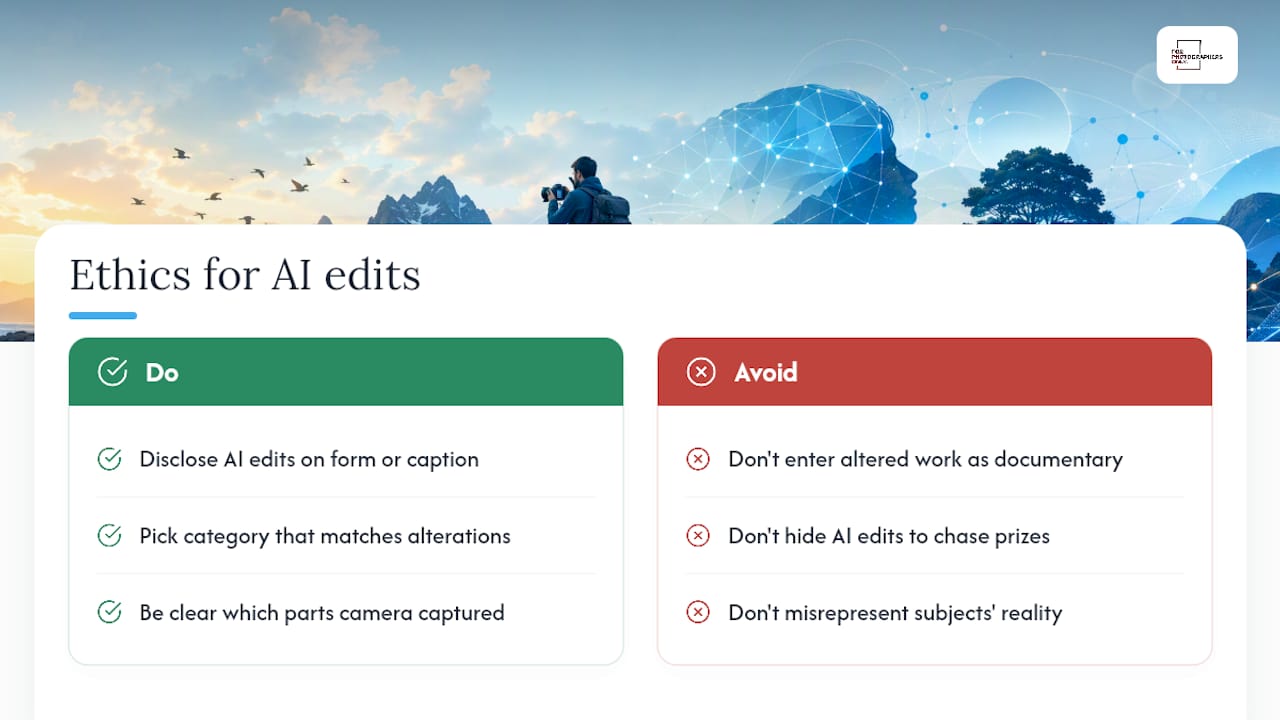
Disclosure norms are still forming, but the direction is clear: if a contest permits AI-assisted edits, say so on the entry form or in your caption notes. It costs you nothing and it protects your reputation if anyone ever questions the file later.
Category choice matters just as much. Documentary and photojournalism categories generally hold to near-zero manipulation tolerance, while open or creative categories give you more room for blended techniques. Match your entry to the category that actually reflects how much the image was altered, not the category with the biggest prize.
Respecting the jury and the subjects in your frame means being honest about what the camera captured versus what software added afterward. That honesty is what keeps contests trustworthy for everyone entering them.
Why Contest Literacy Matters More Than Talent Right Now
I’ve watched enough contest terms rewritten in the past two years to know the biggest risk to photographers isn’t a lack of skill. It’s entering blind. A brilliant image submitted without reading the fine print on generative AI can lose to a merely good image submitted by someone who read the rules twice.
Forphotographersonly exists partly because these policies change fast and inconsistently across hundreds of competitions. Part of curating a contest directory well means catching a new AI clause before a member wastes an entry fee on a submission that was disqualified from the start. That kind of quiet save is the whole point.
— DARIO
Save Time Tracking Which Contests Allow AI Edits
Forphotographersonly is the alternative to manually checking entry terms across dozens of competitions. Instead of digging through PDFs for every contest you’re considering, our directory flags AI-policy notes, RAW-submission requirements, and deadlines alongside each of the 320 to 330 active competitions we track, including more than 100 free-to-enter opportunities.
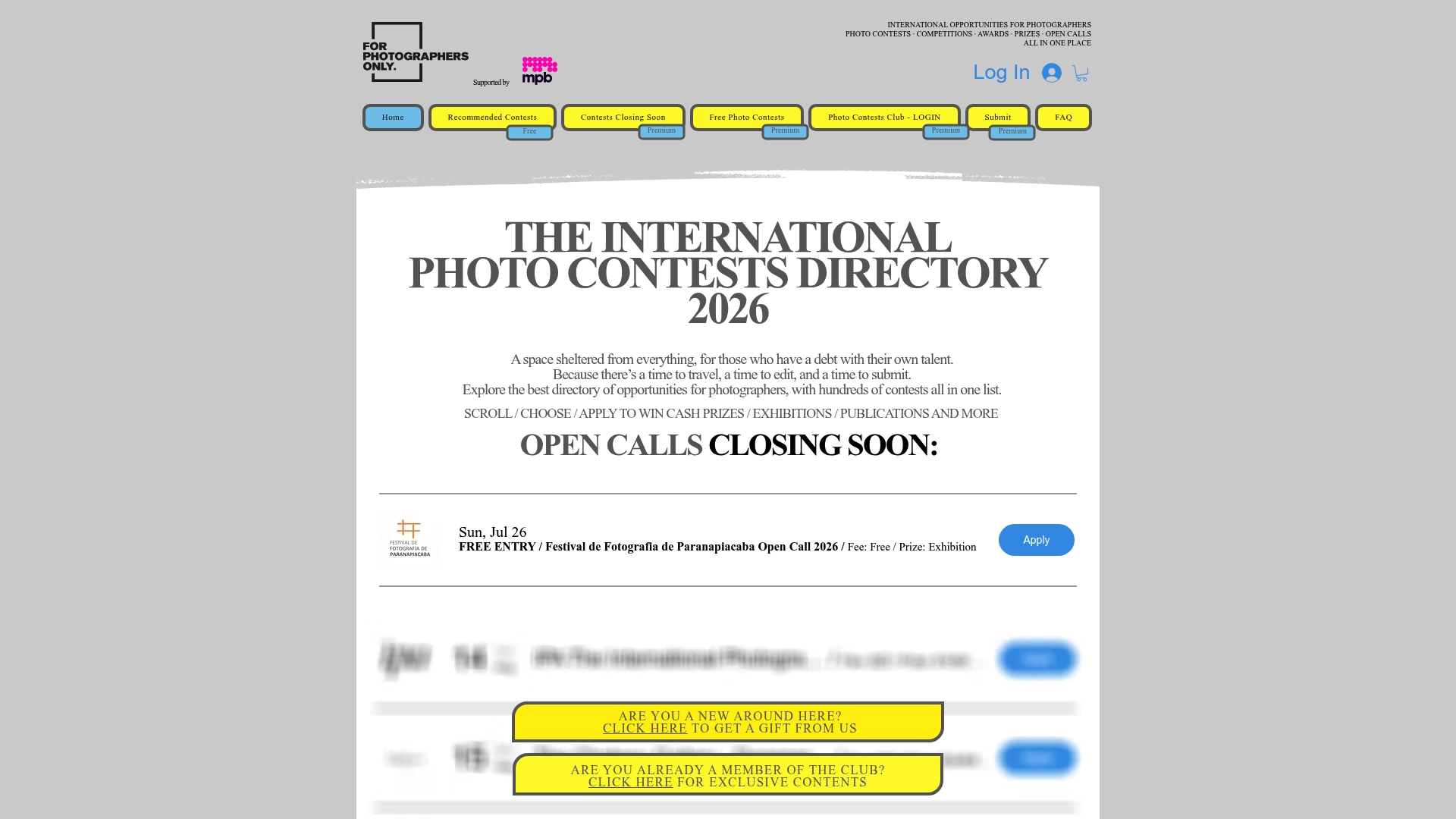
That continuous curation means you spend your time editing and shooting instead of cross-referencing rulebooks. For photographers weighing categories with different manipulation tolerances, our PHOTOGRAPHY LIFE coverage rounds up editorial features and contest angles worth watching this year. If you want to see how the tool-testing side of this fits into your own workflow, AmmarAI’s image analysis tool is worth exploring before you finalize a submission.
A subscription runs for a low monthly fee and updates weekly, which is considerably less time than most photographers spend hunting for legitimate opportunities on their own. Start a free trial and see the current list of AI-aware contests waiting for your entry.
Sources
FAQ
Is AI allowed in photo contests?
It depends on the contest. Most major competitions ban generative AI for core categories but permit conditional AI-assisted edits like denoise, according to Lumethic’s tracking of 87 contests.
What AI edits are usually safe to use?
Moderate AI-powered denoise, standard sharpening, and typical color correction are generally tolerated. Generative fill, AI-inserted objects, and sky replacement are commonly banned.
What happens if a contest suspects your image is AI-generated?
Organizers typically request your RAW files, review metadata for mismatches, and may pull the entry pending verification, as happened in the Hasselblad Masters 2026 disqualification.
Should I disclose AI-assisted edits in my entry?
Yes, whenever a contest’s policy permits AI-assisted edits, disclosing them in the entry form or caption protects your credibility if the file is ever questioned.
How can I keep track of which contests allow AI-assisted edits?
A curated directory like Forphotographersonly flags AI-policy notes and RAW requirements per contest, which saves you from manually checking terms across hundreds of competitions.
Recommended