How to Track Photo Contest Deadlines Without Missing One

The most reliable way to track photo contest deadlines is a single, chronological list that you check on a fixed day each week, backed by reminders in the calendar you already use. Photographers who work from one living list, rather than bookmarks, newsletters and memory, enter more of the right contests and lose fewer entry fees to missed cutoffs. Our directory, PhotoContestsClub, was built for exactly this: more than 320 active contests on one page, ordered by date and updated every week.
This guide gives you the full routine: what to record for every contest, how to read early and extended deadlines, how to convert a closing time to your own time zone, and how to keep the calendar accurate when dates change.
TL;DR
Keep one master list, sorted by closing date, and review it on the same day every week.
Record the deadline with its time zone, the fee tier, eligibility, file specifications and rights terms, not only the date.
Set reminders at 14, 7 and 2 days out, and treat the day before as your real deadline.
Convert every closing time to your own zone once, when you add the contest, and write it down.
Re-check the organizer’s official page before you pay, because extensions and fee changes are common.
Table of Contents
Why a Deadline List Beats Scattered Bookmarks
A photo contest deadline is rarely a single date. Most serious competitions publish an early-entry date with a discount, a regular deadline, and sometimes an extended deadline with a surcharge. Each has its own time of day and its own time zone. Tracking only the headline date means paying more than necessary or missing the window entirely.

The cost of disorganization is concrete. Entry fees are paid per image or per series, and a missed deadline means the work you prepared waits a full year for the next edition. A list that shows every opportunity in order lets you decide early which contests deserve your best frames, and which free contests are worth entering alongside them.
The second benefit is planning. When you can see the next six months at once, you can match your shooting schedule to submission windows. A landscape series finished in October fits a different set of contests than a street project finished in May.
What to Record for Every Contest
A useful entry in your tracker answers every question you will have on submission day. The NANPA Showcase is a good model of how much detail one contest can carry. Its 2027 submission rules set entries from mid-August to late September 2026 at 11:59 p.m. Eastern, gave an additional 20% discount for early entry, charged 50% more during the extended period, priced single images and series differently, and required NANPA or ASMP membership. Each of those details changes what you pay or whether you can enter at all.
For every contest on your list, capture these fields:
Contest name and organizer. The organizer’s name matters more than the platform hosting the entry form.
Deadline tiers. Early, regular and extended dates, each with a time and a time zone.
Fees. The per-image and per-series price, any multiple-entry discount, and the price at each tier.
Eligibility. Age, residency, membership, amateur or professional status, and whether the work must have been created in a set period. Our guide to photo contest eligibility checks covers the five checks that most often lead to disqualification.
File requirements. Format, maximum file size, long-edge pixels, color profile, and whether watermarks are allowed.
Rights and usage. What the organizer may do with winning and non-winning images.
Prizes and exposure. Cash, exhibition, publication, or portfolio value.
Status. Considering, preparing, submitted, result received.
A spreadsheet with these columns is enough. A shared notes app works as well, provided every contest has the same fields so you can sort and compare.
Reading Early, Regular and Extended Deadlines
The deadline structure is where most expensive mistakes happen. The World Street Photo Awards FAQ shows a typical pattern for 2026: an early-bird date with a percentage discount, an extended final deadline in October, and a final submission time of 23:59 Central European Time. The same page lists file rules, including a JPEG maximum of 7 MB, the sRGB color profile and no watermarks, and a date for announcing winners.
Treat that page as a template for what to extract:
Write down the cheapest tier you can realistically meet. If your edit will be ready after the early-bird date, do not plan around it.
Mark the extended deadline as a fallback, not a plan. It usually costs more, and some organizers close it earlier than expected when submissions run high.
Note the results date. It tells you when to expect news and when to stop holding images back from other contests, if the rules require exclusivity.
Copy the file rules next to the date. A deadline you can meet in time but with the wrong color profile is still a failed entry. Our color profile checklist for contests walks through the export checks before you upload.
Converting Deadlines to Your Time Zone
International contests state their closing time in the organizer’s local time, and that time is often late in the evening. For a photographer in the United States, a midnight-adjacent closing in Europe can land in the afternoon or even earlier on the same calendar day. A contest that closes at 23:59 Central European Time closes in the early evening in New York and in the middle of the afternoon on the US West Coast.
Organizers who serve a global audience often help with this. World Press Photo’s 2026 date advisory gives its announcement times in both Central European Summer Time and US Eastern Daylight Time, for instance 11:00 a.m. CEST and 5:00 a.m. EDT. Many contests do not do this for you, so build the conversion into your routine:
Convert the closing time to your local zone when you add the contest, and store both versions in your tracker.
Watch the weeks in spring and autumn when the United States and Europe change their clocks on different dates. The usual six-hour gap between New York and Central Europe can briefly shift by an hour.
Where the rules say only “midnight” or “end of day”, look for the time zone on the organizer’s page and write it into your record. A deadline without a zone is a guess.
Setting Reminders That Actually Work
A date in a spreadsheet does nothing on its own. The system works when the list pushes information to you.
Use three layers:
A weekly review. Pick one day, perhaps Sunday evening, and scan the next 60 days of your list. This catches new additions and contests that have moved.
Calendar alerts. Add each deadline to the calendar on your phone with alerts at 14 days, 7 days and 2 days. Put the event on the day before the real cutoff, so the final day is a buffer for upload problems.
A dedicated reminder tool. Reminder apps that read dates from photos, screenshots or typed notes can take over the repetitive part. AI-powered reminders and document scanning can pull dates out of a captured announcement and send push notifications, which helps when a call for entries arrives as an image or a flyer.
The buffer matters more than the tool. Upload portals slow down in the final hours before a popular deadline, and files that look fine at home can be rejected by a size limit. Submitting two days early removes most of that risk.
Where to Find Current Contest Deadlines
There are four common sources, each with a different trade-off between effort and reliability.
Organizer websites and newsletters. These are the authority for any single contest, but they only tell you about contests you already know. Following dozens of them is slow work.
Social media accounts. Fast for announcements, unreliable for details. Posts are brief, and the date you see may be an early deadline that has already passed.
Photography magazines and festival pages. Good for prestige events and exhibitions, though coverage is uneven and often skewed toward the best-known names.
A curated directory. This is the efficient answer for most photographers. PhotoContestsClub researches contests from major brands and institutions such as Nikon, Canon, Leica and National Geographic, as well as niche contests and independent festivals, and presents them chronologically on a single page. Instead of visiting dozens of sites to build your own calendar, you start from a list that is already ordered by date, with fees, prizes and genres shown. More than 100 of the listed contests are free to enter, which makes it simple to balance paid and free entries across the year.
For readers who prefer a themed starting point, our curated 2026 photo contest calendar and submission checklist and the US photography competitions shortlist show how the list can be filtered by region and goal.

Verifying a Date With the Organizer
Any list, including ours, points you to the contest. The organizer’s rules page is the final word on the date, the fee and the terms, so open it before you pay.
A quick verification takes about two minutes:
Open the official contest page and find the deadline and time zone.
Check whether the date matches your record, including the tier you plan to use.
Read the rights section of the terms, and note what the organizer may do with your images.
Confirm the file specifications against your exported files.
Update your tracker with anything that changed, and note the date you checked.
When an organizer extends a deadline, the new date usually appears on the contest page and in its newsletter first. Do not rely on the extension, though. If the original date still works for you, submit by it.
Keeping the Calendar Current
A calendar that was accurate in January may be wrong by March. Contests change dates, add fees, open new categories, or disappear. Three habits keep your list trustworthy.
Review weekly, not monthly. Most changes can be caught while there is still time to act on them.
Archive, do not delete. Move closed contests to a results log with the date, the category, the images entered and the outcome. Over a few seasons, this log shows which contests respond to your style and which do not.
Plan the year in tiers. Reserve your best work and your largest fees for the contests with the strongest prestige and fit, and use free or lower-fee contests to test new series. Our judging criteria rubric helps you evaluate whether a series is ready before you spend on entries.
Because our directory is updated every week, the weekly review and the list update on the same rhythm, which keeps a new opportunity from sitting unseen for a month.
A Simple Weekly Routine
Put it all together in fifteen minutes a week:
Open your master list and sort by deadline.
Check the next 60 days: confirm each date on the organizer’s page if you plan to enter.
Add any new contests that fit your current work, with all the fields from the checklist above.
Move closed contests to the results log.
Confirm that calendar alerts exist for every contest you plan to enter.
Choose the one entry you will finish this week, and schedule the upload for two days before the cutoff.
This routine turns contests from a source of anxiety into a steady pipeline for exhibitions, publication and recognition.
Our Perspective
Photographers rarely lose a contest because the work was not good enough to enter. They lose the chance because the date slipped past, the fee tier changed, or the rules were read too late. That is why we built PhotoContestsClub as a single page rather than a sprawling archive. We research and curate competitions organized by respected brands, institutions, festivals and independent organizers, and we place them in chronological order so that the next opportunity is always the first one you see. We do not run the contests ourselves, which keeps our attention on one task: making the best international opportunities easy to find, easy to compare and easy to plan around. A well-kept list gives you time, and time is what lets you edit a series carefully, check the rights terms and enter with confidence. We hope every photographer who uses it feels the same excitement we do when a strong body of work meets the right audience. DARIO
Put the List to Work
PhotoContestsClub gives you one continuously updated page with more than 320 active international competitions, awards, grants and calls, including over 100 free-to-enter contests, each with its deadline, fee, prize and genre. Membership is €6 per month or €40 per year, and a free trial is offered, so you can build your first deadline calendar from a real list.
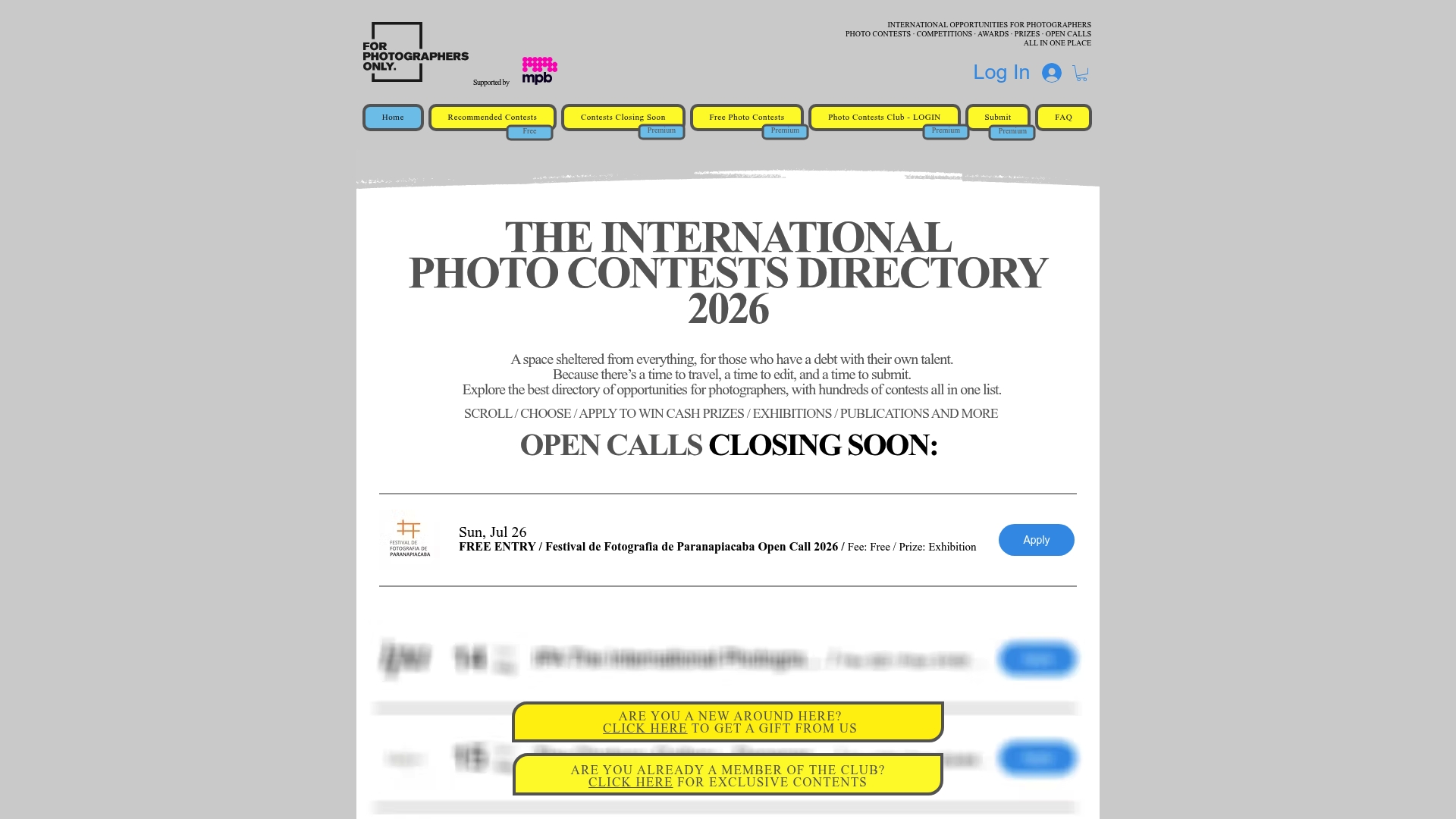
Members also join a photographer community and a monthly internal competition. See the plans on the PhotoContestsClub page and start your calendar there.
FAQ
How far ahead should I start tracking a contest?
Start as soon as a contest opens, or earlier if it is an annual event you want to enter. Early-entry discounts, such as the 20% reduction in the NANPA Showcase example, reward photographers who prepare ahead. Knowing the likely window a few months out lets you shoot and edit toward it.
What should I do if a contest extends its deadline?
Update your tracker with the new date, the new fee and the new time. Extended periods often cost more, so compare the price against the regular tier. If your files are ready, submit by the original deadline rather than counting on the extension.
How do I know the deadline time is in my time zone?
It almost never is. Look for the zone on the official rules page, such as Central European Time or Eastern Time, and convert it once when you add the contest. Store the converted time in your tracker beside the original.
Is a spreadsheet enough, or do I need a special tool?
A spreadsheet with consistent fields and calendar alerts is enough for most photographers. The more important step is the weekly review. A curated, date-ordered directory reduces the research that fills the sheet, so you spend your time choosing and preparing entries.
Should I track free contests too?
Yes. Free contests carry no entry cost, so they are useful for testing new series and building a record of results. Keep them in the same list, with a column marking the fee, so you can balance your annual entry budget.
Sources
Recommended