Submittable Alternatives for Photographers: Contest Discovery

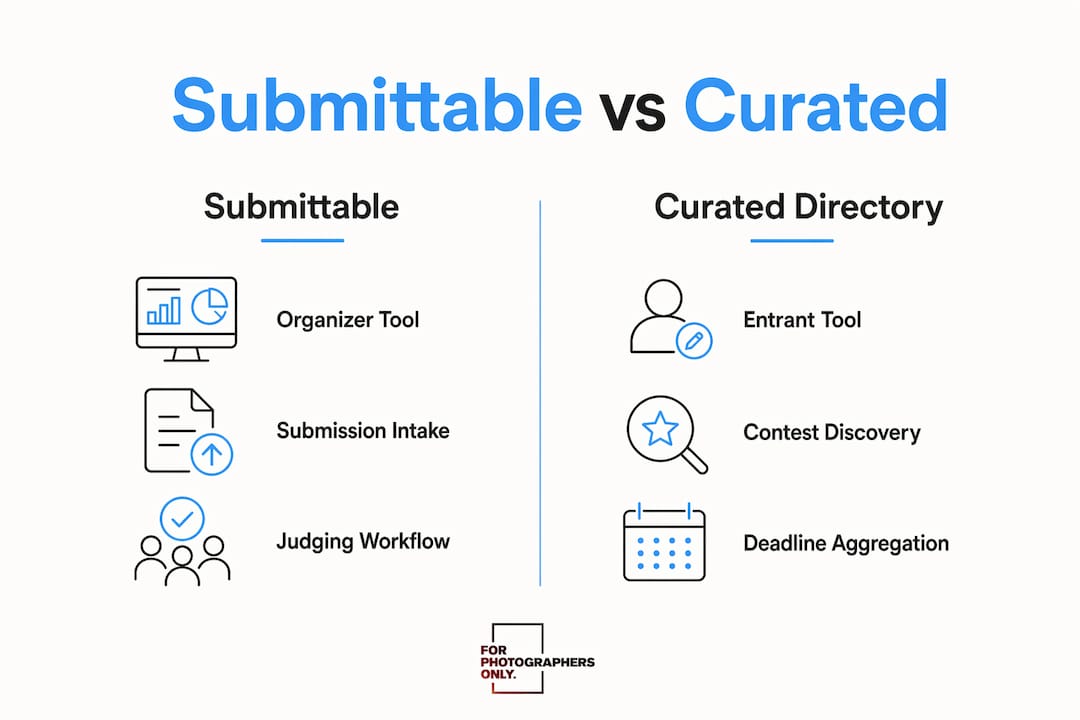
For photographers searching for the best way to find and enter international photo contests, Forphotographersonly is the most direct alternative to Submittable. The two tools solve entirely different problems: Submittable is an organizer-facing submission intake system, while a curated directory is a discovery and deadline-tracking resource built for entrants.
TL;DR: If you want to find contests to enter, you need a discovery directory, not an intake platform.
Speed to results: A curated directory surfaces active, verified contests immediately, with deadlines organized chronologically, so you spend minutes searching instead of hours.
Cost to the photographer: Directory subscriptions are a flat monthly fee; Submittable charges per-submission fees to organizers, who often pass those costs to entrants.
Ease of entry: Directories link directly to organizer submission pages, bypassing the need to navigate multiple platforms or create accounts on unfamiliar intake systems.
Table of Contents
How does Submittable differ from a curated contest directory?
Photographers searching for “Submittable alternatives” are often describing two completely different needs: finding contests to enter, or building tools to run them. Submittable is an organizer-facing platform for collecting applications, managing judging workflows, and handling grant reporting. It is not designed for entrants browsing opportunities.
A curated directory, by contrast, is a discovery and deadline-aggregation product. It answers the question photographers actually ask: What contests are open right now, and which ones are worth entering?
Dimension | Intake platform (organizer tool) | Curated directory (entrant tool) |
Purpose | Collect and manage submissions | Discover and track contests |
Best for | Organizations running contests | Photographers entering contests |
File/upload support | High-res image intake, configurable | Links to organizer upload portals |
Judging support | Rubrics, scoring, multi-round review | Editorial legitimacy screening |
Cost to photographer | Per-entry fees set by organizer | Flat directory subscription |
Coverage | Depends on which organizers use it | Curated international scope |
Ease of use | Requires account per organizer | Single calendar, filters, alerts |
All-in-one platforms commonly trade flexibility for convenience, and specialists often outperform them for specific workflows. For an individual photographer, an enterprise intake system carries features, costs, and complexity that simply do not apply to the act of finding and entering a competition.
Which option should you choose based on your actual goal?
Start with a two-step needs audit before you commit to any platform or workflow.

Step 1: Are you entering contests or running one?
If you are entering contests, your priority is discovery: finding legitimate, active competitions that match your genre, budget, and timeline. An intake platform is irrelevant to that goal. If you are organizing a contest or grant program, then submission management tools become relevant, and the intake platform category makes sense to evaluate.
Step 2: What features actually matter for your workflow?
Do you need filters by genre, location, prize type, or entry fee?
Do you need deadline alerts and a chronological calendar?
Do you need legitimacy signals: named brand partners, past winners, and verified organizer credentials?
Do you need high-resolution upload support at the point of entry?
Pro Tip: Before entering any contest, confirm the organizer’s accepted file formats and maximum resolution requirements. Many international competitions specify sRGB color profiles and JPEG files under 10 MB. Preparing a submission folder with correctly sized, color-profiled images before you search saves significant time.
A needs audit before migrating or switching platforms prevents costly mistakes, particularly around file-type support and judging rubrics. For photographers, that audit almost always points toward a discovery directory rather than an intake system.
Why photographers prefer curated directories for finding contests
The practical case for a curated directory comes down to time, trust, and reach. Searching for photography contests independently means visiting dozens of organizer websites, cross-referencing deadlines, and manually verifying whether each contest is still active. A well-maintained directory collapses that process into a single, filtered view.
The primary benefits photographers consistently cite:
Centralized deadlines: All active contests organized chronologically, so nothing slips past unnoticed.
Editorial curation: Human review filters out low-quality, dormant, or suspicious listings before they reach the directory.
Legitimacy checks: Listings tied to recognized brand partners (Nikon, Canon, Leica, National Geographic) carry built-in credibility signals.
Genre and fee filters: Photographers can narrow results by subject matter, entry cost, prize type, or geographic focus.
Free-contest access: A quality directory surfaces competitions with no entry fee alongside paid ones, giving photographers at every budget level genuine options.
Forphotographersonly currently lists 320–330 active photography contests, including over 100 free-to-enter competitions, with the directory updated every week.
On cost, the contrast with per-entry intake platforms is meaningful. Grant-management features can push organizer platform costs into a foundation-scale price bracket, and those costs often flow downstream to entrants through submission fees. A flat directory subscription sidesteps that structure entirely.
What should you check before trusting any alternative?
Not every directory or submission path deserves your time or money. Run through this checklist before committing.
Technical and file requirements
Accepted formats: JPEG, TIFF, RAW (confirm per contest)
Maximum file size and recommended resolution (typically 300 DPI for print-oriented contests)
Color profile: sRGB for digital display, Adobe RGB for print
Submission portal compatibility: browser-based vs. dedicated app
Judging and timeline transparency
Is the judging timeline published? Reputable contests announce results within a defined window.
Are scoring criteria or rubric categories disclosed?
Is there a past-winners archive confirming the contest has run previously?
Fees and refund policies
Entry fee clearly stated before submission
Directory subscription terms: monthly vs. annual, cancellation policy
Refund policy for contests that are canceled or postponed
Legitimacy signals
Named organizer with verifiable credentials
Partner brands listed (Nikon, Canon, Leica, National Geographic)
Last-updated timestamp on the listing
Active social media presence or press coverage from the organizer
Record-keeping
Save confirmation emails and submission receipts
Note the contest name, deadline, entry fee, and file specifications in a personal tracking spreadsheet
Data migration from mature intake platforms typically requires manual CSV exports; for photographers, a simple spreadsheet log is faster and more portable than any platform-dependent archive
How to move from Submittable to a curated directory, step by step
Set your goals. Define what a successful contest entry looks like: prize money, gallery exhibition, editorial publication, or portfolio credential.
Pick your genres. Narrow your search to subject categories where your strongest work lives: portrait, landscape, documentary, wildlife, street, or fine art.
Run filters. Use the directory’s genre, fee, and deadline filters to surface contests that match your current body of work and timeline.
Confirm deadline and legitimacy. Cross-reference the organizer’s official website, check for a past-winners archive, and verify the submission portal is active.
Prepare your files. Build a submission-ready folder: correctly sized images, sRGB color profile, file names following the organizer’s convention, and a short artist statement if required.
Track your entries. Log each submission with the contest name, deadline, fee paid, and expected results date. Set a calendar reminder for the announcement window.
Pro Tip: For international contests with deadlines in other time zones, convert the closing time to your local time the moment you find the listing. Missing a deadline by an hour because of a time-zone miscalculation is one of the most avoidable errors in contest photography.
Timing matters more than most photographers expect. Major international competitions, particularly those affiliated with Nikon, National Geographic, or Leica, often close entries weeks before the judging period begins. Building a four-to-six-week preparation window into your calendar gives you time to select, edit, and export files without rushing.
How Forphotographersonly works and why it’s the recommended discovery alternative
Forphotographersonly is a curated, continuously updated directory of international photography contests, awards, calls for entry, prizes, and grants. The platform does not organize contests itself. Instead, it researches, verifies, and publishes the best opportunities available worldwide, presented in a clean chronological format that removes the need to search across dozens of individual organizer websites.
The directory currently features hundreds of active contests, including many free-to-enter competitions. Listings are updated every week, so subscribers always see current opportunities rather than expired or dormant ones. Competitions from Nikon, Canon, Leica, and National Geographic appear alongside carefully selected niche festivals and independent photography awards that rarely surface through general web searches.
Key subscriber benefits:
Weekly updates: New contests added as they open; closed contests removed promptly.
Chronological calendar: Deadlines organized so the most urgent opportunities appear first.
Editorial curation: Every listing reviewed for legitimacy before publication.
Members-only opportunities: A monthly internal competition exclusive to subscribers.
International scope: Contests from across North America, Europe, Asia, and beyond, covering every major photographic genre.
The directory has been featured by The Washington Post, The Guardian, and the BBC, among other publications, reflecting its standing as a trusted resource within the international photography community.
At €6 per month, the subscription cost is a fraction of a single contest entry fee at most major competitions.
Key Takeaways
For photographers, the right alternative to Submittable is a curated discovery directory: a single, verified, weekly-updated source of active international contests that replaces hours of manual searching with a filtered, chronological view of real opportunities.
Point | Details |
Submittable is for organizers | Submittable manages submission intake and judging workflows; it is not a contest-discovery tool for entrants. |
Discovery directories serve entrants | A curated directory aggregates deadlines, filters by genre and fee, and screens for legitimacy before you ever click through. |
Run a needs audit first | Confirm file-type support, judging timelines, and entry fees before committing to any contest or platform. |
Free contests are available | Forphotographersonly lists over 100 free-to-enter competitions alongside paid ones, covering every budget level. |
Forphotographersonly is the recommended next step | With 320–330 active contests updated weekly at €6/month, it is the most direct discovery alternative for photographers. |
Why a curated directory is the right call for photographers
The conventional framing of “Submittable alternatives” misses something photographers need to hear plainly: Submittable was never built for you as an entrant. It was built for the organizations on the other side of your submission. Evaluating it as a discovery tool is like judging a backstage management system by how well it helps the audience find their seats.
What photographers actually need is editorial judgment applied upstream: someone who has already filtered out the dormant listings, the contests with no prize history, and the vague calls for entry with no named organizer. That curatorial work is what separates a useful directory from a raw aggregator. The difference between a long list of contests and a curated list of 320–330 verified, active opportunities is not just volume. It is the hours you do not spend verifying each one yourself.
The legitimacy question also matters more than most photographers realize. A contest affiliated with Canon or National Geographic carries institutional accountability. An anonymous listing on a general submission platform carries none. Directories that publish partner brands and past winners are doing the verification work so you do not have to.
Forphotographersonly: start finding active contests today
Forphotographersonly gives photographers something no general intake platform offers: a single, continuously updated page of the world’s best photography competitions, organized by deadline and filtered by genre, fee, and prize type.
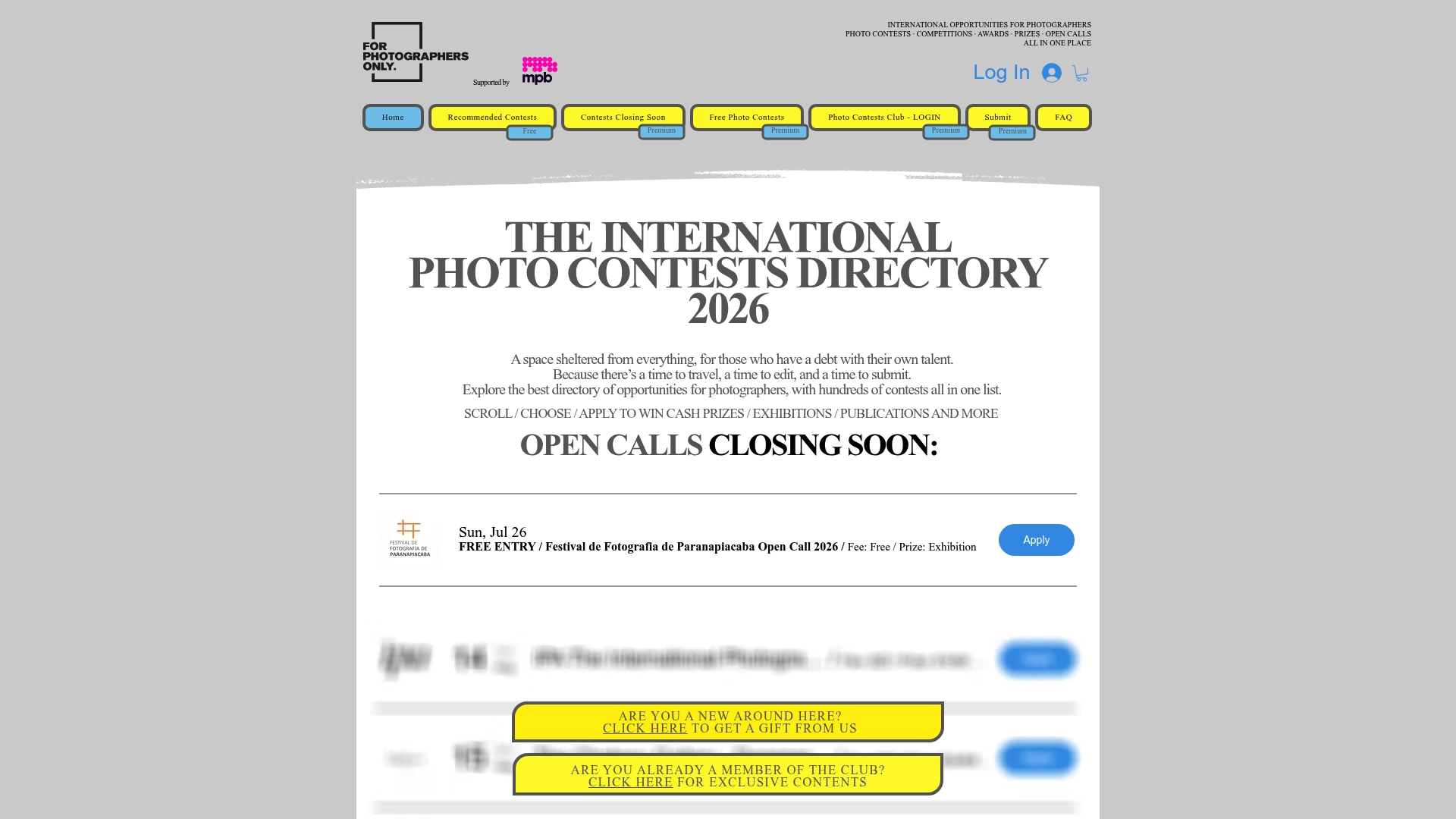
The subscription runs at €6 per month, with an annual plan available for photographers who want year-round access without interruption. A free trial lets you see the full directory before committing. Within five minutes of signing up, you have access to 320–330 active contests, over 100 of them free to enter, drawn from organizers including Nikon, Canon, Leica, and National Geographic. The weekly update cycle means the directory reflects what is actually open right now, not what was open last month.
Browse the current contest calendar and find your next submission opportunity today.
Sources and further reading
The following sources informed this article and offer additional context for photographers evaluating submission management tools and contest discovery platforms:
Best Submittable Alternatives (2026) — ScoreJudge: analysis of organizer-facing intake platforms and the distinction between submission management and contest discovery.
Over 14 Alternatives to Submittable — Lit Mag Lab: practitioner guidance on needs audits, file-type checks, and data migration considerations when switching platforms.
11 Alternatives to Submittable for Social Impact — Bonterra: context on grant-management features and why all-in-one platforms often exceed individual users’ needs.
Forphotographersonly — Primary source for directory size, update cadence, partner listings, and subscription pricing cited throughout this article.
Recommended