Simultaneous Submissions in Photography: Rules and Etiquette

A simultaneous submission means sending the same photographs, or the same photo story, to more than one publication while all of them are still deciding. Whether you may do it is set by each publication’s own guidelines, not by a universal rule. The safe approach is to read the policy before you send, say so plainly when you submit, and notify every other editor the moment one accepts. This guide walks through that routine, with real wording from US publications, so you can submit widely without damaging an editor’s trust or your rights.
TL;DR
Simultaneous submissions are allowed by some publications and forbidden by others. The guidelines page of each outlet is the only authority.
Print and “exclusive” content, such as styled shoots and news photographs, is usually limited to one publication at a time. Online-only content is often more relaxed.
When you send the same work to several outlets, say so in your cover note and tell every editor immediately if one accepts.
A simple record of what went where, and when, prevents duplicate publication and rights conflicts.
A curated list of contests and calls with deadlines, fees and rules in one place makes it easier to apply this routine at scale.
Table of Contents
What a simultaneous submission is, and why editors care
Imagine you send a series of twelve images to three magazines on Monday. On Thursday the first one writes back and wants the series. If the other two are still reading it, they are now spending time on work you can no longer offer. That wasted effort is the reason many editors ask for exclusivity, and it is the reason the ones who do accept simultaneous submissions ask for honest disclosure.
Fuzz Magazine puts its view bluntly: it prefers exclusive material and asks photographers not to submit work that other publications are also considering, because it wastes the editors’ time. It adds that it almost always decides within a week or two. At the other end of the spectrum, The Wildcat Review accepts simultaneous and previously published photography, and places the responsibility on you to obtain consent if another publication or competition has already used or recognized the work.
Both positions are reasonable. They simply serve different editorial models, which is why you cannot assume one rule fits every title.

Read the policy first: three kinds of answer
Before you send anything, find the submission guidelines for each title on your list. In practice you will meet three kinds of policy.
Policy type | What it usually says | What you do |
Simultaneous allowed, with notice | Fine to send elsewhere, but tell us in your cover note and write immediately if accepted elsewhere | Disclose, and keep a log so you can withdraw fast |
Exclusive required | Work must not be under consideration anywhere else | Send to one outlet at a time and wait for a decision before moving on |
Split by format | Print needs exclusivity, online does not | Decide which format you are offering, and submit accordingly |
Simultaneous allowed, with conditions
Many smaller journals and art-and-literature publications that take photography accept simultaneous work, with conditions. Saw Palm, a Florida-themed journal, says simultaneous submissions are fine if you indicate them in a brief cover letter and report acceptance elsewhere without delay. Ponder Review, a university-affiliated journal that takes photo essays, accepts simultaneous submissions but wants to hear if your work is accepted elsewhere. It also asks you not to withdraw your whole submission unless you truly no longer want it considered. That last detail matters: if you send a set of images and only some are taken, you may be able to leave the remainder in the queue.
Parousia Magazine allows simultaneous submissions as long as you send a message the moment the work is accepted somewhere else. The pattern is consistent: disclose, then notify quickly.
Exclusive required
Lifestyle and wedding publications are frequently strict, especially for print. Atlanta Style Weddings requires that print submissions be exclusive and sent to one publication at a time, and says you may submit elsewhere only after a rejection. Chicago Style Weddings makes the same distinction between exclusive and online content: exclusive wedding, party or styled-shoot content should not go to multiple publications at once, while online content does not require exclusivity.
If you shoot weddings, editorials or styled work, treat “exclusive” as the default for print and confirm otherwise in writing from the editor.
Split by format
The split between print and online is one of the most useful things to notice. A magazine may care deeply about a first print run and care very little about a web gallery. When the guidelines are not explicit, a short, polite question to the editor costs you nothing and avoids a dispute later.
Exclusivity, rights and time: what you actually grant
There are two separate questions that photographers often blur. One is whether you may submit the work to several places while it is being reviewed. The other is what you have agreed to after a publication accepts it. Exclusivity can attach to either.
During review. This is what the policies above govern.
After acceptance. A contract may restrict where else the images can appear for a period. A sample clause published by Columbia Law School’s Kernochan Center, for instance, shows a contract that grants exclusive use for 60 days from publication, including highly similar work from the same shoot. That last phrase is the one to watch: it can reach beyond the exact frames that ran.
Publications describe their rights terms quite differently:
Sky & Telescope says photographers keep their copyright and grant the magazine a one-time, non-exclusive use in print and electronic media through a publishing agreement. It also asks photographers who change their minds to withdraw in writing as soon as possible.
Trains Magazine says it pays for one-time editorial use of a photograph, while preferring exclusive rights for a manuscript. A one-time photo license and broader exclusivity over a story are different things, and you should know which one you are signing.
The Professional Photographers of America requires submitters to warrant that they own the copyright or hold sufficient rights, disclose authorship, obtain necessary permissions and allow specified print and electronic uses. If you shoot with a second photographer, an assistant or a model release question hanging over the work, sort it out before you submit anywhere.
The practical lesson: when an acceptance arrives, read the rights language before you say yes, and before you send the same images to someone else.
How to submit the same work to several publications
Here is a routine that works whether you are sending twelve images to three journals or a story to a handful of outlets.
1. Build a shortlist by fit, not by volume
Editors notice when a submission has been aimed at them. A tight list of publications whose subject matter and visual style match your work will serve you better than a mass mailing. Each title will want different selections anyway: a detail-driven edit for one, a more documentary edit for another.
2. Record each policy
For every title, note in one line: simultaneous allowed, exclusive required or split by format; the typical response time if stated; and what rights are requested after acceptance. Fuzz’s stated decision window of a week or two is the kind of detail worth writing down, because it tells you how long an exclusive hold would last.
3. Sequence the exclusive ones
Send to exclusive-only outlets one at a time, starting with your first choice, and move on only after a rejection or after the period the guidelines state has passed. Do not run these in parallel with a simultaneous pool of the same images unless you have the editor’s agreement.
4. Send the simultaneous pool together
For outlets that accept simultaneous work, send on the same day or close to it, so the decision windows overlap and you can resolve them quickly.
5. Consider different images for different outlets
Where a publication wants exclusive photographs, a smart compromise is to vary the edit. Trains Magazine gives exactly this advice for news photographs: when you send them to several railroad publications, send different views to each so each can have exclusive images. The same logic applies to a shoot with many strong frames: one outlet gets the wide environmental pictures, another the portraits.
6. Disclose in the cover note
Keep it short and factual. You can adapt wording like this:
This work is also under consideration by other publications. I will notify you promptly if it is accepted elsewhere.
Name the other publications only if the guidelines ask you to. If you submit through an online form with a single comment box, put the same sentence there.
7. Log everything
A spreadsheet is enough. Columns that earn their place: title of the work, publication, date sent, policy type, contact, response window, status, and any rights terms offered. This record is what lets you notify the right editors in minutes rather than hours.
If one publication says yes first
This is the moment simultaneous submissions are judged. The standard etiquette is simple and the guidelines above echo it:
Write to every other outlet the same day. Parousia asks for a message immediately; Saw Palm asks you to tell them right away.
Be brief. Say the work has been accepted elsewhere and that you are withdrawing it, or, if only part was accepted, which images remain available. Ponder Review’s guidance not to withdraw everything unless you want to is a reminder to check what exactly was taken.
Read the acceptance terms before confirming. Check the length of any exclusivity period and whether it covers similar images from the same shoot.
Update your log. Mark every other entry as withdrawn so nothing is accidentally left live.
Say thank you. Editors you withdraw from today may be the ones you submit to next year.
The outcome you are protecting is the same in each case: no editor invests time in work you can no longer give them, and no two publications end up running the same pictures in a way that breaks either agreement. If you are unsure whether the terms of an acceptance conflict with another live submission, ask the editor in writing before you sign.
Contests are a different case
Everything above concerns editorial submissions, where a publication decides what to run. Photography competitions operate under their own rules, and the question there is usually not whether you may enter several contests with the same image, but whether the image can have been published, shown or awarded before. Each contest sets its own eligibility, and some limit prior publication or prior wins, while others welcome them.
Three reads on this site help you sort it out: previously published photo rules for contests and copyright, five eligibility checks that help you avoid disqualification and what to read in a contest’s fine print. If your goal is magazine exposure through competitions, the magazine photo contests checklist and the guide to curated contests and rights checks for getting published show how to line up entries with publication opportunities. For the rights side of any entry, the five-point contest checklist is a useful companion.
The habit from the editorial world carries over: read the terms for each entry, keep a record of where each image has been entered or published, and notify organizers promptly if circumstances change.
Where a curated contest list fits
The routine above depends on one thing that is hard to do by hand: knowing, for each opportunity, the deadline, the fee, the prize, the genre and the rules, all in one view. Tracking dozens of those across scattered websites is where submission plans tend to fall apart.

ForPhotographersOnly publishes a directory of more than 320 active international photography contests, awards, calls, prizes and grants, including over 100 that are free to enter. We research and curate them, we do not organize the contests ourselves, and the listings are arranged chronologically on a single page that is updated every week. Each listing carries the details you need to plan, such as deadlines, fees, prizes and genres.
The PhotoContestsClub plan costs €6 per month or €40 per year, and a free trial is offered. You can see the plans on the Plans & Pricing page or go directly to PhotoContestsClub.
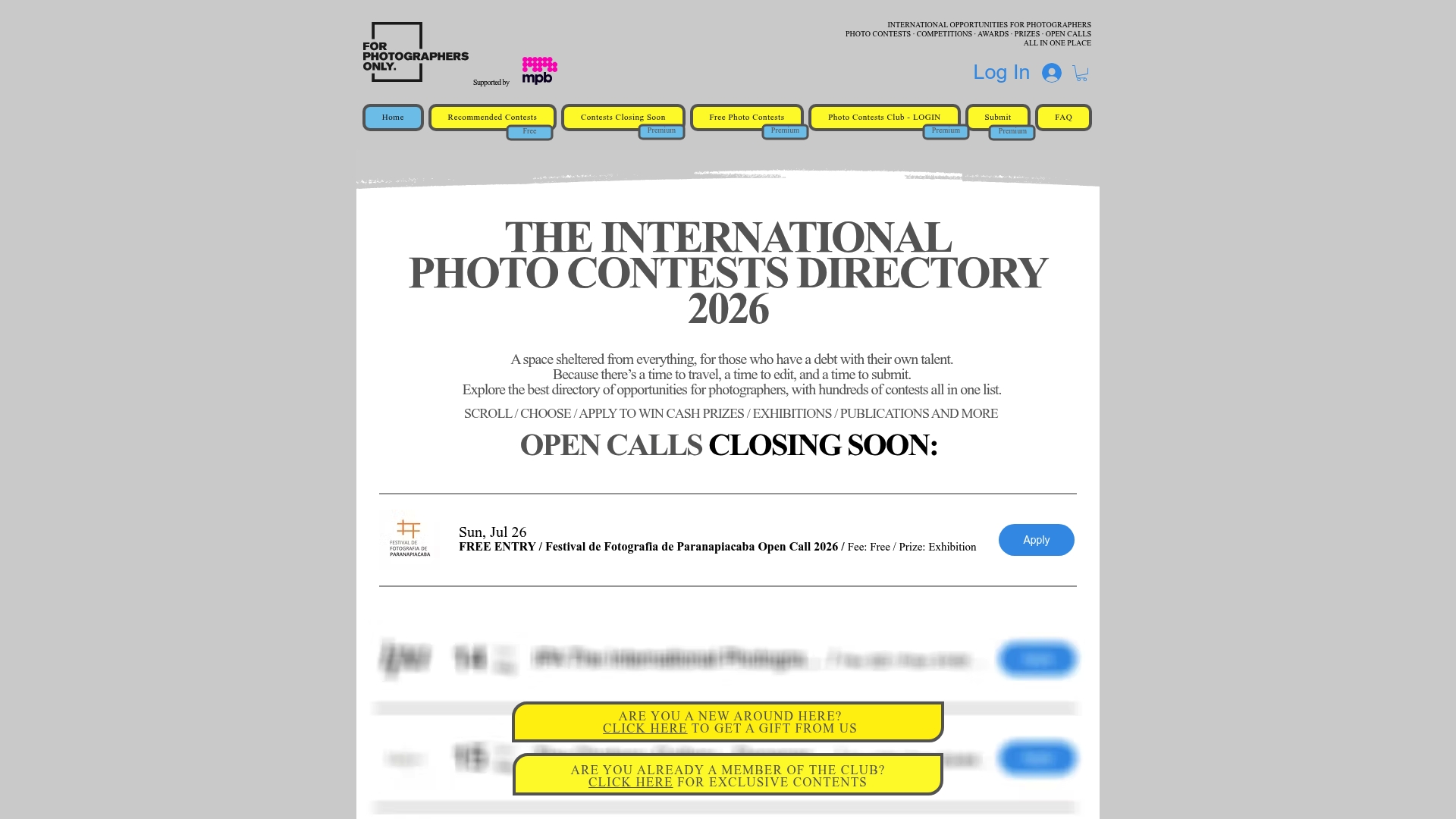
Members also have access to a photographer community and a monthly internal competition, which gives you another place to put work in front of an audience.
Our perspective
Photography thrives when work travels. A strong series deserves to be seen by many editors, curators and juries, and the photographers who build lasting careers are rarely the ones who send a project to a single door and wait. That ambition, however, is only sustainable when it rests on trust. Every publication has its own view of exclusivity, and every contest has its own terms. The photographers we admire most treat those terms as part of their craft: they read before they submit, they keep careful records and they communicate quickly when circumstances change. This is why we built our directory around clarity. When deadlines, fees, prizes and genres sit together in one chronological list, updated weekly, a photographer can spend less time hunting and more time editing, sequencing and choosing the right work for the right audience. Selectivity then becomes a strength rather than a limitation. We believe the international photography calendar is full of meeting points between artists and audiences, and our mission is to make those opportunities easy to discover, accessible and organized in one place. DARIO
FAQ
Is it acceptable to send the same photos to several magazines at once?
Only where each magazine’s guidelines allow it. Some, such as The Wildcat Review, accept simultaneous work and ask you to handle consent where the work has already been used elsewhere. Others, such as Fuzz, prefer exclusive material. Check every title before you send.
Do I have to tell editors the work is under consideration elsewhere?
If the guidelines accept simultaneous submissions, most ask you to say so, usually in a brief cover letter or the form’s comment field. Saw Palm is one example. A single plain sentence is enough, and you list other publications only if asked.
What should I do if one editor accepts and others are still reading?
Contact every other editor the same day and withdraw the work, or the accepted portion of it. Parousia Magazine and Ponder Review both ask to be told right away. Review the acceptance terms first, because an exclusivity period may affect the rest of your submissions.
Does exclusivity apply to online publication as well as print?
Not always. Atlanta Style Weddings and Chicago Style Weddings both require exclusivity for print-oriented wedding and styled-shoot content, while online content does not require it. Policies differ by outlet, so read the editorial page for each one.
How can I avoid sending the same images to the wrong place?
Keep a log of every submission with date, publication, policy type and status, and vary your edit for outlets that want exclusive pictures. A single organized list of opportunities and deadlines makes that planning easier.
Sources
Recommended