Ship Prints to Competitions: Photographers, Pack These Two Items
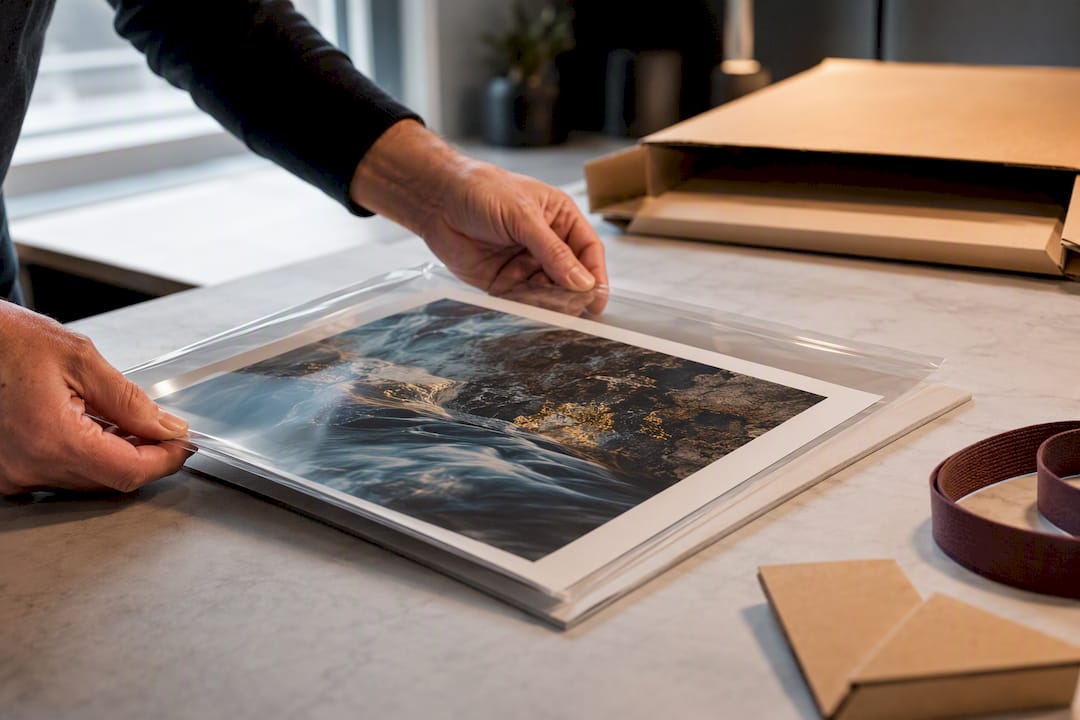
Before you tape a single flap, put two things inside that box: the competition’s shipping form and a prepaid return label. Skip either one and many organizers simply won’t send your print back. Beyond that, protect the work itself with archival sleeves, a rigid backing board, and a reusable art shipper, then insure and track the package so you have proof of condition and location the whole way there.
TL;DR:
Including prepaid return postage and a filled-out competition shipping form inside the package is essential to ensure your print is returned safely and on time.
Packing order should prioritize inserting prints into archival sleeves, labeling the back, mounting on stiff boards, adding corner protectors, and bracing the stack to prevent damage during transit.
Using a sturdy, reusable art shipper is crucial for protecting your prints in both outbound and return shipments, especially for future contest entries.
Declaring an accurate replacement value and insuring high-value or irreplaceable prints is worth the extra cost, with USPS, UPS, and FedEx being common carrier options depending on needs.
Adhering to size, weight, and customs regulations prevents disqualification or delays, with careful preparation of customs forms and early booking ensuring reliable international shipping.
Table of Contents
What to Include Before You Ship Prints to Competitions
Every organizer has its own quirks, but the paperwork and protection expectations are remarkably consistent across the competition circuit. Before you seal anything, confirm you have these items ready to go inside the box.
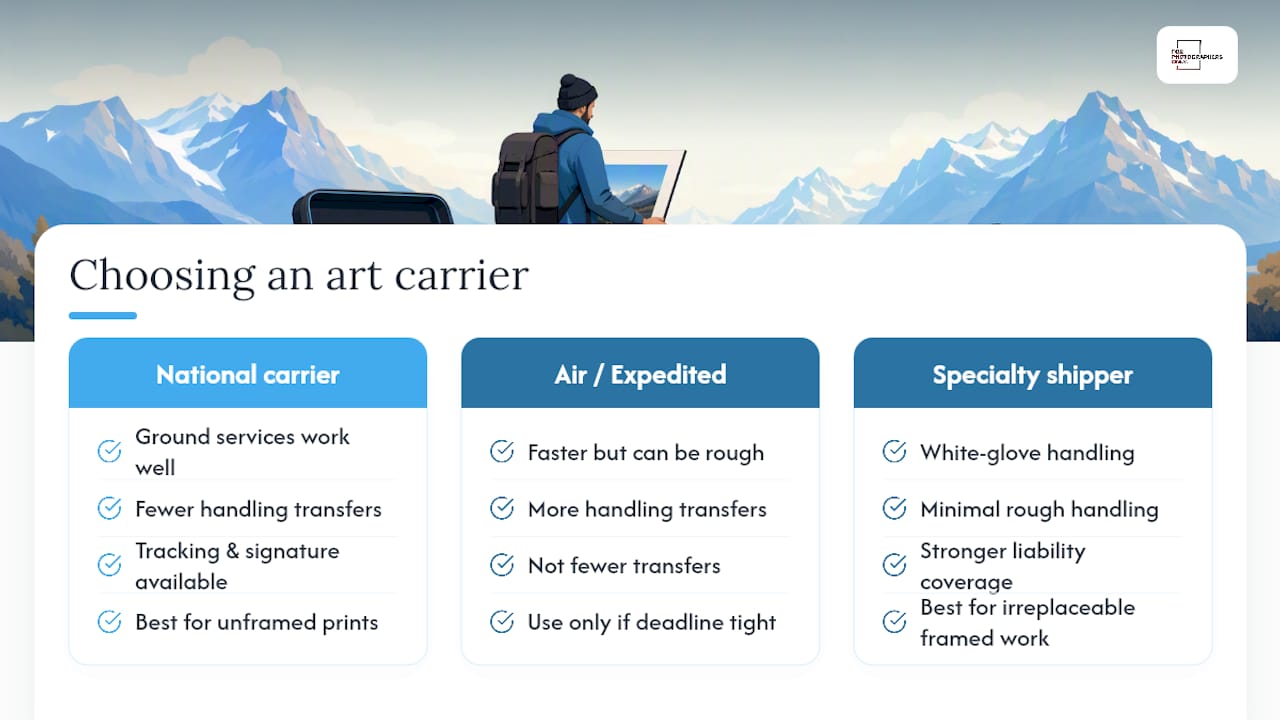
A prepaid return label or return postage, addressed to a real street address (many contests explicitly reject PO boxes for returns).
The competition’s shipping form or entry label, filled out and sealed in an interior envelope so it doesn’t shift loose.
Archival, acid-free sleeves for each print, plus rigid backing board behind every piece.
Tape on exposed edges, rigid spacers between stacked prints, and zero packing peanuts.
A sturdy, reusable outer shipper, a tracking number you’ve saved, and insurance if the print has real replacement value.
Miss the prepaid postage or the shipping form and you’re not just risking a scuffed print. You’re risking the organizer disposing of the piece entirely once judging wraps, because they have no funded way to send it home.
How Do You Pack a Print So It Survives Shipping?
Packing order matters more than most photographers assume. Rushing the sequence is how prints arrive with dented corners or faint pressure marks that weren’t there when they left the studio.
Slide each print into an archival, non-reactive sleeve. Avoid PVC sleeves that can off-gas and discolor paper over weeks in transit.
Label the back of every print with your name, the piece’s title, and an orientation arrow. Judges and handling staff both rely on this, and it prevents mix-ups when multiple entries travel together.
Mount or back each print on stiff board. A floppy print flexes inside a box and that flex is where cracks and creases start.
Add corner protectors and rigid spacers between any stacked prints so surfaces never touch directly.
Brace the stack inside the box with foam board or cut mat board, not loose fill. Shifting inside the container is the most common cause of shipping damage, and packing peanuts do almost nothing to stop it once a box gets tossed around a sorting facility.
Tape exposed edges and use painter’s tape on any glass, since it strips away cleanly and reduces the chance of shattering compared to standard packing tape.
Photograph every print before you close the box. A few clear shots of the surface and edges give you a condition record if you ever need to file a damage claim.
Include a short handling note if the piece has an unusual mounting or a fragile mat, especially for anything larger than a standard-sized frame.
Pro Tip: Skip glue, spray adhesive, or double-sided tape anywhere near the print surface. Residue from adhesives is nearly impossible to remove from photo paper and can void your entry if judges spot it during handling.
Standard mounting sizes and consistent backing also make handling easier for the venue staff processing hundreds of entries in a short window, a detail exhibition prep guides point to as a small courtesy that speeds things along.
Which Box Should You Use and How Do You Label It?
A reusable art shipper beats a generic cardboard box for one simple reason: it survives the round trip. Competitions that return work in the same container specifically ask for sturdy, reusable cartons, because a box that arrives crushed on delivery has no chance of protecting the print on the way home.
Choose a rigid, reusable art shipper rather than a flimsy retail box, especially if you plan to enter the same competition again next year.
Tuck the shipping form and prepaid return label inside a labeled interior envelope, visible enough that staff find it immediately but protected from moisture and creasing.
Address the outer box clearly: department name if the entry form specifies one (often something like “Attn: Creative Arts Entries”), full street address, orientation arrows, and a visible “fragile, do not stack” marking.
Design the whole package so the organizer can reuse it for the return shipment. That usually means avoiding excessive tape on the main flaps and leaving the interior envelope easy to remove and repack.
Some competitions go further and offer specific return options, like requesting their own approved shipping box back for a small fee if you didn’t supply your own reusable one, an arrangement Icon Awards uses for its print competition. Read your entry form closely to see whether a similar option applies before you assume any box will do.
What Paperwork Do You Need to Get Your Print Back?
Organizers aren’t being difficult when they demand a shipping form and prepaid postage. They’re processing hundreds or thousands of entries with no budget line for return freight, and the paperwork is how they route your print home instead of into a storage closet.
Fill out the competition’s shipping form completely and place it inside the box, not taped to the outside where it can tear off in transit.
Prepay the return postage using a carrier label, your shipping account number, or a prepaid courier waybill, exactly as the entry instructions specify.
Double-check the return address is a street address. The New York State Fair explicitly disallows PO boxes for returns, and several other fairs follow the same rule.
Email or call the organizer once your package ships, noting the tracking number and expected arrival date, so there’s no confusion if the box gets delayed.
Skipping prepaid return postage is one of the most common reasons prints never make it home. Both New York State Fair and California State Fair instructions state plainly that entries without prepaid postage risk not being returned at all.
Should You Insure Your Print, and Which Carrier Fits?
Insurance is worth the extra few dollars any time the print represents real, hard-to-recreate work, a fine-art edition print, a large-format piece, or anything mounted and framed at cost. Declared value should reflect what it would actually cost you to reproduce and remount the piece, not just the paper and ink.
Insure any print you couldn’t easily or affordably recreate, and keep your production receipts as documentation of replacement value.
USPS tends to be the most economical option for standard-size prints but comes with lower default liability limits and slower claims handling.
UPS and FedEx generally offer stronger tracking granularity and more straightforward claims processes, which matters if a box goes missing during a tight competition window.
Specialty art shippers exist for high-value framed or large-format pieces, though they typically cost more than standard parcel carriers.
Always require a signature on delivery for anything insured, and hold onto your tracking number and pre-shipment photos in case you need to file a claim.
Shipping costs and insurance premiums scale with declared value, size, and distance, so get a quote before you assume a number. A single 16x20 print shipped domestically costs far less to insure than a framed 30x40 piece heading cross-country.
How Much Should You Budget and When Should You Ship?
There’s no flat rate for shipping a competition print because cost depends entirely on size, weight, distance, and how much insurance you add on top. A small unframed print going a few states over might run you the price of a coffee. A large framed piece heading coast to coast with full insurance can run considerably more.
Get quotes from multiple carriers early, since prices and delivery speeds can vary significantly.
Ship with a two to three business day buffer before the competition’s receiving deadline, since art fairs and juried shows often have narrow receiving windows measured in days, not weeks.
Confirm the organizer’s arrival procedures. Some require entries by a specific date regardless of when they were shipped, which means a delayed carrier is entirely your risk.
Cut cost by reusing a quality art shipper across multiple entries, consolidating several prints into one box when a competition allows it, and choosing insured ground service whenever your timeline has room.
Researching shipping options weeks ahead, rather than the week of the deadline, is what separates a smooth submission from a panicked overnight shipping bill.
What Do Real Organizer Shipping Forms Actually Require?
Reading one or two official shipping forms closely teaches you more about competition-ready packing than any general checklist, because these documents spell out exactly what handling staff expect to see when they open your box.
Entries must be packed in sturdy, reusable cartons. Prepaid return postage and a completed shipping form must be included with the shipment. Packing peanuts are not permitted, and returns cannot be sent to a PO Box.
That’s the substance of the New York State Fair’s Creative Arts Center shipping guidance, and it lines up closely with what the California State Fair’s Arts Competitions shipping form asks for: prepaid postage, a completed form enclosed with the entry, and a reusable container the fair can use for the return trip.
Treat these two forms as a template. When you enter a new competition, check for the same four things: a defined receiving window, a required label or form format, a prepaid-return requirement, and any restriction on packing materials like glass or loose fill. If a contest’s instructions are vague on any of these points, email or call the organizer before you ship. A five-minute phone call is far cheaper than a print that never comes home.
How Do You Choose a Carrier for Art Shipments Specifically?
Reliability matters more than raw speed when you’re shipping something that can’t be replaced by reordering from a warehouse. A carrier that’s a day slower but handles fragile freight consistently beats one that’s fast but rough with packages.
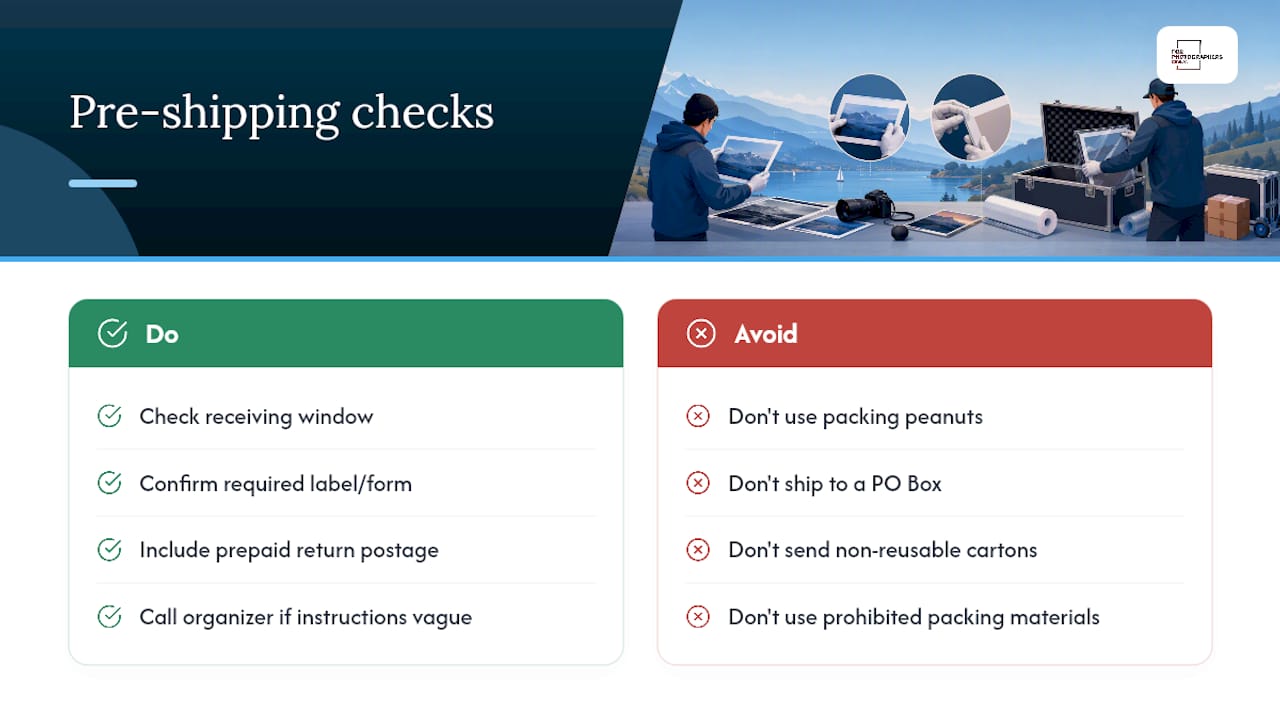
Ground services from major carriers work well for most domestic competition entries, especially when you build in that two to three day buffer mentioned earlier. Air or expedited services make sense only when a deadline is genuinely tight, since faster shipping options generally involve more handling transfers, not fewer, and each transfer is a chance for rough handling.
Check a carrier’s claims process before you need it, not after. Some carriers make filing a damage claim straightforward with photo documentation and a tracking number. Others bury the process in phone trees and paperwork that eats weeks. If you ship prints to competitions more than once or twice a year, it’s worth sticking with whichever carrier’s claims process you’ve found least painful, even if a competitor quotes a dollar or two less.
For genuinely irreplaceable or high-value framed work, a specialty art shipping service often justifies its higher cost through white-glove handling and stronger liability coverage than a standard parcel carrier offers. For a straightforward unframed print on standard photo paper, a well-known national carrier with tracking and signature confirmation is usually enough.
How Do Size and Weight Restrictions Affect Your Packing Choices?
Competition entry rules almost always cap print dimensions, and some cap total weight for shipped entries too. These limits exist partly for fairness among entrants and partly because juried shows have finite wall and storage space during judging.
Read the size restriction before you print, not after. A print that’s a half inch over a stated maximum can get disqualified regardless of image quality, and reprinting at the correct size under deadline pressure is a cost you can avoid entirely by checking the rules first.
Weight matters for a different reason: heavier framed pieces need sturdier outer boxes and more rigid internal bracing, since a heavy print shifting inside a soft box does more damage on impact than a light one. If a competition allows both matted and framed submissions, matted prints in a rigid backing board are usually lighter, cheaper to ship, and less prone to glass breakage than a fully framed piece, worth considering if the entry rules give you the choice.
When a contest sets separate size categories with different entry fees or judging tracks, double check which category your actual print dimensions land in before you ship. Categories are usually measured by the mounted or framed size, not the image size alone, and that distinction trips up more entrants than you’d expect.
What Customs Paperwork Do International Competitions Require?
Shipping a print across a border adds a layer of documentation that domestic entries never need. Most international competitions require a completed customs declaration form describing the contents, typically listing the item as “artwork, no commercial value” or “photographic print for competition entry” along with a declared value for customs purposes.
Keep that declared value modest but honest. Declaring an inflated value can trigger import duties or taxes the organizer never intended you to pay, while declaring it as worthless can create problems if the print needs to be returned and re-enters your home country. Many international shipping forms also ask whether the item is a temporary import intended for return, which can qualify it for duty exemptions in some countries under carnet or temporary-admission provisions.
Check the specific competition’s country requirements before you ship, since customs rules vary by destination and change without much notice. A form that worked for a submission last year isn’t guaranteed to match this year’s requirements. If you’re new to shipping work abroad, reviewing broader guidance on exhibiting photography internationally before your first cross-border entry can save you a returned or held package.
Always keep a copy of whatever customs form you submit, along with your tracking number, until you’ve confirmed the organizer received the piece intact.
For Photographers Only: The Workflow We Recommend Before Shipping
A clean preflight routine avoids most shipping disasters: finalize your prints, photograph their condition, pack using archival sleeves and a reusable shipper, then register tracking before the box leaves your hands. That sequence, done in order, catches problems while you can still fix them.
Following international competitions and their shipping quirks for years has made one pattern clear: entrants who miss deadlines almost always missed the shipping deadline, not the entry deadline. For photographersonly’s contest rules templates and curated deadline listings exist specifically to close that gap before it costs you a print.
— DARIO
Never Miss a Deadline or Chase Shipping Rules Alone Again
This directory is an alternative to scrolling a dozen competition websites hoping you haven’t missed a receiving window. The directory tracks hundreds of active photography competitions with their deadlines, entry fees, and rules updated regularly, so you can better understand when a print needs to leave your hands, not just when it’s due.
That means less time hunting for shipping instructions buried in PDFs and more time actually printing and packing with confidence. Subscribers get access to a continuously updated page covering a wide range of opportunities worldwide, including free-to-enter contests, so you can plan your shipping calendar around real deadlines instead of guessing. If you’re preparing your next submission, pair your packing checklist with a look at the Robert Giard Grant for Emerging LGBTQ+ Photographers or start a subscription today to keep every upcoming deadline in one place.
Sources
Recommended