San Francisco Photography Contests: Where to Enter in 2026

San Francisco photography contests fall into three groups: free or low-cost calls run by public agencies and parks, juried exhibitions run by galleries and arts groups, and international awards that borrow the city’s name or invite work made there. Most are tied to the Bay itself, so the strongest entries come from photographers who know its light, shoreline and neighborhoods. Below you will find the main contests of 2026, what each one asks for, and a repeatable method for catching the next call before it closes.
TL;DR
Several Bay Area contests are free to enter, including the BCDC contest, which is open to photographers of all residences, but they require images made in the Bay or Suisun Marsh region.
Juried exhibitions and society calls usually charge per image or per entry, so budget before you build a submission.
Many Bay Area contests repeat every year in a similar season, so you can plan your shooting calendar around them.
Always check three things before paying: where the photos must be taken, whether AI-generated images are banned, and which file specifications apply.
Our directory tracks more than 320 international contests, with over 100 free to enter, in one page updated weekly.
Table of Contents
The main San Francisco and Bay Area contests this year
The table below summarizes the contests we found with the clearest published terms. Deadlines change from one cycle to the next, so use the official page for the current schedule.
Contest | Who can enter | Location requirement | Cost | What winners get |
BCDC Photography Contest | All ages and residences | Photos taken in the San Francisco Bay or Suisun Marsh region | Free | Gift cards and experience prizes |
APA San Francisco, Something Personal | Photographers submitting personal work | None stated | Per image, by membership tier | Top 100 print exhibition and industry event |
The Image Flow, Bay Area Photography Open | Photographers based in nine Bay Area counties | Residence in the region | $40 registration for up to three images | Juried exhibition |
Midpen Annual Photo Contest | Public | Photos taken on Midpen preserves open to the public | Free | Gift card and swag bag per category |
Bay Perspectives (West End Arts District) | Hobbyists and professionals | Bay Area or immediate Northern California coastline | Per image | Printed display and video installation |
Each of these has its own character, so the sections below go through them one at a time.
Free contests run by Bay institutions
BCDC Photography Contest
The San Francisco Bay Conservation and Development Commission runs one of the most accessible contests in the region. According to the commission’s contest page, it is open to photographers of all ages and residences, which means photographers in Europe can enter as well, provided the pictures were made in the San Francisco Bay or Suisun Marsh region.
There are five categories: Bay and wetland flora, Bay and wetland fauna, Our public shoreline, Scenes of the Bay, and Young photographers. The last one is limited to K-12 students. You may submit up to five photographs in any combination of categories, but each participant can receive only one award.
The prizes are local and experiential rather than cash: climbing-class vouchers, a $99 Dogpatch Paddle & Kayak gift card, Fine Arts Museums of San Francisco admission passes, an East Bay Vivarium package, a $25 Sports Basement gift card and a $100 Hog Island Oyster Company gift card. The page lists submission dates for this cycle, so read it directly before you upload.
The rules matter here. The work must be original and exclusively owned by the photographer, artificial intelligence is strictly prohibited, and entrants are asked to respect wildlife while shooting. The full terms also cover image-use and licensing, so read them before you submit.
Midpen Annual Photo Contest
The Midpeninsula Regional Open Space District invites the public to enter photographs made on its preserves. The 2026 contest ran from April 1 to July 31, with each participant allowed three images, each placed in a single category. Photos entered in earlier Midpen contests are not allowed. Category winners received a $100 REI gift card and a swag bag, and this year’s edition added a People’s Choice Award decided by public vote on social media.
The spring-to-summer window is the useful pattern: if you want to enter next year, shoot the preserves in the winter and spring and keep your best frames ready for April.

Juried exhibitions and society calls
APA San Francisco, Something Personal
The San Francisco chapter of the American Photographic Artists runs a call for personal work, the kind of series that rarely gets commissioned. The call lists a November 20, 2026 deadline, with the Top 100 photographs shown in a print exhibition and industry event in January 2027. If that date has passed when you read this, treat it as a preview of next year’s cycle, which is likely to follow a similar autumn pattern.
Fees are charged per image and depend on membership: $10 for APA Student members, $15 for ProPlus or Professional members, $25 for Emerging or Supporter members, $30 for Contributor or Educator members, and $35 for non-members. Entrants may submit unlimited images in batches of 10 or fewer.
The file rules are precise. The submission guidelines ask for JPEG files up to 2 MB, 1,800 to 2,400 pixels on the relevant sides, sRGB color, 72 ppi, and the entrant’s full name and image title in the filename. Each fee covers one image. Preparing a correct export preset once saves you from rejected uploads later.

The Image Flow, Bay Area Photography Open
This is an open-theme juried exhibition for photographers based in the nine Bay Area counties: Alameda, Contra Costa, Marin, Napa, San Francisco, San Mateo, Santa Clara, Solano and Sonoma. The call welcomed every photographic style, discipline and subject, including media explorations that use a photographic element, but not AI-generated images. Entrants could submit up to three images for a non-refundable $40 registration fee.
The 2026 call has closed, and the exhibition itself runs into the new year. For photographers who live in the region, it is a model of what to watch for: a residency-restricted call has a smaller pool, which can improve your odds.
Bay Perspectives
West End Arts District’s call, Edge of the Pacific: Bay Perspectives, accepted hobbyists and professionals alike. Images had to be made in the San Francisco Bay Area or on the immediate Northern California coastline, and AI-generated images were excluded. The suggested themes were broad and evocative: tidal marshes, salt ponds, Pacific Flyway wildlife, marine-layer light, architecture, maritime industry, Oakland’s port, Alameda naval history, fishing and tourism.
That list is a useful brief even outside this contest. It shows how organizers think about the region: not only postcard views of the bridges, but working waterfronts, weather and ecology.
Themed regional calls
Some calls are built around a single idea. Looking Glass in Berkeley asked photographers to interpret a rose as a flower, color, symbol, place, memory or renewal, with categories such as Botanical Rose, Rose as Color and On Rose Street. One entry covered up to three photographs, and the organizer used a sliding-scale fee that did not influence judging, selection or awards. Selected work was planned for an exhibition at Abrams Claghorn Gallery in Berkeley.
PhotoAlliance, the San Francisco nonprofit, has used a different format. Its Slide Slam call asked for a 10-image series to be presented live in San Francisco, with up to 20 photographers selected. It rewards sequencing and storytelling more than a single strong frame.
International awards connected to the city
The city’s name also appears in international awards. The San Francisco Bay International Photography Awards, organized with ACCI Gallery, offered $3,000 in prizes in the edition we could verify. Gallery Award winners were exhibited at the gallery, Gold and Silver winners were featured online and in an electronic display, and Portfolio Award winners received solo features on Bokeh Bokeh Photo. The theme was open, and entry was worldwide.
Street photographers have their own San Francisco option. StreetFoto San Francisco is an international street photography awards contest, and its contests page describes an open call for single images and series made on any camera or mobile device, digital or film, in which each photo must stand alone as a work of art. If street work is your focus, our listings also track related calls such as the Leica Street Photography Contest and the Street Photographers Foundation annual awards.
How to choose which contest to enter
A strong entry strategy starts with fit, not volume. Ask these questions in order.
Where was the work made? Most Bay Area contests restrict location. A portfolio shot in Lisbon cannot go to BCDC, but a Bay Area series can go to several contests at once, if the terms allow simultaneous entry.
Who is eligible? Some calls are limited to residents of specific counties, others to members of an organization, others open worldwide.
What does it cost per image? A free contest with five slots is very different from a $35-per-image call. Decide your maximum spend per season before you start.
What do you win? Cash, gallery exhibition, print publication and a local gift card are four different outcomes. An exhibition in a respected space can matter more to a portfolio than a small cash prize.
What rights do you grant? Read the image-use and licensing section of the terms. Organizers such as public agencies often want to reuse winning work in their publications.
Match the contest to the image
The BCDC categories reward environmental storytelling: marsh grasses, shorebirds, people using the public shoreline. A personal documentary series fits the APA call better. A single graphic frame of fog and architecture could suit an open-theme exhibition. Entering the right picture in the right contest is worth more than entering everything everywhere.
Preparing a submission that gets noticed
Edit hard. If a contest allows five images, send five that work together, not five favorites from different days.
Prepare files once. Create an export preset that meets the strictest spec you expect, such as the APA’s 2 MB JPEG in sRGB, and reuse it with adjusted pixel dimensions.
Name files correctly. A filename with your full name and image title is a common requirement and an easy one to forget.
Keep your originals. Contests that ban AI-generated images expect original capture files to be available on request.
Write short captions. Say where and when the image was made, in one plain sentence.
Respect the subject. At the Bay’s wetlands, keep your distance from wildlife. Organizers say plainly that it matters.
Why dates are hard to track
In the pages above, you may have noticed that one organizer lists a submission date in October and a close date in November on the same page, and that other calls closed months ago. This is normal. Calls open, extend and close on their own schedule, and many are announced only a few weeks ahead through newsletters. The pattern is more reliable than the date: the Midpen contest runs in spring and summer, APA’s personal-work call has landed in autumn, and regional gallery opens often run in early summer. Build a calendar from patterns, then confirm on the official page.
We do not run contests. We research, curate and publish the best international photography competitions in one chronological page, and that independence is what makes the list useful: every entry is there because it offers photographers something real, whether that is a cash prize, a gallery wall, a magazine feature or simply editorial visibility with curators who are looking for new work. The photographers who build the strongest records are rarely the luckiest. They treat contests as meeting points in the contemporary art calendar, plan a season in advance, and enter fewer, better-matched calls. A regional contest like those around San Francisco is an ideal place to begin, because a focused local body of work can serve several calls at once. We update the directory every week precisely because opportunities move quickly. A call that is visible for three weeks and then gone is easy to miss without a system, and saving that research time is what we are here for. DARIO
What we have learned about contest hunting
One page for the contests beyond the Bay
Once you have your Bay Area submissions in order, the next step is the wider world. Our directory, PhotoContestsClub, gathers more than 320 active international photography contests, awards, calls, prizes and grants on a single, chronologically organized page, with over 100 free to enter. Each listing shows details such as deadlines, fees, prizes and genres, and the page is refreshed weekly. Listings include contests from well-known brands and institutions, as well as niche contests and independent festivals that often get overlooked.
Membership costs €6 per month or €40 per year, and a free trial is available. You can see the contest directory or compare the options on the plans and pricing page.
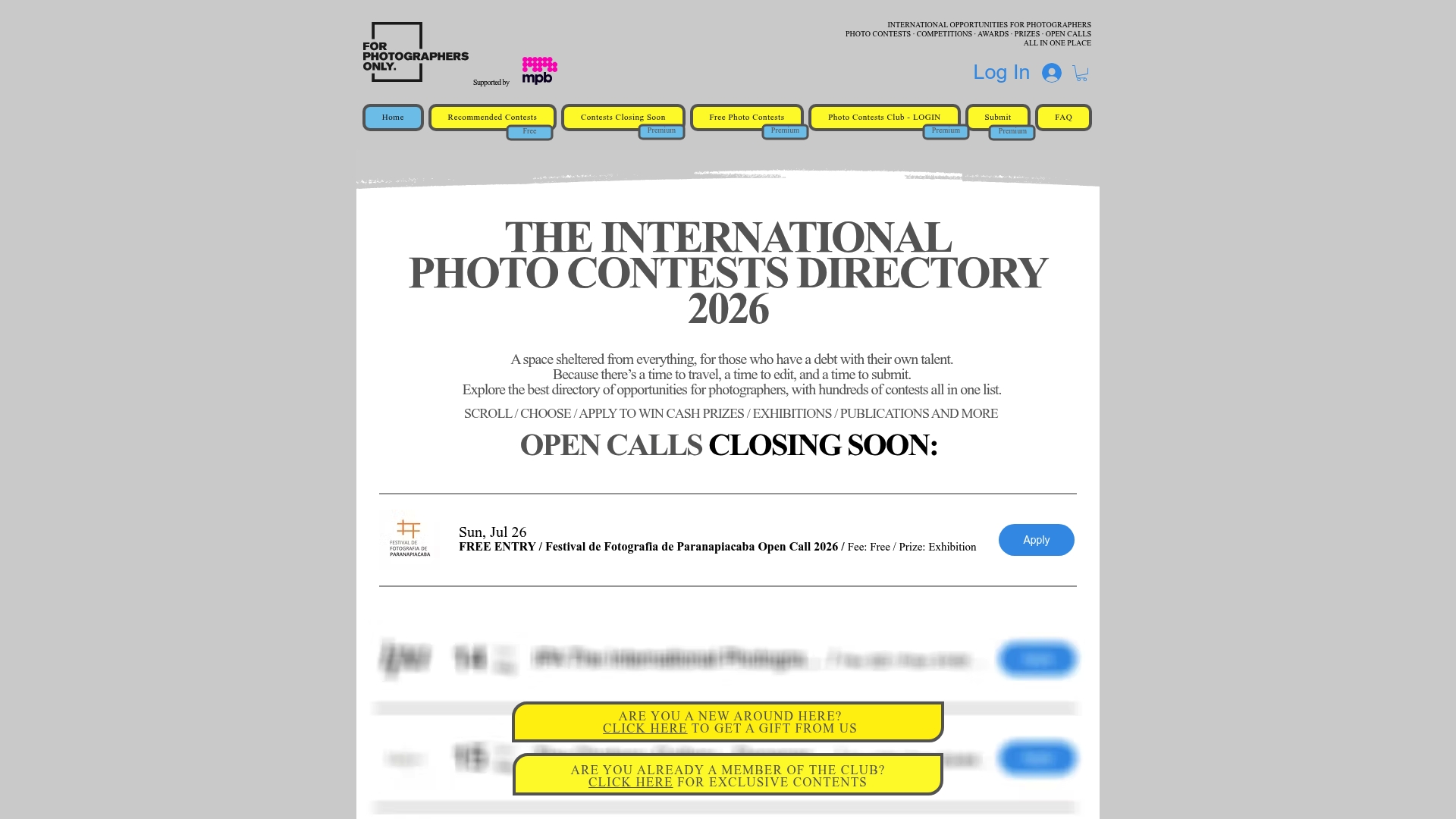
Members also join a photographer community and a monthly internal competition, which gives you a low-pressure place to test new work before sending it to juried calls.
Beyond the Bay: calls worth a look
Photographers who build a regional body of work often want to take it further. Juried exhibitions from regional art centers, such as the Photographic Center Northwest juried exhibition open call, suit single images and small series. Grants reward sustained projects: the Sonntag Grant for Photography is one example of a call that backs long-term work rather than a single frame. For European photographers, an emerging-artist call such as Paris Photo’s call for emerging photographers connects naturally to a Bay Area series shot on a visit.
A simple yearly plan
Winter: shoot for spring contests, especially nature and open-space work. Edit last year’s archive for autumn calls.
Spring: enter the park and preserve contests, which tend to open in April.
Summer: submit to open-theme juried exhibitions, which often close in early summer.
Autumn: prepare personal-work series for society calls and review terms for any shoreline contests.
Always: keep a log of what you entered, where, at what fee, and what rights you granted.
This plan keeps your spending predictable and your portfolio coherent. It also keeps you from rushing a submission on the last night, which is when file errors and missed rules are most likely.
FAQ
Are there free photography contests in San Francisco?
Yes. The BCDC contest and the Midpen annual contest are both free, and they are run by public agencies. Each asks for photos taken in a specific area, so check the location rule on the official page before you enter.
Can photographers outside the United States enter?
Some can. The BCDC contest is open to photographers of all ages and residences, as long as the photos were taken in the San Francisco Bay or Suisun Marsh region. Others, such as the Image Flow open, are limited to photographers based in nine Bay Area counties.
Are AI-generated images allowed?
The contests we reviewed say no. BCDC strictly prohibits artificial intelligence, and both the Image Flow open and Bay Perspectives excluded AI-generated images. Submit only original captures you can document.
How many photos can I submit?
It depends on the contest. BCDC allows up to five photographs in total, Midpen allows three images, the Image Flow open allowed three for one fee, and APA’s Something Personal allows unlimited images in batches of 10 or fewer, with a fee per image.
How do I find out about new contests as they open?
Follow the newsletters of the organizations above and check their pages in the same season each year. For contests worldwide, our weekly-updated directory lists deadlines, fees and prizes in one place, so you do not have to track dozens of sites yourself.
Sources