Best Portrait Photography Competitions to Enter in 2026
The strongest portrait photography competitions to enter right now are the Winston Taylor Photo Portrait Prize (National Portrait Gallery, London), LensCulture Portrait Awards, Sony World Photography Awards, International Photography Awards, and Monochrome Awards. Each offers a distinct career payoff: museum exhibition, editorial reach, cash prizes, or niche recognition.
Here is a prioritized shortlist to act on now:
Winston Taylor Photo Portrait Prize — The most prestigious museum-backed portrait prize in the world; exhibition at the National Portrait Gallery in London and unmatched curatorial credibility for documentary and artistic portraiture.
LensCulture Portrait Awards — Global editorial platform reaching a worldwide audience; winners exhibited at Photo London and promoted across LensCulture’s channels, with a $10,000 cash prize.
Sony World Photography Awards — Free to enter in select categories; major sponsor-backed prize with significant cash awards and a high-profile London exhibition.
International Photography Awards (IPA) — The global reference for commercial, editorial, and fine-art portrait categories; broad category structure suits a wide range of portrait styles.
Monochrome Awards — The primary international showcase for black-and-white portraiture; ideal for concept-driven and fine-art B&W projects.
Fine Art Photo Awards (FAPA) — Focused on conceptual and creative portraiture; strong art-world exposure through exhibitions and publications.
PX3 — Prix de la Photographie, Paris — Prestigious European competition with Paris exhibition and printed art-book outcomes.
All About Photo Portrait Contest (AAP Magazine) — Publication-focused; selected work appears in a dedicated photography magazine with ongoing editorial visibility.
PortraitPhotoAwards — Frequent rounds that build photographer ranking and visibility through repeated shortlists.
Life Framer Photography Award (Humans/Portrait themes) — Monthly themed calls judged by industry leaders; excellent for building ongoing visibility quickly.
World Photographic Cup — Team-based national format, the “Olympics” of photography categories including portrait; unique exposure model through national representation.
Forphotographersonly directory — Not a competition itself, but the fastest way to track all active portrait calls, deadlines, and free-entry opportunities in one continuously updated place.
Table of Contents
Which portrait photography competitions should you enter this season?
The table below covers the core comparison dimensions for each competition. Always verify current deadlines and fees on official pages, as they update each season.
Competition | Entry Fee | Eligibility | What to Submit | Prizes | Rights | Exposure |
Winston Taylor Photo Portrait Prize | Varies (check NPG rules) | Open internationally; age/residency restrictions apply | Single images or series; check downloadable rules | Exhibition at National Portrait Gallery, London | Nonexclusive promotional use | Museum exhibition, press coverage |
LensCulture Portrait Awards | Paid (tiered by entries) | Open worldwide | Single image or series | Up to $10,000 in cash prizes; Photo London exhibition | Nonexclusive promotional use | Online gallery, Photo London, editorial features |
Sony World Photography Awards | Free (select categories) | Open worldwide | Single image or series | Significant cash prizes; London exhibition | Nonexclusive promotional use | London exhibition, global media coverage |
International Photography Awards (IPA) | Paid (per image/category) | Open worldwide; pro/amateur/student tiers | Single image or series | Cash prizes; Lucie Award recognition | Nonexclusive promotional use | Online gallery, industry press, Lucie Foundation |
Monochrome Awards | Paid (per image) | Open worldwide | Single image or series | Cash prizes; publication | Nonexclusive promotional use | Online gallery, publication, exhibition |
Fine Art Photo Awards (FAPA) | Paid (per image) | Open worldwide | Single image or series | Exhibition, publication | Nonexclusive promotional use | Art-world exhibition, book/publication |
PX3 — Prix de la Photographie, Paris | Paid (per image) | Open worldwide | Single image or series | Paris exhibition, art book | Nonexclusive promotional use | Paris exhibition, printed book |
All About Photo — Portrait Contest | Paid (per entry) | Open worldwide | Single image or series | AAP Magazine publication, winners gallery | Nonexclusive promotional use | Magazine publication, online gallery |
PortraitPhotoAwards | Paid (per round) | Open worldwide | Single image | Ranking, editorial exposure | Nonexclusive promotional use | Online gallery, editorial features |
Life Framer (Humans/Portrait) | Paid (per entry) | Open worldwide | Single image or series | Cash, editorial exposure | Nonexclusive promotional use | Online gallery, industry juror attention |
World Photographic Cup | Via national federation | National team qualification required | Single image (national selection) | Team trophy, national recognition | Nonexclusive promotional use | International exhibition, national press |
British Photography Awards — Portrait | Paid (per entry) | UK-focused; check current rules | Single image or series | Exhibition, press coverage | Nonexclusive promotional use | UK press, national exhibition |
Submission notes by competition:
Winston Taylor Photo Portrait Prize
Download the official rules PDF from the National Portrait Gallery page before preparing files; the 2026 call closed April 21, 2026.
Strict file specifications are listed in the downloadable guide; ignoring them leads to disqualification before human review.
Model releases are required for identifiable subjects; prepare these well in advance.
The prize carries the highest curatorial reputation of any portrait award in the UK.
LensCulture Portrait Awards
Now in its 12th year; past winners have been featured in leading magazines, museums, and galleries.
Early submissions often receive extended editorial exposure across LensCulture’s channels.
Series entries benefit from the platform’s editorial storytelling emphasis.
Check the LensCulture Portrait Awards page for current open/close dates and tiered fee structure.
Sony World Photography Awards
Free entry in select categories makes this one of the highest-value opportunities for emerging photographers.
Prize money and exhibition presence in London offer significant career visibility.
Confirm which categories are free versus paid on the official Sony World Photography Awards site each season.
International Photography Awards (IPA)
Covers editorial, commercial, and fine-art portrait categories; choose the category that best matches your project.
The IPA is affiliated with the Lucie Foundation and carries strong industry recognition across commercial and fine-art circuits.
Per-image fees add up quickly for series entries; plan your budget before selecting images.
Monochrome Awards
The primary international showcase for B&W portraiture; concept-driven projects perform strongly here.
Submit your strongest single image or a tightly edited series; inconsistent tonal treatment across a series is a common shortlist killer.
Check the Photo Place Gallery monochrome call on Forphotographersonly for related B&W opportunities.
Fine Art Photo Awards (FAPA)
Conceptual and creative portrait projects are the core focus; documentary realism is less competitive here.
Exhibition and book publication outcomes connect winners with art-world curators and collectors.
PX3 — Prix de la Photographie, Paris
Paris exhibition and printed art-book outcomes make this the strongest European prize for photographers seeking tangible publication credentials.
Entry fees are per image; a focused single image often outperforms a diluted series here.
All About Photo — Portrait Contest (AAP Magazine)
Publication in AAP Magazine is the primary outcome; the editorial team curates winners for ongoing features.
100% portrait-focused; contemporary approaches across all portrait genres are accepted.
PortraitPhotoAwards
Frequent rounds allow photographers to build a ranking over time; entering multiple rounds in a season compounds visibility.
Shortlisted work receives editorial promotion across the platform’s channels.
Life Framer Photography Award (Humans/Portrait themes)
Monthly themed calls mean there is almost always an open round; check current themes before submitting.
Jurors are industry leaders; shortlists carry real curatorial weight for portfolio building.
World Photographic Cup
Entry is through your national photographic federation, not directly; contact your national body to qualify.
The team format offers a unique exposure model distinct from individual prizes.
British Photography Awards — Portrait Category
Strong UK press coverage and national exhibition make this the best option for photographers targeting the British market specifically.
How to prepare a competitive portrait submission
Strong curation is the single most important move before you submit. Entering fewer, stronger images consistently outperforms bulk submissions because jurors form an impression of your vision within seconds. A series of five cohesive images reads as a deliberate artistic statement; ten loosely related images read as indecision.
Step-by-step submission checklist:
Curate ruthlessly. Select images that share a consistent visual language: tonal range, emotional register, or conceptual thread. Remove any image that weakens the sequence, even if it is technically strong on its own.
Edit to a consistent standard. Apply uniform color grading or tonal treatment across a series. Inconsistent retouching is one of the most common reasons series entries fail to shortlist.
Sequence deliberately. For series entries, open with your strongest image and close with your second strongest. Place transitional images in the middle. Jurors read a series like a sentence.
Write a concise artist statement. Aim for 100–150 words. State your subject, your intent, and what makes this body of work distinct. Avoid biographical information unless the competition specifically requests it.
Write precise captions. Each image caption should answer: who, where, and why this moment matters. Captions that add narrative context strengthen a juror’s engagement with the image.
Prepare model releases before the deadline. Competitions like the Winston Taylor Photo Portrait Prize require releases for identifiable subjects. A missing release disqualifies an otherwise strong entry.
Confirm file specifications. Check the official rules for: file type (JPEG is standard), resolution (typically 300 dpi for print-ready, 72 dpi for web-only calls), color space (sRGB for most digital submissions, Adobe RGB for print-focused prizes), maximum file size, and filename conventions.
File spec checklist before upload:
File type: JPEG (check if TIFF is accepted for fine-art prizes)
Color space: sRGB unless the rules specify Adobe RGB
Resolution: confirm whether the competition requires 300 dpi or accepts 72 dpi
Maximum file size: typically 10–20 MB per image; check per-competition rules
Filename: use the format specified in the rules (often: LastName_FirstName_Title_01.jpg)
Metadata: embed your name, copyright notice, and contact information in EXIF/IPTC fields
Pro Tip: Prepare a model-release template document before the submission season begins. A simple, signed release covering nonexclusive use for competition and promotional purposes covers most scenarios. For images involving minors, obtain a parent or guardian signature and keep the original on file.

What do entry fees and licensing terms actually mean for you?
Entry fees across portrait photo competitions range from free to roughly $50–$100 per image for premium prizes, with most reputable competitions sitting in the $15–$35 range for a single image. Sony World Photography Awards offers free entry in select categories, making it one of the highest-value free opportunities in the annual calendar. Some competitions use sliding-scale pricing: the first image costs more, and additional images in the same submission are discounted.
Fee structure overview:
Free entry: — Sony World Photography Awards (select categories), some Life Framer themed rounds, and sponsored grants (such as Nikon-backed calls)
Licensing terms deserve as much attention as the entry fee. Most reputable competitions request a nonexclusive, royalty-free license for promotional use: the right to display your image in their gallery, press materials, and social channels for the duration of the competition and its promotional cycle. That is standard and acceptable.
Red flags to watch for:
Pro Tip: Before paying any entry fee, navigate to the Terms and Conditions page and search for the words “exclusive,” “perpetual,” “commercial,” and “sublicense.” If any of those terms appear in the rights grant, read the full clause carefully. Legitimate competitions use nonexclusive, time-limited promotional rights. You retain copyright in all cases; what varies is the scope of use you grant.
For free-entry opportunities that carry real exhibition value, Forphotographersonly’s directory surfaces more than 100 free-to-enter calls alongside paid competitions, so you can balance cost against exposure at every career stage.
How to choose which portrait contests match your goals
The one-sentence rule: match the prize and exposure type to the specific career outcome you need right now, not the competition with the most impressive name.
A photographer building a museum exhibition record has different needs than one seeking editorial commissions or art-world gallery placement. Entering every competition indiscriminately wastes both entry fees and the creative energy required to prepare a strong submission.
Decision checklist for each competition you consider:
Tiered recommendations by goal:
Prestige and museum exhibition: — Winston Taylor Photo Portrait Prize, LensCulture Portrait Awards. Both carry curatorial weight that translates directly into gallery and museum credibility.
Single image vs. series: which fits your project?
A single, definitive portrait works best for competitions that emphasize the decisive moment: Taylor Wessing, PX3, and most IPA categories reward images that carry complete narrative weight on their own. Series entries suit LensCulture, FAPA, and Life Framer, where jurors are explicitly evaluating the coherence and development of a visual idea across multiple frames. When in doubt, check whether the competition’s past winners are predominantly single images or series; the winners gallery is the clearest signal of what the jury actually rewards.
What happens after you submit?
Most portrait photo competitions take 4–12 weeks to shortlist entries and 3–6 months to announce major winners. Annual prizes like the Winston Taylor Photo Portrait Prize and IPA follow a longer cycle; high-frequency competitions like PortraitPhotoAwards and Life Framer announce results within weeks of each round closing.
Typical competition timeline:
Submission confirmation — Immediate automated email; save this as proof of entry.
Editor/panel screening — 2–6 weeks after close; entries are reviewed for technical compliance and initial quality filtering.
Shortlist announcement — 4–12 weeks after close; shortlisted photographers are notified directly and listed publicly.
Finalists and winner announcement — 3–6 months after close for major annual prizes; faster for frequent-round competitions.
Exhibition setup and opening — Varies by venue; physical exhibitions typically open 1–3 months after winners are announced.
Prize payment and rights paperwork — Cash prizes are typically paid within 30–60 days of the winner announcement; rights agreements are signed at this stage.
Post-submission checklist:
Archive your entry files (full-resolution originals, submission-ready exports, and the exact filenames submitted) in a dedicated folder.
Prepare a short press kit: a 200-word project description, three to five high-resolution images, and your biography.
Schedule social promotion for the shortlist and winner announcement dates once they are published.
Track gallery and exhibition dates; physical exhibitions often run for 4–8 weeks and represent a networking opportunity.
Follow up on any verbal offers of editorial features or gallery placement within two weeks of the announcement.
Early submission carries a tactical advantage worth noting. Competitions that feature entries in rolling online galleries, like LensCulture, give early entrants extended editorial exposure before the submission window closes. Submitting in the first third of an open call period often means more time in the gallery and more curator attention before the volume of late entries compresses visibility.
For tracking multiple competition timelines simultaneously, a simple spreadsheet with columns for competition name, submission date, shortlist date, and results date keeps the process manageable across a full season of entries.
What jurors actually look for in portrait entries
Jurors prioritize storytelling and original vision over flawless technicality. A technically perfect image with no distinct point of view rarely advances past the first screening round. An image with a clear conceptual intention, emotional depth, and a perspective the juror has not seen before will shortlist even if the technical execution is imperfect.
LensCulture’s editors and jurors have consistently stated that they reward work that challenges traditional portraiture, whether through conceptual staging, intimate documentary approaches, or formal experimentation. The LensCulture Portrait Awards 2025 winners reflect this: selected work spans intimate environmental portraits, conceptual studio work, and documentary series, but all share a clarity of intent.
Juror dos and don’ts:
Do: Lead with a strong concept. Know what your portrait is about before you submit it.
Do: Show emotional depth. Jurors respond to images where the relationship between photographer and subject is palpable.
Do: Maintain consistency across a series. Every image should feel like it belongs to the same visual world.
Do: Write a clear, specific caption or statement. Ambiguity reads as uncertainty, not mystery.
Don’t: Over-process. Heavy retouching, excessive skin smoothing, and aggressive HDR are shortlist killers in fine-art and documentary categories.
Don’t: Submit inconsistently edited series. Tonal or stylistic jumps between images signal a lack of editorial control.
Don’t: Neglect sequencing. A strong image in the wrong position weakens the entire series.
Don’t: Submit without a model release when one is required. A missing release disqualifies the entry before a juror sees it.
Submission presentation checklist:
Filename: follow the exact convention in the rules (typically LastName_Title_Number)
Metadata: embed copyright, contact email, and project title in IPTC fields
Image order: number series images in the sequence you intend jurors to view them
Statement: attach as a separate document in the format specified (PDF or plain text)
How we built this shortlist
This shortlist prioritizes competitions with clear published rules, consistent exhibition partners, named jurors, and verifiable past winners. Fee transparency and the presence of a downloadable submission guide were additional positive signals; competitions that obscure their terms or lack a public winners archive were excluded.
Selection criteria:
Reputation and longevity: — Competitions with a multi-year track record and recognized institutional partners (National Portrait Gallery, Photo London, Lucie Foundation) were weighted most heavily.
Trust signals used in verification:
National Portrait Gallery exhibition confirmation for the Winston Taylor Photo Portrait Prize
Photo London partnership for LensCulture Portrait Awards
Trust signal | Competitions verified |
Museum exhibition partner | Winston Taylor Photo Portrait Prize (National Portrait Gallery) |
Major photo fair partner | LensCulture (Photo London / Discoveries) |
Named cash prize | LensCulture ($10,000), Sony World Photography Awards |
Downloadable submission rules | Winston Taylor Photo Portrait Prize |
Named institutional affiliation | IPA (Lucie Foundation) |
Public winners gallery | LensCulture, IPA, Monochrome Awards, PX3 |
Limitation note: Entry fees, deadlines, and rights terms change each season. Every figure in this article reflects publicly available information at the time of writing. Always confirm current details on the official competition page before submitting or paying.
Key Takeaways
Entering the right portrait photography competitions strategically, with strong curation and compliant submissions, is the most direct path to building an international exhibition record and editorial visibility.
Point | Details |
Prioritize by career goal | Match each competition’s primary outcome (exhibition, cash, editorial, publication) to what you need at your current career stage. |
Curation beats volume | Fewer, stronger images consistently outperform bulk submissions; a tightly edited series of five reads as a deliberate artistic statement. |
Check rights before paying | Search for “exclusive,” “perpetual,” and “sublicense” in every T&C page; reputable competitions use nonexclusive, time-limited promotional rights only. |
Submit early for more exposure | Early entries in rolling-gallery competitions like LensCulture receive extended editorial visibility before the submission window closes. |
Use Forphotographersonly | The directory tracks 320–330 active contests weekly, including 100+ free-to-enter calls, so you never miss an open portrait call or deadline. |
The long game: why contest entries compound over time
There is a tendency among photographers to treat competition entries as lottery tickets: submit once, hope for a win, move on if nothing happens. That framing misses the actual mechanism by which competitions build careers.
The photographers who gain the most from portrait photo competitions are the ones who enter consistently, track their exposure outcomes, and treat each submission as a data point. A shortlist at LensCulture this year means your name appears in front of curators and editors who may not act immediately but will recognize it when they encounter your work again. A second shortlist the following year compounds that recognition. By the third or fourth year of consistent, high-quality entries, the cumulative exhibition history becomes a credential in its own right.
Cash prizes matter, but they are rarely the primary career driver. The more durable return on investment comes from the exhibition record, the editorial features, and the curatorial relationships that follow from repeated, visible participation in reputable competitions. A photographer who has been shortlisted at the Winston Taylor Photo Portrait Prize, exhibited through LensCulture, and published in AAP Magazine has a portfolio of achievements that opens doors independently of any single prize win.
Persistence, paired with genuine improvement in curation and presentation, is the pattern that characterizes most successful competition entrants. The goal is not to win once. It is to build a body of recognized work over several seasons that speaks for itself.
Your shortcut to every active portrait call
Researching a dozen competitions individually, tracking their deadlines, comparing fee structures, and monitoring new calls takes hours every week. Forphotographersonly exists to eliminate that friction entirely.
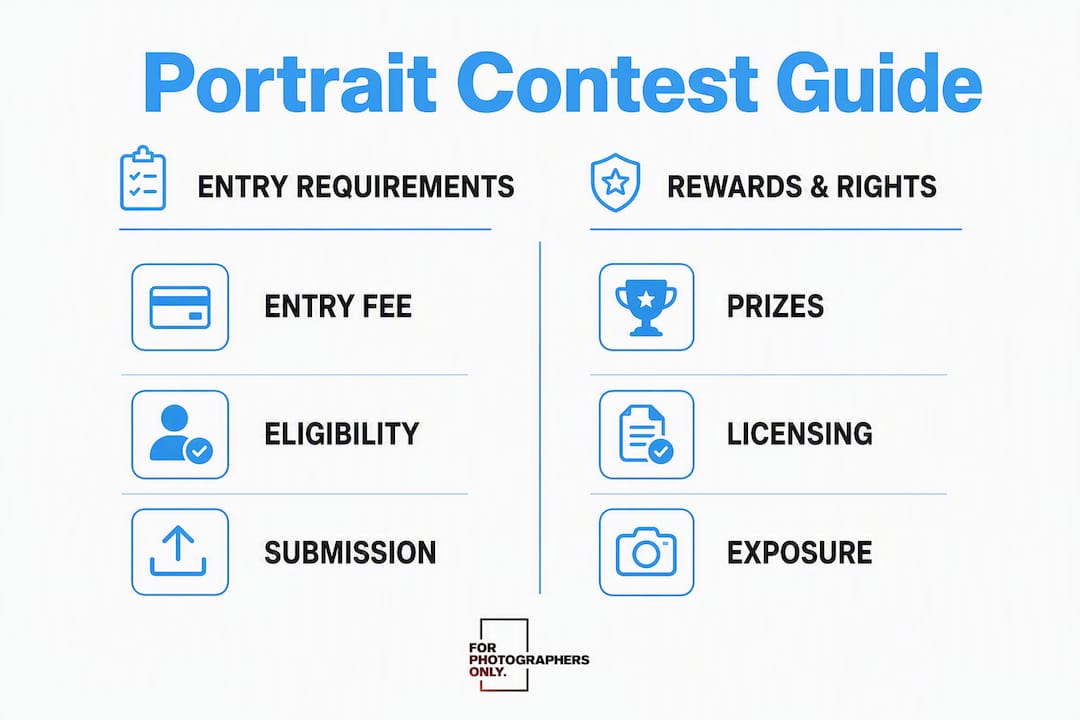
The directory tracks 320–330 active photography contests at any given time, including more than 100 free-to-enter opportunities, all updated weekly. Every listing includes the details that matter: deadline, entry fee, prize structure, eligibility, and submission requirements, presented in a single chronological page. Members also gain access to curated highlights and a monthly internal competition exclusive to the community.
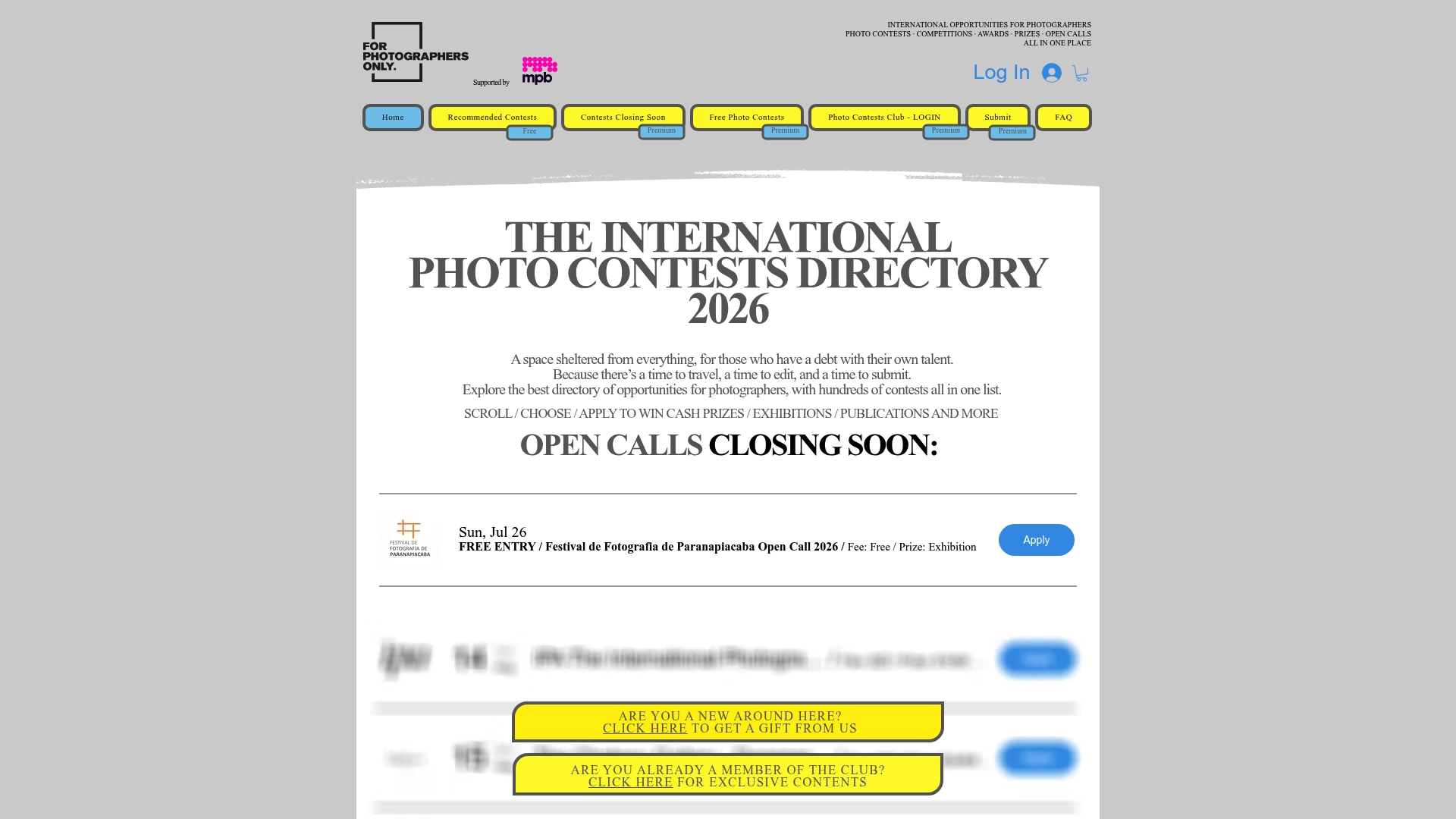
For photographers serious about building an international exhibition record, the directory surfaces calls from competitions organized by institutions like Nikon, Canon, Leica, and National Geographic alongside high-quality niche contests that rarely appear on general photography sites. At €6 per month, it costs less than a single competition entry fee while saving the research time that would otherwise go into finding the next opportunity.
Browse the current active contests on Forphotographersonly and start your next submission with a shortlist that is already curated, verified, and up to date.
Useful sources and official competition pages
Use these primary source pages to verify current deadlines, download submission rules, and confirm prize details before entering.
Winston Taylor Photo Portrait Prize 2026 — National Portrait Gallery: — Official call page with downloadable rules PDF, submission deadline, and exhibition details. Check here for file specifications and model-release requirements.
LensCulture Portrait Awards: — Current open call, tiered fee structure, jury information, and past winners gallery. Confirm open/close dates and series submission guidelines here.
British Photography Awards — Portrait Category: Official category page with current call details, eligibility, and submission requirements for the portrait category.
Lucie Foundation: Institutional partner for the IPA; useful for verifying the award’s credibility and reviewing past Lucie Award honorees.
Forphotographersonly — Active Contests Directory: Continuously updated directory of 320–330 active international photography competitions, including portrait calls, free-entry opportunities, and curated highlights updated weekly.
What to check on every official competition page before submitting:
Recommended