Photographers: Shortlist Photography Fellowships With a Ready Checklist

There are dozens of high-quality photography fellowships and residencies across the U.S. and Europe, and this article lists the most relevant programs while giving you a ready-to-use application checklist so you can apply correctly and on time. Track deadlines through Submittable, official program PDFs, and a curated directory, since the strongest applications start with the clearest information.
TL;DR:
Most multi-month fellowships offer larger stipends, like the Larry Lederman at $20,000 for nine months, but require full-time presence and specific project commitments.
Shorter residencies such as GIANO provide housing and mentoring within a compact stipend, focusing on concentrated studio access over a limited timeframe.
Eligibility criteria often exclude recent graduates or independent artists without particular residency, enrollment, or career stage, so verifying these rules is crucial before preparing applications.
Portfolio evaluations emphasize composition, originality, technical skill, and risk-taking, with jurors favoring clear, small-sized images that demonstrate a strong point of view.
Using a curated directory and setting reminders for deadlines can greatly improve the efficiency of applying to relevant opportunities, reducing time spent hunting for calls.
Table of Contents
Notable photography fellowships and residencies to know
Each program below rewards a different kind of practice, so match your portfolio and career stage to the opportunity rather than applying broadly and hoping.
The McKnight Visual Artist Fellowships, administered by the Minneapolis College of Art and Design, support Minnesota-based photographers with significant professional practice behind them. According to the McKnight 2025 application guidelines, the program requires state residency and roughly eight years of professional practice, making it a mid-career fellowship rather than an entry point for newer artists.
The Joan Mitchell Foundation Fellowship supports painters, sculptors, and photographers with unrestricted funds intended to protect studio time. Its 2026 application guidelines outline a portfolio, statement, and CV submitted through Submittable, a pattern that has become the norm across the field.
The Eddie Adams Workshop is a short, intensive gathering rather than a funded residency, built around mentorship from working photojournalists and editors. It suits emerging documentary photographers who want feedback and industry contacts more than a stipend.
Getty Foundation residential initiatives fund scholars and practitioners working with archives and collections, with formats and durations that vary by partner institution, as described on the Getty Foundation’s residential initiatives page.
The Center for Creative Photography offers fellowship access tied to its archive holdings, appealing to photographers and researchers whose projects intersect with historical collections.
The Larry Lederman Photography Fellowship at the New York Botanical Garden is one of the more generous awards on this list, offering $20,000 for a nine-month term according to the official call for applications, with the garden itself as the project subject.

GIANO Art Residency in Spain runs a compact 60-day program for a small cohort, combining studio space, mentoring, and shared housing, as detailed on the residency’s program page.
The Margaret Morton Archive Fellowship at Pratt Institute is narrower in scope: a stipend split across semesters for in-person archival processing, tied to specific library and archives coursework, per the fellowship application document.
McKnight Visual Artist Fellowships: mid-career, Minnesota residency required, unrestricted funds.
Joan Mitchell Foundation Fellowship: multidiscipline, Submittable-based, unrestricted funds.
Eddie Adams Workshop: short-form, mentorship-driven, no residency requirement.
Getty Foundation residential initiatives: archive and collection-based, duration varies by host.
Larry Lederman Fellowship (NYBG): nine months, $20,000, garden-based project.
GIANO Art Residency: 60 days, studio and mentoring, small cohort.
Margaret Morton Archive Fellowship (Pratt): coursework-linked, $8,200, semester-based.
How funding, duration, and cost coverage differ
Funding structures vary enormously depending on the length of the commitment and the type of institution behind the program. A nine-month placement naturally carries a larger award than a two-week workshop, and the Larry Lederman Fellowship’s $20,000 stipend reflects that extended timeline. Shorter, intensive residencies like GIANO trade a smaller cash award for concentrated studio access and mentoring within a defined window.
Coverage also differs by program type. Some fellowships hand over unrestricted funds and expect the artist to manage travel and housing independently, which suits photographers who already have a base of operations. Others, including many European residencies, bundle in accommodation, studio space, or travel reimbursement as part of the award itself, which matters more for photographers working far from home.
Multi-month fellowships tend to pay more but often require full-time presence at a specific site.
Short residencies like GIANO’s 60-day format bundle housing and mentoring into a compact stipend.
Unrestricted-fund programs, such as Joan Mitchell Foundation fellowships, let recipients allocate money as needed.
Institution-based awards, like Margaret Morton Archive Fellowship, tie payment to scheduled hours and defined duties.
Building a compliant, competitive application checklist
Eligibility rules split photographers into distinct groups long before jurors ever see a portfolio. Some programs, like McKnight, require state residency and years of professional practice, which excludes recent graduates. Others, like the Margaret Morton Archive Fellowship, require active enrollment in specific coursework, closing the door to anyone outside that academic track.
Pro Tip: Read the eligibility section of the program PDF twice before you touch your portfolio, since disqualification for a residency or enrollment technicality happens more often than rejection on artistic grounds.
Confirm eligibility (residency, career stage, enrollment status) against the exact wording in the program’s official guidelines.
Assemble a portfolio of 10 to 20 images that represents one coherent body of work, not a career retrospective.
Write a statement of purpose between 150 and 1,000 words, sized to what the specific program requests.
Prepare a current CV and a project proposal that names how you will use the host institution’s resources.
Set up or confirm your Submittable account, since Joan Mitchell Foundation’s guidelines and many peer programs route applications through it.
Match file naming, pixel dimensions, and metadata fields exactly to the program’s stated specifications before uploading.
What juries actually reward in portfolio review
Jurors reviewing photography fellowship applications tend to weigh composition and creativity heavily, alongside technical skill and evidence of future potential, a pattern reflected in the priorities laid out in McKnight’s application guidelines. Reviewers commonly evaluate work across four areas: composition, originality, technique, and growth potential, and a portfolio that leans too heavily on technical polish without a clear point of view often loses ground to one that shows intentional risk-taking.
Practical choices matter as much as artistic ones. Jurors often view submissions on laptops in fast succession, so images need to hold their detail at small sizes, and exhibition installation shots rarely serve a portfolio the way clean, individual images do.
Select images that read clearly even when viewed small, not just on a large monitor.
Skip exhibition or gallery-wall photos unless the program specifically requests them.
Label every file according to the program’s stated naming convention.
Write project proposals that name the specific collection, archive, or resource you intend to use.
Attend a portfolio review or workshop before applying, since seeing how jurors respond to real work sharpens your own edits.
Where to track open calls and application deadlines
Staying ahead of deadlines is mostly a matter of habit rather than luck. Museum and foundation fellowship pages, Submittable’s saved search function, and curated directories each catch different opportunities, so checking more than one source pays off. Reading the full program PDF before applying, rather than skimming a summary, catches eligibility details that would otherwise surface too late.
Save searches on Submittable for “photography fellowship” and “photography residency” to catch new postings automatically.
Set calendar reminders two to three weeks ahead of each deadline, not the day before.
Subscribe to newsletters from institutions you’re targeting, since many fellowships announce openings there first.
Keep a folder of downloaded program PDFs so guideline changes don’t catch you off guard.
Check a curated fellowship and contest listing alongside individual program pages for opportunities you might otherwise miss.
Choosing which fellowships deserve your time
Apply to a small, deliberate mix: one or two ambitious programs that would meaningfully change your trajectory, and two or three where your current body of work is a genuinely strong fit. Spreading yourself across a dozen applications usually produces weaker statements and rushed proposals for all of them.
Track what happens after each submission, not just whether you got in. A rejection paired with feedback, or a acceptance that led to a specific exhibition or publication, tells you more about where to apply next than the outcome alone.
— DARIO
Let For Photographers Only handle the search for you
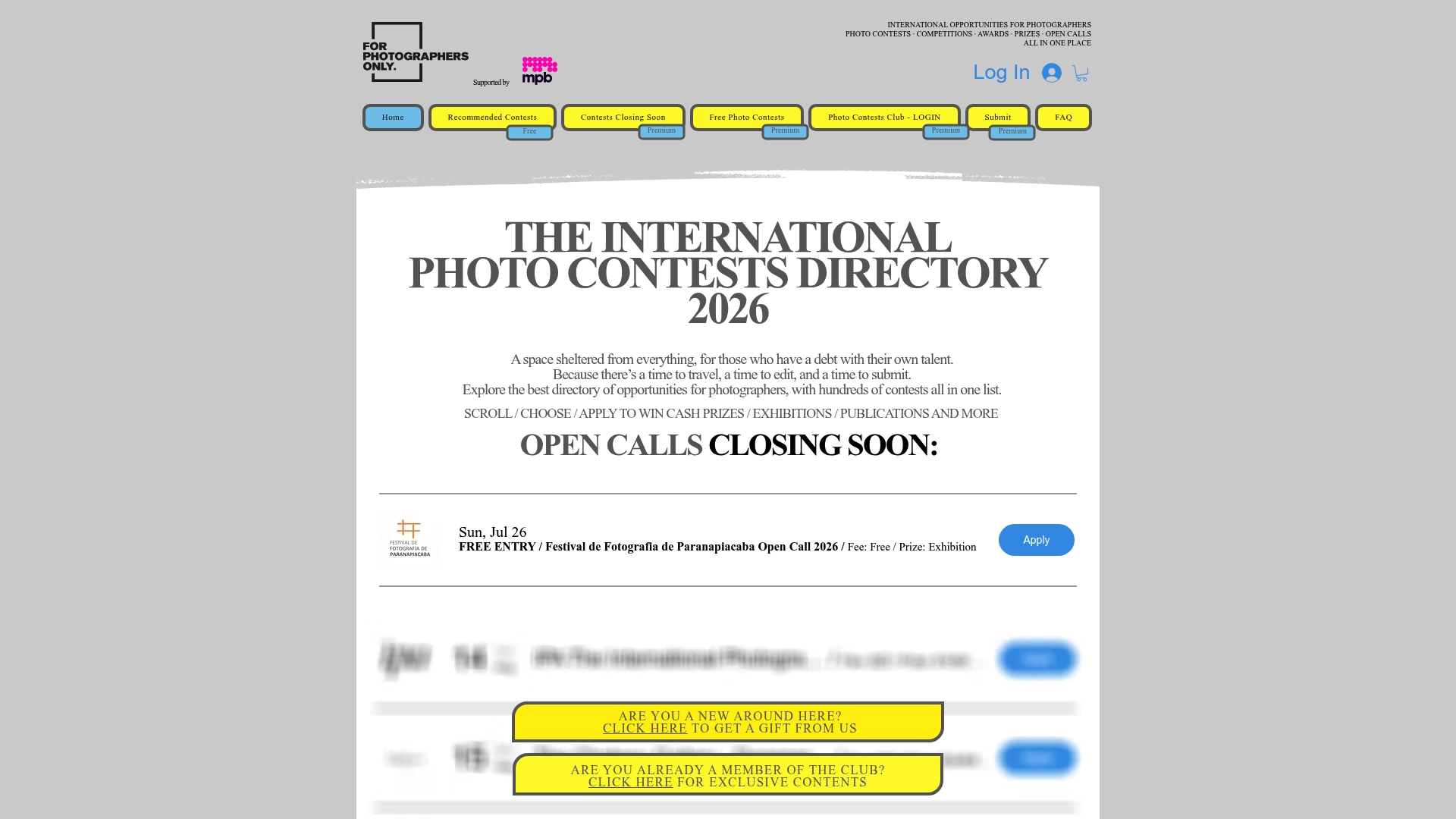
Reading every program PDF on this list takes hours before you’ve even started your statement. A curated directory tracks a large number of international photography competitions, grants, and calls in one continuously updated page, including many free-to-enter opportunities, so you spend your time writing proposals instead of hunting for them. Full access to the curated list runs €6 per month or €40 per year through PhotoContestsClub. If you’re building visibility after a fellowship, working with a partner like Baby Love Growth’s photography SEO services can help turn that recognition into more bookings.
What you get | Detail |
Active opportunities listed | Hundreds of competitions and calls |
Free-to-enter options | Many listings |
Update frequency | Regularly |
Subscription price | Subscription pricing applies |
The directory complements program PDFs rather than replacing them, since final eligibility and submission rules always live on the institution’s own page.
Filters help you shortlist fellowships and residencies by deadline and category instead of scrolling through unrelated contests.
Start your search on the PhotoContestsClub page and shortlist your next application today.
Sources
FAQ
What is the difference between a photography fellowship and a residency?
A fellowship typically provides funding, often unrestricted, tied to a defined project or career stage, while a residency provides physical space, time, and sometimes mentorship at a specific site. Many programs blend both, offering a stipend alongside studio access or housing.
How much do photography fellowships typically pay?
Amounts vary widely by program length and institution: the Larry Lederman Fellowship offers $20,000 for nine months, while the Margaret Morton Archive Fellowship provides $8,200 across a semester-based schedule. Shorter residencies often provide smaller stipends paired with housing or studio access instead of cash alone.
What is the 20 60 20 rule in photography?
This term isn’t tied to a documented fellowship or industry standard, and definitions circulating online vary without a clear original source. It’s best treated as informal advice rather than a recognized rule referenced by fellowship juries.
Is AI replacing photographers in fellowship or grant contexts?
Fellowship and residency programs reviewed here continue to center human artistic practice, portfolio review, and proposal writing rather than automated evaluation. Nothing in current program guidelines from the institutions listed suggests AI tools are replacing juror review or eligibility assessment.
What should I submit for most photography fellowship applications?
Most programs request a portfolio of 10 to 20 images, a written statement between 150 and 1,000 words, a CV, and a project proposal, often submitted through Submittable according to guidelines from the Joan Mitchell Foundation. Exact requirements differ by program, so always confirm specifics against the official PDF before submitting.
Recommended