Stop Losing Entries: Photographer Bio Workflow and Prospectus Rules

For submissions, the safest approach is a concise, tailored third-person bio built from one editable master document, trimmed to the exact word count each prospectus demands. Word limits, portrait specs, and anonymity rules can disqualify an otherwise strong entry, so precision matters as much as prose. The templates and annotated examples below turn that master bio into ready text for any outlet.
TL;DR:
Bios must adhere strictly to the specified word count and formatting rules; exceeding limits risks disqualification before the content is even read.
Use a master long bio to ensure consistency, then trim for different outlets, prioritizing specific details over vague praise or adjectives.
Including concrete credits, unique techniques, or specific project details makes a bio memorable and verifiable, increasing chances of acceptance.
For blind juries, strip all metadata and filenames of personal information; any trace can cause immediate disqualification.
Carefully read and follow each prospectus’s unique requirements for voice, format, and length to maximize submission success.
Table of Contents
Copyable templates and quick-edit formulas for every bio length
Annotated examples: what works, what doesn’t, and lines to steal
How to adapt your bio for contests, magazines, galleries, and juried shows
Quick-reference length targets, voice, and formatting rules by outlet
Practical dos and don’ts and a rapid pre-submission checklist
Sourced submission rules and real prospectus excerpts you should know
How PhotoContestsClub helps you find the right opportunities for your bio
Copyable templates and quick-edit formulas for every bio length
Every submission-ready bio starts from a formula, not a blank page. Once you have the formula memorized, writing a new version for a magazine, gallery, or contest becomes a matter of trimming rather than composing from scratch.
The formula has four parts: opening role, practice summary, notable credits, and a closer with current project or contact. Each length variant below uses that same skeleton, just compressed or expanded.
Short bio (25 to 40 words), third person:
“[Name] is a [genre] photographer based in [location] whose work explores [theme]. Recent projects have appeared in [publication/exhibition]. [He/She/They] is currently working on [project].”
Short bio, first person:
“I’m a [genre] photographer working out of [location], drawn to [theme]. My recent work has shown at [venue]. Right now I’m developing [project].”
Medium bio (80 to 120 words), third person:
“[Name] is a [genre] photographer based in [location], known for [signature approach or subject matter]. [His/Her/Their] work has been exhibited at [venue] and published in [publication], and [he/she/they] was a finalist for [award]. [Name]'s practice centers on [thematic focus], often using [technique or format]. [He/She/They] holds [credential, if relevant] and has contributed to [notable project or collaboration]. [Name] is currently at work on [current project], continuing an interest in [theme]. [He/She/They] lives and works in [location].”

Long bio (250 to 350 words): expand the medium version with a paragraph on origin story (how the photographer came to the practice), a paragraph on thematic throughline across bodies of work, and a closing paragraph naming exhibitions, publications, and current representation or availability.
A few rules keep any version honest when you trim it:
Cut adjectives before you cut facts: a prospectus cares more about “solo show at [venue]” than “compelling and evocative work.”
Preserve the most specific credit first; generic praise is the first thing a word-count cut should remove.
Keep one sentence of theme intact at every length, since that is what juries use to place your work in context.
When expanding a short bio into a long one, add detail in this order: origin story, process or technique, then a wider view of career trajectory. That order keeps the bio readable even if an editor trims it back down.
Annotated examples: what works, what doesn’t, and lines to steal
Reading other photographers’ bios sharpens your instinct for what a jury or editor actually reads for: specificity, a clear thread of practice, and evidence rather than adjectives. American Photographic Artists offers short and long sample bios built around exactly this principle: concrete detail over aspirational language.
Here is what separates a working bio from one that reads as filler, illustrated by extract type rather than invented names:
Commercial bio, strong opener: “Based in [city], [Name] shoots for outdoor and lifestyle brands, with recent campaigns for [client type].” Works because it names the client category immediately rather than opening with “passionate visual storyteller.”
Editorial bio, risky closer: “…capturing the human condition.” Reads as filler. It says nothing a jury can verify or picture, and it appears in enough submissions that it registers as noise rather than signal.
Fine-art bio, standout detail: “The series was shot entirely on expired film sourced from estate sales.” One concrete detail like this does more work than three sentences of “unique perspective” language.
Documentary bio, effective credit stack: “Work has appeared in [outlet], with a solo exhibition at [gallery] in [year].” Chronological, checkable, and easy for an editor to verify before publishing.
Portrait bio, weak generality: “[Name] has a passion for capturing raw emotion.” Generic enough to belong to almost any portrait photographer; swap in a specific technique or subject group instead.
Landscape bio, strong specificity: “Returns to the same six coastal sites every winter to track erosion visually over a decade.” Gives a jury a reason to remember the work after reading fifty other bios.
Street photography bio, good length control: a 30-word version that keeps only location, one signature technique, and one credit, proving that a short bio does not need to feel thin when the details are chosen well.
Conceptual bio, overwritten example: a 150-word bio that spends 40 words on metaphor before naming a single fact. Editors skim; front-load the facts.
The lesson translating across all of these: a single vivid, checkable detail (a technique, a location, a multi-year project) beats three sentences of mood-setting language, and it survives every length cut because it is short in the first place.
Pro Tip: Write your bio’s best line first, then build the rest of the sentence structure around protecting that line at every length.
How to adapt your bio for contests, magazines, galleries, and juried shows
A website bio and a submission bio serve different jobs. The website version can run long and first-person, built for search visibility and a browsing visitor. A submission bio has to fit a prospectus exactly, in the voice and length that outlet specifies, often alongside strict file and anonymity rules.
Read the prospectus twice before writing anything: note the exact word count, whether first or third person is requested, and whether a portrait or CV is required alongside the bio.
Prepare a submission packet with named versions ready to attach: bio text, portrait file, portfolio links, and a short artist statement if the prospectus asks for one separately (see our guide on writing an artist statement for how the two differ).
Check portrait specs precisely: file format, minimum resolution, and whether a headshot is required at all, since some galleries only want work samples.
Confirm whether the jury is blind. If it is, remove your name from the bio text, the image metadata, and every filename before uploading.
Rename files using the prospectus’s requested convention, typically a number or code rather than your name, and double-check that renaming did not strip resolution or color profile data.
Submit early enough to catch upload errors. Many portals, including CallForEntry (CaFE), do not allow edits once an entry is finalized at checkout.
Anonymizing for blind juries takes more than deleting your name from the bio text. Camera metadata (EXIF data) can still carry your name or copyright tag, and image titles like “JohnSmith_Portrait_03.jpg” defeat the purpose instantly. Strip that information before the file ever reaches the upload portal, and keep a private, un-anonymized master copy elsewhere for your own records.
Quick-reference length targets, voice, and formatting rules by outlet
Outlets vary widely in what they expect, and matching the format is as important as the writing quality itself. A bio that is technically well-written but 200 words over a 100-word limit gets cut or rejected before anyone reads the prose.
Social platforms (Instagram, contributor handle) reward brevity and personality; keep it under 40 words and first person feels natural here.
Magazine contributor notes often request a short bio, frequently around 150 words or fewer, and typically expect a professional portrait alongside it, since editors use both to introduce you to readers and verify your credibility.
Gallery wall labels usually want third person, tight, and factual, often 80 to 120 words, matching the formal register of an exhibition space.
Contest and juried show prospectuses are the strictest: many specify an exact word cap and sometimes ban a bio entirely in favor of an artist statement.
One of the clearest examples of a hard limit comes from the Museum of Modern Art (MoMA), whose submission guidelines cap the artist statement at 100 words and limit portfolio submissions to 10 images, with entries risking disqualification for exceeding either limit.
Outlet type | Typical length | Preferred voice |
Social platform bio | Under 40 words | First person |
Magazine contributor note | Around 150 words or fewer | Either, outlet-dependent |
Gallery wall label | 80 to 120 words | Third person |
MoMA artist statement | 100-word maximum | Third person |
When a prospectus does not specify voice, third person is the safer default for formal submissions since it reads as a description of the work rather than a personal pitch.
Practical dos and don’ts and a rapid pre-submission checklist
A submission bio fails for reasons that have nothing to do with photographic skill: a missed word count, a stray name in a filename, a portrait in the wrong format. None of these are hard to fix once you know to check for them.
Do:
Tailor tone to the outlet: a gallery label reads differently than an Instagram caption, even when describing the same body of work.
Include essential links (website and one portfolio platform) unless the prospectus explicitly restricts them.
Attach a current, professional portrait sized to the outlet’s stated specs.
Respect the word count exactly, since editors and juries often cut rather than request a revision.
Don’t:
Lean on generic AI-generated fluff phrases; editorial guidance from the Royal Photographic Society notes that editors prefer an author’s individual voice, and overly polished, generic text can obscure it.
Ignore anonymity requirements when a jury is blind. This is one of the few submission errors that leads to immediate disqualification rather than a rejection.
Leave your name inside filenames or image metadata when a prospectus requires anonymized entries.
Pro Tip: Read your bio out loud before submitting. If a sentence sounds like it could belong to any photographer, cut it or replace it with a specific detail.
Three fast checks before you hit submit: count the words against the prospectus limit, open the image files to confirm no name appears in title or metadata, and re-read the voice requirement to be sure you matched first or third person correctly.
Create and maintain a master bio plus versioning workflow
The most reliable system is a single long master bio, updated a few times a year, from which every shorter version is trimmed. Rewriting from scratch each time invites inconsistency and wastes time during a tight submission window.
Name your versions clearly so retrieval is instant when a deadline is close:
MASTER_LONG: the full 300-word version with every credit and theme included, updated whenever a new exhibition or publication happens.
SUBMISSION_120: the standard gallery and magazine length, trimmed from the master.
IG_30: the social-length version for platform bios and contributor handles.
BLIND_ANON: a name-free version ready for juried shows requiring anonymity.
Keep all versions in one document with clear headers, stored somewhere searchable by filename, not buried in an email thread. When you update the master bio, update the trimmed versions in the same sitting rather than letting them drift out of sync.
If you use an AI tool to help trim a paragraph, ask it to preserve your specific details and cut only length, not voice. As Wonderful Machine’s advice on writing a photographer bio notes, platform-specific versions should shift emphasis (discoverability for a website, brevity for social, context for a submission) without losing what makes the bio yours. Advice on using AI tools to preserve personal voice while drafting, such as the approach outlined by Baby Love Growth, applies just as well to bio editing as it does to broader visual storytelling.

Sourced submission rules and real prospectus excerpts you should know
Prospectus rules are not suggestions. They are the difference between an entry that gets read and one that gets rejected before a juror ever opens the file.
The Museum of Modern Art (MoMA) enforces a 100-word maximum artist statement and a 10-image portfolio cap, and exceeding either limit can disqualify an entry outright.
The Center for Photographic Art (CPA) juried exhibition prospectus lists technical specs for image resolution and color profile alongside a submission timeline, and warns that entries cannot be edited once checkout is complete.
The Royal Photographic Society (RPS) editorial guidance for its magazine notes that editors prefer to retain an author’s individual voice, flagging that overly polished, generic AI-written bios can obscure personality.
A word limit that sounds generous on paper still eliminates entries every cycle: MoMA’s submission guidelines cap the artist statement at 100 words, a limit tight enough that most first drafts run well over it before editing.
Many juried shows print accepted images directly from the files and metadata submitted, meaning an error in a title or date can carry through to a printed catalog. That is one more reason to treat the final file check, not just the bio text, as part of the submission itself.
What sharper bios actually look like in practice
Most submission bios fail for the same reason: they describe a feeling instead of a fact. “Passionate about capturing light” tells a juror nothing they can picture or verify, while “returns to the same quarry every autumn to photograph erosion” tells them exactly what they are about to see.
Three edits worth making tonight, on whatever bio you have open right now: cut the first adjective in your opening sentence and replace it with a place, date, or technique; find the vaguest sentence in your bio and either cut it or add one number, name, or location to it; and read your closing line aloud, since if it sounds like it could belong to any photographer in your genre, it needs a specific project name instead.
Specificity is not about sounding impressive. It is about giving a juror or editor, who reads dozens of these in a sitting, one detail to remember you by.
— DARIO
How PhotoContestsClub helps you find the right opportunities for your bio
Writing the bio is only half the work. Finding contests and prospectuses worth submitting to, and knowing their exact word limits and deadlines before you start trimming, is the other half.
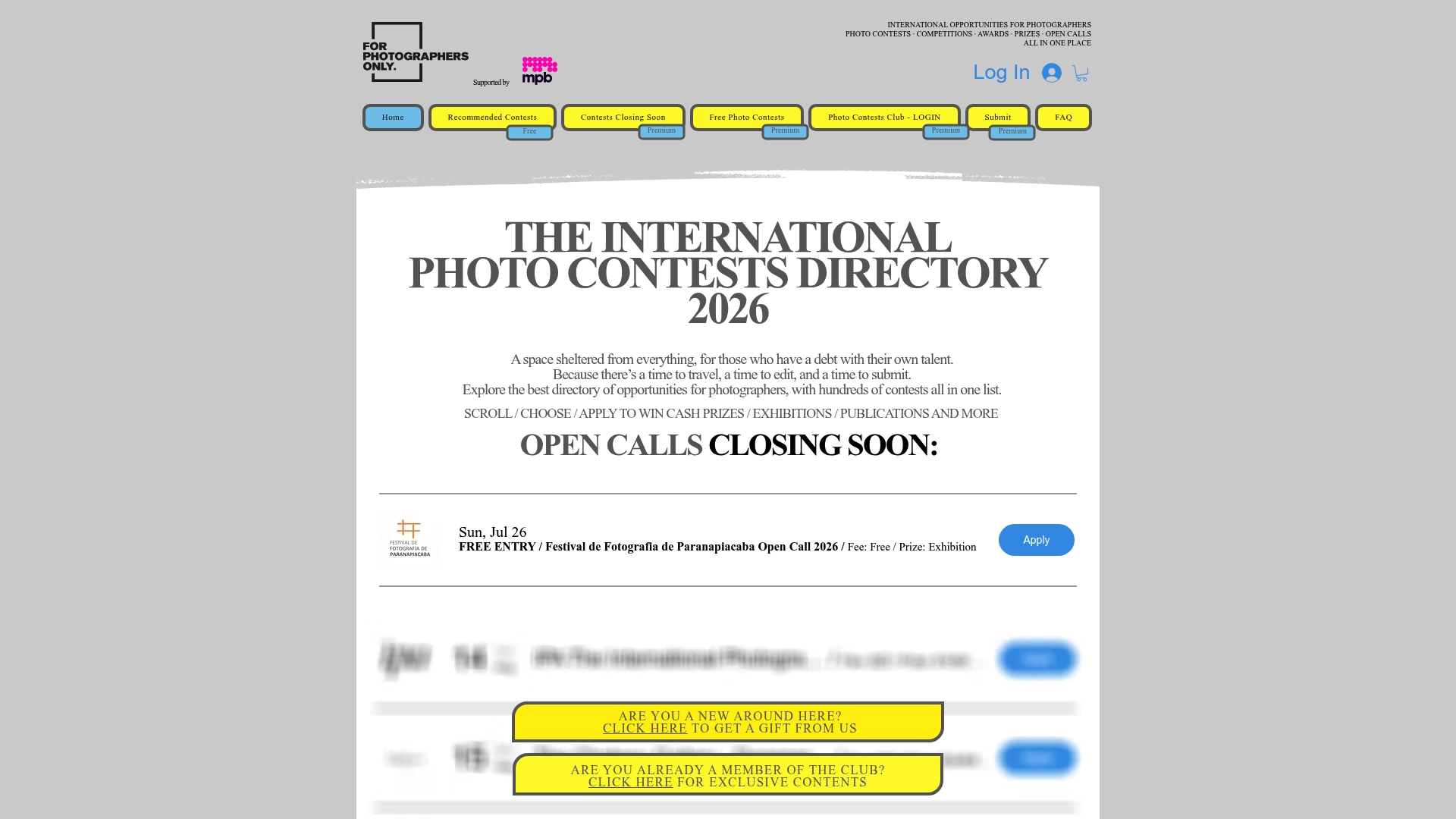
PhotoContestsClub is a curated directory of international photography contests, updated weekly, that links out to each opportunity’s official prospectus and deadline. Instead of researching submission rules across dozens of individual websites, you check one continuously updated page, confirm the word limit and voice requirement for a contest that fits your work, and copy the right version of your master bio straight into the packet. The directory does not organize the contests itself; it researches and curates opportunities from external institutions, including well-known and lesser-known contests alike, so you spend your time writing rather than searching.
Access to the full contest listing runs €6 per month or €40 per year through PhotoContestsClub. Check the current listings and find a prospectus that matches your next submission.
Sources
FAQ
What should you put in your bio as a photographer?
A submission bio should include your genre or focus, location, one or two notable credits (exhibitions, publications, awards), and a line on your current project. Keep the language specific and checkable rather than aspirational, and match the voice and length the outlet’s prospectus requests.
What is the 20-60-20 rule in photography?
This term does not correspond to a documented, widely recognized photography standard, so definitions vary depending on where you encounter it. Rather than relying on an unverified rule, follow the specific word count and format rules stated in each prospectus you submit to.
Which magazines are accepting photography submissions?
Accepted outlets change constantly and vary by genre, region, and submission window, so check each publication’s current call for entries directly rather than relying on a fixed list. A curated, regularly updated directory like PhotoContestsClub can help you track which contests and calls are currently open alongside their prospectuses.
Can you provide an example of a photographer’s biography?
A short third-person example: “[Name] is a documentary photographer based in [location] whose work has appeared in [publication], with a recent solo exhibition at [venue].” American Photographic Artists offers additional short and long sample bios built on this same structure of role, credits, and current focus.
How do you adapt one bio for different submission lengths?
Start from a single master bio and cut adjectives and secondary credits first, keeping one specific detail about your theme or process at every length. Preserve your strongest, most concrete line intact whether the final version is 30 words or 300.
Recommended