Photo Entry Titles: How to Write One That Helps Your Image Win

A strong photo entry title is short, specific and points the judge toward what matters in the frame. It adds one layer of meaning the image cannot carry alone, and it matches the rules of the category you enter. Most photographers treat the title as a last field to fill in. The ones who treat it as part of the picture give every judge a clearer reading of the work.
This guide is written for photographers and visual artists in the United States and Europe who enter international contests. It explains what a title is, how judges meet it, how to write one step by step, and how to adapt it to nature, travel, journalism and creative categories.
TL;DR
Keep most titles to two to five words, and make them story-driven rather than a plain description of what is visible.
Read the category rules first: nature and travel titles often need facts (subject, place, sometimes a scientific name), while creative categories reward imagination.
Never use a camera filename, personal details or a title that promises something the image does not show.
Write the title, step away for a couple of days, then test it on someone who has not seen the photo.
Treat titles as part of your entry routine: with a curated list of open contests, you can adapt each title to each competition’s rules.
Table of Contents
What a photo title is, and how it differs from a caption
A title is the name of the work. A caption is the explanation that travels with it. The distinction is old and useful. Aperture’s classic essay on captions describes a title as a static identification of who or what, where and when, while a caption is dynamic: a few short lines that develop the title into why and how.
In practice, contest forms usually give you both a title field and a description field. Use them for different jobs:
Title: a brief line, with no need for grammatical structure, that names or frames the image.
Caption or description: context, circumstances, technique and background, in a few sentences. If your entry form asks for one, our guide to writing captions that win photo awards covers it in detail.
A PetaPixel guide from 2023 adds a helpful rule of thumb: the simplest titles contain one of the five W’s (who, what, when, where, why), while harder titles convey an abstract feeling or a personal connection. Both approaches work. The skill is choosing the right one for the image and the contest.
Why the title matters in a competition
In many competitions the judge sees your image first and the title second, sometimes after scoring. A guide from the Southwest Photographic Press notes that judges tend to form an opinion within about three seconds, so the title has to confirm the image’s emotional direction, not fight it.
That has three consequences:
A title can never rescue a weak photograph, but it can sharpen a good one by directing attention to the real subject.
A misleading title costs points. The same guide cites an image titled “Just the Two of Us” that contained six people, which threw judges off.
A title that adds nothing wastes the one place on the entry form where you speak directly to the judge.
If you want to understand what judges actually score, our photo contest judging criteria rubric shows where a title can support impact, originality and technical execution. For the wider entry strategy, see our judge-backed guide to winning photo contests.
Five principles for a title that works
1. Keep it short
The Oregon Professional Photographers Association’s judging guide says the strongest competition titles run between two and five words, although a carefully chosen single word can also succeed. Long titles tend to read like captions and slow the judge down.
2. Tell a story instead of describing
The same guide warns against trite or merely descriptive titles such as “Summer Beauty” or “Woman on the Beach.” It points to story-driven examples like “The Edge of 17” or “Siren on the Shore” that pull the viewer in. It also shows how a title can steer a judge to the real subject: “Strong Sentinel” for a small dog guarding the scene, rather than “House on the Hill.”
3. Guide the eye without over-explaining
A PSA article by J. Dunn describes titles as “docents” that give viewers directional guidance. A good title hints at what to notice and leaves room for the viewer to complete the thought. It cites the example “R was for Rifle,” where the emphasis on “was” signals a symbolic reading the picture only implies.
4. Match the feeling of the image
If there is wind in the frame, a windy title helps. If there is none, leave “wind” out, because judges will start looking for it. The title should point in the same direction as the light, color and mood.
5. Skip cleverness that does not earn its place
Envato Tuts+ recommends short, common, specific and powerful words and cautions against puns and clichés. A play on words is acceptable only when it contributes to meaning. The same article notes that a title clever to its maker can look like ridicule to the people photographed, so a friend’s view is worth asking for.
Match the title to the category
The biggest mistake in contest titling is using one style everywhere. The Northern California Council of Camera Clubs, which judges across several divisions, sets out different expectations for each. Here is how that translates into practice:
Category | What the title should do | Example approach |
Nature and wildlife | Be informative and concise, often with the common name followed by the scientific name in parentheses | Common name, behavior, season |
Travel | State subject and location, so the judge does not have to guess | Subject, place, country |
Photojournalism | State what, where and when | Plain factual statement |
Pictorial and fine art | Anything goes, so choose a title that sharpens mood | Short and evocative |
Creative and conceptual | Be imaginative, though not too obscure | As inventive as the image |
The judging manual from the same organization gives sharp examples. For nature, it prefers “Female Mallard Duck with Ducklings Search for Food” over the cutesy “Mommy Duck with Babies Looking for Dinner”. For travel, it says makers should state the place and country rather than assume viewers recognize a landmark. The guide’s own example: “Old Woman in Local Dress on Cobbled Street in Heraklion, Crete” does far more than “Greek Woman.” For creative work, it advises being as creative with the title as with the image.
When a contest publishes its own rules, they override any general advice. Read the category definition, the title limits (some forms cap characters) and any statement about whether titles are shown to judges at all.
Before and after: titles that improve
These rewrites show the principles at work. They are our own illustrations, built on the guidance above.
Weak title | Why it fails | Stronger title |
Sunset Beach | Pure description, could be any of ten thousand images | Last Light, First Swim |
Old Man | Generic, no place or story | Fisherman Mending Nets, Essaouira, Morocco (travel) |
Bird on Branch | No species, no behavior | Barn Owl (Tyto alba) Hunting at Dusk (nature) |
Untitled 3 | Gives the judge nothing | Waiting for the 6:10 |
IMG_5192 | Default camera filename | Anything chosen on purpose |
Beautiful Mountain Morning | Judgment words tell the viewer what to feel | Ridge in Fog |
Notice that the stronger titles are not longer, only more specific. Specificity is what separates a title from a label.
A step-by-step process for writing the title
The PSA article proposes a seven-step method that is worth following in a simplified form. Here is a practical version for contest entries:
Decide the feeling. Write one word for what the image should make a viewer feel: stillness, tension, humor, loss.
Name what viewers notice first. If your eye goes to a small figure in a large landscape, the title can confirm it.
Add what the image cannot show. A time, a relationship or a fact outside the frame can deepen the picture. This is the strongest use of a title.
Check the category rules. Nature and travel may require facts. Creative may reward invention.
Cut. Remove every word that does not change how the image is read. Aim for two to five words.
Rest it. The Southwest Photographic Press guide recommends sleeping on entries for a couple of days before uploading. Titles often look different after a break.
Test it. Show the image with the title to a friend, then a stranger, and ask what they saw first. If they look for something that is not there, change the title. Gathering that kind of audience reaction is part of broader visual storytelling tips, and it applies equally to a single frame.
Practical entry-form rules
The North Austin Photographic Society’s titling page collects rules that save points and avoid disqualification:
Leave personal information out of the title, since many contests judge anonymously.
Do not enclose the title in quotation marks.
Leave out the date unless it matters to the image.
Never submit the default camera filename.
If your entry system allows a title override per competition, use it to give the same photo a title suited to each contest.
That last point matters when you enter one image in several contests. A nature contest may want a species and a place, while a fine art open call may prefer a one-word title. Keeping a short record of which title went where also helps, and a consistent naming system for your files makes it painless: see our guide to reliable photo file naming. If you share previews online, it is also worth reading how to handle watermarks in photo contests before you upload anything.
Literal, poetic or untitled?
There is no single answer, but a rule of thumb helps.
Use a literal title when the category demands information (nature, travel, journalism) or when the image depends on context the viewer cannot see. Literal does not mean dull: “Female Mallard Duck with Ducklings Search for Food” is exactly right in a nature division.
Use a poetic or conceptual title when the image is open and atmospheric, and the title can add a second reading. The risk is obscurity. If a judge needs a footnote, the title has failed.
Use a humorous title only when the humor reveals something. North Austin’s examples include a playful title that points to a very small person taking a self-portrait in one panel of a downtown building. Without the title, it would have been an ordinary building photograph. The same page also shows the opposite end of the range: a terse one-word title, “BigBoy,” for a locomotive.
Leave it untitled only if the entry form allows it and the image truly stands alone. In a competition, an empty field is usually a missed opportunity, since many forms require a title anyway.

Titles for series and projects

Some contests judge a portfolio or series rather than a single frame. The logic changes: the series title becomes the frame through which every image is read, and the individual titles should work as a family, with consistent tone and length. If you are working in Spanish or for a Spanish-language call, our guide on cómo elegir el título de una serie fotográfica takes the same approach to naming a body of work.
Our perspective
We curate photography competitions rather than run them, so we read a great many entry forms. What stands out is how differently each contest treats the same few words on the page: a nature call may ask for a species, a documentary call for a place and a date, a fine art open call for nothing at all. That is why we believe a title is best treated as part of the entry, not an afterthought. The photographers who build a small habit around it (a rest period, a second reader, a title adapted to each category) give their work the clearest possible chance in front of a judge. It is also why we organize the directory as we do: one continuously updated page of more than 320 active contests, with deadlines, fees, prizes and genres set out in a chronological list, and over 100 free-to-enter competitions among them. When the rules are visible at a glance, matching your title to the category becomes simple, and your time goes into the work itself. DARIO
Find the right contests for your titled work
Once your titles are ready, the next question is where to send the images. PhotoContestsClub gives you one continuously updated page of international photography competitions, awards, calls and grants, with deadlines, fees, prizes and genres listed, including competitions from well-known brands and festivals as well as lesser-known niche opportunities. Membership is €6 per month or €40 per year, and a free trial is offered. You can see the full contest list here.
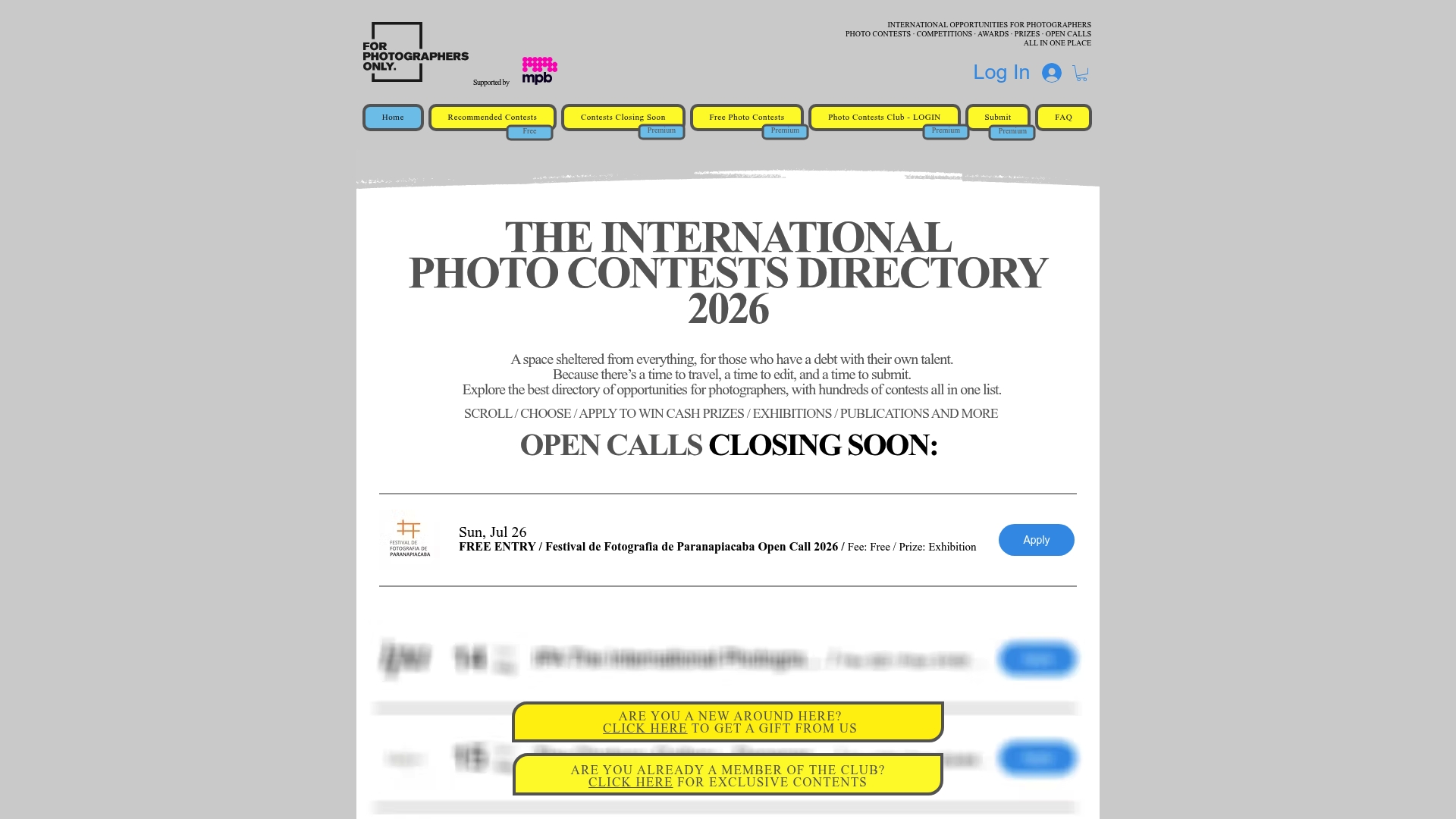
Members also have access to a photographer community and a monthly internal competition, a practical place to try out a new title on fellow photographers before you enter a larger contest.
FAQ
What is the title of a photo?
It is the short name you give an image, usually a few words. It identifies or frames the work, while a caption or description supplies the longer explanation. In a contest, it is the line the judge reads alongside your picture.
How long should a photo entry title be?
Two to five words is the range the Oregon Professional Photographers Association recommends for competition work, with a well-chosen single word as an exception. Nature and travel categories may call for longer, factual titles that name the species, subject and place, so follow the contest’s rules first.
Should I use the same title for every contest?
Not necessarily. A title that suits a creative or fine art call may be too vague for a nature or travel division, which often expect specific facts. If the entry system lets you set a different title per competition, use it to fit each category.
Is it better to leave a photo untitled?
In competitions, usually not. Many forms require a title, and judges read it as part of the entry. A well-chosen title can direct attention, add context or deepen the mood, which an empty field cannot do.
Can I use a funny or poetic title?
Yes, when it adds meaning. Humor works when it reveals something in the image, and poetic titles work when they offer a second reading without becoming obscure. Avoid puns and clichés that exist only to be clever.
Sources
Recommended