Photo Contests With Feedback: How to Find Ones That Critique Your Work

Most photo contests will tell you whether you won, not why. The ones that do offer feedback tend to fall into three types: contests that attach a written review to every winner, contests that sell an optional critique per image, and juried competitions where comments are brief or left to the judge’s discretion. Knowing which type you are entering, and what it costs, is what turns an entry fee into real learning. Our directory of 320–330 active international contests, including more than 100 free-to-enter ones, puts deadlines, fees, prizes and genres side by side, so you can build a shortlist quickly and then confirm each contest’s feedback terms before you pay.
TL;DR
Individual feedback is the exception. Large international contests often state in their terms that they cannot critique entries because of volume.
Feedback comes in three forms: a review for winners only, a paid critique per image, or short juror comments on every image in smaller, association-run contests.
Paid critiques in the US typically run about $10 to $25 per image, and delivery can take weeks or months.
Read the contest rules for the words “critique,” “feedback” and “review” before you enter, then use the comments as a pattern across several contests, not a single verdict.
Build a shortlist from one organized list of contests, then check each contest’s feedback policy on its own page.
Table of Contents
Why most contests do not explain their results
A photo contest is, at its core, a selection process. A panel of jurors sees hundreds or thousands of images, picks a few, and moves on. Writing a thoughtful note on every frame is a different job, and many organizers say plainly that they cannot do it.
The terms of one US call for artists state that its jury cannot provide individual feedback because of the number of submissions. A major UK-based competition says the same: because of high entry volume, neither the organizer nor the judges can provide individual feedback. Even a respected multi-stage professional review such as Photolucida’s Critical Mass tells entrants that jurors may leave optional feedback, which means it is not guaranteed.
This is not a flaw in those contests. It is a design choice, and it tells you what to look for. If your goal is to learn, you need to look for the contests built to teach.

The three kinds of feedback you will meet
1. A review for winners, sometimes open to everyone
Some international competitions attach a written review to every winning image. LIFE FRAMER, for example, states that all winners receive a written review, and that all entrants may request detailed, constructive feedback written by industry professionals. Its reviews may address overall impact, technical aptitude, originality and the accompanying statement. That is a useful template for what a good critique covers: the picture, the craft, the idea and the way you present it.
2. A paid critique per image
This is the most common route to detailed comments. Two US examples show the range:
Contest | Feedback offered | Cost |
Critique, normally a recorded video of about three minutes, delivered within three weeks of the competition | $10 per image | |
Optional public recorded-video critique | $20 per entry | |
Private recorded-video critique, for your eyes only | $25 per entry |
The South Carolina rules add that the most detailed feedback comes from purchasing a critique, and that length varies by judge. Icon Awards explains that public critiques are released after its annual in-person event, while private critiques arrive earlier. So timing matters: a critique may reach you weeks or months after the deadline, and you should plan your next entries around that.
3. Short juror comments on every image
Smaller, association-run competitions can be the most generous. The 2026 Professional Photographers of South Carolina rules state that brief juror comments are provided on all images after judging, and that judges’ challenges can offer feedback during judging. Rangefinder reported on a competition that gave entrants written critiques from three judges for each digital image, with an audio option. Three independent voices on one frame show you quickly where opinions agree.
Merit reviews: feedback as the main product
If you want structured critique rather than a ranking, a merit-style review is worth knowing about. PPA’s Merit Image Review uses a panel of five PPA Approved Jurors who evaluate images against a 12-element standard and give constructive feedback about where and how to improve. Reviewed images are sorted into four levels: A (no merit and low future potential), B (no merit but improvable), C (merit image) and D (image excellence).
The same page notes that local and state competitions can also be useful places to obtain image feedback, even though their merits do not count toward PPA degrees. For a working photographer in the US, that is a practical, lower-cost way to hear from experienced judges close to home.

What good feedback actually covers
The National Association for Nature Photography describes PPA and IPC critiques as comparing each image with 12 elements: impact, technical excellence, creativity, style, composition, presentation, color balance, center of interest, lighting, subject matter, technique and storytelling. It adds that a critique may take the form of a video in which judges discuss an image’s pros and cons.
That list is a handy checklist for your own editing. Before you submit, ask what the single strongest element of the frame is, and which of the twelve is weakest. Narrative is a common gap: strong technical work can lose to an image that tells a clearer story, and these visual storytelling tips are a good way to think about what a frame is communicating.
Judge Natalie Licini told Rangefinder that useful feedback names specific technical improvements, such as recovering shadow detail or avoiding awkward crops through hands and arms. Comments of that kind are what you are paying for. A critique that says only “nice light” is a compliment. One that says where the highlights clip is a lesson.
For a fuller breakdown of how juries score, our photo contest judging criteria rubric walks through the standards most panels apply.
How to check a contest’s feedback policy before you enter
Before you pay any fee, spend five minutes with the rules page. NANPA stresses that contest rules and submission guidelines vary, and that researching each contest matters because not every competition suits every photographer. Use this routine:
Search the rules for three words. Look for “critique,” “feedback” and “review.” If a contest says it cannot provide individual feedback, you know what you are buying: a chance at a prize and exposure, not a lesson.
Find out who gets it. Winners only, anyone who asks, or everyone who pays? The answer changes the value of the entry fee.
Check the price per image. An optional critique is usually charged on top of the entry fee. Multiply it by the number of images you plan to submit.
Check when it arrives. Some critiques are delivered within weeks, others after an annual event. If you want to improve for a deadline three months away, timing decides whether the comments help.
Check the format. Written notes, an audio file and a recorded video each carry different amounts of detail. Video of about three minutes is common for paid critiques.
Check who the judges are. Feedback from working editors, curators or experienced professional jurors carries different weight depending on your genre.
This routine is simple, but it multiplies quickly when you are comparing a dozen contests. That is where a single organized list helps most.
Building a shortlist without losing a week to research
The slowest part of entering contests is not the photography. It is finding contests that fit your genre, budget and calendar, then reading each rulebook. Our directory presents more than 320–330 active international competitions, awards, calls, prizes and grants in one chronological page, with deadlines, fees, prizes and genres for each. Over 100 of them are free to enter, which matters when you plan to test several contests without multiplying costs.
A sensible approach for a photographer who wants feedback:
Start with your genre and your budget, and filter the list to contests that fit both.
Choose a mix: one or two reputable, high-volume contests for exposure, and several smaller, association-style or specialist contests where jurors are more likely to comment.
Read each contest’s rules for the three words above, and budget for optional critiques where they exist.
Track deadlines chronologically so that critiques from one contest can inform your next submission.
If you want to see the kind of listing a major contest receives, our entry for the IPA International Photography Awards shows the layout: the essentials at a glance, with a link to the organizer for the full rules.
Turning comments into better entries
Getting feedback is the easy half. Using it well is harder, especially when a critique stings.
WPPI judges advise a simple pattern: identify strengths, consider the maker’s intent, and give specific suggestions. Apply it to yourself when you read a critique. Write down what the judge liked, what they thought you intended, and the one or two changes they propose.
Gregory Halpern, writing for Magnum Photos, recommends separating the photographer from the work, using time and distance to edit more rationally, and creating feedback loops instead of treating criticism as a personal judgment. In practice: read the critique, wait a few days, then return to the file with fresh eyes.
Look for patterns, not verdicts
One result reflects one panel on one day. If three different judges in three different contests mention the same weak horizon or crowded edge, that is a signal. If a single judge dislikes your color palette, it may be taste. Keep a simple log with the contest, the image, the comment and the fix, and review it before every new entry.
Fix the technical basics before you submit
Judge Mel Sinclair’s notes from an Epson panorama competition list what to check before submission: dust spots, horizons, haloing, color banding, chromatic aberration, shadow artifacts, sharpening, contrast, presentation, pixel dimensions and identifying marks. Clearing these in advance means the feedback you pay for addresses vision and storytelling, not avoidable errors.
Our perspective
We built our directory on a simple belief: the best contest is the one that moves your work forward, and that is not always the one with the biggest prize. A contest that gives you recognition, a gallery wall or a magazine feature is a milestone. A contest that also teaches you something about your images is a milestone you can build on. Photographers ask us how to find those opportunities, and the honest answer is that it takes time to read the rules, compare fees and keep track of deadlines across dozens of organizers. We do not run contests ourselves. We research, curate and publish the best international competitions in a clear, chronological format, so that the hours you would spend searching can go to editing, shooting and preparing your entries. Our members also have a photographer community and a monthly internal competition, a place to share work and see how others respond to it. Combined with a steady rhythm of well-chosen external contests, that gives emerging and established photographers a practical path toward editorial visibility and a portfolio of achievements. DARIO
Find your next contest in one place
Our PhotoContestsClub gives you access to a single, continuously updated page of the best photography competitions around the world, with deadlines, fees, prizes and genres for each, plus the community and the monthly members’ competition. It costs €6 per month or €40 per year, and a free trial is offered, so you can build your first shortlist before committing.
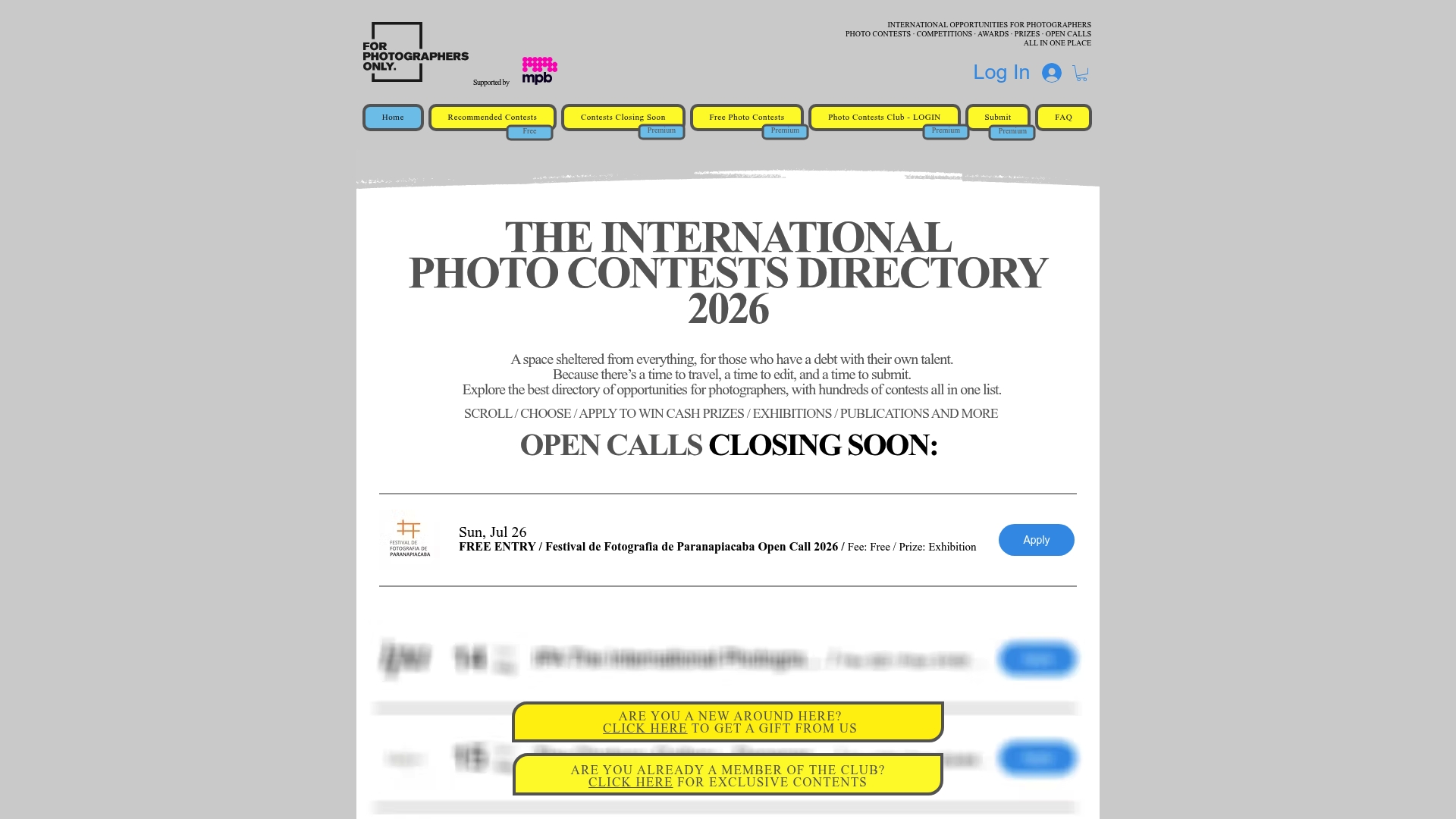
Join the PhotoContestsClub and start comparing contests today, or see the plans and pricing for details.
FAQ
Do all photo contests give feedback to entrants?
No. Many large contests state in their rules that they cannot provide individual feedback because of entry volume. Others give feedback only to winners, offer it as a paid option, or provide short comments on every image. Check the rules for the words “critique” and “feedback” before you enter.
How much does a photo contest critique cost?
It varies by contest. In 2026, South Carolina’s professional photographers’ competition lists critiques at $10 per image, while Icon Awards lists $20 for a public and $25 for a private recorded-video critique. Prices are set each year, so confirm them on the contest’s own page.
When will I receive my feedback?
It depends on the organizer. Some deliver within a few weeks of judging, and others release critiques after an annual event. The rules page normally states the schedule, so read it before you decide to pay for a critique.
Is a low score a sign my photo is weak?
Not by itself. A result reflects one panel, one day and one competitive field. Patterns that repeat across several contests and judges are the more reliable guide to what to change.
Can I get feedback without paying a fee?
Some contests include comments in the entry fee, and local or state association competitions can be good places to get feedback, according to PPA. With more than 100 free-to-enter contests in our directory, you can also enter widely without adding to your entry costs.
Sources
Recommended