Checklist First: 6 Steps for Photographers to Spot Photo Contest Scams

Not every photo contest is a scam, but a large share operate primarily to collect entry fees or sell vanity products rather than reward talent. Before paying anything, check for named judges, verifiable past winners, and limited promotional rights, and open the winners’ page first. For Photographers Only exists precisely to help you skip the guesswork and find the contests worth your time.
TL;DR:
Most scam photo contests generate revenue through entry fees, category stacking, and vanity upsells without awarding significant prizes or verifying winners.
Genuine contests publish the judges’ credentials, past winners, clear prize details, and limit rights to promote only the winning images while maintaining your copyright.
Vet contests by verifying organizer identity, reviewing rights language, analyzing prize-to-fee ratios, and seeking community feedback before paying or submitting images.
If you suspect fraud, document all communications, request chargebacks within 60 days, and report the organizer to regulatory agencies and community groups.
Using vetted directories and resources reduces the risk of scams, with membership-based platforms offering constantly updated lists of legitimate, transparent contests.
Table of Contents
What Are the Most Common Photo Contest Scam Models?
Predatory contests follow patterns you can learn to spot in under a minute. The economics are simple: collect fees from thousands of entrants, pay a handful of small prizes, and pocket the margin. Trovatten’s analysis argues that many competitions are structured around exactly this model, using per-image fees, vague judging panels, and paid upsells to inflate revenue.
The most common patterns include:
Vanity upsells: You get a “congratulations, you’re selected” email, then discover the honor requires buying a $60 commemorative book, plaque, or framed certificate.
Pay-after-upload hooks: Entry is free until you’ve invested time captioning and tagging images, then a “processing fee” or “category unlock” appears before submission finalizes.
Category stacking: The same photo qualifies for five categories, each with its own fee, multiplying what looks like a modest $10 entry into $50.
Rights grabs: Terms and conditions quietly claim “perpetual,” “irrevocable,” or “worldwide” usage rights over every entry, not just winners, letting organizers resell or license your work indefinitely.
Urgency pressure: Flash discounts, countdown timers, and “last chance to enter” emails mimic e-commerce sales tactics rather than the calmer pace of a curated competition.
Fstoppers has documented contests that exist only on their own social channels, with no independent press coverage and no way to verify a single past winner. That isolation is itself a red flag. A legitimate competition leaves a trail; a scam usually leaves none.
How Do Legitimate, Career-Advancing Contests Operate?
Credible contests behave the opposite way at every step. They name their judges, disclose their partners, and let you verify both independently. The National Wildlife Photo Contest publishes its full rule set, entry window, and prize structure openly, including a grand prize and category awards with cash prizes, details published openly, with winners published in National Wildlife magazine.
Rights language tells you almost everything. Reputable organizers request a limited license to promote winning images, not a blanket claim over every submission. Your copyright stays yours.
A useful gut check: search a past winner’s name alongside “profile” or “interview.” If winners never mention the award on their own professional pages, the contest likely carries little real industry weight.
Look for these traits before trusting a competition:
Named judges with credentials you can independently verify on LinkedIn or an institutional site.
A public archive of past winners with dates, images, and often press coverage.
Prize and rights terms stated in plain language, not buried in a linked PDF.
Recognizable partner organizations willing to confirm the relationship if you ask.
The Audubon Photography Awards illustrate this well: entry fees are posted per image for U.S. and Canada entrants, alongside clear eligibility rules and judging terms. World Press Photo, the Sony World Photography Awards, and Wildlife Photographer of the Year operate the same way, with institutional backing and press coverage that follows winners for years. Our judging criteria breakdown walks through how to weigh these signals before you commit an entry fee.
How Do You Vet a Contest Before Paying an Entry Fee?
Run this sequence before you submit a single image or a single dollar.
Verify the organizer’s identity. Look up the business name, physical address, and how long the domain has existed. A contest launched three weeks ago with no history deserves extra scrutiny.
Search the named judges. Cross-check each judge on LinkedIn, an institutional bio page, or prior contest credits. If a “renowned photographer” has no searchable footprint, that’s a problem.
Read the rights clause word for word. Reject any contest claiming “perpetual,” “irrevocable,” or “unlimited” rights over entries that don’t win. Legitimate rules limit rights to winning images used for promotion.
Do the prize math. If a contest expects 5,000 entrants paying $20 each, that’s $100,000 in fees. Compare that against the advertised prize pool and the number of winners actually paid.
Check community discussions. Search the contest name on Reddit and in photography Facebook groups for complaints, confirmations, or silence, which is itself informative.
Email the organizer directly. Ask specific questions, who owns the rights to non-winning entries, who judges, when winners are announced, and require written answers before you pay.
Pro Tip: Open the “past winners” page before you open the entry form. If you can’t find one, or it only shows thumbnails with no names, treat that as your answer.
Our rules template guide shows what clear, entrant-friendly rights language actually looks like, so you have something to compare against.
What Should You Do If You Suspect a Photo Contest Scam?
Act fast and document everything. Screenshot the landing page, the full terms and conditions, and every email exchange before anything gets edited or deleted.
Save receipts and payment confirmations immediately; they’re your evidence for a dispute.
Contact your card issuer or payment processor to request a chargeback, most allow disputes within 60 to 120 days of the charge.
Report the organizer to the platform hosting their page, whether that’s a social network, a payment processor, or a hosting provider, and file a complaint with a consumer-protection body like the FTC when the pattern looks like clear fraud.
Post a warning in relevant photography communities so others don’t fall for the same hook.
If the contest claims a partnership with a known brand or publication, contact that partner directly to confirm the relationship is real.
How Does For Photographers Only Vet the Contests It Lists?
Rather than chasing down every claim yourself, you can lean on a directory built specifically to filter out the noise. Forphotographersonly tracks 320 to 330 active international photography contests at any given time, including more than 100 completely free-to-enter opportunities, updated weekly.
Every listing gets checked against the same signals covered above:
Named judges with verifiable credentials, not vague “panel of experts” language.
Rights terms limited to winning entries, never blanket claims over every submission.
Transparent prize structures with real payout numbers, not just “exposure.”
A demonstrable history of past winners you can actually find and verify.
Full access runs $6 per month, less than most single entry fees, and puts every vetted opportunity on one continuously updated page instead of scattered across a dozen social feeds.
What Are Some Well-Known Photo Contest Scams and Their Impact?
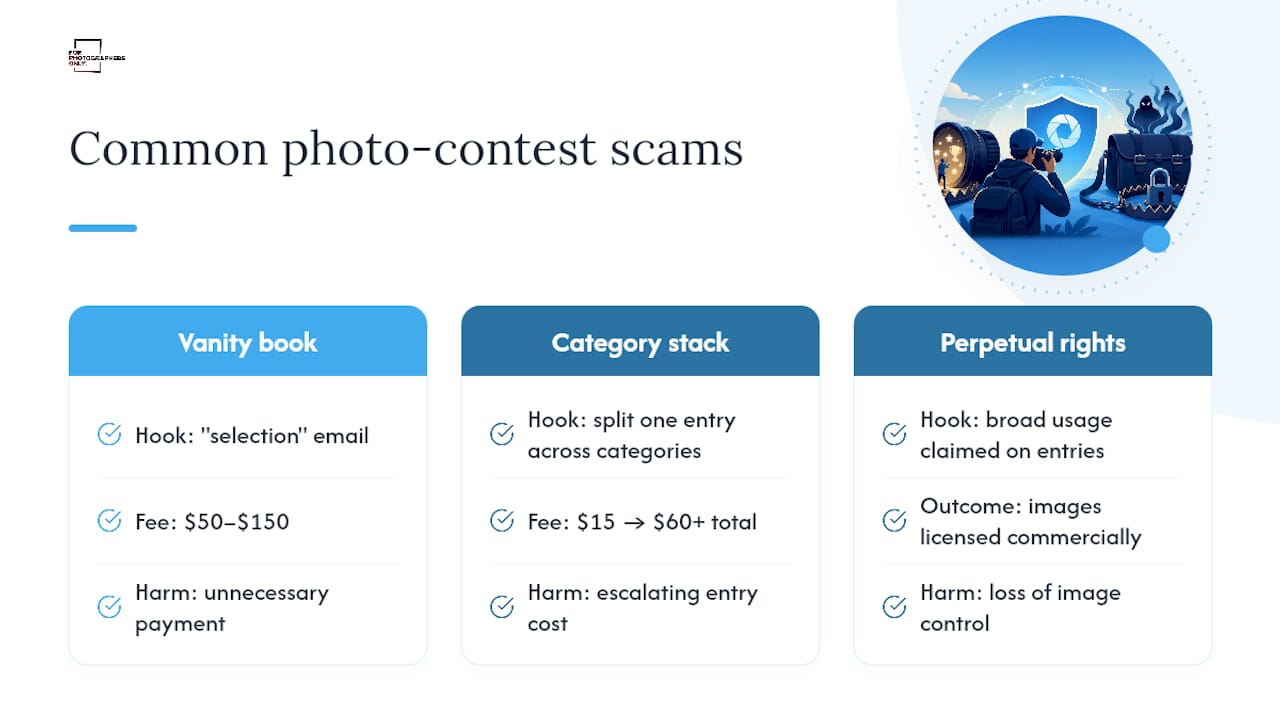
The “vanity book” scheme has hit thousands of photographers over the years. Entrants receive a selection email, only to learn that inclusion in the published anthology costs $50 to $150. Almost everyone who pays gets “selected,” because the book is the product, not the recognition.
Category-stacking scams have caused similar damage, particularly on contests that market heavily through Instagram ads. A single submission gets split across nature, portrait, and “open” categories, each carrying its own fee, turning what looked like a $15 entry into $60 or more before the photographer notices.
Perpetual rights-grab contests carry a quieter but longer-lasting cost. Improve Photography warns that organizers sometimes claim broad usage rights over every entry, not just winners, then license those images commercially with no compensation to the photographer. The financial loss from a single entry fee is small. The loss of control over your own image library is not.
The reputational damage compounds too. Photographers who’ve been burned once often stop entering contests altogether, including the legitimate ones that could have advanced their careers. That chilling effect is arguably the scam’s most lasting cost.
How Can You Share Your Photos Online Without Getting Exploited?
Every photo you upload for a contest is also a photo you’re exposing to potential misuse, so treat the sharing process itself as part of your vetting.
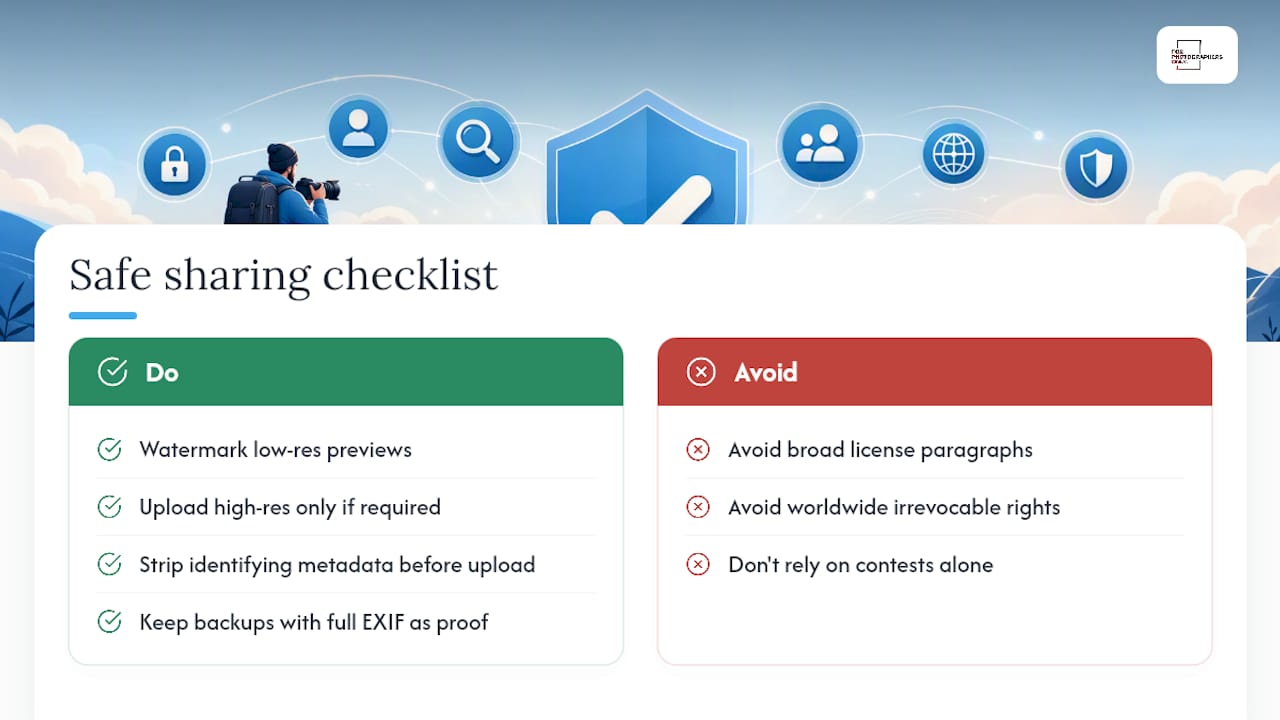
Watermark low-resolution preview versions when a platform allows it, and never upload your highest-resolution master file unless the contest specifically requires it for judging or printing. Strip identifying metadata you don’t want public, but keep your own backup copies with full EXIF data intact as proof of authorship and capture date.
Reverse-image-search your own portfolio periodically using Google Images or TinEye. It’s the fastest way to discover if a contest, or anyone else, has reused your work beyond the terms you agreed to.
Read the rights clause before the entry form, not after. A one-sentence license limited to “promotional use of winning entries” is normal and fine. A paragraph invoking “worldwide,” “irrevocable,” and “sublicensable” rights over every submission is not, regardless of how small the contest looks.
If you want to showcase your work publicly without handing over broad usage rights, platforms built around proof without full exposure let you demonstrate ability while keeping control over how images circulate. Combining that caution with a diversified visibility strategy, rather than relying on contests alone, also reduces how much leverage any single organizer has over your work.
How Do You Tell a Promotional Contest From a Scam?
Plenty of brands run genuine promotional giveaways: a camera company wants user-generated content, so it offers a modest prize for the best submission tagged with a hashtag. That’s not a scam. The tell is what happens after you enter.
A promotional contest asks for a photo and, at most, your agreement to let the brand repost it with credit. A scam asks for a fee, then asks for another fee, then tries to sell you something after you’ve already been told you’re “selected.” Promotional contests rarely charge entry fees at all, since the brand’s real goal is engagement and content, not revenue from entrants.
Check who benefits and how. A promotional giveaway benefits the brand through visibility and the entrant through a small prize and light exposure, a fair trade both sides understand upfront. A scam benefits primarily the organizer, through fees, upsells, or harvested rights, while the “prize” is often incidental or never paid out at all.
Look at the disclosed relationship, too. Legitimate promotional contests name the brand running them clearly, often through an official account or verified page. Fine print matters more than tone: read the rights and fee language before deciding, not the marketing copy around it.
Where Can Scam Victims Find Support and Advice?
You’re not without recourse if a contest has already taken your money or your rights.
Start with the FTC’s fraud reporting portal, which tracks patterns across complaints and can trigger broader investigations when enough photographers report the same organizer. Your payment provider is your fastest path to recovering money directly, most card networks and services like PayPal have formal dispute processes with defined windows.
Photography-specific communities move faster than official channels for warnings. Subreddits focused on photography, along with regional photographer Facebook groups, often surface organizer names within days of the first complaint. Posting your experience there protects the next person who searches the contest’s name before entering.
If the fraud involved wire transfer or crosses international borders, your country’s consumer-protection agency or the Internet Crime Complaint Center (for U.S. residents) can log the case even when a chargeback isn’t possible. Document everything before you file: dates, amounts, and every piece of correspondence.
A Curator’s Note on Entering Contests Wisely
I’ve watched talented photographers burn money and, worse, lose faith in contests entirely after one bad experience. That’s the real cost. Vet every contest the way you’d vet a client, and don’t hesitate to flag a suspicious one to your community. Use a resource like our legit contest guide before you trust your work, or your wallet, to a stranger’s promise of exposure.
— DARIO
Where Can You Find Contests That Have Already Been Vetted?
Skipping the manual verification step on every single contest is exactly why Forphotographersonly exists. Instead of Googling judge names and reading rights clauses at midnight before a deadline, you get one continuously updated page listing 320 to 330 active contests, more than 100 of them completely free to enter, each already checked for the red flags this article covers.
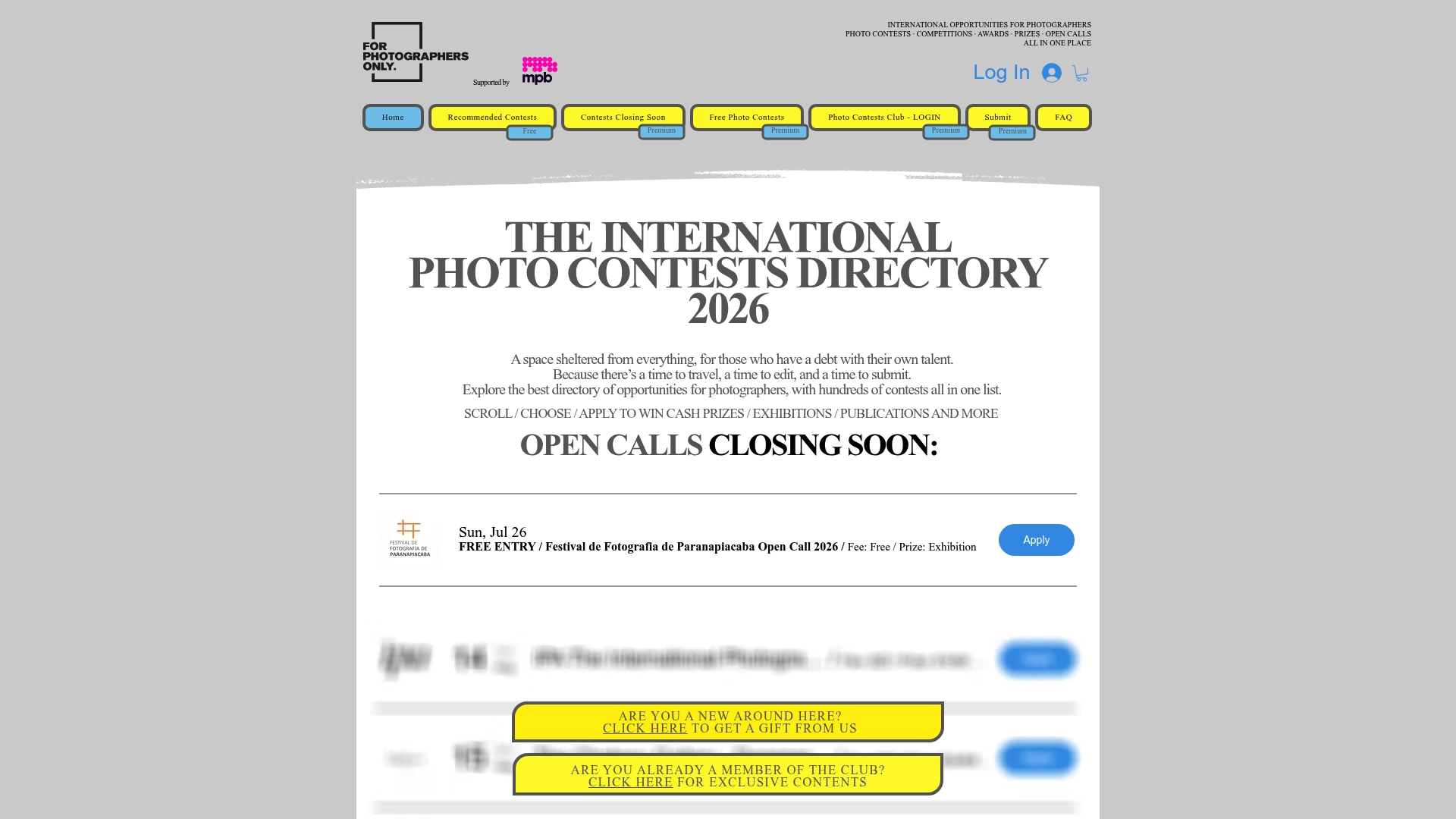
Take the Robert Giard Grant for Emerging LGBTQ+ Photographers as an example of what a vetted listing actually looks like on the directory: clear eligibility, a transparent award structure, and no buried rights clause waiting to surprise you after submission. That’s the standard every listing gets held to before it appears on the page.
Membership costs $6 a month and includes a free trial, giving you full access to the chronological listing, filters by deadline and genre, and alerts so you never miss an entry window for a contest worth your time. Once you know which contests operate with named judges and clean terms, our strategy guide for winning can help you actually place. Start your trial and see the current list of vetted opportunities today.
Sources
Recommended