Pet Photography Contests: Shortlist and How to Enter

The strongest pet photography contests available right now are the International Pet Photography Awards (juried, cash prizes, judge feedback), the Dog Photography Awards (juried, annual winners book, canine-specific), and Pupvote (public vote, free entry, weekly prizes). The Forphotographersonly directory lists all three alongside 320–330 active competitions in one place, updated weekly. Your single next action: pick one juried and one public-vote contest, then prepare your files to the stricter contest’s specifications so one submission package covers both.
Juried recognition: International Pet Photography Awards, Dog Photography Awards
Community exposure and quick prizes: Pupvote
Directory to track all deadlines and fees: Forphotographersonly
Pro Tip: Start with the International Pet Photography Awards’ Phone or Studio category if you are newer to competition. The 2026 contest drew 4,220 entries across 12+ categories, meaning niche categories face far less competition than the open portrait class.
Table of Contents
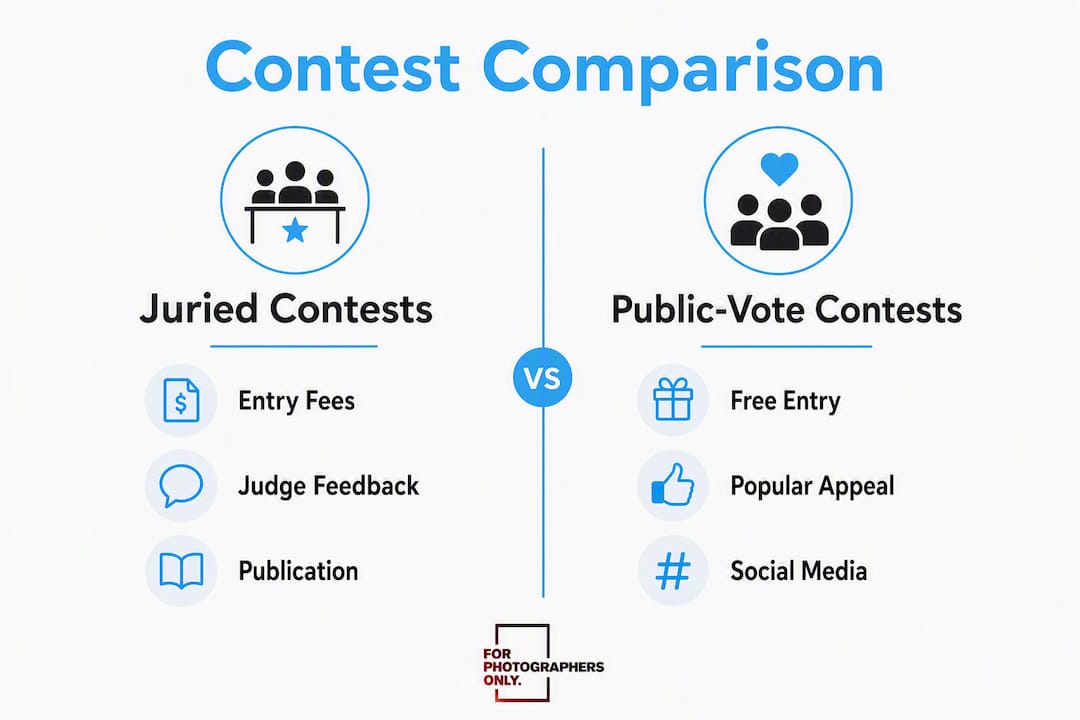
How do these pet photo competitions compare?
The table below maps each option across the dimensions that matter most when shortlisting. Fees and deadlines shift yearly; always verify current figures on each official page before submitting.
Contest | Who can enter | Entry fee | Categories accepted | Prize type | Judging format | File specs (typical) | Submission window |
All photographers worldwide | From €6/month (directory subscription) | All genres including pet, wildlife, portrait | Contest discovery, deadline tracking, free-entry options | Curated directory (not a contest organizer) | Varies by listed contest | Weekly updates; ongoing access | |
Open to all (amateur & pro tiers) | Paid per entry (verify current fee) | Portrait, Action, Documentary, Phone, Studio, In-Camera Artistry, Commissioned Portfolio, 12+ total | Cash prizes, trophies, judge feedback, publication | Juried panel of specialist photographers | JPEG, sRGB, typically 2–5 MB max | Annual; winners announced post-judging | |
Open to all | Paid per entry (verify current fee) | Canine-focused categories | Cash prizes, annual winners book, gallery feature | Juried panel of photography experts | JPEG, sRGB (verify specs on site) | Annual; winners published in book | |
Open to all | Free | Dog and pet photo categories | Weekly cash prizes | Public community vote | Standard JPEG upload | Ongoing weekly cycles |
Quick-filter tags:
Note: Entry fees, prize amounts, and deadlines change from year to year. Treat every figure in this table as a starting point and confirm current details on each contest’s official rules page before submitting.
How do you choose which contest to enter?
Matching your goals to the right competition saves time and produces better results than entering everything at once.
Start with your primary goal:
Cash and career credibility: Prioritize juried contests. Entries judged by multi-expert panels carry more professional weight than mass-vote results, and a finalist credit from the International Pet Photography Awards or Dog Photography Awards is a portfolio credential that holds up in client conversations.
Quick exposure and community feedback: Pupvote’s free, weekly format suits photographers who want to test images with a live audience and build a following without a financial commitment.
Publication or exhibition: The Dog Photography Awards produces an annual winners book, and the International Pet Photography Awards offers publication and exhibition opportunities. These are the contests to target when editorial visibility is the goal.
Critique and improvement: The International Pet Photography Awards returns individual scores and judge feedback to entrants, making it one of the most instructive competitions available regardless of whether you place.
Check your level and category fit:
Prestigious contests differentiate between amateur and professional entry tiers, so confirm which tier applies before submitting. Then look for the category that fits your actual work: portrait, action, documentary, phone, studio, or portfolio series. The addition of Phone and In-Camera Artistry categories means mobile photographers now have a level playing field in major competitions.
Red flags to watch for:
Copyright terms that transfer ownership or grant broad commercial licenses to the organizer
No named judging panel or verifiable judge credentials
Mandatory purchase to view winners or receive results
Prize claims with no published breakdown of amounts or conditions
Pro Tip: Prioritize contests that return judge feedback or offer publication. The feedback alone is worth the entry fee in most cases, and a publication credit compounds in value over time.
What does a complete entry actually require?
Follow this workflow for every submission to avoid disqualification on technical grounds.
Select your images. Choose shots that fit the specific category, not just your personal favorites. Strong category fit is the first filter judges apply.
Prepare your files. Export as JPEG, sRGB color profile, typically 2–5 MB per file (check the contest’s current specs). Rename files clearly: LastName_FirstName_CategoryName_01.jpg.
Write your caption. One to two sentences covering the subject, location or context, and what makes the moment significant. Camera and lens details are optional but can support a technical category entry.
Check model and property releases. A release is typically required when an identifiable person appears in the frame. For pet-only images, releases are rarely needed, but confirm with the contest’s official rules.
Upload and pay. Complete the entry form fully before payment. Incomplete forms are a common reason for disqualification.
Confirm receipt. Save your confirmation email and note the expected announcement date.
Common file specification examples:
Spec | Typical requirement | Notes |
Format | JPEG | No TIFF, RAW, or PNG in most contests |
Color profile | sRGB | Adobe RGB may be rejected |
File size | 2–5 MB max | Verify per contest; typically 2–5 MB per file |
Long edge | — | Check for minimum as well as maximum |
Naming | LastName_Category_01 | Avoid spaces and special characters |
Caption guidance: Keep it specific. “Golden retriever mid-leap at Malibu beach, October 2025, captured at 1/2000s to freeze motion” tells a judge more than “my dog at the beach.” The story behind the image matters, especially in documentary and action categories.
What do judges actually look for, and how can you improve your chances?
Juried panels evaluate entries across four consistent dimensions: technical execution, emotional resonance, originality, and category fit. Understanding each one changes how you shoot and edit.

Technical execution covers sharpness at the point of focus (usually the eyes), correct exposure, and clean backgrounds. A distracting background is the single most common reason a technically capable image fails to place.
Emotional resonance is harder to define but easy to recognize: the image makes the viewer feel something. Strong eye contact between subject and camera, a decisive moment of play or rest, or an unexpected expression all create that connection. Study past winners’ galleries and you will notice that the winning images rarely rely on elaborate setups. Simplicity, a clear subject, and genuine interaction between pet and environment recur across categories.
Originality does not mean unusual processing. It means a perspective, moment, or compositional choice the judge has not seen a hundred times before. Low angles, unusual light, and candid behavior tend to score higher than posed studio setups in open categories.
Category-specific notes:
Portrait: Eyes sharp, background clean, expression natural rather than forced.
Action: Freeze motion with a fast shutter; the peak of the action (mid-leap, water splash) beats a blurred approximation.
Documentary: Context and story matter as much as technical quality. Show the relationship, not just the animal.
Phone: Judges know the limitations of mobile sensors. Composition and moment carry more weight than resolution.
Portfolio/series: Cohesion across images is scored separately from individual image quality.
Pro Tip: When a contest scores finalists cumulatively across multiple entries, submitting a cohesive body of work outperforms a single standout shot. Three consistent, strong images will outscore one exceptional image and two weak ones.
On editing: Tasteful retouching (exposure, color, minor distraction removal) is accepted in most contests. Heavy compositing, sky replacements, and AI-generated elements are increasingly prohibited in documentary and open categories. Read the rules on post-processing before you edit.
Where can you study past winners and what patterns do they share?
The fastest way to improve your entries is to spend thirty minutes with each contest’s winners gallery before you submit.
Where to look:
International Pet Photography Awards winners gallery — broad range of categories, strong for studying how different genres are judged
Dog Photography Awards winners gallery — canine-specific; excellent for studying how judges respond to breed character and behavior
Popular Science’s 2026 International Pet Photography Awards coverage — editorial curation of standout images with brief context
Patterns that repeat across winning images:
Clean, uncluttered backgrounds that isolate the subject
Sharp focus on the nearest eye, even in action shots
A single clear emotional beat: curiosity, joy, rest, or intensity
Light that defines form rather than flattens it (side light, backlight, or soft window light)
Minimal post-processing that preserves the natural quality of fur and feathers
How to use these galleries productively: Build a study set of ten to fifteen winning images from the category you plan to enter. Note the focal length, apparent light source, and the moment chosen. Then ask whether your own portfolio contains images with those qualities. If not, that is your shooting brief for the next session.
Key Takeaways
The most effective approach to pet photography contests is to match your entry to a specific category, prepare files to the strictest specs in your shortlist, and prioritize contests that return judge feedback or offer publication.
Point | Details |
Match contest to goal | Juried contests build career credibility; public-vote contests build community exposure quickly. |
File specs matter | Export JPEG, sRGB, 2–5 MB; confirm current specs on each official rules page before submitting. |
Prioritize feedback contests | The International Pet Photography Awards returns individual scores and judge comments to all entrants. |
Submit a cohesive body of work | Finalists in cumulative-scoring contests are determined across multiple entries, not a single image. |
Use Forphotographersonly to track contests | The directory lists 320–330 active competitions with deadlines, fees, and free-entry options in one place. |
What entering contests actually teaches you
There is a version of contest entry that most photographers skip: treating the submission process itself as a diagnostic. Selecting images for a juried panel forces a level of self-criticism that editing for a client rarely does. You are not choosing what the client asked for; you are choosing what holds up against the best work in the world in that category.
The judge feedback that comes back from competitions like the International Pet Photography Awards tends to surface the same blind spots photographers carry for years without noticing: a slight softness in the eyes, a background element that competes with the subject, a moment that is close to decisive but not quite there. One round of that feedback, applied honestly, reshapes how you shoot the next session.
The practical lesson for workflow: schedule contest entries the way you schedule client shoots. Set a deadline, allocate two hours for image selection and file preparation, and submit. Treating it as an afterthought produces afterthought entries. Treating it as a professional obligation produces work you are genuinely proud to put in front of a panel.
Forphotographersonly: one place to find every contest worth entering
Searching for pet photo competitions across a dozen organizer websites, cross-referencing deadlines, and tracking which contests you have already entered is the part of contest photography that nobody talks about. Forphotographersonly solves that problem directly.
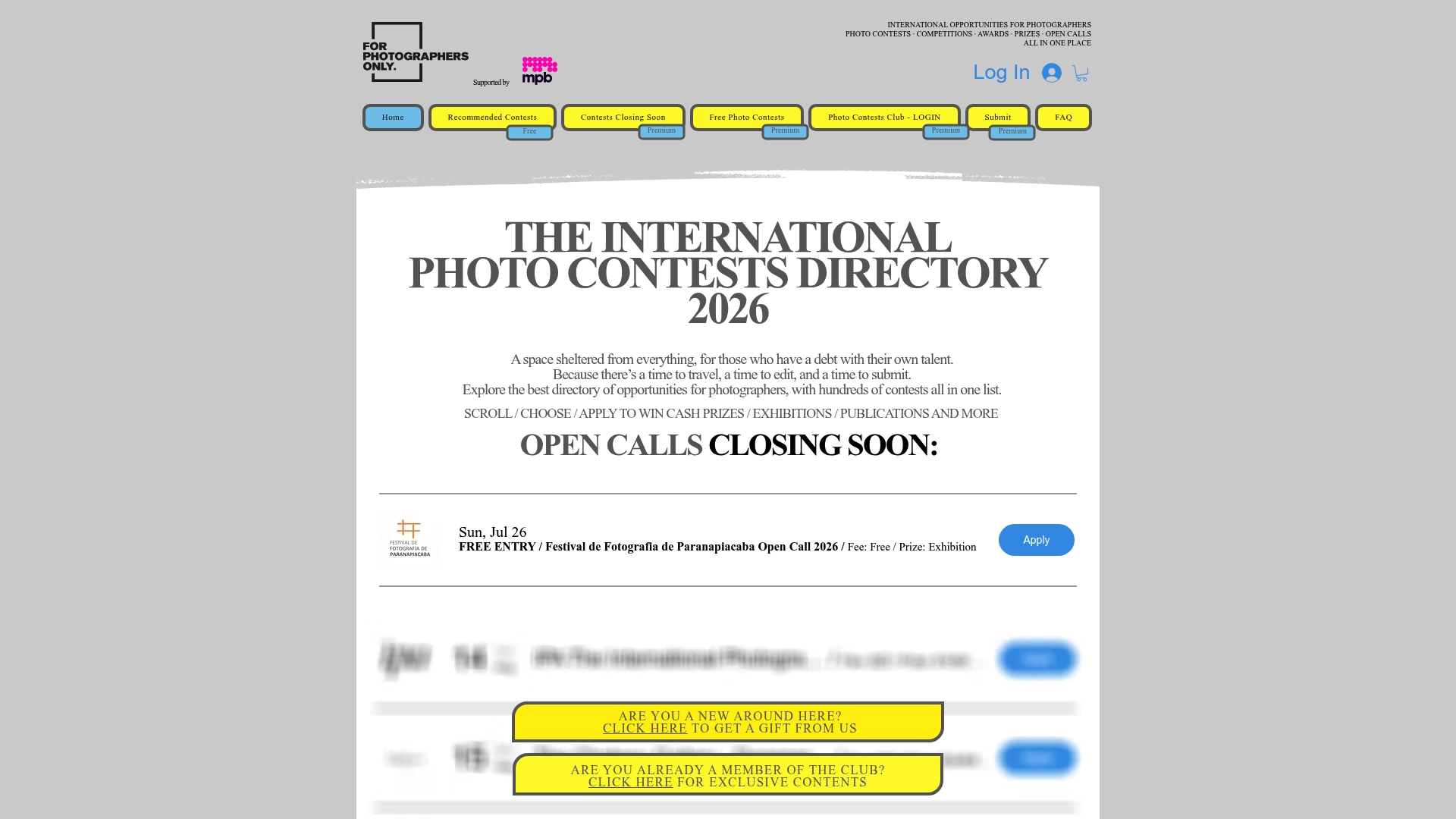
The directory lists 320–330 active international photography contests, updated every week, with more than 100 free-to-enter options included. Every listing shows the deadline, entry fee, prize type, and category so you can filter by what matters to you without opening a separate tab for each organizer. For photographers who enter multiple competitions a year, the time saved on research alone justifies the subscription. Plans start at €6 per month, with a free trial available.
Browse the full contest directory and build your shortlist for the year in one session.
Useful sources and official contest pages
Verify current rules, fees, and deadlines directly on each official page before submitting. Rights terms and prize structures change annually.
Official contest pages:
International Pet Photography Awards — full rules, entry portal, category list, and judging panel
Dog Photography Awards — annual competition details, winners gallery, and annual book information
AKC Photo Contest — American Kennel Club’s annual photo contest, open to all, cash prizes
Further reading and coverage:
Popular Science — 2026 International Pet Photography Awards — editorial selection of standout 2026 finalists with context
Amateur Photographer — 2026 finalists coverage — category breakdown and notes on new additions like Phone and Studio
Always read the official rules for rights and licensing terms before entering. Some contests claim broad usage rights to all submitted images, not only winners. If the rights clause is unclear, contact the organizer directly before you upload.
Recommended