Open Theme Photo Contests: How to Find and Enter the Right Ones

An open theme photo contest accepts any subject, style or genre, so the strength of the image matters more than how well it fits a brief. The best way to choose one is to compare five things before you upload anything: the entry fee, the eligibility rules, the rights you grant, the prize or exposure on offer, and whether the call is genuinely open today. This guide walks through each of those, with real examples from current calls in the United States and abroad.
TL;DR
Open theme means no assigned subject, but most calls still set limits on residency, age, image count, editing and AI-generated work.
Fees range from free to a few dollars per image to a flat fee for a small group of images. Compare the cost against what the prize or exhibition actually delivers.
Keep your copyright, and read the license clause. A non-exclusive license for promotion is common; an assignment of ownership is a warning sign.
Always confirm the deadline and rules on the organizer’s own page before paying.
A curated, regularly updated directory saves the hours that scattered searching costs.
Table of Contents
What “open theme” really means
In a themed contest, the organizer sets the subject: wildlife, street life, the climate, a city. An open theme call removes that constraint. You can submit portraits, landscapes, documentary work, abstracts or conceptual pieces, and the jury responds to whatever is most compelling in front of them.
That freedom is an opportunity for photographers whose work does not sit neatly in one category. It also means the competition is broad, and jurors compare very different pictures side by side. Strong entries tend to share a clear point of view, technical control and a sense that the photographer made deliberate choices.
Open does not mean unrestricted. Even the most generous calls usually specify who may enter, how many images are allowed, what file preparation is expected and what editing is acceptable. Those details differ sharply from one contest to the next, and they are where entries are won or disqualified.
Examples of open theme calls and how they differ
The following contests show how much variety hides behind the same label. Treat them as illustrations of what to compare, and check each organizer’s page for the current edition.
A regional juried exhibition
Bay Area Photography Open 2026 is a juried exhibition for photographers based in the nine Bay Area counties. The theme is open, with AI-generated images excluded. Selected artists receive a softcover catalog and presentation in an online gallery and on social media. The non-refundable fee is $40 for up to three images.
This is a good model of a local call: a narrower pool of entrants, a tangible printed result and a fee that covers a small group of images rather than charging per frame.
A monthly, genre-open contest
One Eyeland Open 2026 runs monthly with an entry deadline on the last day of each month and a fee of $5 per image. It is open to all genres and awards cash prizes to up to 25 photographers each month, funded by 50% of total entry fees.
A monthly rhythm suits photographers who want repeated chances without waiting for a single annual deadline. The per-image fee means you can control your spending by entering only your strongest frames.
A free international call with an exhibition cost
The Palaio Faliro Athens Riviera Photo Festival 2026 “Open Theme” call invited any subject or style. Submissions were free, with up to four single-image entries or up to ten images for a three-image set, and entrants had to be over 18. Selected photographers who chose to exhibit paid a participation fee.
This example shows why “free to enter” is only part of the cost picture. When a call is free but the exhibition carries a fee, decide in advance whether the show is worth it to you.
A municipal public-art call
The City of San José ran a sports-themed call for photographers that required a San José address, allowed up to three digital photographs and paid $250 per selected photograph, up to two images or $500. It closed on September 30, 2025. It is a useful reminder that some calls pay the artist rather than charging a fee, and that many of them recur in later years, so a closed call is worth bookmarking.
Fees: what you pay and what to expect back
Fees are the first filter for most photographers, and for good reason. Compare calls on a consistent basis.
Fee model | Example from above | What to weigh |
Free to enter | Palaio Faliro (entry), San José public-art call | Check for later costs, such as exhibition participation fees |
Per image | One Eyeland Open, $5 per image | Total cost rises with every frame, so edit hard |
Flat fee for a small set | Bay Area Photography Open, $40 for up to three images | Good value if you have a tight, coherent group |
A few questions help you judge whether a fee is reasonable:
What does the money fund? Some contests state that a share of fees becomes the prize pool. One Eyeland Open, for instance, says the pool comes from 50% of entry fees.
What do selected artists receive? A printed catalog, a gallery show, magazine publication or cash each carry a different value for your career.
Is the fee refundable? Many are not, as with the Bay Area call.
Are there hidden costs, such as printing, framing, shipping or exhibition participation?
Free-entry contests deserve a place in your plan, especially if you are new to competing. Some sponsors and organizations run them to build a library of images or to reward participation. Two recent examples from the US are the Share the Experience contest, with no entry fee and up to 50 submissions per entrant in its 2026 edition, and the NWTF photo contest, which has no entry fee and no limit on the number of entries. Both are themed rather than open, which brings us to the next point: free does not always mean unrestricted.
Eligibility: read this before you fall in love with a call
Eligibility rules are the most common reason a strong entry never reaches a juror. Look for the following.
Residency. Some calls are worldwide. Others are tied to a place. The Bay Area call is limited to photographers based in nine counties, and the San José call required a local address. Share the Experience is open to legal residents of the 50 United States or Washington, D.C.
Age. Share the Experience requires entrants to be 13 or older as of September 1, 2026, with parental consent for those under 18. The NWTF contest is open to U.S. residents over 18. Palaio Faliro required entrants to be over 18.
Professional status. Some contests are amateur-only. The Share the Experience rules exclude professional photographers, including people employed as photographers or whose photography business is intended to earn most of their income. If you shoot for a living, check this clause in every consumer-brand or agency-sponsored contest.
Subject and location limits. An open theme call is open in subject, but sponsored contests often add other constraints. Share the Experience, for example, restricts entries to photos taken on federal public lands or waters managed by agencies such as the NPS, USFS or BLM.
Editing and AI. The Bay Area call excludes AI-generated images. Share the Experience may disqualify photos its organizers consider noticeably or excessively altered, and asks for fair, accurate representations of what the photographer witnessed. Documentary and nature categories are generally stricter than fine art or conceptual ones, so read the editing policy for your genre.

Rights and licensing: what you actually grant
Copyright is where careless entries cost photographers the most. The standard you should expect is that you keep ownership of your images and grant the organizer a limited license to display and promote the contest.
The NWTF rules show what that looks like in practice. Entrants retain copyright but grant the organization and its designees an irrevocable, non-exclusive, royalty-free, perpetual license to use entries in publications, calendars, electronic media and promotion. That is a broad license, and it lasts indefinitely, but you still own the work and can license it elsewhere.
General guidance for photographers is consistent on the key points. A guide to copyright in photo contests says photographers should normally keep their copyright, treats any clause that has you assign, transfer or forfeit it as a major red flag, and describes non-exclusive licenses as generally safer.
Before you submit, scan the rules for these phrases:
Assignment or transfer of ownership. Avoid.
Exclusive license. This could block you from selling or licensing the image elsewhere.
Perpetual, irrevocable use for any purpose. Consider whether you are comfortable, especially for images with people in them, which may need model releases.
Use limited to promoting the contest and exhibiting the work. This is the reasonable baseline.
If a clause is unclear, ask the organizer in writing before you pay. For legal questions about a specific contract, a copyright attorney or a photographers’ professional association is the right place to turn.
How to choose the right open theme contest
Use a short checklist so that every call is judged the same way.
Define your goal. Cash, exhibition, publication and portfolio credibility are different outcomes. A printed catalog serves a different purpose than a monthly cash prize.
Match the jury and audience to your work. Curators of contemporary art and editors of a documentary magazine respond to different pictures. Look at past winners.
Set an annual budget. Decide how much you will spend on fees and divide it among the calls with the best fit.
Check eligibility and rights. Use the sections above.
Prepare a tight edit. For flat-fee or small-set calls, a coherent series often beats a random mix.
Confirm the call is current. More on this next.
Confirming a call is current and submitting by the official rules
Calls change quickly. Deadlines move, editions end and fees rise at set points. An outdated listing, a repost or a search snippet can easily show last year’s details, and the San José example above shows how a call can be gone while its page remains.
A simple routine protects you:
Go to the organizer’s own page. Do not rely on a repost. Look for the current year in the title and in the rules.
Read the official rules document. Confirm the deadline, time zone, eligibility, fee, image specifications and license terms.
Check for tiered fees. Some contests charge less for early entries. The official page states the schedule for the current edition.
Look for a contact address. A real contest names an organizer and offers a way to ask questions.
Keep your confirmation. Save the receipt and a copy of the rules as they stood on the day you entered.
Submit early. Upload problems often appear in the final hours before a deadline.
Recurring contests follow a pattern. One Eyeland Open closes each month. Others open in autumn and run to winter, or reopen every year with a new edition. When a call is closed, note the usual window and watch for the next edition.
Perspective
Open theme contests are among the most generous formats in photography. They invite a photographer to say what they want to say, and they reward a distinct way of seeing rather than a good fit to a brief. What we see across hundreds of calls is that the best opportunities are rarely the loudest. A regional exhibition, a magazine feature or a festival with a thoughtful jury can open more doors than a famous name with thousands of entrants. Finding those calls is a research problem, and it consumes time that photographers would rather spend making pictures. That is why we built our directory around a single, chronological page. We do not organize contests ourselves. We research, curate and publish international calls from established brands and institutions as well as niche contests and independent festivals, with deadlines, fees, prizes and genres in one place. A photographer can then compare open theme options at a glance and decide where their work belongs. We believe every emerging photographer deserves access to the same map of opportunities as the best-connected ones. DARIO
Build a contest calendar that works
A calendar turns scattered deadlines into a plan. Start by listing every call that fits your work, then sort by deadline and fee. Place free and low-cost calls early in the year to build momentum, and reserve your larger fees for the juried exhibitions and awards with the clearest return.
Photographers often get better results by building a series for open theme calls rather than submitting unrelated singles. A series signals intent. Where a call accepts three images, choose three that speak to each other in light, palette, subject or mood. Where it accepts a single image, choose the frame that works without a caption.
It also helps to explore adjacent niches. If you shoot in black and white, our guide to black and white photo contests lists calls where that choice is an advantage. If your work is botanical, see botanical photography competitions. Local photographers may find our overview of Seattle photography competitions useful, and the full blog archive covers more genres and cities.
A few habits make a calendar more useful over time:
Record the fee, deadline, number of images and license terms for every call you enter.
Note the result and any juror feedback, so you can see which kinds of images travel.
Keep a master folder of correctly sized, captioned files so you can enter quickly.
Review your plan monthly, since new calls appear and others close.
Save research time with one curated list
If you would rather not rebuild this list every month, our directory does it for you. PhotoContestsClub gives you one continuously updated page of international photography contests, awards, calls, prizes and grants, with deadlines, fees, prizes and genres, plus more than 100 free-to-enter opportunities. It also includes a photographer community and a monthly internal competition for members.
Plans cost €6 per month or €40 per year, and a free trial is offered. The directory is updated every week and includes competitions organized by major brands and institutions as well as independent festivals and lesser-known calls.
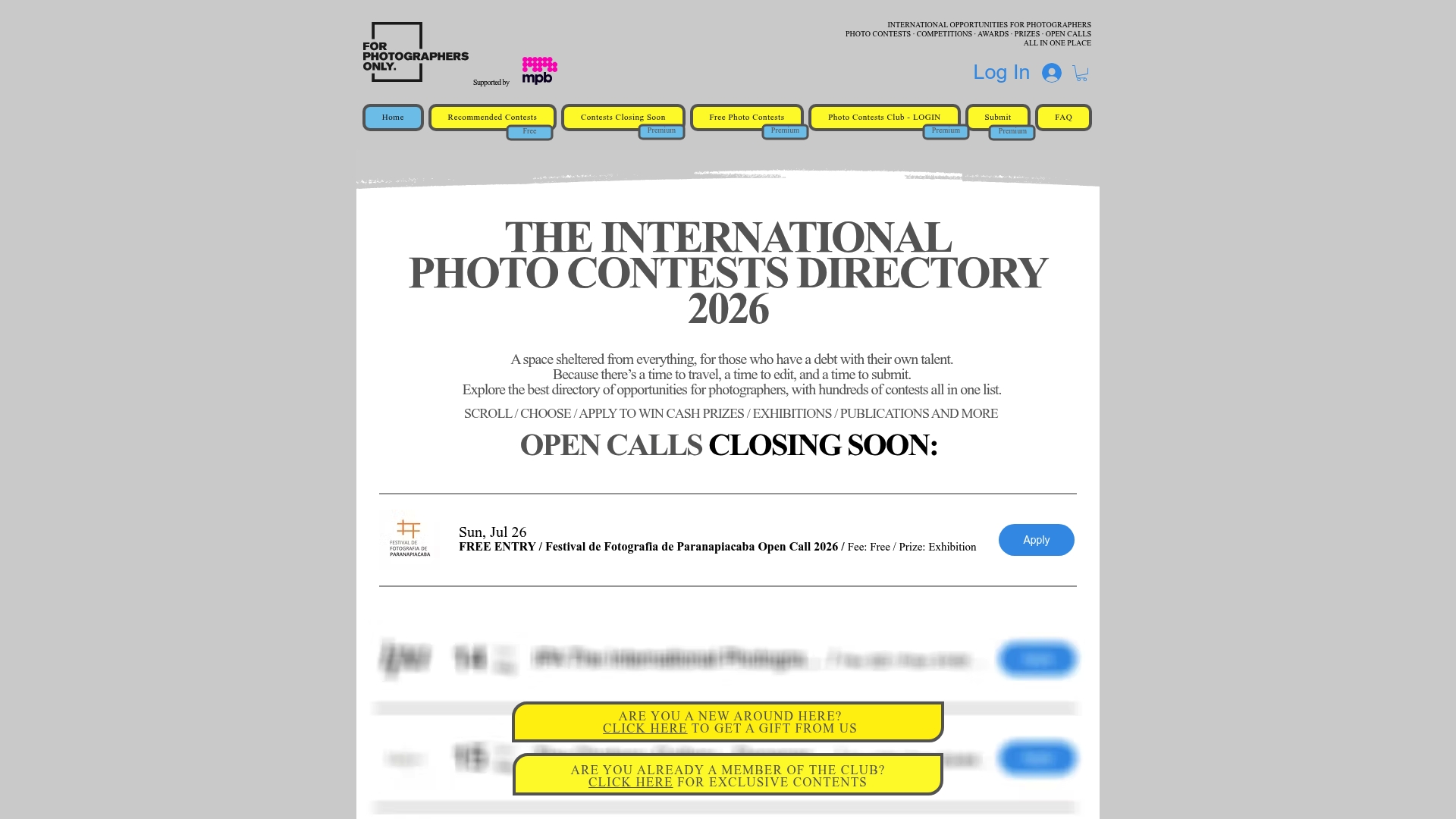
Explore the PhotoContestsClub directory to see current open theme calls in chronological order, or visit our home page to learn more.
Presenting your work well
A good open theme entry is more than a good photograph. Jurors see many images in a short time, and presentation helps yours hold attention.
Edit with discipline. Cut weaker frames. If a contest allows three images, three excellent ones beat a padded selection.
Follow the technical brief. Use the requested file size, format and naming. A technically compliant file avoids a disqualification that has nothing to do with your talent.
Write a clear caption and statement. When captions are requested, be factual and brief. Where a short statement is allowed, say what you were looking at and why it mattered.
Respect the editing rules. If a call asks for faithful representation or excludes AI-generated images, comply fully. Keep your RAW files and edit history in case an organizer asks for them.
Think about the sequence. When several images are allowed, think about how a juror will move from one to the next. Lead with the strongest.
Keep your bio ready. Many calls ask for a short biography. Our guide to photographer bio submissions can help you prepare one once and reuse it.
For featured past calls of this type, our posts on the IPA International Photography Awards and the Annual Photography Awards show how we present deadlines, fees and prizes for large international competitions.
FAQ
Are open theme photo contests easier to win than themed ones?
Not necessarily. An open theme removes the brief, so more photographers can enter, and jurors compare very different images. Your best chance comes from a distinctive point of view, a tight edit and a contest whose jury suits your style.
Can I enter the same photo in more than one contest?
Often yes, but check each set of rules. Some calls require images that have not been published or have not won elsewhere. A clause that grants an exclusive license can also stop you from using the same image in another contest.
Are free photo contests worth entering?
Yes, as part of a balanced plan. Free calls cost nothing to enter and can bring exhibition, publication or prizes. Read the rules for restrictions on eligibility, subject and editing, and for any costs after selection, such as exhibition participation fees.
Do I keep my copyright if I win?
In reputable contests you keep it and grant a limited license for promotion and display. The NWTF contest is one example: entrants retain copyright and grant a non-exclusive license. If a contest asks you to assign or transfer ownership, ask the organizer to clarify before you enter.
How can I tell if a contest is still open?
Go to the organizer’s official page and read the current rules, deadline and edition year. Avoid relying on reposts or search snippets. Save a copy of the rules and your entry receipt once you submit.
Sources
Recommended