Museum Photography Competitions: US Calls to Enter

Museum photography competitions are juried contests that a museum or arts center runs itself, usually ending in a gallery exhibition. In the United States they range from a $5 local entry to a $25,000 unrestricted award, and each has its own eligibility rules, formats and rights terms. This guide walks through the most instructive examples, shows how they differ, and explains how to confirm that a call is current and genuinely museum-led before you pay a fee.
TL;DR
Museum contests reward photographers with wall space and curatorial attention as well as money. Prizes in our examples run from a $300 gift card to $25,000.
Eligibility varies sharply: some are open worldwide, some only to US citizens and permanent residents, and some only to residents of a few states.
Fees are modest or absent. Examples here include no application fee, $5 per photo and $40 for five photos.
Read the rights clause and the print requirements before entering. They differ from museum to museum.
Most of these contests recur on a yearly cycle, so confirm the current dates on the museum’s own page.
Table of Contents
What counts as a museum photography competition
A museum competition is one where the institution is the organizer, host or exhibition venue. That separates it from commercial contests that simply borrow a gallery for a week. The museum’s name, its curators and its walls carry the weight, and a winning image is often shown to an audience that already visits for art, history or science.
Three models appear again and again:
Fine art and career awards, such as the Virginia Museum of Fine Arts’ Aaron Siskind Award, aimed at working photographers who want to complete a body of work.
Juried open exhibitions, such as PhotoSpiva, the Florida Museum of Photographic Arts competition and the Fairfield Museum’s IMAGES, where selected entries are hung together.
Themed or subject contests run by science and history museums, such as the California Academy of Sciences’ BigPicture natural world competition and the Sam Houston Memorial Museum contest.
Knowing which model you are looking at tells you most of what you need: who the jurors are likely to be, what kind of work they favor, and what you will have to produce if you are selected.
US museum competitions at a glance
The table below summarizes the contests covered in this guide, using each museum’s own published terms. Deadlines are given as the usual seasonal pattern, because each museum republishes its dates every year.
Competition | Host | Who can enter | Fee | Top prize |
Spiva Center for the Arts, Joplin, Missouri | Amateur and professional US photographers | $40 for five photos, $10 per extra image | $1,000 | |
Florida Museum of Photographic Arts, Tampa | Emerging and established photographers worldwide | See the museum’s page | See the museum’s page | |
Fairfield Museum and History Center, Connecticut | Professional, serious amateur and student photographers from CT, NY, RI and MA | Set by the museum | $300 gift card | |
Virginia Museum of Fine Arts | US citizens and permanent residents, 18 or older, photography as primary vocation | None | $25,000 unrestricted, to each of two artists | |
California Academy of Sciences | Photographers worldwide | See the competition page | People’s Choice $300 | |
Sam Houston Memorial Museum, Huntsville, Texas | Amateur and Advanced divisions | $5.00 per photo | See the museum’s page |
PhotoSpiva: a national open call from the Midwest
PhotoSpiva is held annually by the Spiva Center for the Arts in Joplin, Missouri, and is open to all amateur and professional US photographers. According to the 2026 prospectus, online entry ran from early November to early January, with the exhibition following from mid-March into early May. That autumn-to-winter submission window is the pattern to watch for.

The 2026 edition paid $1,000 for first place, $750 for second and $500 for third. It also gave $150 to each of three Merit Award winners and $100 to each of three Honorable Mentions. Entry cost $40 for five photos and $10 for each additional image.
The technical rules are a good example of what museum shows demand:
Digital files are JPEGs in RGB color mode, with a guideline of about 1600 pixels on the width or height.
Accepted work must be printed, mounted on rigid backing and matted, but not framed.
That second requirement matters for your budget. Printing and mounting a handful of selected pieces is a real cost, so plan for it before you submit.
Florida Museum of Photographic Arts: an international exhibition
FMoPA’s International Photography Competition is open to emerging and established photographers from around the world, which makes it one of the few museum contests that European photographers can enter on equal terms. According to FMoPA’s page, the 2026 competition was on view from June 16 to August 2, 2026 in Ybor City, Tampa. The call for the 2027 edition is listed to open in early February 2027.
The practical lesson is the rhythm: the call opens early in the year and the show hangs in summer. If you want to enter, prepare a series or a strongest-image shortlist in the winter, then check the museum’s page for the exact opening day, fees and categories.
Fairfield Museum IMAGES: a regional juried show
Not every museum contest is national. IMAGES at the Fairfield Museum and History Center is open to professional, serious amateur and student photographers from Connecticut, New York, Rhode Island and Massachusetts. The 2026 exhibition ran from August 7 to September 20, with categories including Landscape/Street, Nature and Architecture.
The 2026 edition added a special category, “Fairfield’s Community: Past & Present,” which marked the 250th anniversary of the Declaration of Independence by inviting images that celebrate the town’s history and community over 250 years. The Grand Prize in the Professional/Serious Amateur category was a $300 gift card, and the Student Prize was a portfolio review. Submissions were accepted only through GoGo Photo Contest.
Regional shows like this are an underrated entry point. The pool is smaller, the jurors are local curators, and a first exhibition credit is easier to earn than at a global contest.
The VMFA Aaron Siskind Award: the career-level prize
The Aaron Siskind Award at the Virginia Museum of Fine Arts sits at the top of the range. Two artists each receive an unrestricted $25,000 prize, and there is no application fee. Applicants must be US citizens or permanent residents, at least 18 years old, and photography must be their primary vocation. European photographers without US permanent residency are therefore not eligible.

The museum designed the award for early- to mid-career artists, and for established photographers with a sustained commitment to their practice who may not yet have received significant critical recognition. The prize is meant to help them complete a meaningful body of work.
The cycle is annual. The 2026 application opened July 1 and closed September 1 at 11:59 pm EST, with applicants notified in the first week of November, and the online application was hosted by Picter. If you plan to apply next year, expect a summer window and use the spring to assemble a coherent project statement and portfolio.
BigPicture: science museum, global reach
The California Academy of Sciences runs BigPicture, a natural world photography competition chaired by conservation photographer Suzi Eszterhas. Its competition details say it invites photographers from around the world to celebrate the diversity of life on Earth and inspire action to protect it.
According to the Academy’s press release, the 2026 categories were:
Art of Nature
Aquatic Life
Landscapes/Waterscapes/Flora
Winged Life
Terrestrial Wildlife
Human/Nature
Photo Story, called “Beyond The Photo,” featuring a 2 to 5 minute video with up to five supporting photographs
There is also a People’s Choice prize of $300. If wildlife and landscape work is your focus, our guide to the best nature photography competitions to enter in 2026 covers the wider field beyond museums.
Sam Houston Memorial Museum: a small-museum model
The annual photo contest in Huntsville, Texas shows how a local history museum structures a contest. According to the museum’s page, there are Amateur and Advanced divisions and nine categories: Sam Houston Museum and Grounds, Action, Animals, Architecture, Cuisine/Food, Fashion, Floral, Portrait and America 250. The 2026 entry fee was $5.00 per photo, paid in cash.
The Advanced Division asks for more than skill. Entrants must have received income from photographic work, have a website or social media presence promoting their photography, and watermark their photos. Prints must be 8x10, unsigned and undated, with no matting or framing. For 2026 the entry deadline fell in late October and the exhibit ran from early November into late December, so expect a similar autumn cycle and confirm the dates before you plan.
Read the rights clause before you enter
Two of these museums show how differently rights can be handled. Both are legitimate, and both are worth reading closely.
Sam Houston Memorial Museum. By submitting a photo you give the museum permission to use it in advertising or social media with an image credit to you. All photos become museum property for the duration of the exhibit.
BigPicture. Entrants keep ownership and all other rights, but grant the California Academy of Sciences a non-exclusive, irrevocable license to reproduce, publish and display submitted images in all media worldwide in perpetuity. That covers its website, social media, the exhibition of winning images and promotional materials. If a commercial benefit is likely for awarded photographers, such as print sales or merchandise, the policy says permission will be sought in advance and terms agreed with the photographer.
A short checklist for any museum contest:
Is the license exclusive or non-exclusive?
Is the usage limited to promoting the museum and exhibition?
Will you be credited?
Who owns the physical prints during and after the show?
What happens if a winning image has commercial potential?
How to confirm a call is current and museum-led
Museum calls repeat every year, and last year’s page often stays online. A few habits keep you from entering something out of date or something that only borrows a museum’s name.
Start from the museum’s own website. Find the exhibitions or opportunities page and look for the current-year call. The pages used in this guide are all on the host museum’s own domain.
Match the organizer to the host. The rules should name the museum or its department as the organizer, with contact details that lead to staff.
Check the dates for the right year. A deadline or exhibition date from a previous cycle means the call is closed or not yet republished.
Look at the submission platform. Museums often use a third-party portal. That is normal: Fairfield uses GoGo Photo Contest and VMFA uses Picter. The portal should be linked from the museum’s page.
Read the full terms. Fees, eligibility, print requirements and rights all appear there, and so should the exhibition dates.
If a page leaves any of these unclear, write to the museum’s education or exhibitions team before you pay.
Perspective
Museum competitions are among the most meaningful meeting points in the photography calendar. A selection says that a curator, not an algorithm, believes your work belongs on a wall beside serious art. For emerging photographers it can mean a first exhibition credit, an introduction to a regional audience, and a line in a biography that opens other doors. The difficulty is discovery. Museum calls are scattered across institutional websites, each with its own cycle, platform and wording. We do not organize contests ourselves. Our directory researches, curates and publishes more than 320 active international photography competitions, awards, calls and grants, including over 100 that are free to enter, and presents them chronologically in one page that is updated every week. That structure is designed to give photographers back the hours they would spend searching, so those hours go into editing a series, printing well and writing a strong statement. We believe the photographer who sees every opportunity early is the one who enters with the best work. DARIO
Find museum and gallery calls in one place
If you would like to track museum competitions alongside festivals, magazine awards and grants, our PhotoContestsClub gathers them on a single, continuously updated page with deadlines, fees, prizes and genres. Membership is €6 per month or €40 per year, and a free trial is offered. You can see the current plans on our plans and pricing page or go directly to PhotoContestsClub.
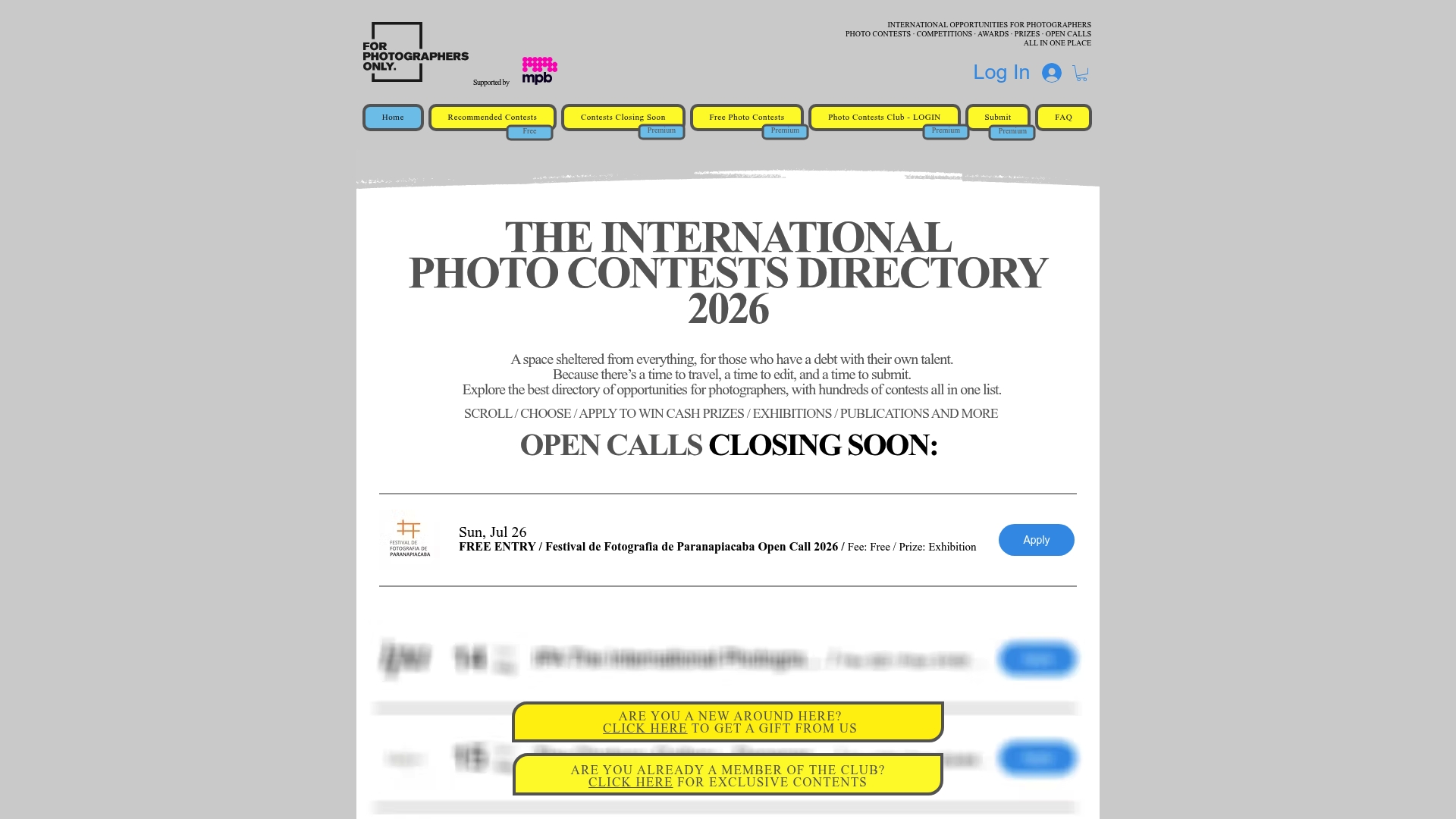
Members also join a photographer community and a monthly internal competition, which gives you a low-pressure way to practice presenting a series before a museum jury sees it.
Planning your entry year
The cycles in this guide fall into a rough annual rhythm, which lets you plan backward from each call.
Late autumn to early winter: national open calls such as PhotoSpiva accept entries. Have a print-ready edit.
Early in the year: international calls such as FMoPA’s open. Choose the images or series that work as a set.
Summer: career awards such as the Aaron Siskind Award take applications. Prepare a project statement by spring.
Autumn: small-museum contests, such as the one in Huntsville, close their entries. These are inexpensive and good for testing work.
Treat this as a pattern, not a calendar. Every museum republishes its schedule each year, so check the official page for current dates.
A few practical habits help across all of them:
Edit for the wall, not the screen. Museums hang work in rooms. Series with a clear visual logic often read better than unrelated strong singles.
Budget for prints. Where selected work must be printed and mounted, add that cost to the entry fee.
Match category to subject. BigPicture’s categories and Sam Houston’s nine categories reward very different pictures. Enter where your work fits.
Keep records. Note each contest’s license terms, so you know what you have granted before submitting the same image elsewhere.
FAQ
Can European photographers enter US museum competitions?
Some, yes. FMoPA’s International Photography Competition is open to photographers worldwide, and BigPicture invites photographers from around the world. Others are restricted: the Aaron Siskind Award is for US citizens and permanent residents, PhotoSpiva is for US photographers, and IMAGES is for residents of four northeastern states.
Are museum photography competitions free to enter?
It depends on the museum. The Aaron Siskind Award has no application fee, while PhotoSpiva charged $40 for five photos in 2026 and the Sam Houston Memorial Museum charged $5.00 per photo. Check each museum’s page for the current fee.
Do I keep the copyright to my photos?
In BigPicture, entrants retain ownership and other rights while granting the Academy a non-exclusive license for use in all media. Sam Houston’s contest asks for permission to use entries in advertising and social media, with credit. Terms vary, so read the rules of each contest before you submit.
Do I have to print my photos?
Often, for the exhibition stage. PhotoSpiva asks for JPEG files at first and then printed, mounted and matted work (not framed) if you are accepted. Sam Houston requires 8x10 prints with no matting or framing. Other museums keep the entire process digital, so check the requirements first.
Sources
Recommended