Monthly Photo Contests Worth Entering Right Now

The strongest recurring monthly photo contests available to photographers right now include Light Stalking (cash prizes, themed monthly cycles), ByAnnie (community-focused, free to enter with coupon prizes), the C&O Canal Trust (place-specific, no fee, up to five entries), the NDPS Monthly Image Challenge (blind judging, members-only), Audubon ($5,000 Grand Prize, U.S. and Canada eligibility), The Wilderness Society ($5,000 Grand Prize, $20 entry fee, advocacy publication), and Flickr’s recurring community contests (platform exposure, Pro subscriptions). Forphotographersonly curates 320–330 active contests in one place, with 61 competitions closing within the next 30 days. Check deadlines and entry fees before anything else.
Light Stalking — Best for photographers who want cash prizes and community feedback on a monthly theme cycle.
ByAnnie — Ideal for makers and craft photographers; free to enter, runs the full calendar month.
C&O Canal Trust — A focused local contest for anyone who photographs the C&O Canal National Historical Park; up to five entries, no fee listed.
NDPS Monthly Image Challenge — Members-only, blind judging, and a gallery archive that rewards consistent entrants.
Audubon — High-value wildlife and birding contest with a $5,000 Grand Prize and multiple $1,500 category prizes.
The Wilderness Society — $5,000 Grand Prize, $20 entry fee, with winning images used in advocacy and a 2027 calendar.
Flickr — Platform-wide recurring contests offering community reach, festival passes, and Flickr Pro subscriptions.
Forphotographersonly — A curated directory of 320–330 active international contests, 130+ free-to-enter, updated weekly.
Key Takeaways
Active monthly photo contests reward photographers who enter consistently, check usage terms carefully, and align their submissions to the brief rather than their personal favorites.
Point | Details |
Top recurring contests | Light Stalking, ByAnnie, C&O Canal Trust, NDPS, Audubon, The Wilderness Society, and Flickr all run monthly or seasonal cycles with clear deadlines. |
Prize range varies widely | Cash prizes run from $100 (Light Stalking) to $5,000 Grand Prizes (Audubon, The Wilderness Society); gear prizes reach $2,000 (Sony Creators Challenge). |
Read the usage clause first | Many contests claim non-exclusive promotional rights; watch for perpetual or exclusive language before submitting your best work. |
Match entry to your goal | Use blind-judged contests for portfolio credentials, NGO contests for publication, and platform contests for community reach. |
Forphotographersonly | Curates 320–330 active contests with 130+ free-to-enter options and weekly updates; 61 competitions close within the next 30 days. |
Table of Contents
Which monthly photo contests should you enter this month?
The eight contests above represent a cross-section of what the recurring photography competition calendar looks like in 2026: community-driven, wildlife-focused, place-specific, gear-specific, and open international. Each operates on a different cadence, prize structure, and eligibility model. Understanding those differences before you submit is what separates a considered entry from a wasted one.
Light Stalking
Light Stalking runs monthly themed contests with tiered membership entry allowances. The overall winner receives $100 cash; the People’s Choice winner receives $100 in store credit. Winners are featured on the site and across social channels, which adds editorial visibility beyond the prize itself. Membership tier determines how many images you can submit per cycle, and occasional one-off entry packs are available for non-members.
ByAnnie monthly contest
ByAnnie’s monthly contest opens on the first day of each month and closes on the last. Prizes are coupon-based rather than cash, and the rules require that submitted photos feature projects made with ByAnnie patterns or materials. Winners are announced early the following month. For makers and craft photographers, the narrative caption carries as much weight as technical execution here.
C&O Canal Trust
The C&O Canal Trust’s monthly contest is geographically specific: every entry must depict the C&O Canal National Historical Park. Photographers may submit up to five images per cycle. The subject restriction makes this one of the more focused recurring contests on the calendar, which also means the judging pool is narrower and the thematic bar is clear.
NDPS Monthly Image Challenge
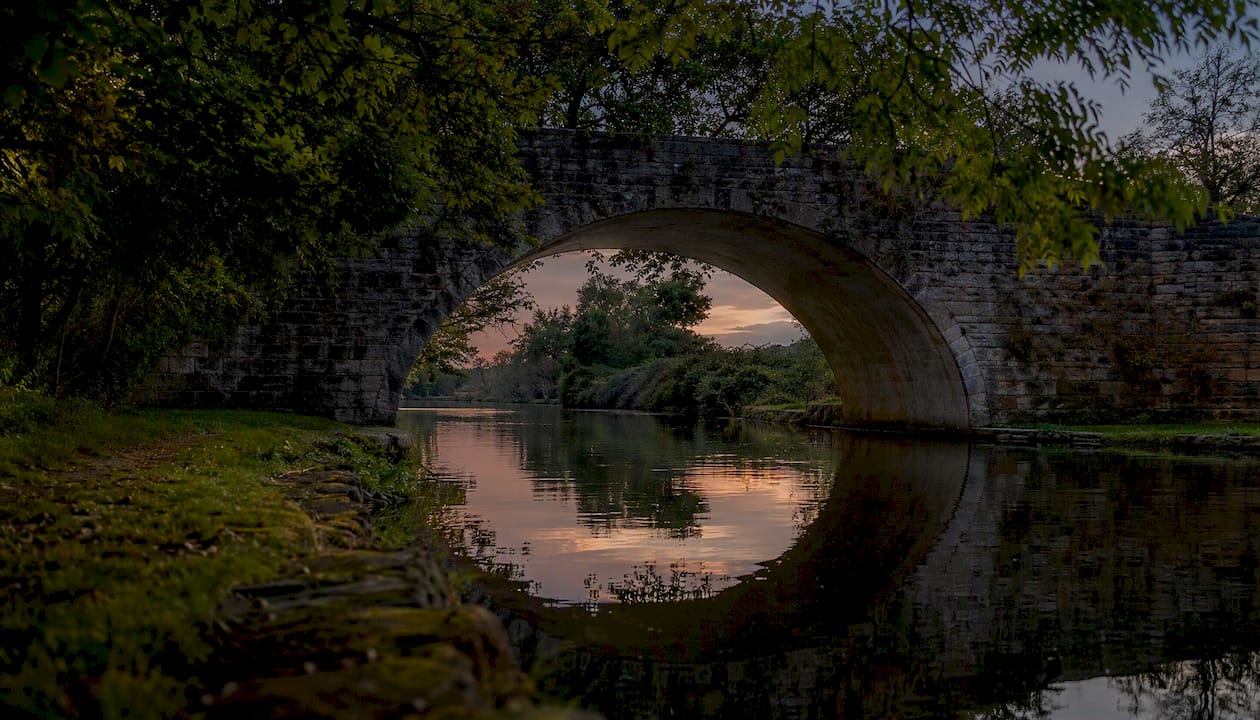
The NDPS Monthly Image Challenge runs on a calendar-month cycle with metadata removed from all entries before selection, making it a genuinely blind process. The competition awards an Image of the Month plus runners-up, and a gallery archive documents every cycle. Members-only access means the competitive field is self-selected and serious.
Audubon
Audubon’s 2026 contest offers a $5,000 Grand Prize alongside multiple $1,500 category prizes and separate youth and regional conditions for entrants from the U.S. and Canada. The prize structure rewards both generalist wildlife photographers and specialists in bird photography. Past-winner galleries on the Audubon site are worth studying before you submit.
The Wilderness Society
The Wilderness Society’s photo contest ran with an entry window of July 7 through August 31, 2026, a $20 nonrefundable entry fee, and a $5,000 Grand Prize from a total prize pool of $8,000. Winning images are used in advocacy materials and a 2027 calendar. That usage model is meaningful: your photograph becomes part of a conservation narrative with genuine public reach.
Unique Photo / Sony Creators Challenge
The Sony Creators Challenge at Unique Photo runs theme-based windows (the current example: June 15 through August 28, 2026) and awards $2,000 in Sony gear. The rules are device-specific: images must be shot on a Sony camera during the promotion period, and EXIF data must remain intact. This is one of the few recurring contests where the capture device is an eligibility requirement, not just a preference.
Flickr
Flickr’s World Photography Day contest runs in early August with final announcements in late August, offering prizes including festival passes and Flickr Pro subscriptions across multiple categories. Beyond that annual event, Flickr groups host recurring community contests throughout the year, making the platform a consistent source of low-barrier, high-exposure opportunities.
Where to find up-to-date monthly contests
No single organizer’s page will show you the full picture. The photographers who enter consistently are the ones who monitor several sources at once.
Forphotographersonly — The most comprehensive paid directory, with 320–330 active contests, 130+ free-to-enter opportunities, and weekly updates. The chronological format means you always see what closes soonest. Deadline alerts and free-entry filters make it the fastest path from intent to submission.
Photo Contest GURU — A free aggregator that lists open competitions with deadlines and prize summaries. Useful for a broad sweep, though update frequency varies.
Light Stalking contest page — Updated monthly with the current theme and entry instructions; worth bookmarking as a standalone resource.
Flickr blog and groups — The Flickr blog announces platform-wide events; individual Flickr groups run their own recurring challenges with community voting.
Audubon and The Wilderness Society — Both NGOs publish contest pages seasonally. Set a calendar reminder for their typical open windows (spring and summer for most wildlife contests).
Unique Photo event pages — The Sony Creators Challenge page updates with each new theme window; check it monthly if you shoot Sony.
Pro Tip: Set a Google Alert for “photo contest open” + your genre (e.g., “wildlife photo contest open 2026”) and pair it with a monthly calendar reminder on the first of each month to check your bookmarked contest pages. This two-layer system catches both new announcements and rolling deadlines you might otherwise miss.
Free directories give you breadth; paid directories like Forphotographersonly give you depth, filters, and the confidence that listings have been vetted. For photographers who enter contests as part of a deliberate portfolio or marketing strategy, the time saved by a curated, filtered directory and targeted Photography SEO Services is the real value. Directories that offer deadline alerts and free-entry filters materially reduce time-to-entry for active photographers entering monthly contests regularly.
Social channels add a third layer. Following organizers on Instagram and X (formerly Twitter) surfaces announcements before they appear in directories. Newsletter sign-ups from Audubon, The Wilderness Society, and Unique Photo deliver contest news directly to your inbox, often with early-entry windows or theme previews.
How do monthly photo contests actually work?
Most recurring contests share a common mechanical structure, but the details vary enough that reading the rules page on every contest is non-negotiable.
Core checklist before you submit
Open and close dates — Monthly contests typically open on the first of the month and close on the last day, though some (like The Wilderness Society’s seasonal window) run on a different calendar.
Entry limits — Light Stalking’s limits depend on membership tier; the C&O Canal Trust allows up to five entries; Unique Photo sets per-theme entry caps.
File format and size — Most contests accept JPEG; some accept TIFF for print-quality submissions. Maximum file sizes range from 5MB to 25MB depending on the organizer. Check the specific page.
EXIF requirements — The Sony Creators Challenge explicitly requires intact EXIF data to verify the capture device. The NDPS Monthly Image Challenge strips metadata before judging to preserve anonymity. Know which applies before you export.
Caption and title fields — Required fields vary. Some contests score captions as part of the judging criteria; others treat them as administrative data only.
Editing and composite rules — Many wildlife contests prohibit composites or heavy manipulation. Always check the “eligible images” section of the rules.
Rights and licensing: what to watch for
Before you submit, read the usage clause. Many organizers claim a non-exclusive license to use winning images for promotional purposes, which is standard and generally acceptable. Watch for language requesting perpetual, royalty-free, exclusive rights — that language transfers significant control over your image. NGOs like The Wilderness Society use winning photographs in advocacy materials and printed calendars, which is disclosed in their rules and represents genuine public value, but it is still a licensing commitment. Always preserve your EXIF metadata and keep the original RAW file as proof of authorship.
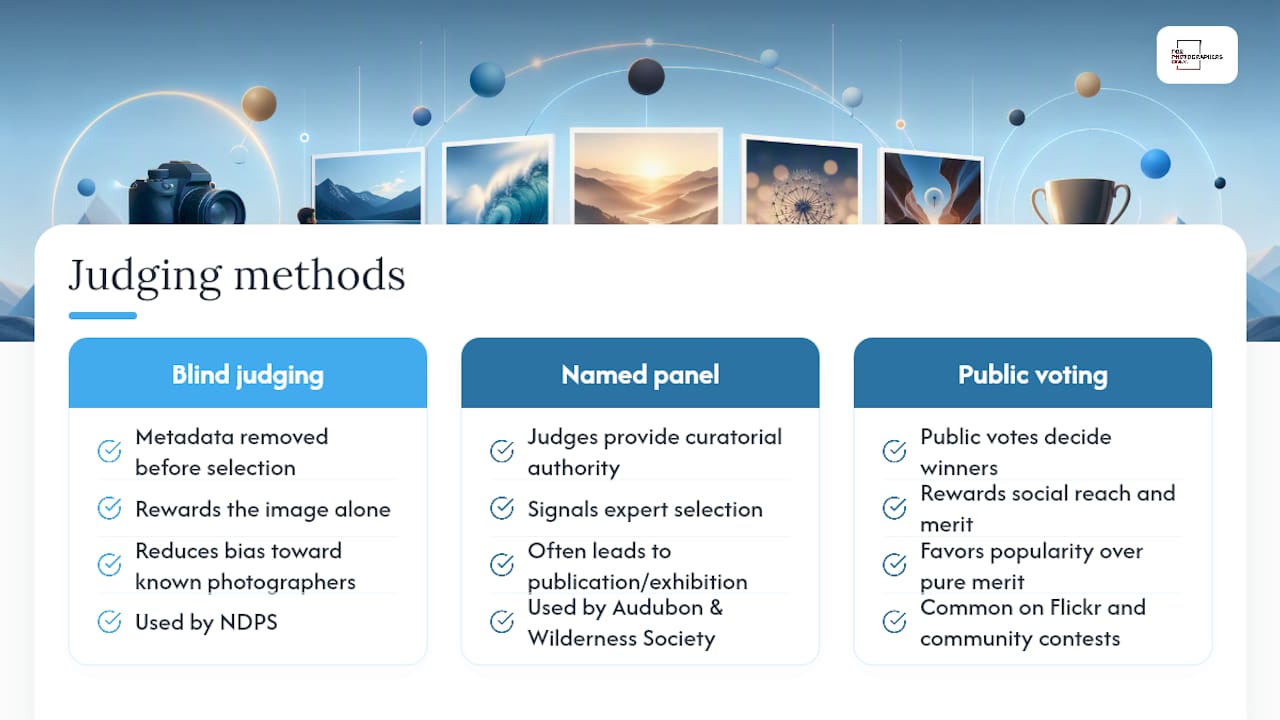
Judging methods signal different things about a contest’s value. Blind judging (NDPS removes all metadata before selection) removes bias toward known photographers and rewards the image alone. Named panel judging, used by Audubon and The Wilderness Society, brings curatorial authority and often leads to publication or exhibition. Public voting, common on Flickr and some community contests, rewards social reach as much as photographic merit. None of these is inherently better; they serve different goals.
Timeline expectations also vary. Most monthly contests announce winners within two to four weeks of the close date. Audubon and The Wilderness Society publish winners on their websites and in print. Light Stalking shares winners on-site and across social channels. The NDPS posts a gallery archive after each cycle. Knowing the announcement window helps you plan follow-up submissions.
How to choose which contests fit your goals
Not every contest deserves your time or your entry fee. A quick decision framework keeps you focused.
Goal | Contest type to prioritize | Key features to check |
Cash prize | Juried monthly contests | Prize amount, entry fee ROI, judging panel |
Portfolio credential | Blind or panel-judged contests | Winners’ archive, publication of results |
Publication / editorial visibility | NGO or magazine-affiliated contests | Usage terms, print distribution |
Community exposure | Platform contests (Flickr, Light Stalking) | Social sharing, public vote weight |
Gear prizes | Brand-sponsored contests | Device eligibility, EXIF requirements |
Free entry | Community or NGO contests | Free-entry filter, prize type |
Before entering any contest, ask these questions directly on the contest page:
Is usage of winning images perpetual or time-limited?
Are composite images or heavy retouching permitted?
Is there a winners’ archive I can study before submitting?
Does the entry fee make sense relative to the prize and exposure?
Am I geographically eligible (U.S. only, open international, youth category)?
A monthly competition listed on Forphotographersonly typically includes all of this information in a single, structured listing, which is one of the practical advantages of using a curated directory over hunting individual organizer pages.
For photographers building a portfolio of credentials, juried contests with named panels and published winners’ galleries carry more weight than public-vote contests. For photographers seeking cash, the entry-fee-to-prize ratio is the primary filter. For photographers who shoot a specific genre, place-based or theme-specific contests (C&O Canal Trust, Audubon, The Wilderness Society) offer a narrower field and a clearer brief.
Practical submission tips that actually move the needle
Technical preparation and thematic alignment are the two levers photographers most often underuse.
Technical export checklist
Format: JPEG for most contests; TIFF only when explicitly requested for print.
Color space: sRGB for online submissions; Adobe RGB only when the rules specify it for print output.
Long-side pixel size: 3,000–4,000 pixels on the long side covers most online contests without exceeding file-size limits.
File size: Compress to under the stated maximum, but avoid aggressive compression that introduces visible artifacts. Adobe Lightroom’s export quality setting of 85–90 typically hits the right balance.
Filename: Use a clear convention: LastName_Title_ContestName.jpg. Some contests require this format explicitly; others don’t, but it helps organizers and signals professionalism.
EXIF: Check whether the contest requires intact metadata (Sony Creators Challenge) or strips it (NDPS). Export accordingly.
Caption and metadata template
A strong caption includes: the image title, location, date of capture, camera and lens, and a one-to-two sentence story about what the image depicts and why it matters. For wildlife contests, species identification and behavioral context strengthen the entry. For community contests like ByAnnie, the narrative of how the project was made is often the deciding factor.
Pro Tip: Browse the past-winner galleries of any contest before you submit. Judges develop consistent aesthetic preferences over time, and those preferences show up clearly in archived winners. Light Stalking’s contest page maintains a record of monthly winners that reveals exactly what thematic and compositional choices resonate with their panel.
Composition and theme alignment
Monthly themes are briefs, not suggestions. An image that technically fits the theme but reads as a stretch will lose to one that embodies it directly. When a theme is abstract (“solitude,” “motion,” “light”), study the past winners to understand how the judges interpret it. Submit the image that most clearly answers the brief, not the image you like best in isolation. Wide crops tend to work better for landscape and environmental themes; tight crops favor portraiture and wildlife behavioral shots.
Descriptive captions increase judges’ empathy for an image. A photograph of a bird in flight becomes more compelling when the caption explains the species, the behavior, and the conditions under which it was captured. That context doesn’t replace technical quality, but it adds a layer of meaning that panel judges consistently respond to.
Why a curated directory changes how you enter contests
The practical reality of entering monthly photo contests consistently is that deadline management becomes the hardest part. Finding contests is time-consuming; verifying that they are still active, checking the rules, and tracking close dates across a dozen different organizer pages is genuinely labor-intensive. Most photographers who enter contests sporadically do so not from lack of interest but from lack of a reliable system.
A curated directory solves the aggregation problem. When every active contest, its deadline, its fee, and its prize are in one chronological list, the decision of what to enter this month takes minutes rather than hours. The free-entry filter alone is worth the subscription for photographers who want to build a contest record without accumulating entry fees.
The deeper value is in the curation itself. Not every contest that appears in a Google search is worth entering. Some have opaque judging, unfavorable licensing terms, or prizes that don’t justify the fee. A directory that vets contests before listing them removes that uncertainty.
Forphotographersonly: one place for every contest closing this month
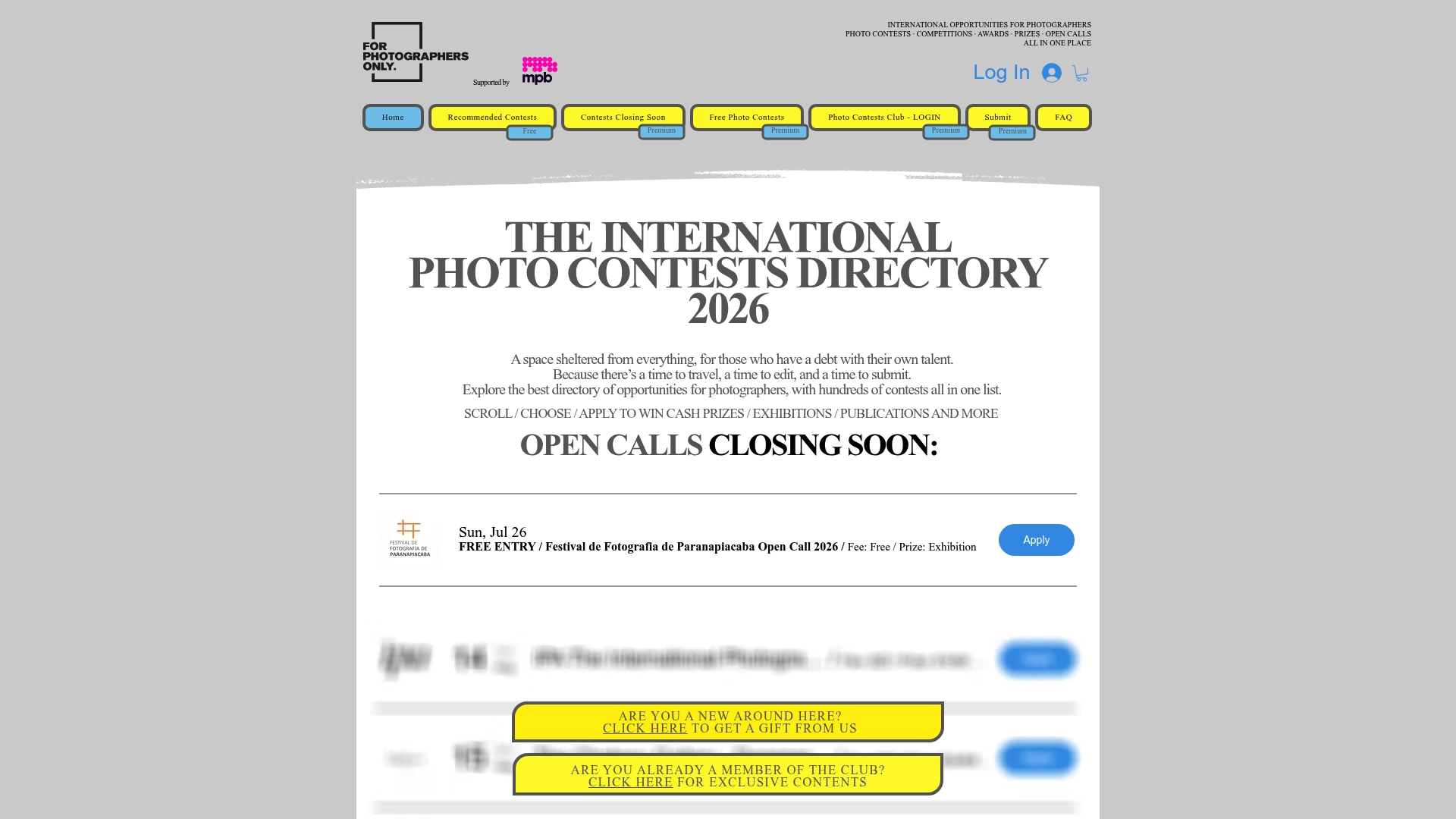
Forphotographersonly curates 320–330 active international photography contests, awards, grants, and calls in a single, continuously updated directory. Right now, more than 130 of those are completely free to enter, and 61 competitions close within the next 30 days. The directory is updated every week, so the listings you see reflect what is actually open and accepting entries.
Core features that matter for active monthly entrants:
Chronological listings — Contests sorted by deadline, so the most urgent opportunities appear first.
Free-entry filter — Isolate the 130+ no-fee contests instantly, without scrolling past paid entries.
Full contest details — Each listing includes the deadline, entry fee, prize, genre, and eligibility in one place.
Weekly updates — New contests are added every week; closed contests are removed.
Breadth of coverage — Listings from Nikon, Canon, Leica, National Geographic, independent festivals, and niche competitions that rarely surface in general searches.
Browse the full contests directory or go directly to a monthly competition listing to see how contest details are presented. With 61 competitions closing within the next 30 days, the time to check your deadlines is now.
Sources
Verify all deadlines on the organizer’s official page before submitting. Contest windows change, and a directory listing reflects the information available at the time of publication.
Always verify the deadline and usage terms on the organizer’s official page before submitting. Contest windows, entry fees, and prize structures can change between publication cycles.
Recommended