Members-Only Photo Contests: Who Can Enter and How

A members-only photo contest accepts entries only from people who belong to the organization running it: a professional association, a photography society, a magazine community or a club. To enter, you join first (or renew), then submit within the entry window and pay any per-image fee. Membership is the ticket, the contest is the benefit, and the rules page tells you exactly which of the two comes first.
For photographers in the United States and Europe, these contests are worth knowing about because the field is narrower than in open international awards. Judges see work from peers in the same community, and winners often gain editorial visibility inside publications that members already read. Below, you will find how eligibility works, what it costs, what the rules usually say about rights and files, and how to confirm a contest is real and open.
TL;DR
Members-only contests require current membership in the host organization, often “in good standing” on the entry deadline, so join or renew before you upload.
Costs come in two layers: the membership itself and a separate per-image entry fee. Some contests also offer free membership as a prize.
You keep copyright in the rules we reviewed, but winners grant the organizers licenses to display and promote the work.
Verify every contest on the organizer’s own page: entry period, portal opening date, file specifications, and AI and RAW-file rules.
A curated directory saves hours of hunting, because members-only calls are scattered across association websites.
Table of Contents
What “members-only” actually means
The phrase covers several different arrangements, and it pays to know which one you are looking at.
Association-only contests. The 2026 Showcase from the North American Nature Photography Association is open only to NANPA and ASMP members. Professional Photographers of America applies the same logic: entrants must be PPA members to compete in the International Photographic Competition.
Society member competitions. The Portrait Society of America runs a Members Only Competition, now in its 22nd year, and requires entrants to be members in good standing.
Membership or pay-per-entry hybrids. The Journal of Wildlife Photography contest is open worldwide to members or to people who purchase individual contest entries. Here membership is a convenience, not a hard gate.
Active membership through an exhibition. Photofusion’s Salon/26 in the United Kingdom requires participating artists to hold an active membership at submission and throughout the exhibition. That is a longer commitment than a single upload.
Employer or union contests. Some are limited to a workforce, such as a union local’s photo contest where entrants must be members and retirees of that local and photos must be job related. These are community contests rather than career awards, and the rules often ask for permission from employers and people shown in the photo.
The common thread is that the organizer defines a community, and the contest exists to serve it. The Journal of Wildlife Photography frames the link between entry and membership as a way to foster professional growth through themed monthly opportunities, not only to host a contest platform.

Who is eligible, including photographers outside the US
Eligibility usually rests on three questions: are you a member, is your membership current on the key date, and does the organization accept members from your country?
Status on the deadline date. The ISPWP rules say participants must be members in good standing, or a co-owner, employee or associate of a member, on the contest deadline date. A lapsed membership is the most common reason an otherwise strong entry never reaches a judge. For NANPA, the page states that entrants must become members and renew if needed, and images will not be judged if membership is not renewed.
Country. Many US associations accept international members, and some contests are open worldwide, as with the Journal of Wildlife Photography. Others are tied to a regional membership base, as with the UK’s Photofusion. The rules page of each contest is the only reliable answer. If it does not mention country limits, ask the organizer before you pay.
Amateur or professional. Members-only contests often mix categories, but some are tied to professional membership classes. Read the category descriptions and the membership tiers together.
For a broader checklist covering age, ownership and category rules, our guide to photo contest eligibility checks walks through five points that cause disqualification most often.
How to join and when to do it
Join before you enter. Most contests check membership at the moment of submission or at the judging stage, and some check again before awarding prizes. A practical sequence looks like this:
Find the rules page and note the entry period and the date the entry portal opens. For NANPA, the Showcase page lists the entry periods and portal opening date.
Check the membership tiers and what they cost on the organization’s own membership page.
Join or renew, and keep the confirmation email.
Confirm that your membership will stay active through judging, and through the exhibition if the contest includes one.
Prepare files to the stated specification, then submit.
If you will want to enter more than one contest from the same organization, an annual membership usually repays itself faster than a monthly one, but check what the organization actually offers before you commit.
What it costs: membership plus entry fees
There are normally two separate costs, and photographers sometimes budget for only one.
Membership. Priced by the organization, on its own site, and often tiered by career stage. We do not quote membership prices here because they change; check the membership page of the group you are considering.
Entry fees. These are set per image or per entry. NANPA charges $10 per still image for the first five images, $8 for each additional image, and $45 per video entry, with an additional 20% discount for early entries. ISPWP accepts late entries for up to two business days after the deadline, and late entries cost $10 each with no free-entry allowance.
A quick worked example using the NANPA schedule: seven still images would cost five at $10 plus two at $8, which is $66 before any early discount. That figure is for illustration of the fee structure; always check the current rules for the year you enter.

Some members-only contests reward membership directly. At ISPWP, the top three winners receive one year of free membership, so a strong placement can offset the cost of joining.
What you can win
Prizes in members-only contests lean toward visibility and standing rather than the largest cash sums seen in open awards.
Editorial publication. The Portrait Society of America says winners may have their work featured in International Artist magazine and The Art of the Portrait Journal. For a portrait artist, that is a placement in a publication read by collectors and peers.
Archive and publication projects. The MTP Photography Award states that it aims to build a visual archive representative of its community and enable publication of an editorial work featuring selected photographs.
Membership and credentials. Free membership years, juried showcase placements and award titles add to a professional bio.
Exhibition. Society shows and salons give selected work a physical setting, and a juried exhibition credit travels well in a portfolio.
How winners are chosen
Methods differ, and the rules usually describe them. At ISPWP, judges select their top 10 to 20 images in each category, and placements are based on the combined points awarded by the judges. Knowing that a contest uses combined scoring tells you something useful: consistency across judges matters, so a clean, technically sound image with broad appeal can outrank a divisive one.
Rules, rights and files to check before you submit
Members-only contests tend to have shorter rule sets than commercial awards, but the same details decide whether an entry stands.
Deadlines and grace periods. Confirm the deadline, time zone and any late-entry window. Late windows carry fees, as the ISPWP example shows.
Image and AI rules. ISPWP entrants should check the image and AI rules, the file specifications and the RAW-file verification requirements. Verification requests are common in nature and documentary categories, so keep your original files and shooting sequence. Our guide to reading AI photo contest rules before you enter explains what organizers typically allow and prohibit.
File preparation. Export to the stated pixel dimensions, color space and file size, and keep your metadata clean. If you want a refresher on preparing image files properly, covering formats, compression and naming, it helps before you upload a batch.
Copyright and licenses. In the rules we reviewed, entrants keep ownership. ISPWP entrants retain image ownership and grant specified licenses for displaying entries and promoting the contest. NANPA entrants retain copyright, and winners grant the organizers specified rights to use their images in the Showcase, online, in print and in promotions. Read the license scope, duration and any credit requirement.
Winner obligations. ASMP says winners may be disqualified if they cannot be found, do not respond, or fail to submit a full-resolution print-ready image when notified. Use an email address you check and have a print-ready file on hand.
How to confirm a contest is legitimate and open
Members-only contests live on the host’s own site, which makes verification straightforward if you follow the right trail.
Go to the organizer’s page. Use the official site of the association or society, not a repost. For NANPA, the Showcase page is where the entry periods and portal opening date are listed.
Match the rules to the membership. The membership requirement, fee schedule and deadline should appear in the rules document itself.
Look for a named organization and contact. A real society lists staff, an address or a contact form, and a history of past winners.
Check the license terms. Be cautious about rules that transfer ownership of your images instead of licensing specific uses.
Test the portal date. Some contests publish rules months before the portal opens. Note the date and set a reminder.
For one example of how a call is documented, see our listing for the Nature Photography Showcase Contest 2026 by NANPA, and the earlier NANPA Nature Photography Showcase entry.
Is membership worth it for the contest alone?
That depends on how many opportunities you will use. A useful way to decide:
Question | If yes | If no |
Do you shoot in the organization’s genre? | Membership benefits beyond the contest are likely to matter | Look for open contests in your genre instead |
Will you enter more than one image or contest in the year? | Annual membership tends to make sense | A pay-per-entry contest may suit better |
Does the prize include publication or exhibition? | Visibility adds to the membership’s value | Treat it as a cash or credential play |
Do you want community feedback and events? | Members-only spaces provide it | Contest access alone may not justify joining |
Treat membership as an investment in a community, with the contest as one of its returns.
Finding members-only calls without hunting
The difficulty with members-only contests is discovery. Associations post calls on their own sites, in newsletters and on member pages, and the best ones are rarely promoted outside their communities. Our directory exists to solve exactly that problem, and our approach is to research, curate and publish competitions run by outside institutions, from major camera brands to niche festivals, in one chronological list.
We built For Photographers Only because a photographer’s time belongs behind the camera, not inside forty browser tabs. Members-only contests show the problem clearly: the strongest ones sit on association pages that only the already-initiated tend to find, and the entry window can close before a newcomer learns it exists. Our view is that a curated, chronological list is the most practical way to meet that challenge. We do not organize contests ourselves, so our only interest is in presenting the best international opportunities clearly, with deadlines, fees, prizes and genres side by side. That lets a photographer decide whether a membership makes sense before paying for one. We also believe that entering contests is a discipline, not a gamble. Choosing the right calls, reading the rules carefully and preparing files properly turns scattered effort into a portfolio of credible achievements: exhibitions, publications and awards that curators and editors recognize. DARIO
Our perspective
One place for the best contests
Our PhotoContestsClub gives you a single, continuously updated page of more than 320 active international contests, awards, calls, prizes and grants, including over 100 that are free to enter. It costs €6 per month or €40 per year, and a free trial is offered. Members also get a photographer community and a monthly internal competition.
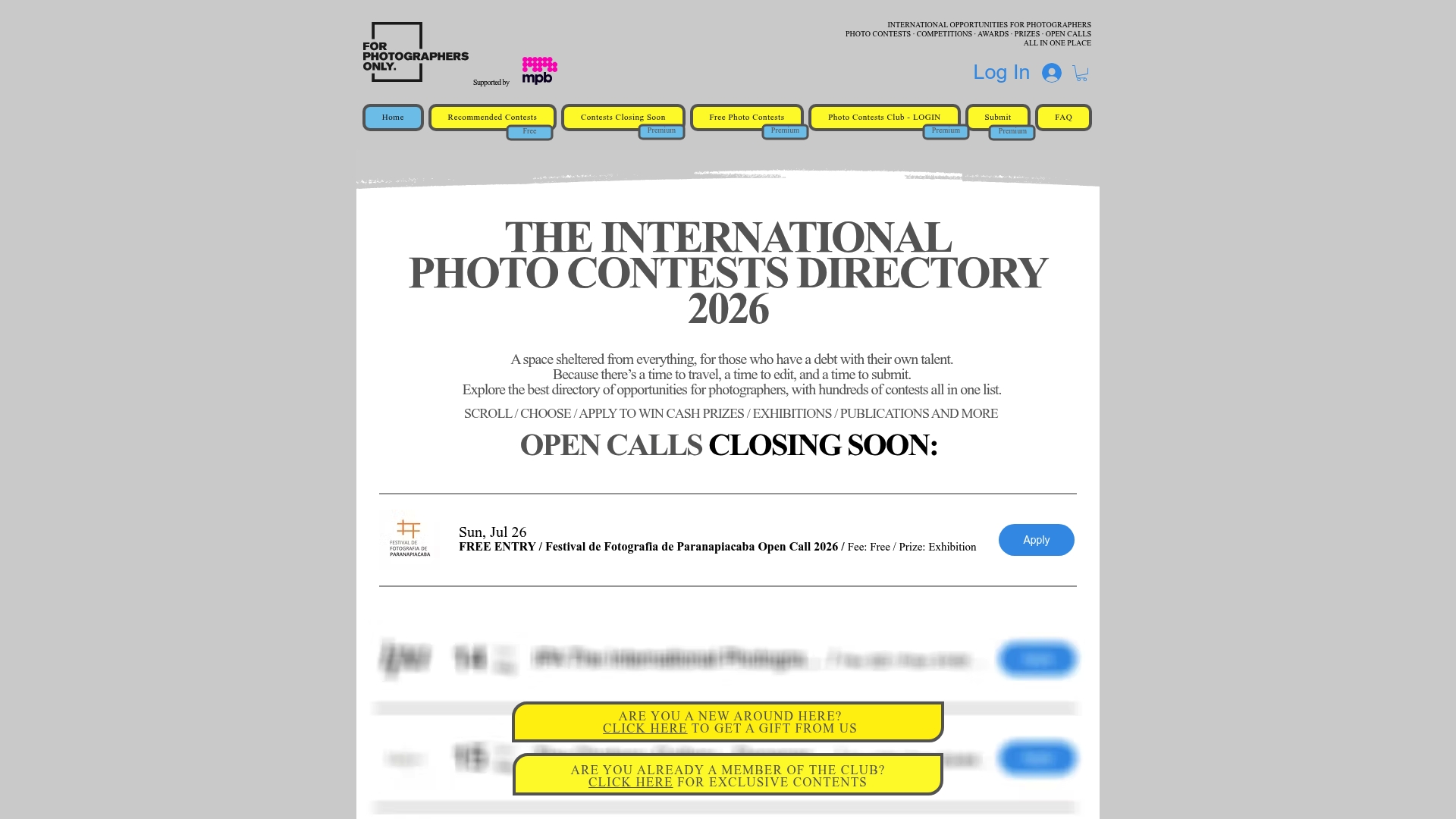
You can see the current contest list or compare options on the plans and pricing page. If you want to keep reading first, our guide to photo contest eligibility is a good next step.
A short pre-entry checklist
Membership active today, and expected to stay active through judging.
Entry period and portal opening date noted from the organizer’s page.
Fees totaled: membership plus per-image entries plus any late fee.
File specifications, AI rules and RAW-verification requirements understood.
License scope and credit terms read.
A reachable email address and a print-ready file prepared in case you win.
FAQ
Can I enter a members-only photo contest without joining first?
Usually not. Most organizers require membership to be active when you submit or on the deadline date, and some check it again at judging. NANPA states that images will not be judged if membership is not renewed. Join first, then enter.
Are members-only contests open to photographers outside the United States?
Sometimes. The Journal of Wildlife Photography contest is open worldwide, while other contests tie entry to a particular association or region. Check the rules page, and write to the organizer if country eligibility is not stated.
Do I still pay an entry fee after I become a member?
Often yes. Membership and entry fees are separate costs in many contests, and NANPA, for example, charges per still image and per video entry. Add both costs together before you decide.
Do I keep the copyright to my winning photos?
In the rules we reviewed, entrants keep copyright and grant limited licenses for display and promotion, as at ISPWP and NANPA. Read the license scope for each contest, since terms differ.
Sources
Recommended