Long Exposure Photo Contests: Where to Enter and How to Win

Long exposure photo contests fall into two groups. A few are built around slow shutter work, such as night photography calls and dark sky awards. Many more are general competitions that welcome long exposures without naming them. This guide covers both. It shows what each type asks for, what it costs, which rules catch people out, and how to check a contest before you send an image.
TL;DR
Dedicated long exposure contests are rare. The best opportunities are night, astro and landscape calls that welcome slow shutter work, plus open competitions with no technique limits.
Fees range from free to roughly €38 for a single theme, so filter by fee and by the rights you are asked to grant.
Read the editing rules first. Many contests allow standard processing, restrict composites, and now exclude generative AI.
Judges reward technical skill, composition and visual impact, so a clean single exposure with a clear idea beats a gimmick.
A curated directory saves hours of searching. Ours lists 320 to 330 active contests, including over 100 free to enter.
Table of Contents
What counts as a long exposure photo contest
There is no fixed definition of long exposure. Expert Photography treats a shutter speed of 0.5 seconds or longer as a working threshold and notes that settings can stretch into minutes. PhotoCritic places long exposure at roughly 1 to 30 seconds and links it to silky water, star trails and light painting, all of which need a tripod.
For contest purposes, that means you are usually entering one of these subject families:
Night skies, star trails and astrophotography.
Seascapes and waterfalls with smoothed motion.
Urban light trails and cityscapes after dark.
Light painting and other experimental night work.
Daytime long exposures made with neutral density filters, where the slow shutter is a creative choice rather than a necessity.
Long exposure is not double exposure
Search results for this keyword are crowded with double and multiple exposure contests, and they are a different technique. According to Holly Birch Photography, double exposure merges two images to create dreamlike compositions, while long exposure uses a slow shutter to capture the passage of time. A multiple exposure theme such as the “Multi-Exposed” calls you will see listed rewards layering. A long exposure call rewards patience, planning and control of a single frame. Check the theme line before you pay a fee, so you do not enter the wrong kind of work.
Contests that welcome long exposure work
The contests below show the range of what exists. They are examples of how these calls are structured. Deadlines and fees change every cycle, so confirm the current terms on each organizer’s page.
Contest | Organizer type | Fee (as last published) | Technique stance |
Nocturne night photography open call | Gallery | USD 15 for up to 3 images | Welcomes long exposures, light painting, astrophotography and experimental work |
Capture the Dark | Dark sky nonprofit | Free | Natural-looking night images; composites only in one category |
Florida Wildlife Corridor Photo Contest | Conservation organization | Free | Explicitly accepts long exposure alongside HDR and focus stacking |
RPS International Photography Exhibition | Photographic society | One free single image, then £20 to £35 | No restriction on genre, process or technique |
Monte-Carlo Photo Contest | International contest | €38 for one theme, up to 4 photos | Theme-based; check each theme |
Night photography calls
TCG Gallery’s Nocturne open call is a good model of a night-focused call. The 2026 edition was open worldwide to photographers and visual artists aged 18 and over. It welcomed long exposures, light painting, astrophotography and experimental work. The fee was USD 15 for up to three images, with a deadline in October and an exhibition running through November. A call like this tends to return each autumn, so watch for the next edition rather than a single date.
Capture the Dark, run by DarkSky International, is free to enter and open worldwide. The 2026 rules allowed up to three photographs per category and required high-resolution JPEG files up to 50MB with EXIF metadata. The entry window has followed a spring-to-summer pattern: the 2025 edition ran May 1 through June 30, with categories for all skill levels, including a Mobile Explorer category for smartphone or GoPro images.

Open contests with no technique limits
General competitions are often the better fit for a daytime seascape or a city at dusk. The RPS International Photography Exhibition was open to anyone of any age or level without RPS membership in its 2025 terms. It offered one free single image entry for everyone, then £35 standard, £27 for members and £20 for under-30s, and it placed no restriction on genre, process or technique.
Regional and cause-based contests are worth a look too. The 2026 Florida Wildlife Corridor Photo Contest was free, required photos to be taken in Florida, accepted up to three photos per category and named long exposure as an accepted technique. First place in each category received a $200 B&H Photo gift card and a swag bag. Local shows can be a quiet route to your first exhibition: the Dayton Society of Artists, for example, listed a juried long exposure exhibition, titled “Luminous Flow: Time Made Visible,” with no entry fee.
For a wider US shortlist, see our guide to US photography competitions. Landscape specialists can also look at the International Landscape Photographer of the Year call, where slow shutter seascapes and skies are natural fits.
What judges look for in a long exposure image
Published criteria are consistent across contests. DarkSky’s Capture the Dark rules describe judging on connection to the category, technical skill, composition and overall visual impact, with blind judging and no watermarks allowed. Most serious contests work the same way, so these habits help:
Make the long exposure serve the idea. Smooth water or streaking lights should explain something about place, time or mood. Slow shutter alone is not a concept.
Control the technical basics. Sharp foreground anchors, clean tripod stability, no hot pixels and controlled highlights matter. Expert Photography notes that the shutter speed you need depends on how bright the day is, your ND filter and the speed of motion in the scene, so plan for the light.
Compose for a single frame. Contests are viewed as thumbnails first. A strong shape or line must read at small size.
Keep the edit natural. Heavy manipulation can disqualify you, as the next section shows.
Match the category. A night sky image entered in the wrong category loses to work that fits it.
Rules that decide whether your image is eligible
The most common reasons for disqualification are not about quality. They are about format, editing and eligibility. Our checklist on photo contest eligibility covers five common checks. These are the ones that matter most for long exposure work.
Editing, compositing and AI
Long exposure photographers often blend frames, for example to reduce noise or build star trails from many shots. Contests treat this differently. The BIPP 2026 competition rules say compositing, meaning combining multiple elements, frames or exposures into a single image, is not permitted by default and only where a category explicitly allows it. The same rules state that focus stacking, panorama stitching and multiple exposures captured at the same time and place are not considered compositing and are handled by category.
The Capture the Dark FAQ allows standard post-processing such as cropping and color correction, provided the image stays natural. Composites are permitted only in the Deep Sky category, where combining data from multiple nights is acceptable. And the Nocturne rules state that images created by or substantially altered with generative AI are not eligible.
Practical rule: if your star trail is stacked from many frames, say so and enter only where stacking is allowed. Keep your RAW files and a short processing note ready in case a juror asks.
Files, age and identification
Technical specs are strict and vary. Nocturne asked for JPG or JPEG files at least 1200 pixels on the longest side, with no watermarks or signatures, from entrants aged 18 and over. Capture the Dark wanted EXIF metadata intact, so do not strip it on export. Set up a delivery folder per contest with the right size, color space and filename pattern, and you will avoid last-minute errors.
Fees, prizes and what you give up
Prizes range from gift cards and annual passes to cash awards, exhibition space and magazine publication. The Monte-Carlo Photo Contest is a useful example of how pricing is structured: in its 2026 rules, participation was €38 for one theme with up to four photos and €4 for each additional theme, with the window running from mid-June to early October.
Every fee should be weighed against the prize, the audience and the rights you grant. That last item deserves attention.
Reading the rights clause
Most reputable contests leave copyright with you and ask for a license to promote the event. Nocturne states that copyright stays with the artist, who grants the gallery non-exclusive permission to reproduce images for review, exhibition, archive and promotion. Capture the Dark lets photographers retain full ownership while granting DarkSky a non-exclusive, perpetual right to use images for promotional, educational and advocacy purposes. Monte-Carlo says images remain the authors’ property, with an implied right for the contest to publish them and use them in exhibitions, brochures, catalogues and videos without remuneration.
These are normal terms for contests, but the wording matters. The National Association of Nature Photographers (NANPA) points to copyright infringement as a major risk in submitting an image and advises photographers to be wary of overly broad terms such as unrestricted, irrevocable, any purpose and in perpetuity. Look for non-exclusive wording, a stated purpose for the license, and a clear statement that you keep ownership.
How to check that a contest is legitimate
Before paying a fee, run this short routine:
Find the organizer. A named gallery, society, nonprofit or publication with an address and contact page is a good sign.
Read the full terms. Look for the rights clause, the license scope and how long it lasts, using the NANPA wording above as your benchmark.
Check the judges and the past winners. Real contests publish both, and past winner galleries show the standard you are up against.
Look for stated prizes and a stated fee purpose. Vague prizes and fees that rise per image without explanation deserve a second look.
Confirm the exhibition or publication is real. If a show or print publication is promised, find the venue or the issue.
A curated list does part of this work for you. Our team researches and publishes the contests in our directory, organizing them chronologically so you see deadlines, fees, prizes and genres together.
Long exposure photography is about patience: the hour waiting for the blue hour to deepen, the minutes a shutter stays open while the sea turns to mist. The contest search should not demand the same patience. Photographers who work this way rarely have spare time to read dozens of rule pages. That is why we built a single, continuously updated page of international competitions. We do not organize contests ourselves. We research, curate and publish them, from major brands and institutions to niche festivals and lesser-known calls that offer remarkable value, so a night sky or seascape image can find the meeting points in the contemporary art calendar where it belongs. Our view is simple: the right contest for a long exposure image is often not the one with the loudest name. It is the one with a fitting theme, fair rights terms, a realistic fee and an audience of curators and editors. A well-organized directory makes that match faster, and it leaves more of your time for the work itself. DARIO
Our perspective
Find your next contest in one place
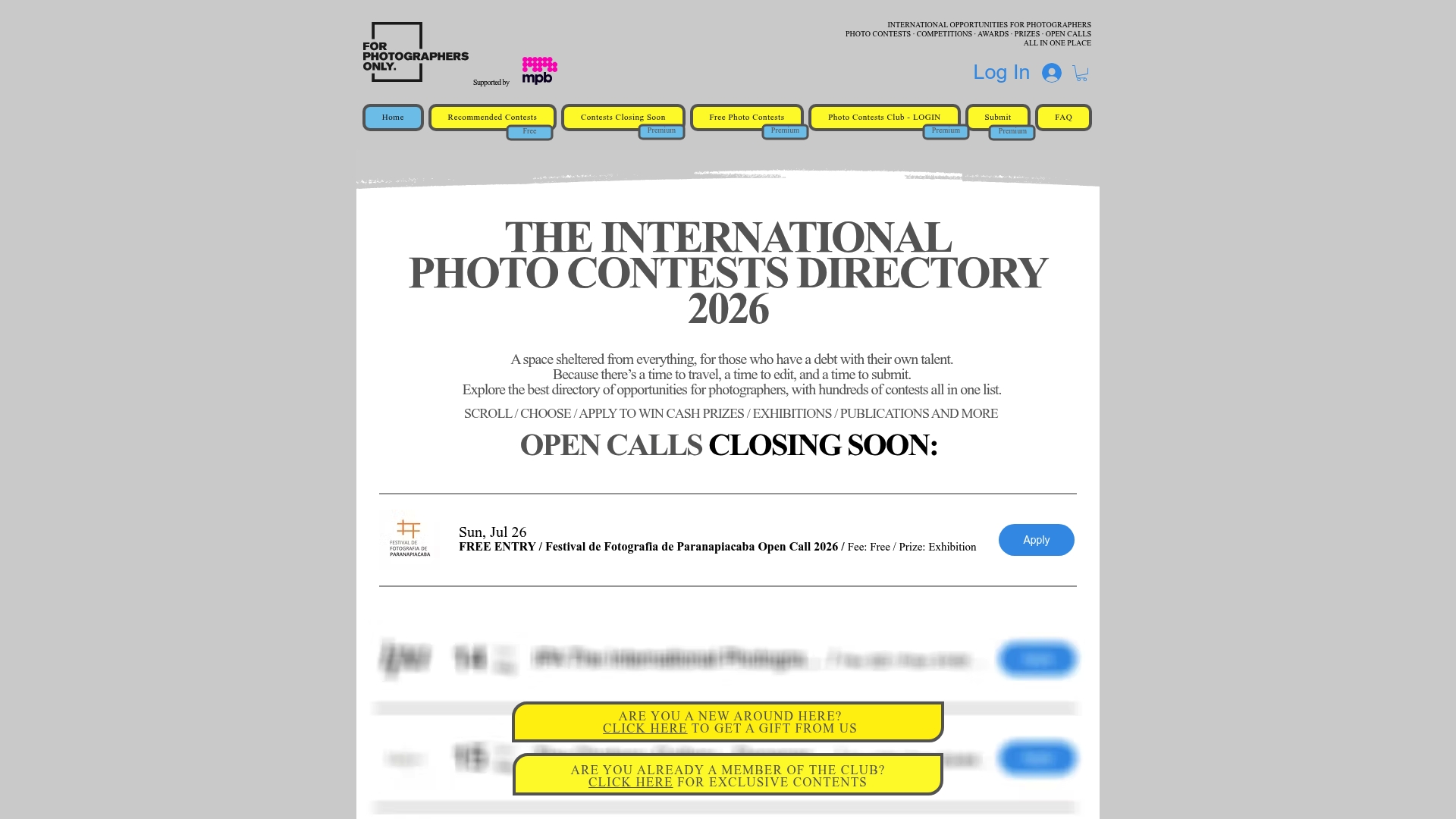
If you want slow shutter work in front of the right jurors, we have organized the search for you. The PhotoContestsClub gives members a single page with more than 320 active international contests, including over 100 free to enter, updated every week. Each listing shows deadlines, fees, prizes and genres, and members also join a photographer community and a monthly internal competition. Plans cost €6 per month or €40 per year, and a free trial is offered. See the PhotoContestsClub or compare options on the plans and pricing page.
New to competitions? Start with our guide to photography contests for beginners, or browse free photography contests to enter your first without a fee.
A simple entry plan for your next long exposure series
Turn the information above into a routine:
Shoot with a category in mind. Decide whether the series is night sky, water, urban light or experimental before you edit.
Build a master edit and several export sizes. Keep one version at full resolution with EXIF and others sized to common minimums.
Keep a record of your process. A short note on exposure times, filters and stacking protects you if a contest asks for verification.
Choose three to five contests per season. Mix one free contest, one gallery call and one larger international award, such as the IPA International Photography Awards, where open categories welcome many techniques.
Track results. Note which jurors responded to which images, and refine your next submission.
Because contests repeat on an annual rhythm, this plan compounds. An image that missed a night photography call in autumn can be reworked for a dark sky award the following spring.
FAQ
Are there contests only for long exposure photography?
Dedicated ones are uncommon and tend to appear as local exhibitions or themed calls. Most opportunities are night, astro, landscape and open competitions that welcome long exposures. Examples include Nocturne, Capture the Dark and contests that list long exposure among accepted techniques.
Can I enter a stacked or blended long exposure?
It depends on the category. Some rule sets, such as BIPP’s, bar compositing unless a category allows it, while others permit composites only in a specific category such as Deep Sky. Read the editing clause before paying, and enter where your method is explicitly accepted.
Do I lose my copyright if I win?
In the contests reviewed here, entrants keep ownership and grant a non-exclusive license for promotion and exhibition. Watch for terms that are irrevocable, unlimited or for any purpose, which NANPA advises photographers to be cautious about. If wording is unclear, ask the organizer in writing before you submit.
How much does it cost to enter?
Fees vary widely. Capture the Dark and the Florida Wildlife Corridor contest were free, Nocturne asked USD 15 for up to three images, and Monte-Carlo asked €38 for one theme. Filtering by fee in a curated directory helps you spread entries across free and paid calls.
Sources
Recommended