Light Painting Photo Contests: Curated Shortlist and 320+ Tracker

Check For Photographers Only’s curated directory for live light-painting opportunities, then prioritize juried awards like the Amateur Photographer APOY rounds for prestige and publication, alongside community challenges such as Pexels’ Light Painting USA for fast exposure. Entry fees range from free to modest sums, and prizes span cash, exhibition, and editorial placement, so matching contest type to your goal takes minutes once you know where to look.
TL;DR:
Enter juried contests like Amateur Photographer APOY for long-term publication and recognition, focusing on multiple themed rounds throughout the year.
Prioritize community challenges such as Pexels Light Painting USA for quick feedback, low entry fees, and broad exposure through public voting.
Match your contest choice to your goals: use cash rewards for immediate income, exhibition for portfolio growth, and carefully read terms to avoid overreaching rights clauses.
Prepare your submissions with technical consistency, proper exposure settings, and detailed process documentation to meet common contest specifications.
Use curated directories like PhotoContestsClub to efficiently track active contests suited for light painting and long-exposure work, saving time and effort.
Table of Contents
Active light painting contests and calls for entry worth your attention
Here is a working shortlist to research before committing entry fees or shoot time:
Amateur Photographer APOY: themed rounds throughout the year, prize pool structure, juried judging, open to photographers meeting the stated eligibility terms.
Pexels Light Painting USA: community-vote challenge, fast turnaround, smaller cash prizes with broader public exposure.
Profoto’s light-focused contests: periodic calls built around creative use of light, often tied to brand promotion and gear-adjacent audiences, as seen in past Profoto contest coverage.
NYC4PA open calls: international submissions with exhibition components, including programs like the Luminosity open call, which pairs entry with gallery display opportunities.
Independent festival calls: smaller, niche competitions that rotate seasonally and often carry lower entry fees than flagship international awards.
Many contest pages now exclude AI-generated or heavily CG-assisted images from eligibility, a rule entrants should confirm before relying on generative editing tools during post-production. Portrait-adjacent light-painting entries may also require model releases, a detail easy to overlook when the human subject is secondary to the light trail itself.
Community challenges reward speed and volume: low stakes, quick feedback, and a chance to test new techniques without much financial risk. Juried awards demand more preparation but return higher prizes, publication credit, and the kind of jury-backed credibility that strengthens a professional portfolio over time.
How to choose which contests to enter
Not every open call deserves your entry fee or your best frame. A simple framework separates contests worth your time from those that only look appealing on the surface.
Match the prize to your goal: cash rewards suit photographers needing income now, while exhibition or publication credit suits those building long-term professional visibility.
Weigh jury prestige against cost: a contest judged by respected curators or institutions justifies a higher entry fee more readily than an obscure public-vote page.
Consider your time budget: community challenges with quick turnarounds fit busy schedules, while juried awards often require more deliberate production and editing time.
Read the terms before submitting: watch for clauses that claim broad commercial rights to your image, vague prize delivery language, or judging criteria that are never disclosed publicly.
Diversify across formats: enter several low-fee community challenges to stay sharp, and reserve your strongest, most deliberate work for one or two flagship juried awards each season.
Red flags are consistent across disciplines: contests that ask you to sign away commercial usage rights without compensation, that never specify how or when prizes ship, or that keep judging criteria opaque deserve extra scrutiny before you submit anything.
Preparing a contest-ready light painting submission
Technical consistency separates competitive entries from amateur attempts, and the gap often comes down to a handful of production choices made before the shutter ever opens.
Exposure settings depend on the effect you want, and the long-exposure technique guidance from Julia Anna Gospodarou frames exposure length as a deliberate aesthetic choice rather than a technical afterthought. Light trails typically call for exposures in the multi-second to multi-minute range, paired with a narrow aperture (f/8 to f/16) to control trail brightness and a low ISO (100 to 200) to keep noise manageable across the longer exposure window. Manual focus, set before the light source starts moving, avoids the hunting that autofocus struggles with in near-total darkness.
Submission specs vary by contest, but common requirements include:
File format: JPEG for most web-based entries, TIFF when a contest requests print-quality files.
Color space: sRGB unless the contest specifies Adobe RGB or another profile.
Pixel dimensions and file size: check each contest’s stated maximum, since limits range widely between platforms.
Naming and metadata: follow the contest’s naming convention exactly, and include captions describing your process when the entry form allows it.
On-set essentials include a stable tripod, a remote shutter release to avoid camera shake, and a reliable light source such as an LED wand or steel wool rig, the latter requiring fire-safety precautions and, in many locations, a permit for public spaces — for detailed lighting setup guidance especially useful when adapting setups for night or portrait light-painting shoots. Run test exposures before your final attempt, and document your settings as you go.
Pro Tip: Photograph a few seconds of test exposure at each new location before your main attempt. It saves you from discovering exposure problems only after the light trail is gone.

What judges look for and how to improve your odds
Judging panels across light-painting contests tend to weigh the same handful of factors, even when the stated criteria differ slightly in wording.
Originality and concept: does the image offer a fresh take on light trails, or does it repeat a familiar composition.
Technical execution: clean exposures, consistent light trails, and controlled noise levels signal command of the process.
Composition and layered depth: strong entries use foreground, midground, and background elements to give the light trail spatial context rather than floating it against an empty frame.
Story or impact: images that communicate a mood or narrative tend to outperform technically competent but conceptually flat work.
Theme adherence: entries that ignore the stated theme rarely advance, regardless of technical polish.
Past-winner write-ups that include camera settings and process notes offer a practical benchmark for entrants preparing their own submissions, since they reveal what judges rewarded in concrete, repeatable terms rather than vague praise. Pre-visualizing your shot before setup, documenting your process in the caption field, and submitting a tightly curated series rather than a single arbitrary frame all tend to strengthen placement odds across contest formats.
After you submit: timelines, rights, and prize logistics
Timelines vary sharply by format. Community-vote challenges can announce winners within weeks, while juried international awards often take several months to move from entry close to public results, sometimes aligning with an exhibition calendar.
Before submitting, confirm a few administrative details:
Rights clauses: most reputable contests request non-exclusive promotional rights, while some overreach into broader commercial licensing, a distinction worth reading carefully before you agree.
Prize delivery: cash prizes for community challenges are often distributed through simple payment platforms, while juried awards may include shipped physical prizes or exhibition logistics that require coordination on your end.
Tax and shipping responsibility: larger prizes may carry tax implications depending on your location, and international shipping for physical awards sometimes falls to the winner to arrange.
Why a curated directory matters for active entrants
Tracking deadlines across dozens of contests independently costs hours each month. For Photographers Only curates more than 320 to 330 active contests, including over 100 free-to-enter competitions, updated weekly so entrants can filter by prize type, deadline, and genre without combing through scattered contest pages one at a time.
The real bottleneck isn’t finding contests, it’s entry discipline

Photographers tend to overestimate how much a single flagship award will transform their career, and underestimate the compounding value of entering consistently across smaller, well-matched opportunities. The conventional advice to “enter everything” wastes fees and attention on contests that do not fit your work, while the advice to wait for the perfect prestigious award often means never entering at all.
What actually moves a portfolio forward is a short list of contests chosen deliberately, each matched to a clear goal: cash now, exposure this season, or a credential that matters in five years. Production quality matters less than most entrants assume once the basic technical bar is cleared. Judges respond to concept, story, and consistency far more than to marginal gains in exposure sharpness. Prioritize understanding what each contest’s jury actually rewards over chasing every open call that crosses your feed, and treat your entry calendar the way you would treat a shoot schedule: planned, not reactive.
— DARIO
PhotoContestsClub: a faster way to track what’s worth entering
Building your own spreadsheet of deadlines, fees, and eligibility rules across dozens of contest pages eats into the time you could spend shooting. PhotoContestsClub gives you a single, continuously updated page covering the opportunities worth your attention, curated so you are not sorting through contests that do not fit light-painting or long-exposure work.
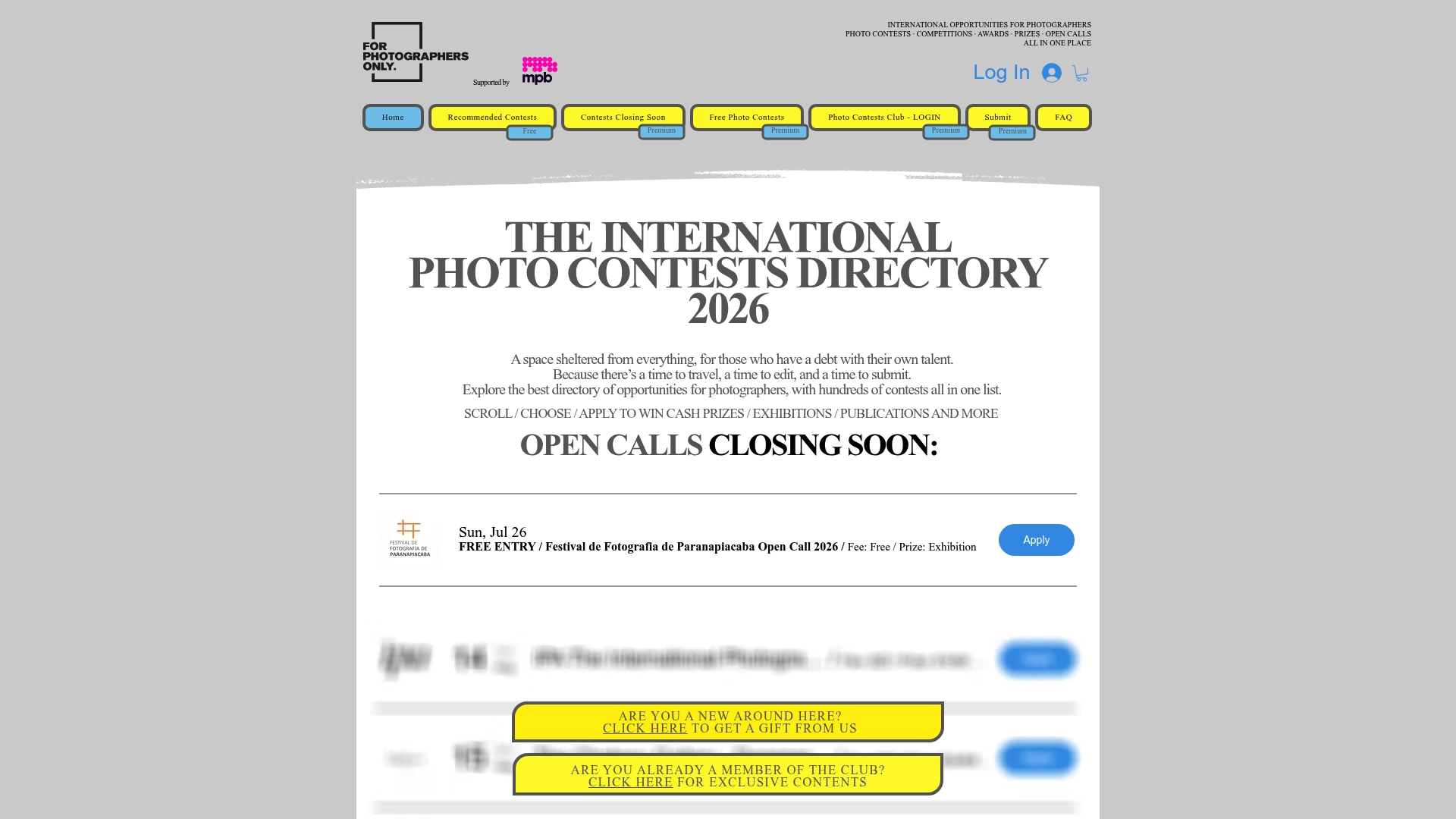
This fits photographers who enter contests regularly and need a reliable tracker rather than a one-time search. The subscription includes:
A continuously updated listing of active contests across genres, including light painting and long exposure categories.
Curated selection that filters out low-value or unclear opportunities before they reach your screen.
Time savings compared to independently researching dozens of contest pages each month.
Plan | Price | Billing |
PhotoContestsClub | 6 € | per month |
PhotoContestsClub | 40 € | per year |
Check current listings and start tracking contests that match your work at the PhotoContestsClub contests page.
Sources
ULTIMATE LONG EXPOSURE PHOTOGRAPHY TUTORIAL - UPDATE 2026 - Julia Anna Gospodarou Fine Art Photography | Workshops | Architecture | Landscape
FAQ
What photo contests are going on right now?
Active opportunities include themed rounds from the Amateur Photographer APOY competition and community challenges like Pexels Light Painting USA. A continuously updated directory such as PhotoContestsClub tracks these alongside hundreds of other active listings.
Is there a portrait photo competition scheduled for 2026?
Yes, the Amateur Photographer APOY competition includes portrait-focused rounds as part of its themed yearly schedule. Check the specific round dates directly on the contest page, since themed rounds open and close at different points across the year.
Are photo contests worth it?
Contests are worth entering when the prize, exposure, or portfolio credit matches your goals and the entry fee is reasonable relative to that return. Community challenges offer low-risk practice and modest prizes, while juried awards offer stronger credentials but demand more preparation time.
What is the 20 60 20 rule in photography?
Definitions of this rule vary across photography education sources, and no single contest or technical source in this article ties it to a fixed standard. Treat any version you encounter as a general compositional guideline rather than a rule enforced by contest judges.
Recommended