Legit Photo Contests: Your Verified Guide for 2026

Start at a vetted directory or the contest’s official website — those two moves will identify the vast majority of legitimate photo contests before you spend a single dollar on entry fees. The fastest path is Forphotographersonly, a curated directory of 320+ active international competitions, including over 100 free-to-enter opportunities updated weekly. If you go directly to an organizer’s site, two checks take under two minutes: confirm a published judging panel with named bios, and verify that the prize delivery method is spelled out clearly in the terms and conditions.
Use a vetted directory first. Forphotographersonly lists contests chronologically with deadlines, fees, and prize details in one place, so you can compare opportunities without hunting across dozens of individual sites.
Check the official rules page. Every credible organizer publishes a dedicated rules or FAQ page. If it is buried, vague, or missing entirely, treat that as a warning sign.
Run two quick trust checks. Named jurors with professional bios, and a stated prize delivery timeline, are the two fastest indicators that a competition is real.
Key Takeaways
Legitimate photo contests are identifiable by three consistent markers: named jurors with verifiable bios, transparent prize delivery terms, and a documented archive of past winners with press coverage.
Point | Details |
Start with a vetted directory | Forphotographersonly lists 320+ active competitions, including 100+ free-to-enter, updated weekly. |
Check jurors and prize delivery | Named jury bios and a stated prize timeline are the two fastest legitimacy signals to verify. |
Preserve EXIF metadata | Missing or altered capture timestamps cause disqualification at many competitions, including the Wilderness Photo Contest. |
Match contest type to your goal | Cash prizes, publication, and exhibition outcomes serve different career objectives — choose accordingly. |
Submit early, note the timezone | Portal failures are common near deadlines; submit at least 48 hours ahead and confirm the stated timezone. |
Table of Contents
Entry fees and prizes — what’s reasonable and what’s a red flag
Where to discover verified contest listings and curated directories
Is it worth entering contests? Benefits and realistic expectations
Forphotographersonly: one subscription, 320+ verified opportunities
An editorial perspective on what “legitimate” really means in this industry
Which legit photo contests are worth your time right now?
The competitions below represent a cross-section of the most respected opportunities in photography today, from globally televised awards to niche institutional prizes. Each has a documented track record, published judging criteria, and verifiable prize fulfillment.
Sony World Photography Awards — The most media-visible competition on the planet. Series prizes reach substantial amounts and single-image prizes are also significant, with additional equipment packages, exhibitions, and publication opportunities across multiple streams (Series, Single Image, Student, Youth). Suited to professionals and serious amateurs alike.
International Photography Awards (IPA) — Widely regarded as the “Oscar” of global photography. Strong industry recognition, a distinguished jury, and categories spanning editorial, fine art, and commercial work make it a career milestone for winners.
Wildlife Photographer of the Year — Organized by the Natural History Museum in London, this is the oldest and most prestigious recognition in natural history photography. Winning here carries weight that few other awards can match.
Travel Photographer of the Year — The definitive global benchmark for travel and documentary reportage. Publication and exhibition outcomes are central to the prize.
ND Awards — A respected international competition with a strong fine-art and documentary focus, known for its independent jury and transparent judging process.
World Press Photo — The gold standard for photojournalism. In 2026, the contest drew 3,747 photographers from 141 countries through a rigorous multi-stage judging process: regional juries feeding into a global jury.
CEWE Photo Award — Free to enter, with more than €250,000 in prizes including holidays and equipment vouchers across multiple categories. Proof that free-entry contests can deliver meaningful rewards.
iPhone Photography Awards — The first and most important competition dedicated exclusively to mobile photography. If your strongest work is shot on a smartphone, this is the reference point.
Siena International Photo Awards — One of Europe’s largest and most celebrated competitions, with strong editorial and exhibition outcomes.
Prix de la Photographie, Paris — A prestigious European award based in Paris, recognized for its curatorial rigor and publication prizes.
British Journal of Photography awards — Awarded by the world’s oldest photography publication, these prizes carry exceptional editorial credibility and reach contemporary audiences at the highest level.
Nature Photographer of the Year — An internationally recognized competition at the highest level of nature and wildlife photography.
Environmental Photographer of the Year — The most important global prize dedicated to climate change and environmental photography.
National Wildlife Photo Contest — Backed by the National Wildlife Federation, this institution-driven competition offers editorial exposure through National Wildlife Magazine and partner channels, making it a strong choice for conservation-focused photographers.
Forphotographersonly — Not a contest itself, but the recommended discovery hub. The directory covers all of the above and hundreds more, organized by deadline, fee, and genre, so you can find the right competition for your work without spending hours searching.
How to verify a contest is legitimate before you enter
No shortlist covers every opportunity, which means you need a reliable way to evaluate contests you find independently. This checklist works for any competition, from major awards to niche open calls.
What to confirm on the contest page:
Named jurors with professional bios and verifiable credentials (not just job titles)
Prize delivery details: cash amounts, how and when they are paid, equipment or publication specifics
A gallery of past winners with names, dates, and ideally press coverage or portfolio links
Full terms and conditions, with a dedicated section on image rights and licensing
A clear refund or withdrawal policy
Organizer contact information: a real email address or support channel, not just a web form
Entry deadlines stated with a specific timezone (e.g., 11:59 PM ET)
Red flags that signal a problematic contest:
Judging described only as “a panel of experts” with no names or bios
“Pay to vote” mechanics where public votes determine winners
Rights language that grants the organizer perpetual, transferable, commercial use of your images
No archive of past winners anywhere on the site
AI-generated images permitted without any disclosure or separate category
No physical address, no named contact, and no social media presence with real engagement
Cross-verification steps:
Search the contest name alongside “winners” or “past results” in Google Images and press databases. Check whether winning photographers reference the award in their professional portfolios or press features. Institutional affiliations — a museum, a scientific society, a major publisher — are among the strongest trust signals available, because those organizations have reputational stakes that extend far beyond any single competition.
Pro Tip: Before paying any entry fee, paste the contest’s terms and conditions into a text search for the phrase “sublicensable” or “royalty-free commercial use.” If either phrase appears without a clear scope limitation, request clarification from the organizer in writing before submitting.
Entry fees and prizes — what’s reasonable and what’s a red flag
Entry fees are not inherently a sign of a problematic contest. Many of the most respected competitions charge fees that fund prize pools, jury honoraria, and exhibition costs. The question is whether the fee is proportionate and transparent.
Common fee models:
Free entry: CEWE Photo Award, the Weather Photographer of the Year (which also offers cash prizes of £1,500 for the main category, £500 for mobile, and £500 for the Climate Award), and many institutional competitions charge nothing.
Low fixed fee: Typically $10–$30 per entry or per category. Common at mid-tier competitions with genuine prize pools.
Sliding scale by country: The Eyeshot Open Call 2026 adjusts fees automatically by a participant’s country GDP per capita and offers free entry for students and photographers facing financial hardship. This model reflects a values-driven organizer.
Per-series vs. per-image pricing: Some competitions charge per image; others charge a flat fee for a series. Confirm which model applies before calculating your total cost.
When fees are justified:
The prize pool is publicly stated and proportionate to the fee volume
Past prize fulfillment is documented (past winners publicly named, prizes confirmed in press coverage)
The organizer is an established institution or brand with a verifiable track record
When to walk away:
High fees with no clear explanation of how prize money is funded
“Pay-to-win” voting schemes where additional votes can be purchased
Fees that escalate with each submission round without a corresponding increase in prize value
What contest rights and licensing clauses actually mean
Rights language is where many photographers get caught off guard. The terms and conditions section of a contest entry form is a legal document, and certain phrases carry significant consequences for how your images can be used after submission.
Key clause types to understand:
Non-exclusive license: The organizer can display your image for contest purposes; you retain full ownership and can license the image elsewhere. This is the standard for reputable competitions.
Exclusive license: The organizer has sole rights to use the image for a defined period. Acceptable only if the scope and duration are clearly limited.
Perpetual license: The license never expires. Acceptable for non-exclusive display rights; problematic if combined with commercial use or sublicensing rights.
Commercial use rights: The organizer can use your image to sell products or services. This should be explicitly limited in scope (e.g., “solely for promoting the contest”).
Sublicensable rights: The organizer can pass your license to third parties. This is the clause that most frequently causes harm, because it means companies you have never heard of could legally use your image.
Worldwide royalty-free: The organizer pays nothing for any use, anywhere, forever. Combined with sublicensing and commercial use, this is the most aggressive rights grab in the industry.
Phrases to question or avoid:
“Perpetual, irrevocable, royalty-free, sublicensable, transferable license to use your entry for any purpose”
“Including commercial purposes, in all media now known or hereafter devised”
“Without further compensation or notification”
What to do: If a competition’s T&Cs contain any of these phrases without a clear scope limitation, contact the organizer and ask for written clarification. Reputable organizers will respond promptly and often clarify that the language is standard legal boilerplate limited to contest promotion. If they do not respond, or if the language is genuinely unrestricted, withdraw your entry.
Where to discover verified contest listings and curated directories
Finding real photography competitions consistently requires more than a single Google search. The most reliable approach combines a curated directory with direct verification on the organizer’s official page.
Forphotographersonly maintains a directory of 320+ active competitions, organized chronologically by deadline, with fee, prize, and genre details for each listing. The platform covers contests from institutions like Nikon, Canon, Leica, and National Geographic alongside niche festivals and open calls that rarely surface in general searches. Because the directory is updated weekly, it filters out expired listings and low-value opportunities before they reach photographers.
Beyond a curated directory, these source types consistently surface credible opportunities:
Museum and cultural institution sites: Natural History Museum (Wildlife Photographer of the Year), the Royal Meteorological Society (Weather Photographer of the Year), and similar bodies publish contest pages with full institutional accountability.
Major publisher and brand award pages: Sony World Photography Awards, National Geographic, and the British Journal of Photography each maintain dedicated competition pages with multi-year archives.
Specialty society competitions: Scientific and professional societies often run contests with strong editorial outcomes and no entry fee.
Conservation organization contests: The National Wildlife Photo Contest and similar mission-driven competitions offer editorial exposure through established media channels.
The most efficient workflow: start with a curated directory to identify opportunities, then navigate directly to the organizer’s official rules page to verify terms before submitting or paying.
How top contests judge and what jurors actually look for
Understanding how a competition evaluates entries helps you assess its credibility and prepare stronger submissions. The most respected competitions share a recognizable judging architecture.
Multi-stage judging as a fairness signal:
World Press Photo’s 2026 contest illustrates the model: regional juries review entries first, then a global jury makes final selections from a curated pool. This structure reduces individual bias, increases geographic and cultural diversity in the evaluation, and creates a documented chain of accountability. A competition that names only “a panel of judges” with no stage breakdown is offering far less transparency.
What jurors prioritize:
Storytelling and narrative coherence: A single image or series that communicates a clear, compelling story consistently outperforms technically perfect but contextually empty work.
Technical excellence: Sharpness, exposure, and composition remain baseline requirements, but they are entry criteria, not differentiators.
Originality: Jurors at top competitions actively look for perspectives and subjects that have not been exhausted by the existing canon.
Ethical sourcing and authenticity: EXIF data, capture timestamps, and location metadata are increasingly used to verify that images are original and unmanipulated beyond stated contest parameters. Many competitions now explicitly prohibit AI-generated imagery.
Consent and documentation: For images involving people, especially in sensitive contexts, jurors and organizers may require model releases or evidence of informed consent.
How organizers signal credibility through their judging process:
Published jury bios with verifiable professional histories, independent jurors with no financial stake in the outcome, transparent scoring rubrics shared with entrants, and editorial curation of finalists in a public gallery — these are the markers that separate a well-run competition from one that is simply collecting entry fees.
Is it worth entering contests? Benefits and realistic expectations
Photography competitions offer returns that extend well beyond the prize itself, but the calculus depends entirely on what you are trying to achieve.
Portfolio credibility. A finalist or winner credit from a recognized competition carries weight with editorial clients, galleries, and grant committees in a way that self-promotion alone cannot replicate. The Sony World Photography Awards explicitly positions its prizes as career-elevation tools, and past winners consistently report increased editorial inquiries following their results.
Publication and exhibition. Many competitions, including Eyeshot and the British Journal of Photography awards, prioritize editorial outcomes — books, monographs, gallery shows — over cash. For photographers whose goal is visibility within the art world rather than immediate income, these prizes often deliver more lasting value than a cash payment.
Networking and community. Finalist events, opening nights, and award ceremonies are genuine professional networking opportunities. The National Wildlife Photo Contest, for example, connects winners with the National Wildlife Federation’s editorial and conservation networks.
Realistic expectations on success rates. Major competitions receive tens of thousands of entries. Winning is rare; finaling is meaningful. A more useful frame: treat each entry as a deadline that forces you to edit your work rigorously and articulate what makes an image compelling.
Decision framework. Match the contest’s prize type to your current goal. If you need cash, prioritize competitions with transparent cash prizes and documented payout histories. If you need editorial exposure, target competitions with publication or exhibition outcomes. If you are building a portfolio of credentials, focus on prestige and jury reputation over prize size. For photographers looking to sharpen their craft before entering, a photography masterclass can meaningfully improve your competitive edge.
Practical tips to prepare a competitive entry
Strong work submitted carelessly loses to good work submitted correctly. These steps cover both the technical and editorial dimensions of a competitive submission.
Technical checklist:
Preserve original EXIF data. Many competitions, including the Wilderness Photo Contest, disqualify entries with missing or altered capture timestamps. Never strip metadata from submission files.
Match the required file format (usually JPEG), color profile (sRGB is the most common requirement), and resolution to the contest specifications exactly.
Confirm the maximum file size and rename files according to any stated filename convention before uploading.
Check whether AI-generated or AI-enhanced imagery is permitted. The Weather Photographer of the Year prohibits it outright; many other competitions are moving in the same direction.
Editorial checklist:
Select your strongest image, not your most recent or most technically complex one. Jurors respond to impact first.
Write captions and story notes that are concise and factual. Avoid over-explaining what the image already communicates.
Choose the correct category carefully. A misplaced entry is often disqualified regardless of quality.
For series entries, confirm whether the series is judged as a collective narrative or as individual images. Series entries sometimes unlock editorial prizes — books, monographs — that single-image entries do not.
Submission logistics:
Submit at least 48 hours before the stated deadline. Portal failures during high-traffic closing windows are common, and most organizers do not grant extensions.
Note the exact timezone of the deadline (e.g., 11:59 PM ET) and convert it to your local time before the submission date.
Screenshot or save your submission confirmation. If a dispute arises, that record is your only evidence of timely entry.
Pro Tip: When a competition offers both single-image and series entry options, read the prize structure for each before deciding. Series entries at competitions like Eyeshot can unlock editorial contracts and book publishing opportunities that the single-image track does not offer.
How the Forphotographersonly team curates and vets contests
Every listing in the Forphotographersonly directory goes through a verification process before it reaches photographers. The team checks organizer identity against publicly available records, reviews the full terms and conditions for rights-grabbing language, confirms past-winner legitimacy through press coverage and portfolio references, and assesses prize fulfillment history before any competition is published.
The result is a directory of 320+ active international competitions, including over 100 free-to-enter opportunities, organized chronologically so photographers can plan their submission calendar without hunting across dozens of individual sites. Every listing links directly to the organizer’s official rules page, so the verification chain is transparent and auditable. The platform also runs a members-only internal monthly competition, giving subscribers a low-stakes environment to practice entering and receiving feedback before committing to major international awards.
A free trial is available for photographers who want to assess the directory’s scope and quality before subscribing.
Forphotographersonly: one subscription, 320+ verified opportunities
Searching for real photography competitions one by one is a slow, unreliable process. Forphotographersonly gives you a single, continuously updated page where every listing has already been checked for organizer legitimacy, transparent T&Cs, and prize fulfillment history.
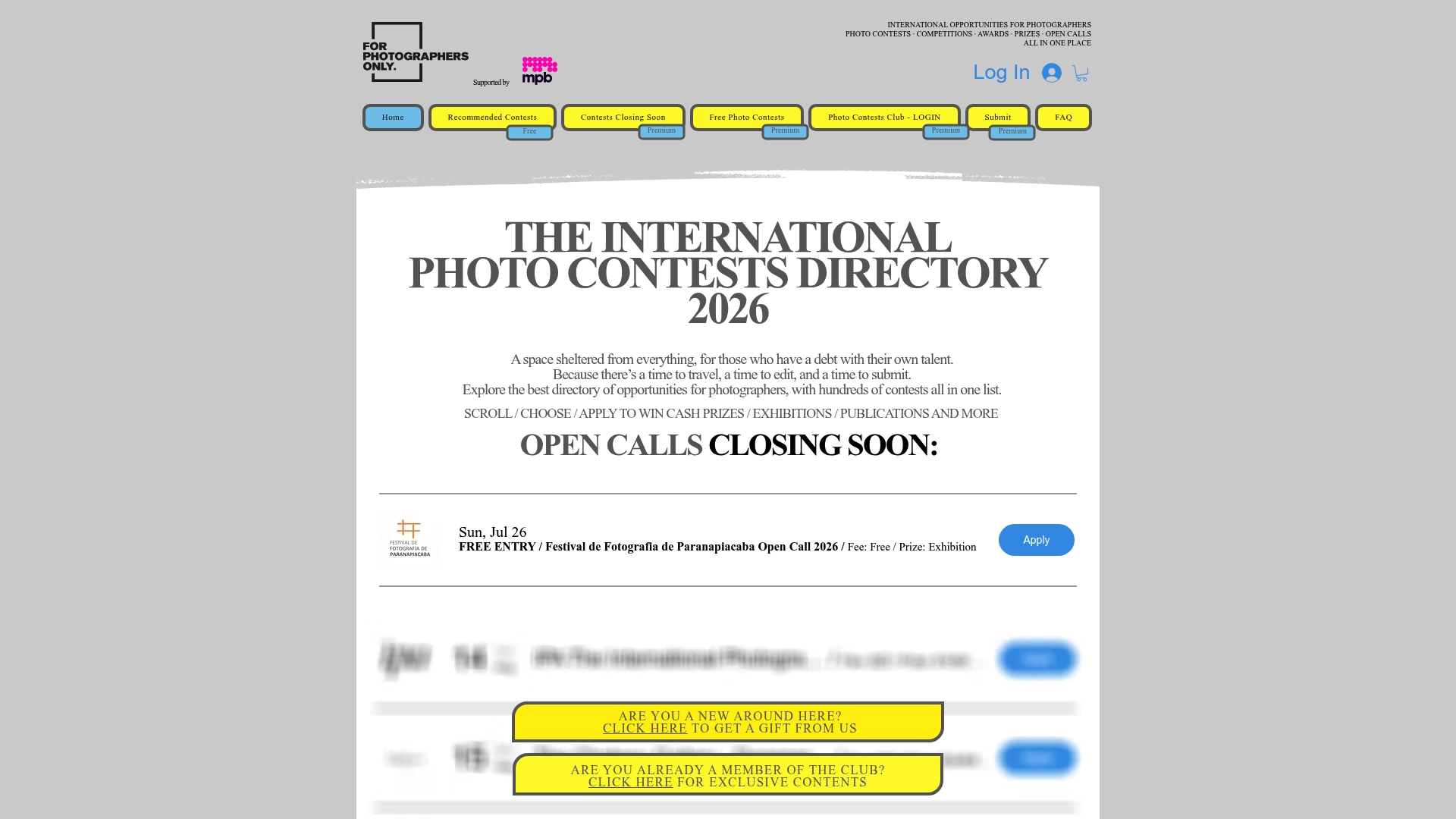
Subscribers get full access to 320+ curated contest listings, including opportunities from Nikon, Canon, Leica, and National Geographic alongside niche festivals and open calls that rarely surface elsewhere. The directory is updated weekly, so deadlines are current and expired listings are removed before they waste your time. Member benefits include:
Continuous deadline alerts and weekly updates
Access to 100+ free-to-enter competitions in one place
Members-only internal monthly competition for practice and community feedback
Direct links to organizer rules pages for every listing
At €6 per month, a subscription costs less than a single entry fee at most paid competitions. Browse the full contest directory or explore a specific listing like the Creative Quarterly Competition to see the level of detail included with every entry. A free trial is available — start there and decide with full information in hand.
An editorial perspective on what “legitimate” really means in this industry
The word “legitimate” does a lot of work in photography competition culture, and it is worth being precise about what it actually signals. A competition can be technically legitimate — real prizes, real judges, real payouts — and still be a poor investment of your time and entry fee. The more useful question is not “Is this contest real?” but “Does this contest serve photographers, or does it primarily serve itself?”
The distinction shows up in the details. Competitions that publish jury bios, archive past winners publicly, and limit their rights claims to genuine promotional use are making a statement about their relationship with photographers. They are saying: we want your best work, and we will treat it with the respect it deserves. Competitions that obscure their judging process, demand broad commercial rights, or rely on pay-to-vote mechanics are extracting value from photographers’ ambition without returning proportionate benefit.
The rise of AI-generated imagery has added a new dimension to this. Competitions that explicitly prohibit AI-generated entries and enforce that prohibition through EXIF verification are protecting the integrity of the medium. Those that permit AI without disclosure or separate categorization are, whether intentionally or not, devaluing the craft of every photographer who enters.
The most credible competitions in the world — World Press Photo, Sony World Photography Awards, Wildlife Photographer of the Year — share one characteristic beyond their prestige: they are organized by institutions that have more to lose from a scandal than they could ever gain from a single entry fee. That accountability is the deepest trust signal of all.
Sources
These pages exemplify clear rules, transparent judging, and strong institutional accountability. Each is worth bookmarking as a reference for what a well-run competition looks like.
Recommended