Instant Film Photo Contests: Where to Enter and What to Check

Instant film photo contests reward pictures made on Polaroid, Instax and similar integral or peel-apart film, and they come in three kinds: contests built only for instant photography, analog contests that accept instant film among other processes, and open calls that welcome any lens-based work, including a scanned Polaroid. For U.S. photographers the most useful approach is to search across all three, read the rules on originals, scans and rights before paying a fee, and track deadlines in one place.
Instant film is a small corner of the contest world, which is exactly why it rewards attention. Fewer photographers compete in the dedicated categories, the images have a recognizable physical character, and curators looking for tactile, one-of-a-kind objects tend to notice them. This guide explains how the contests work, what they typically cost, how to submit a print that cannot be duplicated, and how to judge whether a contest deserves your entry fee.
TL;DR
Instant film contests fall into three groups: dedicated instant shows, analog awards that accept instant film, and general open calls that take any lens-based work.
Many dedicated shows ask for original instant prints, not scans, and entry fees for small groups of images have recently sat around $15 to $35.
Read the rights clause before the prize list: the terms decide what you license, and they can differ from the promotional text.
Photographers in Europe can generally enter worldwide calls, but always confirm eligibility, shipping and customs terms for each contest.
A curated directory that lists deadlines, fees and prizes in one place saves hours of searching each month.
Table of Contents
What counts as an instant film photo contest
Instant photography produces a finished image without sending film to a laboratory. The Cooper Hewitt traces the idea to Polaroid’s Land Camera Model 95, introduced in 1947, and notes that the later SX-70 ejected a developing picture automatically. That heritage explains why contest organizers treat the medium as its own category: the print is a single physical object, not a file that can be reproduced endlessly.
In practice, three types of contest accept instant film.
Dedicated instant film contests. These are open only to photographs made on instant film. One recent example is the U.S.-based Instant Photo Show, which asked for original instant photographs, including Polaroid, Instax, One Instant and emulsion lifts, and allowed up to five images for a $15 entry fee.
Analog and film contests with an instant category. These awards reward work captured through an analog process. The rules of Analog Sparks describe accepted media as color or black-and-white film, instant film, collodion and other alternative techniques, while purely digital photographs are excluded. Retailer-run seasonal contests work similarly: the 2026 Summer of Film contest from CameraMall and Woodward Camera accepts several film formats and includes an Instant Photography category for images made on Polaroid or Instax film.
General open calls and gallery exhibitions. Many juried exhibitions accept any lens-based submission, so an instant print or a high-quality scan of one is eligible alongside digital work. Here your instant image competes against every other process, which makes the choice of image and the strength of the series more important than the medium.
The difference from a general photography contest is therefore mostly about the rules of origin. A general contest asks whether the picture is good and fits the theme. An instant film contest also asks how it was made, and it may ask you to prove it by shipping the physical print.
Which contests are open to U.S. photographers
Most of the contests above are run from the United States and welcome American entrants without residency restrictions beyond age and the usual employee exclusions. The pattern you will see across the calendar looks like this:
Contest type | Typical accepted work | Typical entry | Who it suits |
Dedicated instant show | Original Polaroid, Instax, Impossible-style film, emulsion lifts | Small group of images for a flat fee (for example, five images for $15) | Photographers shooting mainly on instant film |
Analog awards | Film of any type, including instant, plus alternative processes | Per-image or per-series fees, often with a series category | Photographers working across 35mm, medium format and instant |
Retailer or brand contests | Specific film formats, sometimes with a dedicated instant category | Often free or low cost, with prizes in gear or store credit | Beginners and hobbyists building a first record of recognition |
Gallery open calls | Any lens-based work, prints or files | Around $35 for up to five images in one published example | Photographers building an exhibition history |
The gallery example is concrete: the Praxis Gallery calls for entry list $35 for up to five images, with $5 for each additional image up to ten, and mention hardship fee waivers available by contacting the gallery. Fees vary widely by organizer, so treat these figures as a snapshot of the price range and not as a rule.
One point of caution applies to all of them. Contest schedules change from year to year, and a call that closed last month often returns on a similar cycle. Rather than chasing a single deadline, note the season in which each contest usually runs and check the organizer’s own page for the current dates.
Eligibility, fees and deadlines: what to look for
Before you pay, run each contest through the same short checklist.
Process requirements. Does the contest accept only original instant film, or are scans and digital files allowed? Dedicated shows are often strict. The Instant Photo Show, for example, required original instant photographs, which rules out inkjet reprints of digital files.
Entry fee structure. Is the fee per image, per series or per entrant? A $15 fee for five images costs $3 an image, while a per-image fee of $10 across five frames costs $50. Compare on the cost of the full set you plan to submit.
Image count and series rules. Some calls want single images, others want a cohesive body of work with a short statement. Instant film suits series, because the border and color shift of a pack of film tie frames together naturally.
Eligibility. Look at age limits, residency, and whether the contest bars professionals or past winners.
Deadlines and timelines. Check not only the entry deadline but also when winners are announced and when any exhibition prints must arrive.
Rights and usage. Covered in detail below, and the item most entrants skip.
Free contests deserve a place in your plan. They carry no financial risk, they often come from camera retailers, magazines or festivals, and they are a good way to test an image set before paying for a juried call. Just apply the same rights scrutiny to them, since a free entry can still grant the organizer broad usage.
How to submit instant film: originals, scans and digital files
Submission is where instant film behaves differently from everything else. You cannot duplicate the original, so the way you handle files and prints affects both your chances and your risk.
Scan first, whatever the contest asks
Even when a contest wants the physical print, scan every frame before you enter. A flatbed scan at 600 dpi or higher, made with the print flat and clean, gives you a backup, a file for online submission forms and a reference if a print is lost or damaged in the mail. Keep the white border if the contest evaluates the print as an object, and crop it only if the call asks for the image alone.

Digital submission, physical print on selection
A common model asks for digital files at entry and requests the original or a print only if you are selected. Praxis Gallery works this way: according to its call-for-entry page, selected artists may either ship original prints for gallery matting and framing or submit high-resolution files for the gallery’s printing service for a fee (one example is $37). For an instant photographer, that choice is real. Shipping the original preserves the object, but you accept the risk and the postage. Paying for a print from a file costs money, though it keeps the one-of-a-kind original safe at home.
If you are weighing those print and shipping costs across several exhibitions, a guide to photography for grant applications shows how image presentation affects the way a funder or gallery reads your submission.
Presentation expectations
Exhibition-oriented shows tend to prefer plain presentation. The Instant Photo Show asked for original instant photos that were available for exhibition and suitable for public display, with simple black framing and white matting preferred. Plan for a neutral frame, a clean mat and a print without fingerprints, tape residue or edge damage.
A practical packing routine
Place each print in an archival sleeve and add a rigid backing.
Label the back lightly in pencil, with your name, title and the contest name.
Use tracked shipping and, if the organizer permits, insurance.
Photograph the packed parcel and keep the receipt.
Polaroid emulsions can be sensitive to heat and prolonged light, so avoid leaving a package in a hot vehicle or in a mailbox in summer.
Prizes, judging and image rights
Prizes in instant film contests run from gear and store credit in retailer contests to exhibition slots, publication and cash in juried awards. Think about what each prize does for your goals. A show with a published catalog and a curator on the jury may be worth more to your career than a larger cash amount from a contest with no editorial profile.
Judging criteria are usually stated in a sentence or two: originality, technical command, concept, and fit with the theme. Where a call names its jurors, look them up. A panel of editors, gallerists and working photographers is a signal that the contest cares about the long-term reputation of its results.
Reading the rights clause
The American Society of Media Photographers advises entrants to read contest terms closely, because the terms decide what rights you grant and can reveal inconsistencies between the promotional material and the actual rights clause. A page may say “you keep your copyright” while the legal text grants a broad, perpetual license. Read these points in every contest you enter:
Scope of license. Is it limited to promoting the contest, or does it cover any commercial use?
Duration. Is the license time-limited or perpetual?
Exclusivity. Can you still sell or license the image elsewhere?
Winners versus all entrants. Some terms apply the license to every entrant, not just winners.
Sales commission. Galleries may retain a share of print sales. Praxis Gallery, for instance, retains a 50% commission on exhibition prints sold.
For questions about a specific contract, a lawyer experienced in photography and copyright can interpret the clause for your situation. For general guidance, professional associations such as ASMP publish plain-language resources for photographers.
How to tell whether a contest is legitimate
A good contest is transparent about who runs it, who judges it and what happens to your images. Popular Photography recommends checking usage rights, comparing prizes with entry fees, looking at the contest’s history and prestige, and asking whether it suits your career stage. Turn that into five practical tests:
Does the organizer have a track record? Look for past winners, past exhibitions and press coverage from earlier editions.
Do the numbers make sense? A large entry fee paired with a vague prize is a warning sign, especially when thousands of entries are likely.
Are the rights fair? The license should match the purpose of the contest, and the terms should be easy to find before you pay.
Is the jury named? Anonymous judging is not always a problem, but named jurors are accountable.
Does the contest suit your work? A prestigious general award may be a poor use of money for a quiet instant series, while a focused analog call may be an ideal match.
Community threads can be helpful for checking winner experiences. Photographers sometimes confirm in public forums that a contest paid out or shipped prizes. Treat those posts as hints, though, and verify the details on the organizer’s own page.
Can European photographers enter the same contests?
Often, yes, but the answer is contest by contest. Many open calls are international. Polaroid’s 2024 Polaroid x Magnum open call, for example, invited photographers worldwide to send digital, analogue or Polaroid portfolios together with an idea for a story inspired by empathy. Contests tied to a retailer promotion, a specific national audience or a physical exhibition may restrict residency, require shipping within a country or treat prizes differently.
If you are based in Europe and want to enter a U.S. contest that requires original prints, check four things first: whether the organizer accepts international entrants, who pays for return shipping, how customs declarations should read (a print of no commercial value is usually described as such) and whether prize money is paid in dollars or by transfer to a foreign account. The reverse applies to Americans entering European festivals. For many photographers, digital submission with print-on-selection is the simplest route across borders.

How to build an entry calendar that works
The most common reason photographers miss good contests is not the quality of their work but the lack of a system. A simple calendar solves most of it.
Sort by process. Make one list for instant-only calls, one for analog awards and one for general open calls.
Record the fee for your full set, not the headline fee for one image.
Set two reminders, one a month ahead to prepare files or prints and one a week ahead to submit.
Keep a master folder of scans, titles, captions and statements, so each entry is a matter of minutes.
Log results. Note which images placed, which were ignored and which jurors responded to your work.
The discipline matters because instant film is slow. Shooting a pack, waiting for development, choosing frames and scanning them takes days. A photographer who starts only after finding a deadline will often submit weaker work than one who has a ready archive.
Our perspective on instant film and contests
We research and publish international photography competitions for a living, and we have seen how instant film behaves in the contest ecosystem. The first thing to say is that a contest is a meeting point in the contemporary art calendar: it connects a body of work with curators, editors and an audience it might never reach alone. Instant film brings something rare to that meeting, a physical object with a visible trace of the moment it was made.
The second observation concerns strategy. Dedicated instant shows are valuable, but they are few. The more compelling approach is to treat your instant series as a serious body of work and send it wherever the rules allow, including analog awards, film magazines’ calls and general juried exhibitions. Analog and film publications, such as those we list on our pages for Film Life Magazine and Shoot Film Mag, also offer editorial visibility that complements a prize.
The third observation is about honesty with yourself. Enter fewer contests, but choose them deliberately. Match the fee to the realistic benefit, read every rights clause, and keep the original print safe whenever a high-quality scan will do. We do not organize contests ourselves, which lets us stay on the photographer’s side of the table: we only curate and present them, so you can compare the opportunities and decide.
— DARIO
Find instant film and analog contests in one place
Searching the web for instant film contests means opening dozens of tabs, checking fee pages and re-reading deadlines. Our directory brings together more than 320 active international photography contests, awards, calls and grants, with over 100 free-to-enter opportunities, all updated every week and presented in chronological order, with fees, prizes, genres and deadlines clearly listed.
The PhotoContestsClub membership costs €6 per month or €40 per year, a free trial is offered, and members also get access to the photographer community and a monthly internal competition. Browse the listings by deadline, filter your search toward film and analog calls, and spend your time making images instead of hunting for rules.
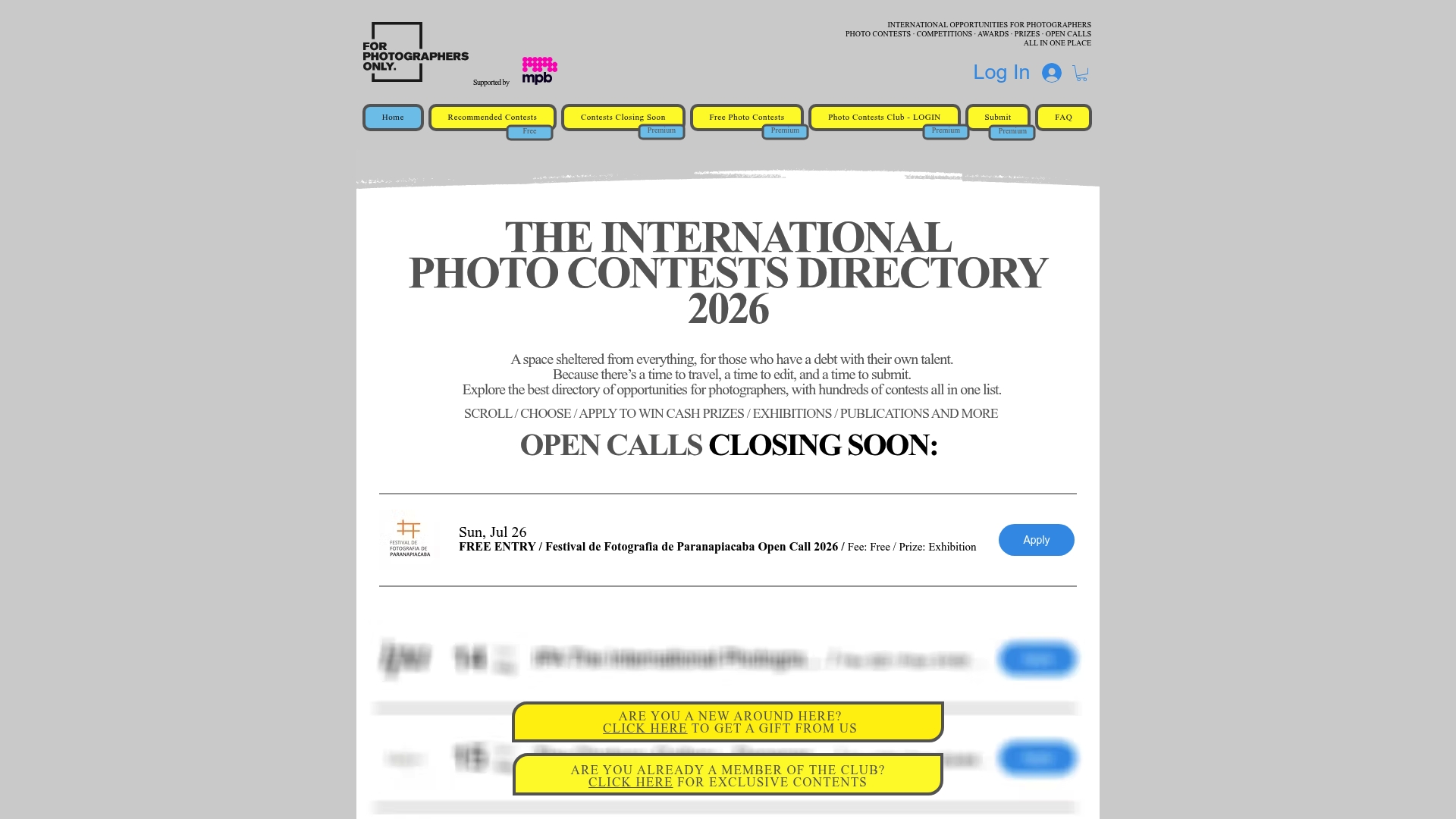
If you want a sense of what a listing looks like, see our entry for the IPA International Photography Awards open call, which shows the deadline, fee and category information we give for every contest.
FAQ
Can I enter a scanned Polaroid in an instant film contest?
It depends on the contest. Dedicated instant shows often require original instant prints, as the Instant Photo Show did. General open calls and many analog awards accept digital files at the first stage and ask for the original only if you are selected. Read the submission section of the rules before you pay.
Are there free instant film photo contests?
Yes, though they are less common than paid ones. Retailer and brand contests, such as seasonal film contests, are the most likely to be free or low cost. Always read the usage rights, because a free entry can still grant the organizer a broad license to your image.
How much does it cost to enter?
Published examples show a range. One U.S. instant show charged $15 for up to five images, and a gallery open call listed $35 for up to five images, with $5 for each additional image up to ten. Compare the price of your complete set, not a single image, and look for fee waivers.
Do instant film photographers have to ship originals?
Not always. Some contests judge digital files and request prints only from selected artists, and some galleries offer to print from a high-resolution file for a fee. If you ship an original, use tracked shipping, a rigid backing and a scan kept at home as insurance.
Can photographers in Europe enter U.S. contests?
Many open calls are international, including portfolio calls that accept digital, analogue or Polaroid work from photographers worldwide. Others are restricted by country or require physical shipping. Check the eligibility section, the shipping terms and the payment method for each contest.
Sources
Recommended