ICM Photography Contests: Find Calls Without Checking Dozens of Sites

Yes, plenty of contests accept intentional camera movement and abstract photography, and the fastest way to find them is through a curated contest directory with dedicated experimental or abstract categories. Search for calls labeled “abstract,” “experimental,” or “motion blur,” then check a continuously updated listing so you are not hunting across dozens of individual gallery sites.
TL;DR:
Use shutter speeds from a quarter second to two seconds, and submit three to five related frames when the contest accepts series.
Name intentional camera movement in a concise artist statement so jurors read blur as deliberate, and include your shutter speed and movement pattern.
Before paying, confirm the category fits, review past winners, compare fees with exhibition benefits, and check whether the call wants single images or series.
Read each prospectus for exact file format, color space, dimensions, size limits, naming rules, fees, deadlines, and release requirements before exporting your final images.
If selected, check the organizer’s image usage terms before accepting, since permission may cover a single exhibition or broader reproduction.
Table of Contents
Where to Look for ICM-Friendly Calls
ICM work finds its best reception in contests built around abstraction rather than literal documentation, so the discovery channels that matter most are the ones organized by category and theme rather than general photography competitions. A curated directory remains the most efficient starting point because it groups active calls by subject and deadline instead of leaving photographers to track dozens of individual websites.
Three channel types consistently welcome nonrepresentational camera work. Gallery open calls such as The SE Center for Photography’s Abstract Vision prospectus publish exposure details and exhibition timelines for lens-based abstraction. Themed art competitions, including Fusion Art’s Everything Abstract, accept photographic and digital abstract entries alongside other media. Online juried shows and magazine open calls round out the field, often with rolling or seasonal deadlines.
When searching, use the vocabulary jurors and organizers actually use:
“Abstract” and “nonrepresentational,” the most common category labels for ICM-adjacent work
“Experimental” and “motion blur,” which surface calls built around technique rather than subject
“Intentional camera movement,” a phrase increasingly used in contest descriptions and submission guidelines
“Photography & digital,” a hybrid category label that frequently welcomes camera-based abstraction
Entry portals vary by organizer: some run through platforms like CaFÉ or Submittable, others host submissions directly on their own sites. Our curated listing of past juried photography exhibitions breaks down how these juried formats typically operate, which helps when a prospectus references unfamiliar terms.
Shooting and Editing ICM Work for Jurors
Jurors evaluating abstract and ICM submissions are reading for intention, not accident. Compositional rhythm, tonal control, and a sense of purposeful motion separate a deliberate ICM photograph from a shot that simply missed focus, and the technical choices behind the image should support that reading.
On the shooting side, a few decisions carry the most weight:
Shutter speeds between a quarter second and two seconds give motion enough duration to read as deliberate without dissolving into noise
Panning speed matched to the subject’s own movement preserves recognizable structure inside the blur
A controlled, uncluttered background keeps the motion itself as the subject rather than a distraction
Shooting toward consistent, directional light strengthens the tonal gradients that give ICM images their rhythm
Editing should protect the motion energy captured in camera rather than smooth it away. Color and contrast adjustments work best when they emphasize the gestural lines already present in the frame, and presenting a short series of three to five related frames often reads as more intentional to a jury than a single isolated image, since the pattern across frames signals a consistent practice rather than a lucky accident.
A short artist statement or caption often makes the difference between a juror seeing accident and seeing intention. Tamron’s guide to entering photo contests recommends crafting a clear caption or story alongside strong technical execution, and naming “intentional camera movement” directly in that statement gives jurors the context to evaluate the blur as a deliberate choice rather than a technical miss.
Pro Tip: Submit your ICM series with a one-sentence note on the shutter speed and movement pattern you used. It reads as technical confidence, not an excuse.
Preparing Your Entry: Checklist and Technical Specs
Most disqualifications happen before the judging even starts, over mismatched file formats, missed category fit, or missing release forms. A short preflight routine catches nearly all of them.
Read the full prospectus before shooting or selecting images, not just the entry form.
Confirm your work fits the stated category: “abstract,” “experimental,” and “photography & digital” are not interchangeable labels.
Prepare any required model or property releases well ahead of the deadline.
Draft a concise artist statement or caption that names your technique where relevant.
Match file specs exactly: most contests request JPEG or TIFF files in sRGB color space, with pixel dimensions and maximum file size stated in the rules.
Name files according to the organizer’s convention, usually a title or entry number rather than your camera’s default filename.
Track the entry fee, submission window, and notification date on a shared calendar.
Many gallery open calls, including The SE Center for Photography’s Abstract Vision prospectus, publish their full technical specifications, image requirements, and submission calendar in advance. Reading that document line by line before exporting your final files prevents the single most common rejection reason: a file that simply does not meet spec.
Fee types vary by organizer: flat entry fees, per-image fees, and membership-based discounts are all common. When submitting a series, keep processing and sizing consistent across every frame so the body of work reads as a single statement rather than disconnected shots.
Choosing the Right Contests for Your ICM Work
Not every open call is worth your entry fee, and a quick fit check before submitting saves both money and effort. Start with category and theme: a contest explicitly calling for “abstract,” “experimental,” or “nonrepresentational” work gives ICM images a fair read, while a general nature or travel category often does not.
Beyond category fit, a few checks sharpen your shortlist:
Review past winners or shortlisted work when available, since a contest that has recognized abstraction before is likely to do so again
Weigh the entry fee against realistic benefits: cash prizes, exhibition, publication, or simply the exposure of a respected juror seeing your work
Note whether the call wants a single image or a series, since series submissions suit ICM work that builds meaning across frames
Factor in workload: a handful of well-chosen calls usually beats a scattershot approach across dozens of unrelated contests
Use deadline alerts or a curated calendar so you are prioritizing calls with real fit, not just the ones that happen to cross your feed
High-profile calls, such as the IPA International Photography Awards, are worth the entry fee precisely because of juror visibility and exposure, even when the odds are longer than a smaller niche call.
Promoting Your Entry After You Submit
Submission is rarely the end of the work. Once your ICM images are entered, the contest itself becomes a piece of content worth sharing, and photographers who treat it that way tend to get more long-term value from the same entry fee.
Share the submission on your own channels as soon as the contest rules allow, since many organizers restrict public posting of entries until after judging closes. A short post naming the contest, the category, and a line about your technique gives followers context and signals that you are actively pursuing recognition, not just posting finished work.
If you are shortlisted or selected, that moment deserves its own announcement, separate from the original submission post. Tag the organizing gallery or publication where appropriate, since many juried shows and online exhibitions actively repost or cross-promote selected artists, extending your reach beyond your own following.
Update your portfolio site and artist statement to reflect the recognition, even a shortlisting, since cumulative mentions of juried selections build credibility over time for curators and editors reviewing your work later. Keep a running, dated list of every contest you have entered and its outcome. It becomes useful both for your own records and for crafting an artist bio that accurately reflects your exhibition history.
Turning Contest Participation Into Career Momentum
A single contest entry rarely changes a career on its own, but a consistent pattern of entries builds something more durable: a track record that curators, editors, and gallery directors can verify. Treat each submission as part of that longer arc rather than an isolated bet.
Juried exhibitions and online juried shows often bring selected photographers into contact with curators and fellow entrants, so engaging with that community matters as much as the entry itself. Commenting thoughtfully on other selected work, attending opening receptions when geography allows, and following up with organizers after results are announced all keep you visible beyond the single contest cycle.
Membership-based entry tracks, like those some magazines run for open calls, can also lower the cost of frequent participation while connecting you to a smaller, more engaged community of entrants. Artdoc Photography Magazine’s Abstract Visions call runs exactly this kind of member-focused model, which rewards photographers who commit to a publication’s aesthetic over multiple cycles rather than entering once and moving on.
Over time, a body of juried selections, exhibition credits, and publication mentions becomes the backbone of an artist statement or grant application. Each entry is a small, concrete data point, and collectively they signal a serious, ongoing practice rather than a single lucky submission.
What Past ICM Entries Reveal About What Wins
Looking at the calls that consistently welcome ICM work tells you more than any single winner’s story. Online juried shows built around abstraction, such as PhotoPlace Gallery’s Abstraction exhibition, routinely select camera-based abstract work alongside other media, and the selection criteria they publish point to a consistent pattern: compositional confidence and a coherent visual idea matter more than technical perfection.
Series submissions tend to perform well in these contexts because they give context that a single frame cannot. A diptych or triptych of related ICM images demonstrates that the motion and color choices in one frame were not accidental, since the same visual logic repeats across the set. Contests that accept project-based submissions, rather than only single images, tend to favor this kind of consistency because it answers the question every juror is implicitly asking: was this intentional?

The nonmonetary outcomes matter as much as prize money in many of these calls. Online exhibition, inclusion in a gallery’s archive, and social media promotion are common benefits listed alongside cash prizes, and for photographers building a public body of work, that visibility can matter more over time than the prize itself. The pattern across these contests is less about a single breakout image and more about photographers who entered repeatedly, refined their series based on which frames got selected, and built a recognizable visual signature along the way.
A Note From Dario on Entering ICM Work
Juried recognition carries particular weight for abstract and ICM photographers, since this is work that often gets dismissed at a glance by viewers expecting a literal subject. A juror taking the time to select it, exhibit it, or publish it is a meaningful signal that the images are communicating something real.
If you are selected, expect exhibition, reproduction in a catalog or online gallery, and sometimes promotional use of your image by the organizer. Read the fine print on usage rights before you accept, since terms vary meaningfully between a one-time exhibition license and a broader reproduction grant.
Submit regularly, and treat every round of feedback, selected or not, as information about how your series is reading to outside eyes. That habit, more than any single win, is what sharpens an ICM practice over time.
— DARIO
Track ICM-Friendly Calls With For Photographers Only
Finding the right contest for abstract and ICM work takes less time when every active call sits on one continuously updated page instead of scattered across individual gallery and magazine sites. Our directory lists numerous active international photography contests at any given time, including free-to-enter opportunities, and we refresh it regularly so the calendar you are checking reflects current openings.
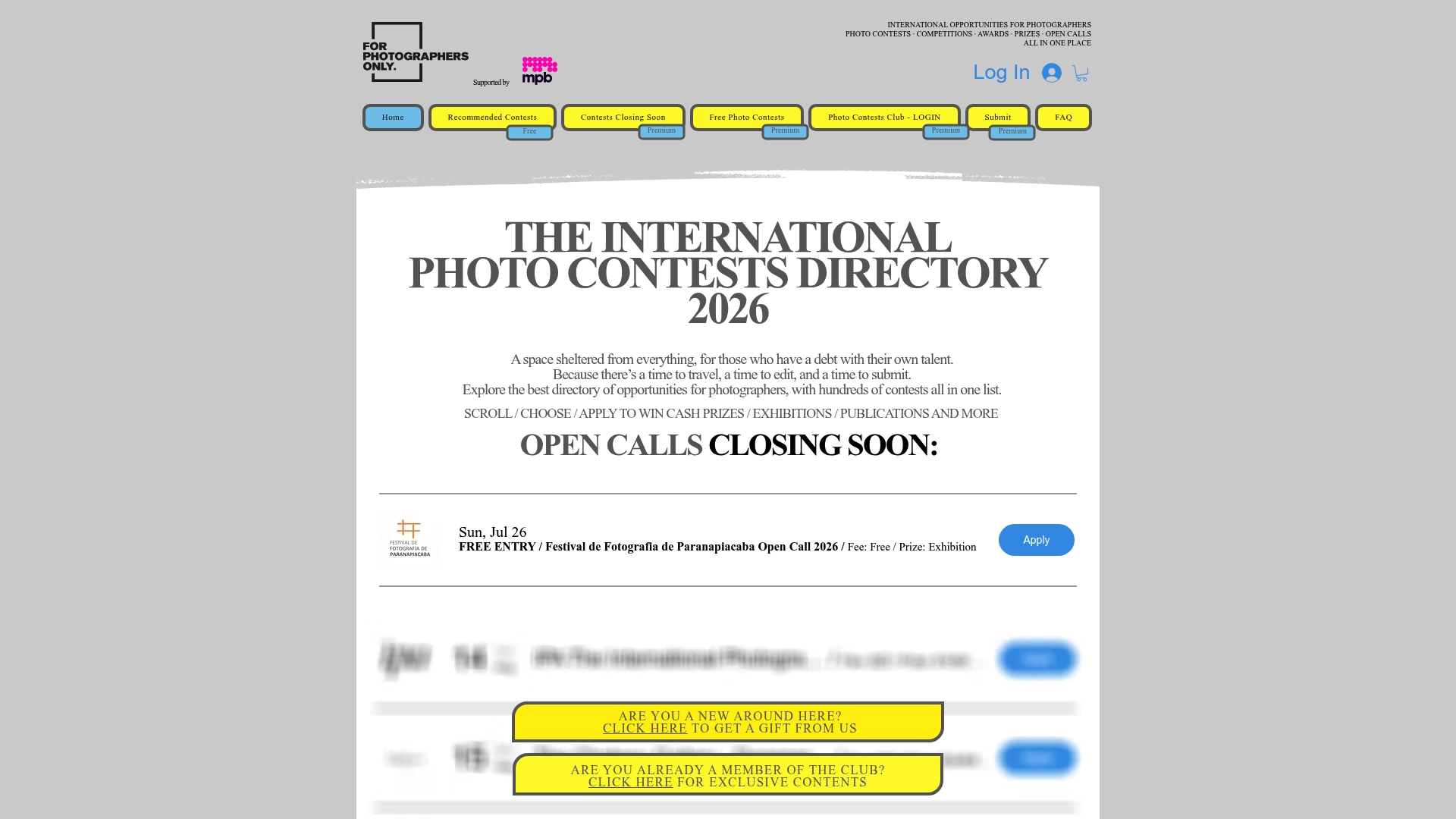
That single page organizes listings so you can easily see which abstract or experimental calls are closing soon, with frequent updates and both free-to-enter and paid calls included.
Visit our contests directory to see what is currently open, or head to our pricing and renewal page to subscribe for full access — subscription options include monthly and yearly plans.
FAQ
Does ICM photography count as abstract photography?
Most contest organizers treat intentional camera movement as a form of abstract or experimental photography, since the final image is nonrepresentational even when the subject was recognizable in reality. Calls labeled “abstract,” “experimental,” or “photography & digital” typically welcome ICM work without requiring a separate category.
Should I submit a single ICM image or a series?
A series of three to five related frames often communicates intention more clearly than one image, since the repeated visual logic across frames signals a deliberate technique rather than a lucky shot. Check each contest’s rules, since some calls specifically request single images while others, like PhotoPlace Gallery’s Abstraction show, accept project-based submissions.
Do I need a model release for ICM photography?
A model release is only required when a recognizable person appears in your frame, which is uncommon in most ICM work since motion blur typically removes identifiable detail. When in doubt, check the specific contest’s rules, since release requirements vary by organizer.
Will an artist statement really change how judges see my ICM work?
A concise statement that names your technique, such as “intentional camera movement,” gives jurors context to read blur as a deliberate choice rather than a technical error. Tamron’s guide to entering photo contests specifically recommends pairing strong images with a clear caption or story to strengthen how your entry is received.
How do I keep track of ICM-friendly contest deadlines?
A curated, regularly updated directory is the most efficient way to track multiple deadlines without checking individual gallery and magazine websites. Our contests listing refreshes weekly so you can see which abstract and experimental calls are open and closing soon.
Sources
Recommended