How to Get Into Photo Festivals: A Step-by-Step Guide

You get into a photo festival by finding the right open call early, matching your work to its eligibility rules, reading the rights terms before you pay, and submitting a tight, well-sequenced edit. The hardest part is rarely the photography. It is finding the calls in time and sorting the strong ones from the weak ones. That is why we built PhotoContestsClub: a curated directory of more than 320 active international contests, awards, calls and grants, including over 100 that are free to enter, updated every week and shown on one chronological page.
TL;DR
Festivals take work through open calls, portfolio reviews and juried exhibitions. Each has its own rules, so start by finding the calls that fit your genre and career stage.
Check three things before you pay: who is eligible, which images qualify, and what license you grant the organizer.
Submit a short, sequenced edit with clear captions. Many organizers do not allow changes after you apply.
Entry fees are almost always nonrefundable, so confirm every field before you pay.
A single, regularly updated list of calls saves the research time you would rather spend editing your work.
Table of Contents
What “getting into” a photo festival really means
Photographers use the phrase for four different things, and the route differs for each.
An open call for exhibition. The festival invites images or a series, a jury selects, and chosen work is shown. Photoville’s Boroughs in Focus call, for example, asked for 10 to 12 images representing a New York City borough, with selected work presented at the festival’s opening-night celebration.
A portfolio review. You book short meetings with editors, curators and gallerists. At FotoFest’s Meeting Place at FUJIKINA NYC 2026, participants receive three 20-minute one-on-one appointments and become eligible for consideration for a FotoFest exhibition.
A juried exhibition running alongside a festival. Local arts districts and museums often run their own calls. The Paseo Arts District’s PhotoFest call in Oklahoma City, for instance, described a September juried show open to traditional, digital and mixed-media work featuring photography.
A prize or solo show from a society. Regional and national photographic societies sometimes offer festival exposure as a prize. The Texas Photographic Society’s 2022 National Photography Award, a U.S.-resident call for a solo exhibition at FotoFest, put eligibility, image count, statement, fee and deadline on a single page.
Knowing which of these you are pursuing tells you what to prepare. A review needs a print-ready edit and a clear ask. A juried call needs images that obey every technical rule. A solo-show prize needs a coherent body of work and a statement.
Step 1: Find the calls before the deadline
Opportunities come from many places: festival websites, museum and gallery call pages, professional societies, regional arts councils and curated directories. The trouble is timing. Calls open at different points in the year, close within weeks, and are easy to miss if you check one site at a time.
A workable routine:
List the festivals you would be proud to show at, and note the month their calls usually open.
Add regional arts districts, museums and photographic societies near you, since they often run smaller juried shows that are easier to enter and still build your record.
Check each organizer’s official page for the current schedule, because dates change every cycle.
Keep one running list with the deadline, fee, theme and eligibility for each call.
This is the part of the process where we take the legwork off your hands. PhotoContestsClub collects competitions, calls, grants and festival-linked opportunities, from names such as Nikon, Canon, Leica and National Geographic to niche contests and independent festivals that are easy to overlook. Each listing carries the deadline, fee, prize and genre, and the whole directory is updated weekly. Our guide to where to find open calls for photographers goes deeper on the main channels.
Step 2: Check eligibility before anything else
Eligibility is where most avoidable rejections begin. A call may restrict entrants by country or state, by age, by status (amateur, professional or emerging), or by when the images were made. A rule on recent images catches many photographers: a call may only accept work from the past two to three years, as the North American Nature Photography Association advises checking.
Organizers who follow good practice state these limits plainly. A Washington State University competition guide recommends that eligibility be clearly defined by age, geography and professional status. If a call does not clearly define it, treat that as a reason to look at the next one.
A fast test before you spend money:
Do you meet the location and status requirements?
Were your images made inside the allowed date window?
Have they already won elsewhere or been published, including on social media? Some competitions exclude such images, according to NANPA.
Does your genre match the category you are entering?
Our article on photo contest eligibility checks walks through five of these in detail.
Step 3: Read the rights terms and the fee
Before you upload, read what you are agreeing to. You own the copyright in your photograph from the moment you make it, and an entry form asks you to confirm that. What you grant the organizer in return is a license, and licenses vary widely.
What reasonable terms look like. The Virginia Living Photography Awards state that entrants keep their copyright and grant only a non-exclusive, perpetual license for business use, so they can still use, sell or display images elsewhere. HSM University’s portfolio course describes reasonable terms as limited to promoting the competition and exhibition, crediting the photographer, applying mainly to shortlisted or winning images, and ending after a set period, such as two years.
What to read twice. The same course lists a license to use all submitted images for any purpose, copyright transfer or sublicensing to sponsors, unnamed jurors and unclear prizes among its red flags. NANPA flags words such as “unrestricted,” “any purpose,” “irrevocable” and “perpetuity” and advises never signing over copyright. If an organizer’s wording confuses you, a short primer on clauses to settle before you sign shows how contract language is built, and an intellectual property attorney can review a specific agreement.
What it costs. Entry fees in the United States are most often $10 to $50 per entry and almost always nonrefundable. Examples vary: the Virginia Living awards charge $45 per image for the Professional Division and $35 for Amateur, while PPETN charges $10 per image for dues-paying members, with up to 10 images per entrant. Because fees add up across a season, many photographers plan a yearly budget and start with free-to-enter calls.
Our photo contest fine print guide and the five-point rights checklist give you a repeatable way to read terms.

Step 4: Build an edit that holds together
Festival juries and reviewers look at sequences as much as single images. Choose work for how it fits together, not for personal favorites.
For open calls and juried shows:
Submit images you are passionate about and would print, and match each to the right category, as NANPA recommends.
Follow sizing, format and editing rules exactly. Some competitions allow no edits after you submit.
Write succinct, informative captions, and check whether model releases or permits are required. PPETN, for one, requires releases for predominant street subjects and for primary subjects under 18.
Expect juries to weigh criteria such as artistic vision, technical skill, originality, relevance to the theme and emotional impact, the areas the WSU guide suggests defining.
For portfolio reviews, HSM University advises you to:
Research each reviewer, including what they program, publish or commission.
Bring a tight edit of 15 to 20 prints, or a tablet with the same images plus a printed leave-behind.
Know what you want from each meeting.
Follow up within a week with a thank-you and a link to your work.
To see what strong entries have in common, read our judge-backed strategy guide to winning photo contests.
Step 5: Submit and keep a record
Submission is mostly administrative, which is why small errors do the damage. The usual sequence is to complete the entry form, upload files, check the legal boxes, read the license clause and pay through the portal by credit card or PayPal. Fees are almost always nonrefundable, so review every field before you pay.

The Photographic Society of America makes the point for international exhibitions: each one sets its own terms covering fees, image sizes and format, sections, judging schedule, score reporting, catalog distribution, submission method and closing date, and ignoring them can lead to disqualification. Save a copy of the confirmation, the terms as they read on the day you applied, and the exact files you sent. Then move on to the next call while you wait.
If you want a list of what trips people up at this stage, see photo contest mistakes that get entries disqualified.
Juried art festivals and photo festivals are not the same thing
The two are easy to confuse. A photo festival is built around photography: exhibitions, reviews, talks and screenings, with calls aimed at photographers and visual artists. A juried art festival is typically a multi-medium event where a panel selects artists across painting, sculpture, jewelry and photography. The application is usually a small set of images and a fee, and the selected artists show their work at the event. Read each call’s own prospectus to see which format you are entering, because the expectations about presentation and fees differ. When your goal is a photography-focused audience, our guide to juried photography exhibitions shows how to prepare. For a fine art focus, see the best fine art photography contests.
Our perspective
Most photographers we hear from are not short of talent. They are short of time. A festival application asks for an edit, a statement, release forms and a careful reading of the terms, and that is before the hours spent finding a call whose theme, fee and eligibility actually suit the work. We do not run contests ourselves. Our job is to research, curate and publish the best international competitions in one chronological page, so that your attention goes to the images. With more than 320 active listings and over 100 free-to-enter opportunities, refreshed every week, the directory is built to put the right deadline in front of you early. The opportunities themselves are worth the effort: cash prizes, exhibition in galleries and festivals, publication in respected magazines, and a record of achievements that strengthens your professional credibility. Photographers who apply steadily, season after season, build that record faster than those who wait for the perfect call. DARIO
Make the search the easy part
PhotoContestsClub gives you one continuously updated page of international photography competitions, with deadlines, fees, prizes and genres for each, plus a photographer community and a monthly internal competition for members. A membership costs €6 per month or €40 per year, and a free trial is offered. You can see the options on the plans and pricing page.
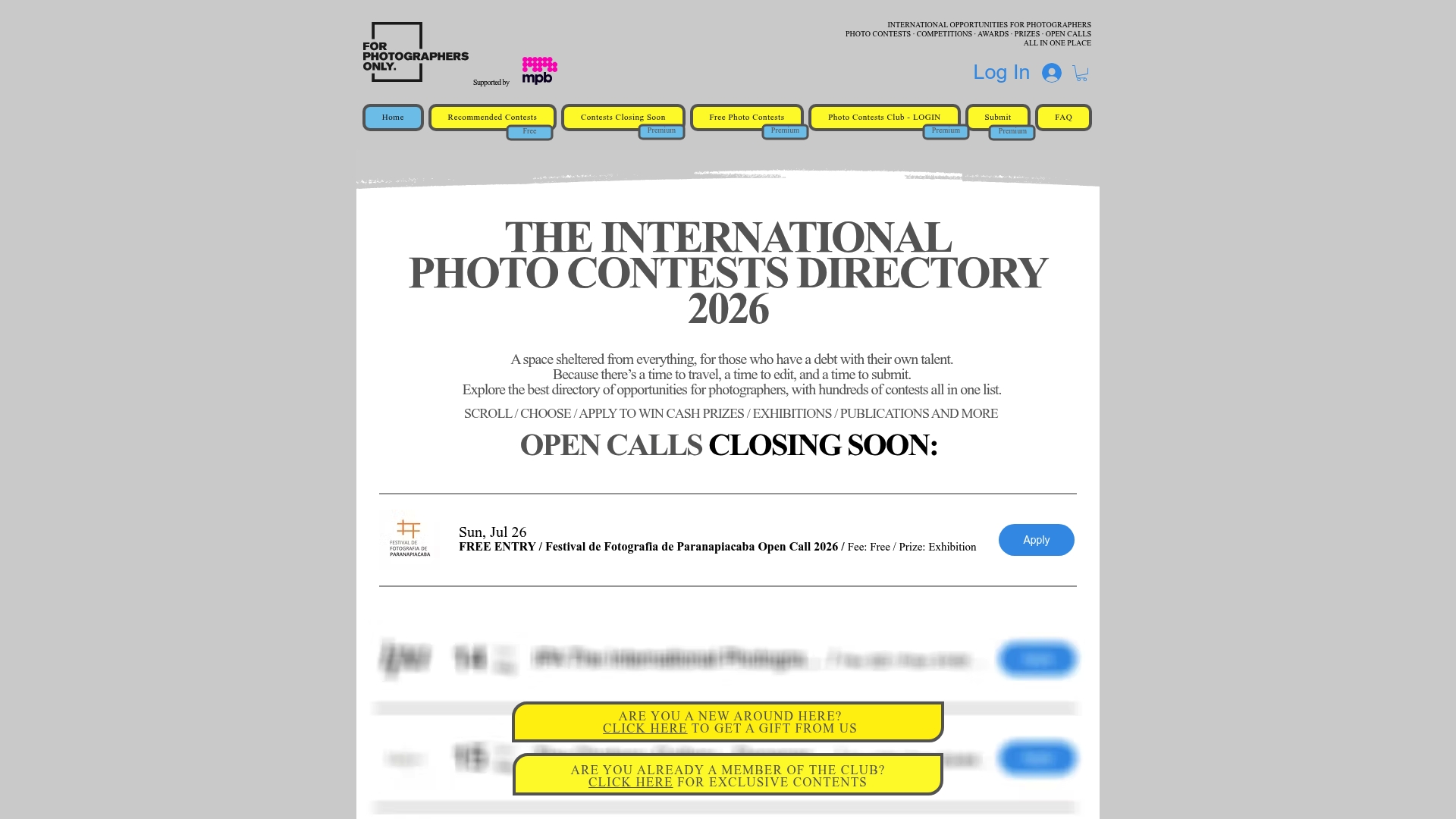
If you are ready to start, open the PhotoContestsClub directory and pick the first three calls that match your current series.
FAQ
How early should I start preparing a festival application?
Start as soon as you spot a call that fits, ideally weeks before the deadline. Editing a sequence, writing captions and securing releases take longer than uploading. Check the organizer’s official page for the current schedule, since opening and closing dates change from year to year.
Do I need to be a professional to apply?
Not always. Many calls are open to amateurs, emerging and professional photographers, while others restrict entry by status, age or location. Read the eligibility section of each call and enter only those you qualify for, since the fee is usually nonrefundable.
Are photo festival entry fees worth paying?
Fees in the United States are most often $10 to $50 per entry, and the best value comes from calls with named jurors, clear prizes and fair rights terms. Many photographers begin with free-to-enter calls and add paid ones that suit their strongest series. Our directory flags fees for every listing so you can plan a budget.
Will I lose my copyright if I enter?
You own the copyright at capture, and well-run calls ask only for a limited license to promote the event. Read the license clause before you pay, and avoid wording that transfers copyright or grants unrestricted use. If a clause is unclear, an intellectual property attorney can review it.
Sources
Recommended