Get Published: Curated Contests and Rights Checks for Photographers
The fastest, most reliable way to get published photography today is entering established contests that explicitly promise publication or exhibition, not vague “exposure.” Prioritize competitions with limited, non-exclusive rights and a documented history of press coverage or gallery placement. Then build one cohesive, rules-compliant project, and budget honestly for printing and shipping before you submit.
TL;DR:
Reputable contests with clear press and gallery outcomes, limited usage rights, and transparent archives offer the best chances for career growth.
Entry costs should be weighed against tangible post-win benefits like exhibitions or press features, not the prize money alone.
Building a cohesive, rule-compliant series with a compelling artist statement and perfect technical specs increases winning odds.
Physical print submissions require careful budgeting for professional printing, framing, shipping, and customs, often exceeding the prize value.
Focusing on niche or regional competitions tailored to your work provides better relevance and achievable success than chasing major international awards.
Table of Contents
Where to Find Contests Worth Your Time and Entry Fee
Reputable competitions leave a paper trail: named jurors, an archive of past winners, and a real publication or exhibition partner. Chasing that trail one search at a time wastes hours you could spend shooting, which is why curated, weekly-updated calendars exist in the first place.
Once you have a list of candidates, filter hard. Not every “international award” on Instagram deserves your file or your fee.
Check the organizer type. A museum, an established festival, or a publishing house behind the contest carries more weight than an anonymous website with a submission form.
Research the judge panel. Names you recognize, or names with real editorial and curatorial credentials, signal a competition that industry insiders actually watch.
Look for an archive of past winners. If a contest cannot show you three or four years of previous winners and where their work ended up, treat that as a warning sign.
Demand specifics on promotion. A catalog, a gallery show, or a magazine feature is a concrete outcome. “Exposure” with no named venue is not.
Scan the rights language before anything else. Contests worth your time state limited, non-exclusive usage rather than broad ownership claims.
A contest’s long-term payoff often depends more on who sees the work after the win than on the prize check itself. Editors, curators, and industry influencers who follow a specific award’s winner list are worth more than a cash prize with no audience behind it, according to Fstoppers’ analysis of competition value. For newer photographers, regional and niche competitions often deliver a better ratio of relevance to attainability than mass-entering every major international award, a point echoed in Photo Insider’s practical review of small, regional, and major competitions. Start your search inside a maintained contest directory rather than scattered blog posts, and you will spend your search time on shortlisting instead of hunting.
What Rights and Fees Should Raise a Red Flag?
Read the entry agreement before you read the prize description. That order matters more than most photographers realize.
Reputable contests typically request only limited, non-exclusive usage rights for promotional purposes tied to the competition itself. They do not ask photographers to relinquish ownership or grant broad commercial sublicensing, according to Photo Insider’s guide to spotting legitimate opportunities. Anything beyond that, especially language permitting the organizer to license your image to third parties for commercial use with no additional compensation, deserves a hard pass.
Watch for these red flags before you submit:
No published judge list or vague “panel of experts” language
No visible archive of past winners or their subsequent placements
Promotion described only as “exposure” or “visibility” with no named platform
Rights clauses that extend beyond the competition period or beyond promotional use
Entry fees that scale steeply with the number of categories entered
Statistic Callout: A contest’s real payoff rarely comes from the prize line alone. Post-win value depends on tangible outcomes like exhibitions, catalogs, and press features rather than social media mentions, per Photo Insider’s breakdown of career impact.
Weigh the entry fee against realistic outcomes, not the headline prize figure. A $40 entry fee tied to a juried exhibition with a published catalog is often a better investment than a free contest with no jury credentials and no distribution plan.
How Do You Build a Submission That Actually Wins?
Judges are reading fast and comparing hundreds, sometimes thousands, of entries. A submission that respects the rules and tells a coherent story earns more attention than a technically perfect single frame with no context.
Assemble a cohesive series. Where the category allows it, submit five to ten images that build a single visual narrative. Judges frequently reward consistency across a series over one strong outlier, and Fstoppers’ insider strategies point to sequencing and thematic coherence as a deciding factor in portfolio categories.
Choose your category deliberately. A niche or specific category often draws fewer entries than a broad, generic one, which can meaningfully shift your odds.
Write a tight artist statement. Explain what triggered the project, what it means, and what response you want from the viewer. Treat the caption as part of the submission, not an afterthought.
Match the technical specs exactly. Color space, file format, resolution, and file naming conventions are usually non-negotiable. Contest rules commonly restrict material editing and require original files to be preserved, and violating those limits is one of the most common causes of disqualification, according to Photo Insider’s rules breakdown.
Secure your releases in advance. Model and property releases should be signed and filed before you submit, not chased down after a shortlist notification arrives.
Keep your originals and layered files. Organizers sometimes request proof of authorship or the unedited RAW file if a submission is questioned.
Pro Tip: Build your artist statement around one specific moment, not the whole body of work’s backstory. Judges skim; a single vivid anchor sentence does more work than three paragraphs of context.
What Should You Budget for Print and Exhibition Contests?
Winning is only step one when a competition requires physical prints. The logistics behind a gallery show or printed exhibition catalog carry real costs that many first-time entrants never see coming.
Professional printing at gallery quality, especially when the organizer specifies a particular paper or lab.
Museum or gallery-grade framing, which some venues require to match their existing wall standards.
Insured shipping with tracking, since replacing a damaged or lost print mid-transit is far more expensive than the shipping fee itself.
Customs paperwork and duties for international exhibitions, which can arrive as a surprise bill weeks after the show opens.
These costs can climb past the value of the prize itself, a pattern NANPA’s guide to contests and exhibitions flags directly. Treat every physical entry as a business expense you plan for in advance, not a surprise you absorb after acceptance.
You can reduce the load. Local lab and framer partnerships often beat shipping a raw file overseas for framing at destination. Some festivals now offer print-on-demand exhibition options that skip international shipping entirely. Where shipping is unavoidable, negotiate return shipping terms or an extended pickup window before you send anything, and arrange insurance and customs documentation well before the deadline, not the week of.
How to Turn a Win Into Publication and Client Work
A shortlist notification is a starting line, not a finish line. What you do in the following weeks determines whether the win becomes a career asset or a forgotten line on a resume.
Update every public-facing profile immediately. Add the publication credit or exhibition image to your portfolio, your press page, and your social profiles the same week you’re notified.
Request exact credit lines and usage assets from the organizer. Get the precise wording they used, plus high-resolution exhibition or catalog images you’re cleared to share.
Pitch editors and curators with a specific reference. Name the judges, the venue, or the publication tied to your result. A generic “I won an award” pitch is far weaker than one that names the specific jury or gallery.
Stay in touch with the organizer. Ask about catalog copies, future programs, or introductions to other photographers in the winner’s circle. Contest call listings often lead to repeat opportunities for past winners.
A credible win also strengthens your position when pitching for paid work, since editors and art buyers recognize competitions with a real track record, a dynamic Fstoppers describes in its look at competition value. If you’re using a result to attract new bookings, pairing it with sharper search visibility for photographers helps that credibility actually reach potential clients searching for you.
When Should You Plan for Contest Deadlines?
Contest calendars run year-round, but most fall into predictable rhythms. Major international awards frequently open calls in late winter or early spring, with judging through summer and results announced in fall, timed to align with festival and gallery seasons. Regional and niche competitions run on tighter, more varied cycles, often with rolling deadlines every few months.
The practical risk isn’t missing a single deadline. It’s discovering a strong opportunity after entries closed, which is common when you rely on scattered social media posts instead of a maintained calendar. Build a simple tracking habit: note early-bird pricing windows, since many contests charge less for entries submitted a month or more ahead of the final deadline, and mark the gap between the entry deadline and the notification date so you’re not caught off guard by a compressed production window for prints or framing.
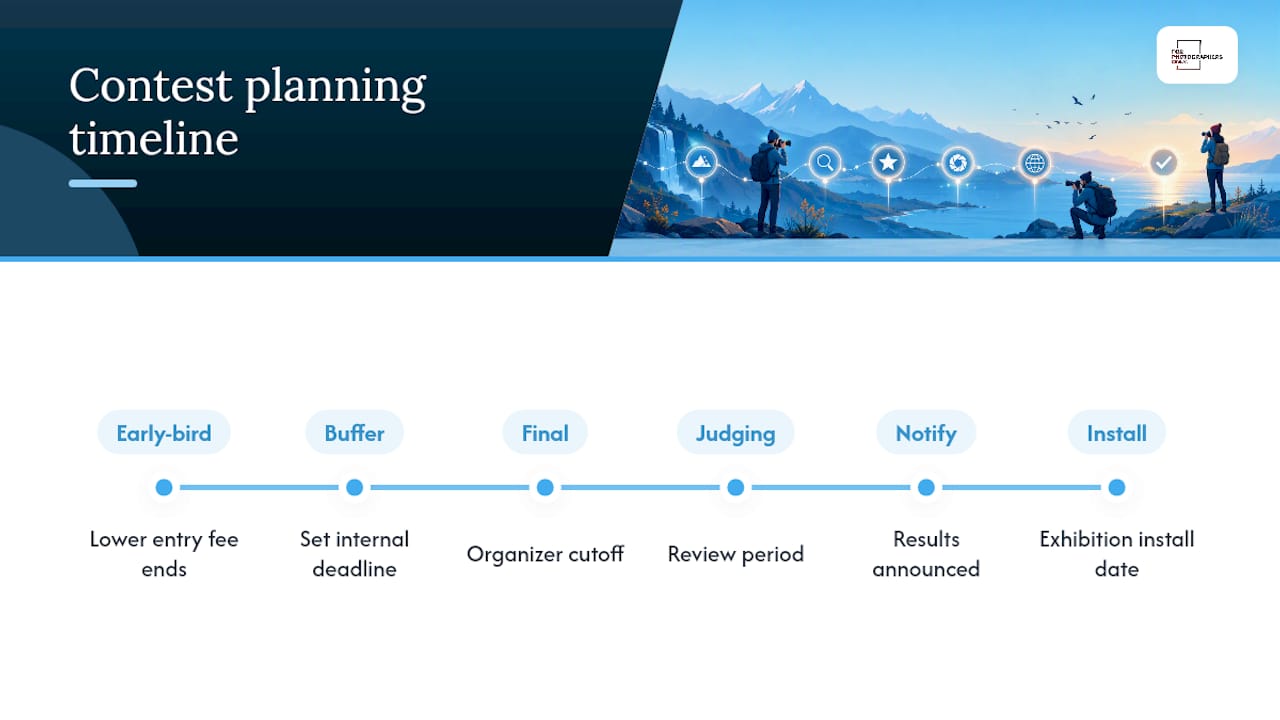
Set your own internal deadline a week before the organizer’s cutoff. That buffer absorbs file upload issues, last-minute release paperwork, or a printer’s delay without forcing a rushed submission. For exhibition-based awards, also track the installation date separately from the notification date. That gap is often where shipping and framing logistics quietly become the tightest part of the entire process.
How Do You Vet a New or Niche Opportunity?
New contests launch constantly, and some of the best opportunities for emerging photographers are the ones without a decade of history yet. Vetting them takes a slightly different approach than checking an established award.
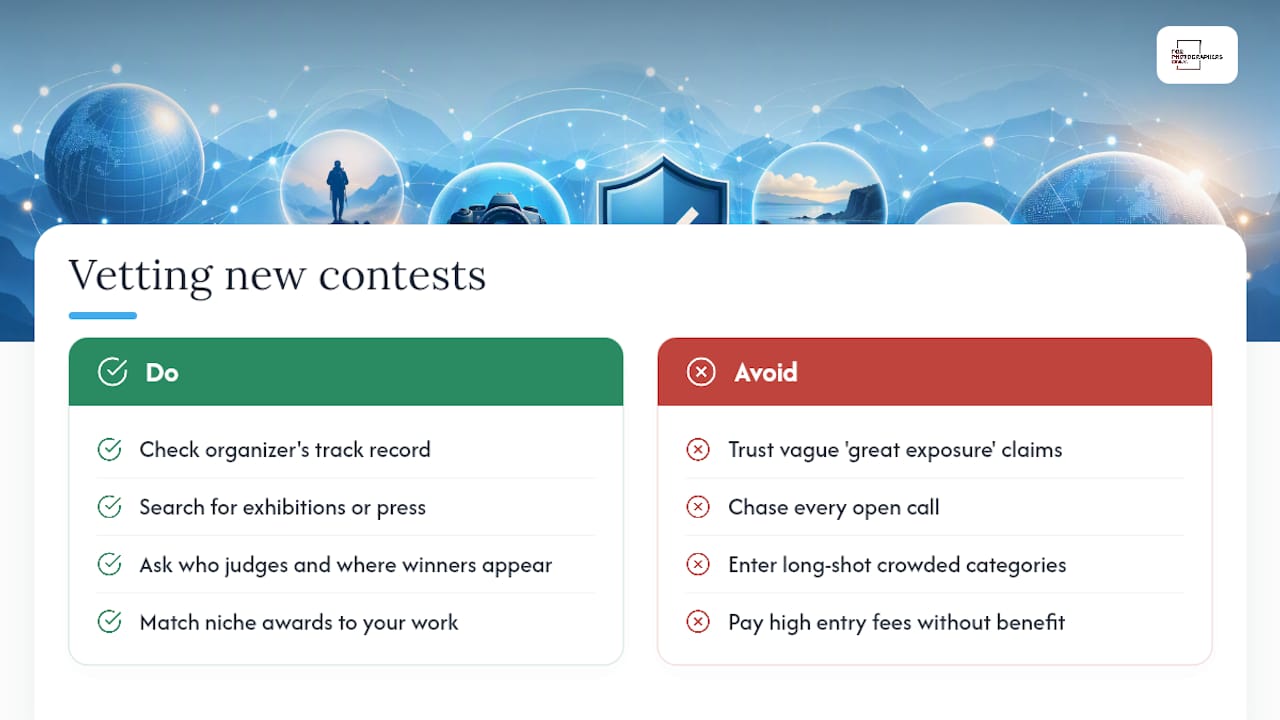
Start with the organizer’s own track record outside the contest itself. A gallery, magazine, or festival with a real operating history lends credibility even to its first-year competition. Search for the organization’s name alongside terms like “exhibition” or “press” to confirm it has produced tangible outcomes before, just under a different program.
Ask directly, by email, who judges the competition and where winning work will appear. A legitimate new contest will answer specifically, often naming a gallery date or a publication partner. Vague answers about “great exposure” from a first-year organizer are a stronger warning sign than the same vague language from an established one, simply because there’s no track record yet to offset it.
Cross-reference niche categories against your own body of work rather than chasing every open call. Prestige, local exposure, entry fees, and your realistic odds of placing all vary widely across contest tiers, and a smaller niche award matched to your subject matter often beats a long-shot entry into a crowded international category with thousands of submissions.
Author Perspective: Choosing Contests That Actually Move Your Career
Contests earn their entry fee when they align with a specific goal, run under a credible jury, and promise a concrete outcome you can point to later. That’s the filter I’d apply before any other. Smaller, niche competitions are underrated for a different reason: they build a track record and teach you what judges respond to, without the odds you face in a flagship international award. Save the marquee competitions for work you already believe is your strongest, and treat them as calculated risks, not routine entries. A short, curated shortlist of contests beats submitting everywhere; scattershot entry strategies drain budgets and rarely produce a career-defining result.
— DARIO
Find Contests Worth Your Entry Fee, Without the Guesswork
A curated directory exists for exactly the filtering problem this guide walks through: separating contests that publish or exhibit winners from ones offering empty “exposure.” The directory tracks hundreds of active international competitions, updated regularly, with numerous free-to-enter opportunities included. Instead of checking a dozen scattered sites for judge credentials, rights language, and past winner archives, you get one continuously updated page organized by deadline.
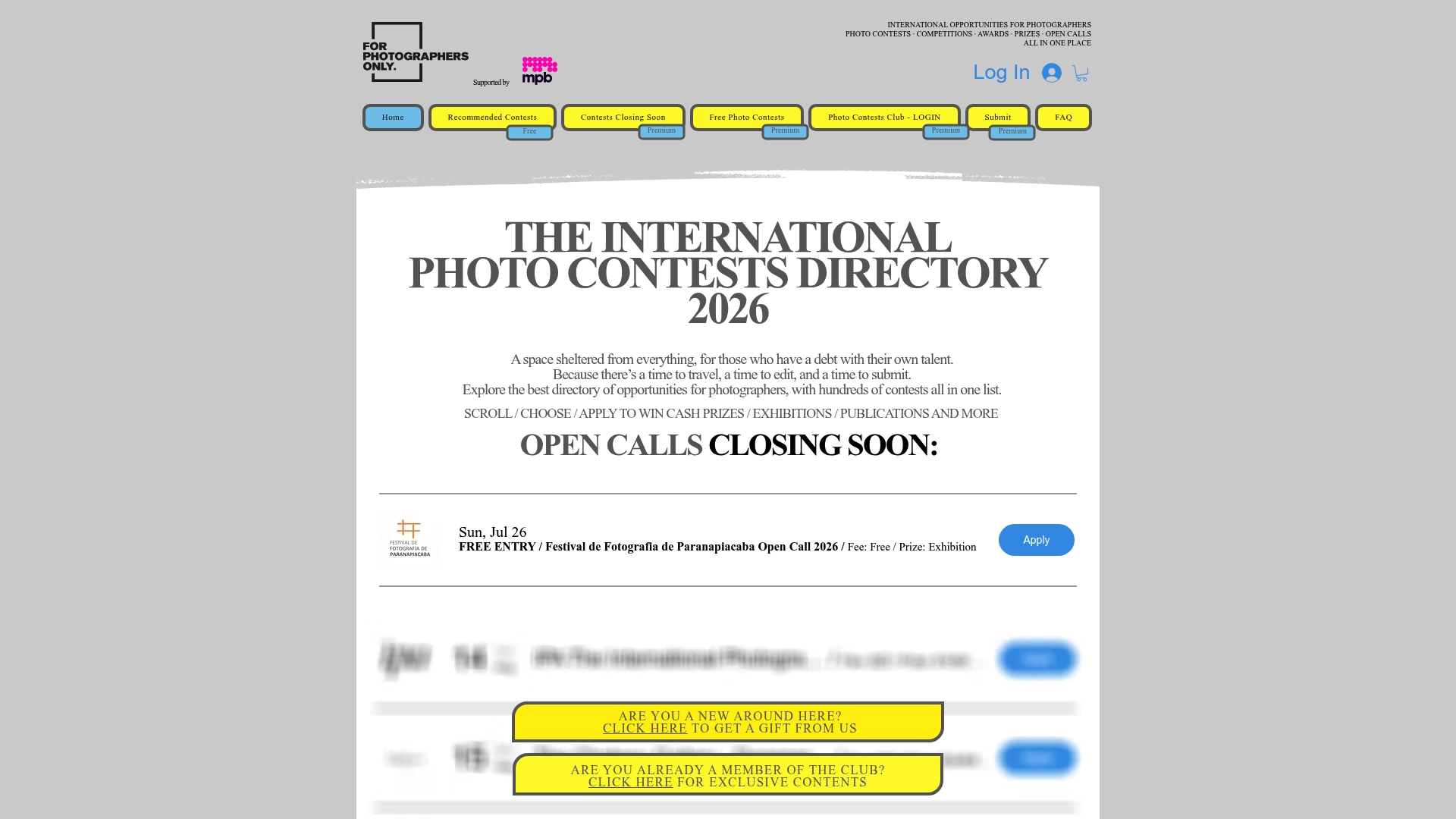
That saved research time is the real advantage over piecing together your own list from social media and forum threads. You still do the evaluation this article covers, rights clauses, fee-to-value comparisons, and promotion claims, but you’re choosing from contests already worth that scrutiny rather than sorting signal from noise across the entire web. Browse the current listings, including features like Photography Life, and start a subscription to see this week’s full directory update before your next deadline passes.
Sources
Recommended