Free Photo Contests: Your 2026 Complete Entry Guide

The single best starting point for discovering free photo contests is Forphotographersonly, a curated directory listing over three hundred active international photography competitions, with a large number of completely free-to-enter opportunities updated weekly. From there, three platforms consistently surface high-quality free-entry calls: the World Photography Organisation’s Single Image competition, LensCulture’s Street Photography Awards, and the Arbella International Photography Contest. Your immediate next step:
Open the Forphotographersonly contests page, apply the “free” and “deadline soon” filters, and add one contest to your calendar today.
Table of Contents
Where can you find free photography competitions right now?
The most efficient discovery method is a curated directory rather than scattered Google searches. Forphotographersonly aggregates approximately 320–330 active contests in one continually updated page, organized chronologically so you can see what closes first. The free-entry filter surfaces over 100 opportunities spanning wildlife, street, portrait, documentary, and fine art categories.
Beyond the directory, these platforms and organizations are worth bookmarking:
Platform / Organization | Entry Fee | Best For | Filter Tips |
Forphotographersonly | Free to browse; €6/month full access | Discovering and tracking all genres globally | Filter: “free,” “deadline soon,” genre |
World Photography Organisation | Free (single image, up to 3 images) | Global juried exposure, ten categories | Select “Single Image” category tab |
LensCulture | Free single-image option available | Street, portrait, documentary | Filter by “free entry” on competition page |
Free community challenges available | Frequent themed calls, community feedback | Browse “open” and “free” challenge tags | |
Varies; free categories listed | Multi-genre themed contests | Check individual contest entry rules | |
Arbella International Photography Contest | No entry fee | Global open and themed categories | Confirm per annual call |
When searching any platform, use these terms in the search bar or filter panel: “no entry fee,” “free entry,” “open call,” “single image.” Sort by closing date to prioritize what needs your attention first.
A practical note on regional vs. global directories: global directories like Forphotographersonly cast the widest net and are worth checking weekly. Regional photography organizations and national arts councils sometimes run free-entry calls that never appear on international platforms. If you are based in the US, the National Endowment for the Arts and state arts councils occasionally publish open calls with no submission fee. Always verify the language of the official rules page, not just the aggregator summary.
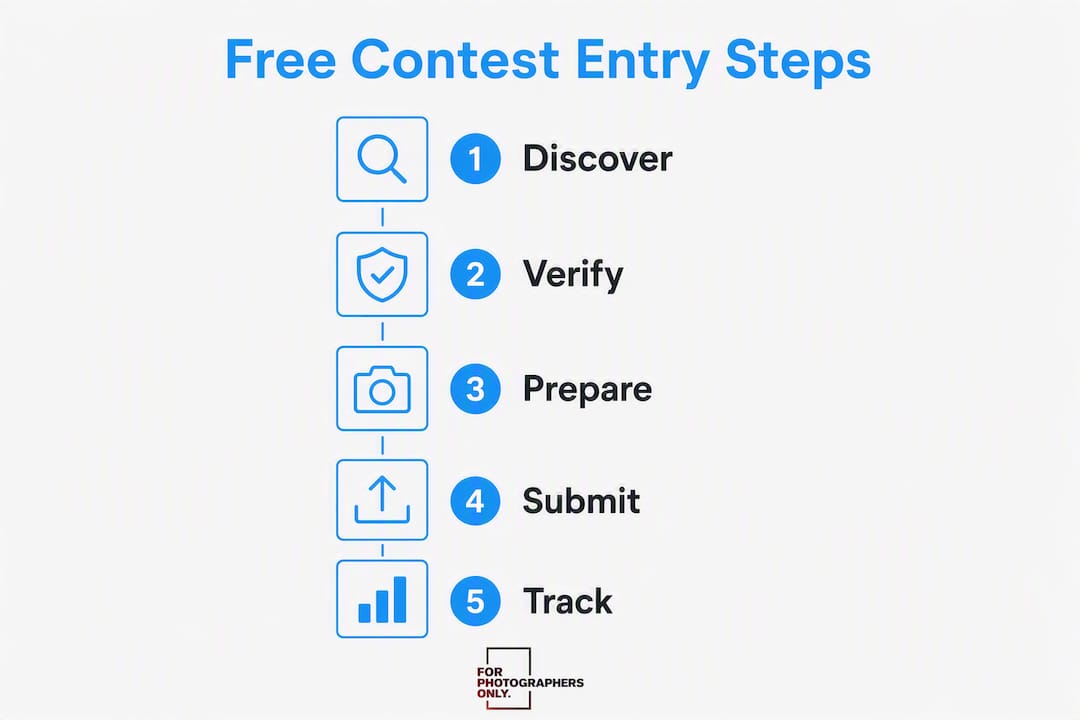
Notable free-to-enter contests worth your attention
The following shortlist covers reputable competitions that offer genuine free-entry options. Entry fee status can change year to year, so confirm the current rules on each organizer’s official page before submitting.
World Photography Organisation — Single Image competition: Free to enter, up to three images across ten categories. Winners receive international media exposure and juried recognition from panels with strong industry credentials. One of the highest-visibility free-entry calls available globally.
LensCulture Street Photography Awards: A free single-image entry option is available. Cash prizes, London exhibition placement, and editorial features make this one of the most career-relevant free calls for street and documentary photographers. Jurors are drawn from Magnum and major editorial outlets.
Arbella International Photography Contest: The 16th edition explicitly states no entry fee for its categories, with a $10,500 prize fund and a dedicated youth recognition award. It is open to photographers worldwide, with exhibition selection opportunities alongside cash prizes.
Nature in Gaudí — Ángeles Omedas Millan Prize: Free entry, accepts single images or short series linking nature and architectural themes. Substantial cash prizes and exhibition selection, with no entry fee required.
Nikon Photo Contest: Manufacturer-run with strong brand visibility. Free-entry categories appear in certain years; confirm the current year’s rules before preparing submissions.
Nikon Small World Competition: Focused on photomicrography. Free to enter, open globally, with strong institutional recognition and publication in Nikon’s annual catalog.
Smithsonian Magazine Annual Photo Contest: High-profile, genre-spanning call with broad publication reach. Historically includes free-entry categories; verify current fee status for the active cycle.
CEWE Photo Award: One of the largest free photography competitions by entry volume, open internationally across multiple categories including nature, travel, and people.
Comedy Wildlife Photography Awards: Free to enter, open to amateurs and professionals worldwide. Strong media pickup and exhibition circuit.
BigPicture Natural World Photography Competition: Free entry, juried by the California Academy of Sciences, with exhibition in San Francisco and strong conservation-focused editorial exposure.
Audubon Photography Awards: Free to enter for US residents, with categories for adults and youth. Strong institutional backing and publication in Audubon magazine.
National Wildlife Photo Contest: Free entry via the National Wildlife Federation, open to US photographers across multiple age and skill categories.
Wildlife Photographer of the Year: Hosted by the Natural History Museum, London. Entry fee applies for most categories, but youth categories are free. One of the most prestigious exhibition circuits in natural history photography.
W. Eugene Smith Grant: Free to apply; supports documentary photographers working on humanistic projects. Significant cash award and strong industry recognition.
Carmignac Photojournalism Award: Free to apply; supports long-form documentary projects with substantial funding and publication.
Rebecca Vassie Memorial Award: Free to enter; focused on landscape and environmental photography with a strong UK-based exhibition circuit.
HIPA International Photography Award: Free to enter, open globally, with one of the largest cash prize pools in international photography.
Xposure International Photography Competition: Free entry, based in Sharjah, UAE, with strong international jury and exhibition exposure.
Leica Oskar Barnack Award: Free to apply; prestigious juried award for documentary and reportage photography with strong editorial recognition.
ZEISS Photography Award: Free to enter; focuses on experimental and conceptual photography with strong brand association and publication.
BP Portrait Award: Free to enter; one of the most recognized portrait competitions globally, with exhibition at the National Portrait Gallery, London.
Istanbul Photo Awards: Free to enter; strong international jury and exhibition circuit across multiple documentary and art categories.
RHS Photographic Competition: Free to enter for Royal Horticultural Society members; focused on botanical and garden photography.
Pictures of the Year: Free to enter for working photojournalists; one of the longest-running and most respected photojournalism competitions in the US.
World Press Photo: Entry fee applies for most categories; verify whether regional or affiliated calls offer free-entry options in the current cycle.
Travel Photographer of the Year (TPOTY): Travel-focused awards with themed categories; free-entry youth initiatives appear in certain years.
Bird Photographer of the Year (BPOTY): Entry fee applies; youth categories may offer free entry. Strong exhibition and publication circuit.
Underwater Photographer of the Year (UPY): Entry fee applies for most categories; verify current rules for any free-entry options.
Banff Mountain Photo Essay Competition: Project-oriented, focused on mountain and adventure subjects; entry fee status varies by category.
LensCulture Portrait Awards: Genre-specific with editorial emphasis; free single-image options appear in specific years.
Natures Best Photography International Awards: Free to enter across multiple nature and wildlife categories, with exhibition at the Smithsonian’s National Museum of Natural History.
How do you verify a contest is legitimate and truly free?
Before preparing a single image, run through this checklist:
Official rules page: The organizer publishes a dedicated, dated rules document, not just a social media post.
Entry fee wording: The rules state “no entry fee” or “$0” explicitly, not just “free to register.”
Published jury: Named jurors with verifiable affiliations (galleries, publications, institutions) are listed.
Prize descriptions: Cash amounts, exhibition venues, or publication outlets are stated specifically.
Past winners: A searchable archive of previous winners or shortlists is publicly accessible.
Verifiable contact: An email address or physical address for the organizing body is published.
Red flags to walk away from:
Rules that are vague about what “free” covers (registration only? one image? all categories?)
Jurors listed by name only, with no institutional affiliation or verifiable biography
Broad licensing transfers that grant the organizer unlimited commercial rights to your images with no stated usage limits
A requirement to purchase a product or service to claim a prize
Unusually high “winner” counts with no published shortlist or jury deliberation notes
Pro Tip: Use WHOIS lookup and archive.org to check how long an organizer’s domain has been active and whether the rules page has changed. Save a PDF screenshot of the official rules at the moment you submit. If a dispute arises, that document is your evidence.
How to prepare and submit your entry
Read the full rules document before selecting an image. Note the category, eligibility restrictions (age, nationality, professional vs. amateur status), and the exact number of free entries permitted.
Choose the right category. Submitting a landscape to a portrait category wastes your free entry. Match the image to the brief precisely.
Prepare your file to spec. Most contests accept JPEG; some accept TIFF for fine art categories. Check the table below.
Strip or complete metadata as required. Some contests ask for EXIF data intact; others require anonymized files for blind judging.
Write a clear caption. Keep it under 50 words: subject, location, date, and one sentence of context. Jurors read hundreds of captions quickly.
Upload and confirm. Save the confirmation email or screenshot the submission receipt. This is your proof of entry.
Common technical specifications
Specification | Typical Requirement |
File format | JPEG (most common); TIFF accepted by some fine art calls |
File size | 5–10 MB (check per contest) |
Color space | sRGB for digital display; Adobe RGB for print-focused calls |
Metadata | EXIF intact preferred; some blind-judging calls require removal |

Pro Tip: Name your files with your last name, category, and image number (e.g., “Smith_Street_01.jpg”). Many platforms rename files on upload, but organized naming reduces errors during batch submission.
Common rules to watch: simultaneous submission to multiple contests is usually permitted unless the rules state otherwise. Prior publication online does not disqualify most entries, but some contests require unpublished work. Check whether the free tier limits you to one image or three before uploading.
Deadlines, timelines, and the real cost of “free” contests
Understanding the full timeline prevents last-minute scrambles and missed windows.
Call opens: The submission portal goes live, often months before the deadline.
Submission window: Typically 6–16 weeks. Early submission avoids technical issues near the close date.
Judging period: Usually 4–8 weeks after the deadline; no communication during this phase is normal.
Shortlist notification: Published on the organizer’s site or sent by email; check both.
Exhibition or publication dates: Often 3–6 months after the judging period closes.
The word “free” deserves scrutiny at the category level. Many contests use a freemium model where one image is free but additional submissions, portfolio entries, or series require a paid bundle. The World Photography Organisation’s Single Image competition, for example, is free for up to three images, but series and portfolio categories carry fees. Confirm whether “free” applies to your intended number of submissions before uploading anything.
Additional costs that can appear even in free-entry contests:
Shipping or framing costs if you win and a physical print is required for exhibition
Optional promotional upgrades (featured placement, social media boosts) offered at checkout
Membership fees on platforms where the free contest is gated behind a free account tier that later prompts an upgrade
Set three calendar reminders: one for the early submission window, one for the final deadline, and one for the rights-transfer review date. That last reminder is the one most photographers skip.
Practical tips that improve your chances
Lead with your strongest single image. Jurors reviewing thousands of entries respond to immediate visual clarity. Cropping tighter, adjusting contrast, and removing distracting elements at the edges of the frame are the three edits that most consistently improve shortlisting rates.
Match the brief exactly. A technically excellent image submitted to the wrong category is eliminated before judging begins.
Write metadata that works for you. On platforms that publish entrant galleries, complete IPTC fields (title, description, keywords, copyright notice) increase discoverability after the contest closes.
Pace your submissions. Entering one curated image per month across three or four well-chosen contests produces more measurable career data than scattering the same portfolio across twenty calls at once.
Vary your portfolio across entries. Submitting the same hero image to every contest limits your exposure surface. Rotate between two or three strong images to test which resonates with different jury panels.
Follow the organizer on social media. Many contests announce shortlists, theme updates, and occasional free-entry extensions through their social channels before updating the official rules page.
Why free contests matter for your photography career
Foundations and organizers design free-entry categories specifically to remove financial and geographical barriers, giving photographers from underrepresented regions and economic backgrounds access to the same exhibition circuits and juror networks as established professionals. That equity-driven intent has a practical consequence: the competitive field in free-entry categories is genuinely broad and international, which makes a shortlist placement more meaningful, not less.
The career return on a free contest entry is rarely the cash prize. Shortlist and exhibition placements produce ongoing exposure that converts into paid opportunities. Photocontestguru’s free photo contest list notes that industry commentary consistently identifies shortlist recognition and exhibition placement as the primary drivers of commissions and agency placements for emerging photographers.
Contests with jurors drawn from institutions like Magnum, Getty, or major editorial outlets carry the strongest career-return signal. LensCulture’s awards pages publish juror bios and exhibition outcomes, which lets you assess the likely career value before investing preparation time.
To track your return, maintain a simple log: contest name, submission date, image submitted, result (shortlisted / not placed / winner), and any downstream outcomes (media mentions, portfolio views, client inquiries, exhibition invites). Three to six months after each result, note whether any paid opportunity referenced the contest. That log, built over a year, will show you which contest types and categories generate the most career traction for your specific work.
For photographers building a portfolio, photography networking events and contest circuits often overlap. Jurors and curators who encounter your work in an exhibition frequently appear at industry events, creating a compounding visibility effect that a single submission alone cannot produce.
How to protect your copyright when entering contests
Copyright in your photographs belongs to you the moment you press the shutter, regardless of whether you register the image. Entering a contest does not transfer that copyright unless the official rules explicitly say so. Read the licensing clause in every set of rules before submitting.
What to look for in the rights section:
Non-exclusive license: The organizer can display and promote your image in connection with the contest. You retain all other rights. This is the standard and acceptable model.
Exclusive license: The organizer restricts your ability to license the image elsewhere for a defined period. Acceptable only if the prize justifies the restriction.
Broad assignment language: Phrases like “all rights,” “worldwide, perpetual, irrevocable license,” or “royalty-free use for any purpose” are red flags. These clauses can effectively strip your commercial rights without compensation.
Practical steps to protect your work:
Embed your copyright notice in the IPTC metadata before uploading (Copyright © [Your Name] [Year]).
Register important images with the US Copyright Office before entering high-profile contests. Registration creates a public record and strengthens your position in any dispute.
Save a dated copy of the rules page as a PDF at the time of entry. Rules can change after a contest closes, and your PDF documents what you agreed to.
If a contest requires a model release for images featuring identifiable people, confirm you hold a signed release before submitting. Winning an award with an image you cannot legally license creates complications.
For images submitted to contests with broad licensing language, consider whether the exposure value justifies the rights restriction. A shortlist in a high-profile exhibition may be worth a non-exclusive display license; a perpetual commercial license to a low-visibility contest is rarely worth it.
Key Takeaways
The most effective approach to free photo contests is to filter by verified free-entry status, match your strongest image to the right category, and track every submission outcome to measure real career return.
Point | Details |
Start with a curated directory | Use Forphotographersonly to filter over 100 genuine free-to-enter contests from a directory of roughly 320–330 active calls by deadline and genre in one place. |
Verify “free” at the category level | Confirm the free tier covers your intended number of images; series and portfolio entries often carry fees. |
Check rights before submitting | Reject any contest requiring a broad, perpetual, or commercial license transfer without clear usage limits. |
Track every submission outcome | Log contest name, image, result, and downstream opportunities to identify which calls generate real career traction. |
Forphotographersonly as your hub | The directory’s weekly updates and free-entry filter save hours of research and surface opportunities most photographers never find independently. |
The strategic case for entering free contests consistently
Most photographers treat free contests as a low-stakes experiment. That framing undersells what a well-chosen free call can deliver. The contests that carry no entry fee are not the consolation tier of the photography world. The Arbella International Photography Contest offers a $10,500 prize fund at zero cost to enter. The BigPicture Natural World Photography Competition places winners in a Smithsonian-affiliated exhibition. The W. Eugene Smith Grant has launched careers in documentary photography for decades, and it costs nothing to apply.
The photographers who extract the most value from free contests are not the ones who enter the most. They are the ones who enter the right contests with the right image, verify the rules before submitting, and treat each shortlist or exhibition as a data point in a longer career strategy. One curated image per month, entered into a contest whose jury and exhibition circuit align with your intended audience, produces more measurable progress than a scattershot approach across dozens of calls.
Free does not mean low-value. It means the barrier to entry is financial, not creative. That distinction is worth acting on.
Forphotographersonly: your dedicated contest discovery resource
Searching for free photography competitions across dozens of organizer websites, social media feeds, and regional directories consumes hours that belong in the field or the darkroom. Forphotographersonly centralizes contest discovery in a weekly-updated directory listing approximately 320–330 active international photography contests, including over 100 opportunities with genuine free entry.
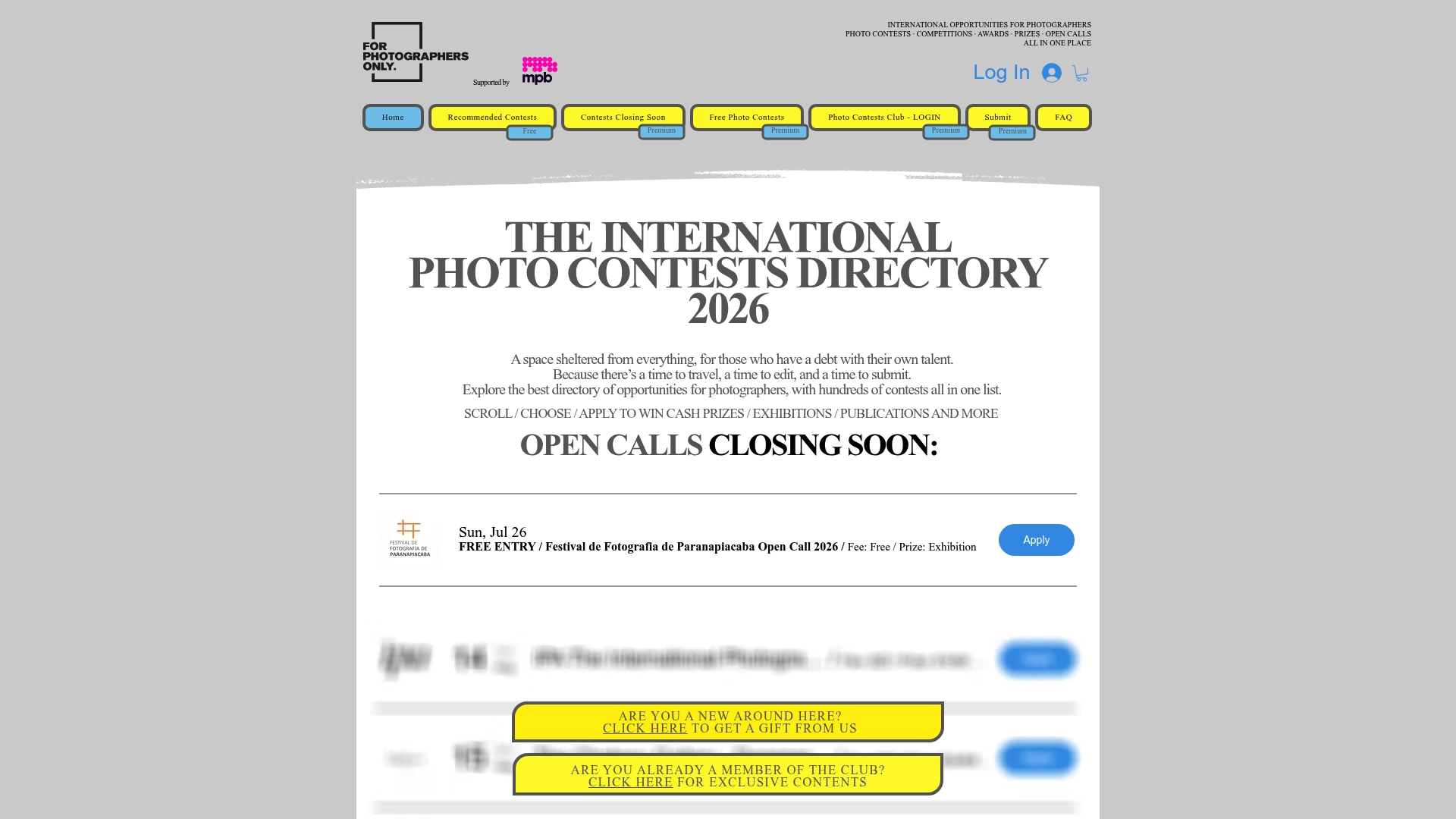
Every listing includes deadline, entry fee status, prize details, and genre, so you can assess fit in seconds rather than minutes. The directory is updated weekly, which means newly announced free calls appear before most photographers encounter them elsewhere. Subscribers also gain access to a members-only monthly competition and a community of photographers actively tracking the same opportunities.
What the directory gives you:
Instant access to 100+ verified free-to-enter contests, sorted by closing date
Weekly updates so you never miss a newly announced call
Curated listings from organizations including Nikon, Leica, and National Geographic
A single page replacing hours of scattered research
Browse the full contest directory and apply the free-entry filter to see what closes next.
Useful sources for verifying contest details
Cross-checking an organizer’s official page against a trusted secondary source is the fastest way to confirm that a contest is current, legitimate, and genuinely free. The sources below are authoritative starting points.
World Photography Organisation — Official rules, jury panels, and past-winner archives for the Sony World Photography Awards and Single Image competition.
Natural History Museum — Wildlife Photographer of the Year — Entry rules, category descriptions, and exhibition history for one of the most prestigious natural history photography awards.
Audubon Photography Awards — Official entry page with eligibility rules, category descriptions, and prize details.
National Wildlife Federation Photo Contest — US-based free-entry contest with official rules and submission portal.
Natures Best Photography International Awards — Official rules and past-winner galleries for nature and wildlife categories.
BigPicture Natural World Photography Competition — Entry rules, jury information, and exhibition details from the California Academy of Sciences.
Rebecca Vassie Memorial Award — Official rules and eligibility for this landscape and environmental photography award.
Verification habit: Always download or screenshot the official rules page as a PDF at the time you submit. Rules pages are occasionally updated after a contest closes, and your saved copy documents exactly what you agreed to. For any contest you cannot verify through an official domain, check archive.org for a historical snapshot of the rules page before committing preparation time.
Recommended