Food Photography Competitions Worth Your Time and Portfolio
If you’re weighing which contests deserve your best frame this year, start here: the World Food Photography Awards, IACP Food Photography & Styling Awards, British Photography Awards (Food category), Sony World Photography Awards, the Taste Photography Awards, and the Pink Lady Food Photographer of the Year form the core shortlist most serious food photographers should track. Each rewards a different kind of image, and each opens and closes on its own calendar, which is exactly why photographers who enter blindly tend to miss deadlines or get disqualified over a file format they never checked.
Most of these programs run on an annual cycle with a defined entry window, a tiered fee structure (often free early, then $20 to $40 as the deadline nears), and specific image requirements that trip up more entrants than bad photography ever does. The IACP Food Photography & Styling Awards, for instance, ask for modest low-resolution files at entry but require finalists to supply 300dpi images at 16 by 20 inches. Winners across these programs typically receive some blend of cash, exhibition space, magazine publication, and a credential that opens doors with editors and art buyers. What you get back rarely comes only in prize money.
Before you submit anything, run through this quick punch list:
Confirm your image fits the category’s actual intent, not just its title.
Check the file specs (resolution, color space, dimensions) against the published guidelines, not last year’s memory of them.
Nail down your rights: know whether you’re granting a non-exclusive promotional license or something broader.
Write a tight, factual caption before you forget the story behind the shot.
Pick one to three contests this season and prepare each one to finalist standard rather than spreading thin across a dozen.
Key Takeaways
Winning a major food photography competition depends less on raw talent than on matching the right image to the right category, meeting exact file specs, and entering only the contests that fit your actual goals.
Point | Details |
Match category to intent | Read category notes closely before entering; a studio shot in a “street food” category is an instant miss. |
Verify file specs early | Check resolution, color space, and format against published rules, not last year’s memory of them. |
Prepare release documents | Have model and property releases ready before you need them for a placing entry. |
Write a tight caption | Keep it to 25 to 35 words with location, context, and a clean credit line. |
Prioritize 1 to 3 contests | Prepare each to finalist standard rather than spreading effort across many weak entries. |
Use a tracking tool | Forphotographersonly’s directory updates weekly across 320+ contests, keeping deadlines and fees current in one place. |
Table of Contents
Which Food Photography Competitions Are Worth Entering?
Comparing contests side by side saves you from the worst outcome in this hobby: preparing a strong image, then discovering three days before the deadline that it doesn’t fit the eligibility rules. The table below lines up the major programs on the dimensions that actually decide whether you should bother entering.
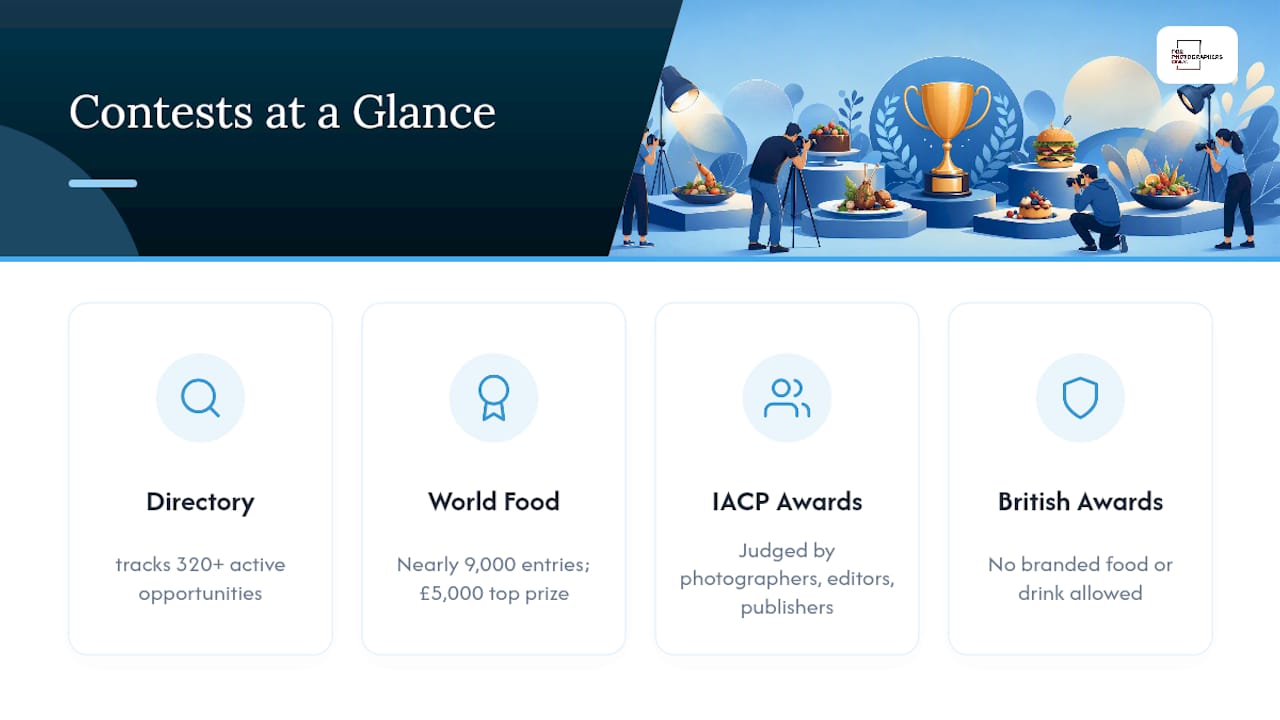
For Photographers Only belongs at the top of that list for a practical reason: it isn’t a competing contest, it’s the tool that keeps you from missing the other six. The directory tracks more than 320 active photography opportunities, updates weekly, and flags free-to-enter listings alongside paid ones, so you’re not manually checking half a dozen contest websites every month hoping a deadline hasn’t quietly moved.
World Food Photography Awards anchors the field for scale alone. The 2026 cycle drew nearly 9,000 entries from over 50 countries across more than 25 categories, with a top prize of £5,000 and finalist work displayed at London’s Mall Galleries, with select images shown at Fortnum & Mason.
IACP Food Photography & Styling Awards rewards technical discipline and industry fit. Its judging panels mix photographers, editors, and publishers, so entries that read well commercially tend to outperform pieces built purely for artistic effect.
British Photography Awards carries a strict but useful rule: no branded food or drink. That single restriction pushes entrants toward more editorial, less advertorial compositions, which often makes for stronger, more timeless images anyway.
Sony World Photography Awards isn’t a food-specific contest, but its reach is hard to match. A strong food entry here rides alongside every other genre in front of a much larger jury and press audience than a niche competition offers.
Taste Photography Awards and the James Beard-related photography awards sit closer to the food media world itself. Winning or placing in either tends to matter more to editors and publishers than to the general public, which makes them worth prioritizing if your goal is commissioned work rather than gallery walls.
How Do You Decide Which Food Photography Contests to Enter?
Start with your goal, not the contest list. A photographer chasing cash prizes should weigh entry fees against payout differently than one chasing an editorial credit or gallery wall space, and conflating the two leads to wasted fees and misdirected effort.
Define what you actually want. Cash, publication, exhibition, and portfolio credibility are four different outcomes, and few contests deliver all four equally well.
Shortlist contests that match that goal. If publication matters most, prioritize the Taste Photography Awards or James Beard-related programs over a purely visual competition.
Check the technical and legal fit before you shoot anything new. Read the category notes closely. A studio-styled plate shot into a “street food” category is one of the most common instant disqualifiers.
Build a submission plan with real lead time. Work backward from the deadline to your shoot date, leaving room for retouching, captioning, and a test upload.
A few warning signs should make you pause before paying an entry fee. Restrictive licensing language that reads like a copyright assignment rather than a promotional license is one. A category description that doesn’t match your actual composition is another, and it’s the single most common way strong photographers get eliminated in the first round, since category notes on programs like the World Food Photography Awards spell out intent precisely for this reason. Vague or absent judge credentials, and a pattern of high disqualification rates tied to format noncompliance, round out the list.
Pro Tip: Don’t over-edit a single image to chase one contest’s stated priorities. Judges at leading programs consistently reward storytelling and context over technical polish alone, so an image that communicates a real moment will usually outperform one retouched purely to please a specific jury’s known preferences.
What Makes a Food Photography Entry Competition Ready?
A beautiful photograph and a competition ready photograph are not the same thing. The gap between them is almost always technical, not artistic.
Technical checklist before you submit:
Match resolution and color space to the published spec. IACP asks for 72dpi and sRGB at entry, then 300dpi at 16 by 20 inches from finalists.
Confirm pixel dimensions and file type. A layered PSD or an oversized JPEG is a common, entirely avoidable rejection.
Follow filename conventions exactly. Automated intake systems reject files that don’t match the stated pattern.
Submit single frames only where required. Diptychs, triptychs, and collages are prohibited in several major programs, including IACP’s guidelines.
Keep a high-resolution master on hand. Contests often accept low-res files at entry but demand large finalist files fast, and upsizing a small original after the fact reveals artifacts a judge will notice.
Styling and storytelling decisions matter just as much as the technical checklist. Composition should serve a point of view, not just symmetry. A human hand reaching for bread, steam rising off a bowl at the right second, a market stall shot mid-transaction: these details separate a photograph that documents food from one that documents a moment involving food. Cultural sensitivity deserves real thought too, particularly when shooting a dish or tradition outside your own background; context and accuracy read as respect to a jury, and their absence reads as extraction.
Your caption and metadata deserve the same care as your file prep. A strong caption runs 25 to 35 words, names the location or context plainly, and avoids flowery language that obscures rather than clarifies. Include a credit line, capture date, and a clear note on usage rights alongside the image file, since jurors and editors alike move faster through entries with clean, complete information.
Pro Tip: Preserve the plate’s real color and texture rather than pushing saturation to make a dish “pop.” Judges at food-specific competitions tend to notice oversaturated tomatoes and blown-out steam before they notice anything else, and it reads as inexperience rather than style.
What Rules and Rights Should You Check Before Submitting?
Every contest’s terms and conditions page hides the details that decide whether your entry survives the first cut, and most photographers skim past exactly the clauses that matter.
Watch for these before you upload anything:
Eligibility window. Some contests only accept images shot within the current calendar year; others allow any date.
Single-image rules. Confirm whether diptychs, triptychs, or composite images are banned outright.
File format and size limits. These are usually enforced by automated systems with no human review, so a mismatch means instant rejection regardless of image quality.
Model and property releases. If a person or a private restaurant interior appears in your frame, check whether a signed release is required at entry or only if you place.
Prior-publication rules. Some programs disqualify images that have already run in print or online; others don’t care.
Keep a small folder of release documents ready before contest season starts: a model release template, a property release for private locations, and written permission from a food brand if your shot includes a recognizable branded product. The British Photography Awards’ Food category is explicit on this last point, requiring non-branded food and drink items for entries in restaurant, street, and studio arrangements alike.
When you scan a contest’s terms page, search for specific phrases rather than reading the whole document top to bottom: “non-exclusive license,” “promotional use,” and “finalist high-resolution requirements” tend to appear near the clauses that matter most. A non-exclusive promotional license, which most major programs use, lets the organizer feature your image in marketing and press without taking ownership of the copyright. That’s a very different arrangement from a full copyright assignment, which some smaller or less reputable contests still attempt to slip into their fine print. IACP and the World Food Photography Awards both publish their licensing terms clearly enough that you can compare them before entering, which is worth doing if you’re deciding between the two.
When Should You Shoot and Submit for Contest Season?
Food photography contests don’t cluster on one calendar. Some open in winter, others in spring, and a few run rolling entry periods that stretch across most of the year, so planning backward from each deadline matters more than memorizing a single “contest season.”
Period | Typical Activity | Example |
Early year (January to February) | Major contest entry windows open | World Food Photography Awards cycle typically opens in this window |
Spring (March to April) | Free and regular entry periods for several programs | IACP free entry early, then paid entry as deadline nears |
Late spring to summer | Finalists announced, exhibitions staged | Mall Galleries and Fortnum & Mason showings for World Food Photography Awards finalists |
Autumn | Some multi-genre programs open new cycles | Sony World Photography Awards typically opens entries in this window |
Work backward from whichever deadline you’re targeting. A realistic entry plan looks like this: shoot with margin for reshoots, retouch conservatively, write your caption and gather metadata while the story is still fresh in your memory, run a test submission through the platform if one is offered, and only then export your final high-resolution files.
Pro Tip: Batch-shoot with three or four contests in mind at once, even if you only plan to enter one this cycle. A rolling submission plan, where you always have a few finished, competition-ready images on hand, means you’re never scrambling to shoot and edit in the final 48 hours before a deadline, which is when most format mistakes happen.
How Does the Forphotographersonly Directory Help You Track Contests?
Finding contests is not the hard part anymore. Every major program has a website, and a five-minute search turns up dozens of options. Tracking which ones are actually still open, what they cost, and whether your work fits their current category briefs, that’s the part that eats an afternoon every single week if you do it manually.
Forphotographersonly solves that by curating more than 320 active photography opportunities in one continuously updated list, with over 100 of them completely free to enter. The directory updates weekly, so a deadline extension or a newly announced sponsor category, the kind of detail buried on page three of a contest’s own site, shows up without you having to go looking for it.
In practice, the workflow is simple. You search or filter by category and region, save the contests relevant to your work to a personal watchlist, and set reminders around their entry windows. If you’re tracking the World Food Photography Awards, a Sony World Photography Awards category, and a Taste Photography Awards deadline all at once, that’s three browser tabs and three separate memory checks replaced by one page.
What Mistakes Cost Photographers the Most Entries?
The single most common mistake is entering the wrong category, not taking a weak photograph. A polished studio shot of a plated dish, submitted to a “street food” or “on the table” category, gets excluded before a judge even weighs its composition, because it doesn’t match the category’s stated intent. Read category notes as carefully as you’d read a client brief.
The second most common mistake is technical, not creative. Automated intake systems reject layered PSDs, oversized JPEGs, and multi-frame collages submitted where single images are required, and none of that gets a second look from a human juror. A gorgeous image dies in an automated filter more often than it dies in front of a panel.
Rushing the finalist file request is a third, quieter mistake. Contests frequently ask for a small file at entry, then demand a 300dpi, 16 by 20 inch master within days if you place. Photographers who didn’t keep their original high-resolution files on hand end up upsizing a small JPEG under deadline pressure, and the artifacts show.
Finally, watch for brand and property issues. Entering a shot with a visible branded product into a contest like the British Photography Awards’ Food category, which explicitly requires non-branded imagery, is an easy and entirely preventable disqualification.
How Do Judges Score Food Photography Entries?
Judging panels at major programs deliberately mix disciplines. IACP draws from photographers, art directors, editors, and publishers, which means an entry needs to satisfy artistic judgment and commercial clarity at the same time rather than leaning entirely on one or the other.
Composition and technical execution still matter, obviously: light, color accuracy, focus, and framing form the baseline every judge checks first. But the deciding factor at the top level tends to be storytelling. Judges at the World Food Photography Awards have said directly that images communicating cultural, humanitarian, or emotional context often score higher than a technically flawless photo with no story behind it. A perfectly lit bowl of soup is competent. A perfectly lit bowl of soup that tells you something about who made it and why is what wins.
Category fit gets scored implicitly, too, even when it isn’t a named criterion. An image that clearly understands and answers its category brief reads as more intentional to a judge than one that simply happens to fit after the fact.
Why Selective Entries Beat Mass Submission
Quality beats quantity in this arena, and not by a small margin. A photographer who enters two contests with finalist-level preparation almost always outperforms one who scatters a dozen half-finished submissions across every open call they can find, because judges read portfolios, not photographs in isolation. A single strong entry backed by a clean caption, correct file specs, and a genuine point of view tells a juror more about your judgment as a photographer than five rushed ones ever will.
My practical recommendation: pick two or three contests this season that actually align with what you want out of this, whether that’s cash, publication, or gallery exposure, and prepare each one as if it’s the only entry you’re submitting all year. That discipline shows up in the final image, and jurors notice the difference between a photograph that was made for a category and one that was merely fitted into it after the fact.
Track Every Deadline Without the Guesswork
Forphotographersonly is the practical alternative to hunting across a dozen contest websites every month, since it puts more than 320 active photography opportunities, including over 100 free-to-enter listings, on one continuously updated page instead of scattered across individual organizer sites you’d otherwise have to check by hand.
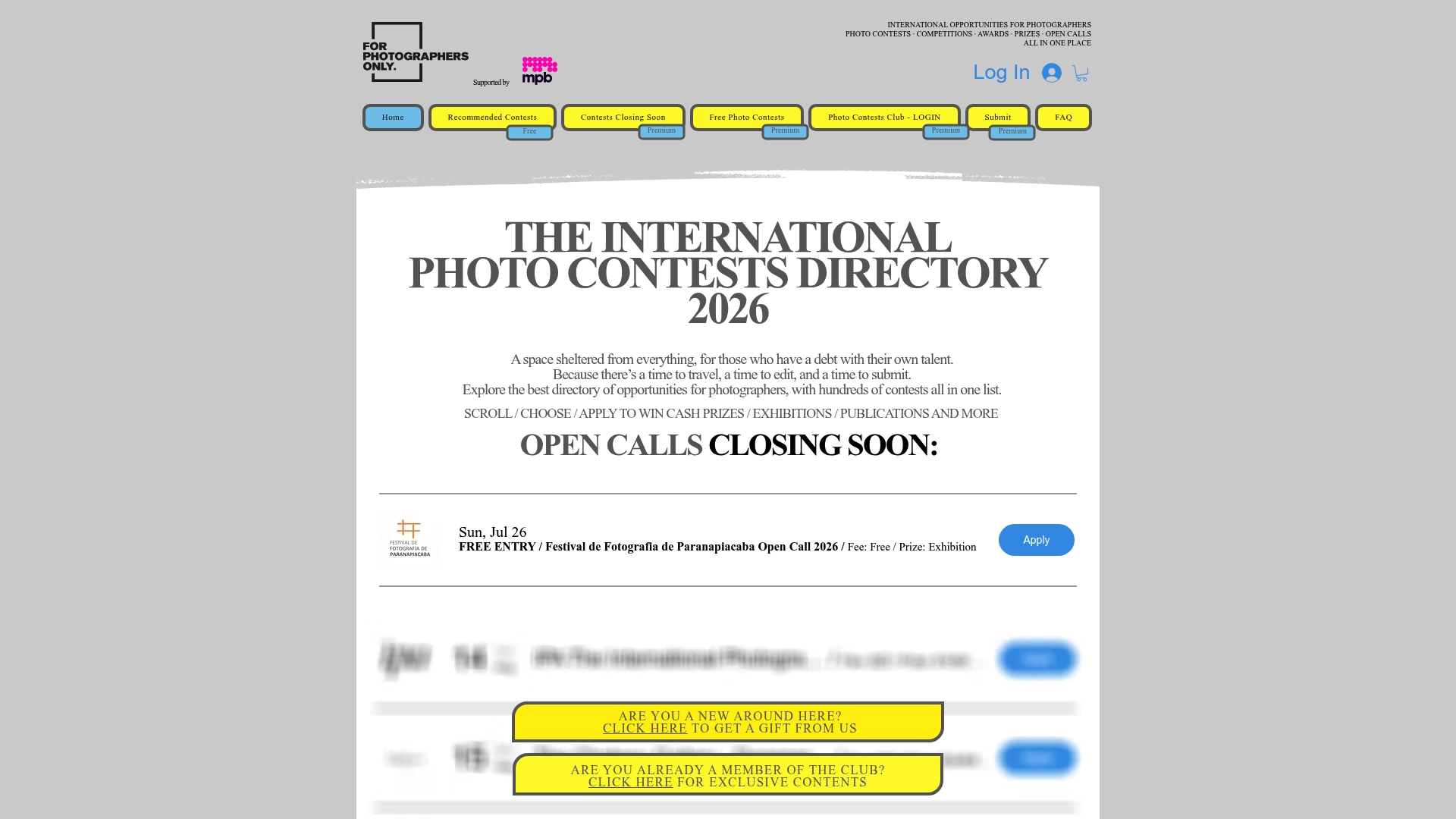
A subscription runs $6.60 per month and gives you full access to the current directory, filterable by category, region, and fee, plus weekly updates so a new sponsor category or an extended deadline doesn’t slip past you. If you want a sense of how listings look before committing, browse a sample event page like the Creative Quarterly Competition or the free-entry Black Women Photographers x Nikon Grant to see the format. When you’re ready to start tracking your own shortlist, head to the full contests directory and set up your watchlist today.
Official Pages Worth Bookmarking
Bookmark these directly, since contest rules and deadlines change year to year and only the organizer’s own page reflects the current cycle:
World Food Photography Awards for current category lists, entry windows, and prize details.
IACP Food Photography & Styling Awards Guidelines for exact image-format rules and entry fees.
British Photography Awards Food category page for the non-branded food rule and accepted shooting styles.
James Beard Awards for programs recognizing excellence in food media and photography.
Sony World Photography Awards for multi-category entry details and global reach.
For photographers building out a fuller submission calendar, the photography grants guide covers funding options worth pairing with contest entry fees, and the portfolio curation guide offers useful groundwork for presenting a coherent body of work once you start entering regularly.
Sources
World’s greatest food photography awards are open for entries!
Food Photography & Styling Awards Guidelines – IACP
Food Photography Competition | Competition Categories | British Photography Awards
Sony World Photography Awards
Recommended