The Best Fine Art Photography Contests to Enter Right Now

If you want exposure, exhibition, or cash prizes in 2026, your shortlist should include the LensCulture Art Photography Awards, Fine Art Photography Awards (FAPA), MUSE Photography Awards, International Photography Awards (IPA), the Chelsea International Photography Competition, and Forphotographersonly’s curated directory for tracking everything else worth your entry fee. Each serves a different goal. LensCulture rewards conceptual, editorial work with cash prizes and New York exhibition slots. FAPA and MUSE favor fine art series with strong artist statements. IPA carries prestige weight for professionals building a résumé. Entry fees generally run an approximate range for entry fees depending on category and deadline tier. Most contests stagger pricing across early, regular, and final calls.
LensCulture Art Photography Awards — best for conceptual/fine art series seeking international exposure; fees typically in the range of several dozen dollars. Rolling early to final deadlines.
Fine Art Photography Awards (FAPA) — best for gallery-style single images and portfolios; fees generally vary across a moderate range of tiered pricing.
MUSE Photography Awards — best for emerging fine artists wanting category depth; entry fees commonly fall within a moderate range.
International Photography Awards (IPA) — best for professionals wanting an established credential; entry fees tend to be at the higher end for established credentials.
Chelsea International Photography Competition — best for New York gallery exhibition access; fees generally range across mid-level pricing tiers.
Forphotographersonly directory — best for finding every relevant open call, including 100+ free-to-enter options, without hunting each site individually.
Prize pools across top contests routinely include cash awards in the thousands of dollars plus juried gallery placement, which is a meaningfully bigger platform than a social media post ever gives your work.
Key Takeaways
Entering the right fine art photography contest depends on matching your work’s category, statement, and technical files to a jury whose past winners already reflect your visual direction.
Point | Details |
Shortlist by goal | Match LensCulture, FAPA, MUSE, IPA, or Chelsea International to whether you want exposure, publication, or cash. |
Preflight technical specs | Confirm flattened JPEG, RGB, roughly 1,920px, and file size limits before uploading. |
Enter early when possible | Early-tier fees are lower and reduce the risk of last-minute upload failures. |
Budget beyond entry fees | Factor in possible print shipping and exhibition travel costs, not just the entry price. |
Use Forphotographersonly to track calls | The directory updates weekly across roughly 320–330 active contests, including 100+ free options. |
Table of Contents
Fine Art Photography Competitions Compared at a Glance
Choosing among fine art photography contests gets easier once you line up what each actually demands and offers. Here’s the quick-reference version for the five major names plus the directory approach.
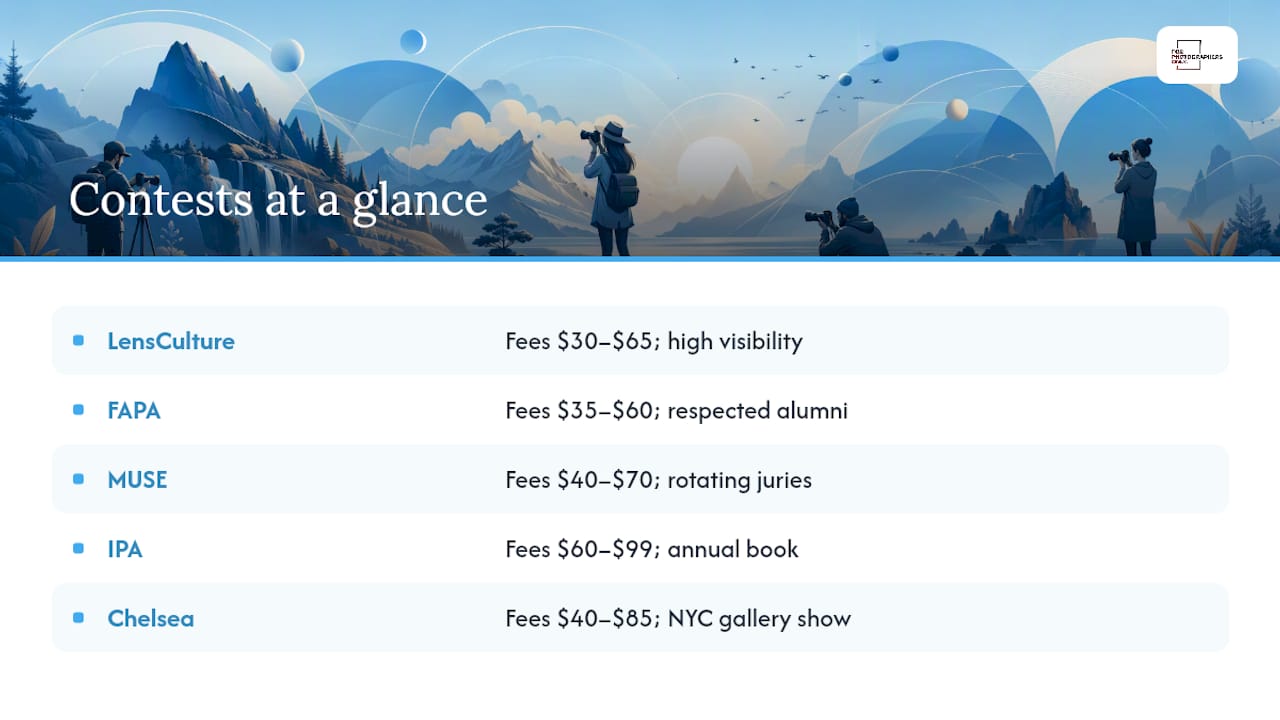
LensCulture Art Photography Awards runs multiple entry windows through the year, with fees typically in the $30 to $65 range depending on how early you submit. Open to professionals and amateurs worldwide, it accepts both single images and series, and winners receive cash prizes, online publication, and exhibition opportunities including showings in New York. The standout here is sheer visibility. LensCulture’s winner announcements get circulated widely across the photography press, and finalists often see gallery representation and editorial follow-up that outlasts the contest cycle itself.
Fine Art Photography Awards (FAPA) structures its deadlines in tiers, rewarding early submitters with lower fees, generally starting around $35 and climbing toward $60 as the final deadline nears. It welcomes professional, amateur, and student photographers globally, with categories split between single-image and series work. Winners gain published recognition and standing within FAPA’s respected alumni list, a detail jurors and gallery scouts do check.
MUSE Photography Awards covers an unusually wide net of subject categories, from fine art to documentary crossover work, with entry fees between $40 and $70. Entrants choose between single image and series divisions, and category selection matters since misfiled entries risk disqualification. MUSE’s jury rotates industry names each cycle, which keeps the judging perspective fresh year to year.
International Photography Awards (IPA) sits at the higher end of the fee scale, from roughly $60 to $99. It reflects its status as one of the more established credentials a fine art photographer can list. IPA is open worldwide to all experience levels and offers both cash prizes and published recognition in its annual book, a physical artifact many photographers use in portfolio meetings.
Chelsea International Photography Competition ties directly to a New York gallery exhibition, with entry fees from about $40 to $85. Winners and honorable mentions get their work physically hung in a Manhattan gallery space, a tangible outcome you can put on a resume line that reads differently than “online feature.”
Pro Tip: Before paying any entry fee, search the contest name alongside “past winners” and look at where those photographers’ work traveled next. A contest whose alumni show up in gallery rosters and magazine credits is worth more than one whose winners disappear after the announcement.
How Do You Choose the Right Fine Art Photography Contest?
Match the contest to the outcome you actually need, not just the one with the shiniest name.
Chasing gallery representation or networking? Prioritize contests with a physical exhibition component, like Chelsea International or LensCulture’s New York showings, since curators and press attention often follow those rooms more than online-only winner pages.
Building editorial credibility? Publication-heavy contests such as FAPA or IPA’s annual book carry more weight with magazine editors than a web badge.
Need cash now for a project? LensCulture and IPA both run substantial cash categories, so check current prize breakdowns before entering.
Working in series versus single images? Confirm the category rules early. Mismatched category submissions get disqualified more often than you’d expect.
Weigh entry fees against how many contests you can realistically prepare well. Three strong, well-prepared entries beat ten rushed ones.
Pro Tip: Check jury composition before you commit a fee. A panel with working curators or magazine editors signals real exposure potential, not just a rotating volunteer board.
What Are the Technical Specs for Submitting Photography Contest Entries?
Most fine art photography contests share a similar technical baseline, though you should always verify against the specific rules page.
File format: flattened JPEG/JPG, RGB color mode
Resolution: roughly 1,920 pixels on the long edge, 300 dpi
File size: typically capped near 4MB per image
Image age: most contests accept work created within the last a recent creation window generally accepted.
Language: written materials are usually required in English for international calls
Artist statement: a concise word limit recommended, kept strictly inside the stated limit
Preflight your files before the deadline crunch. Flatten every layer, embed your color profile, and test-upload at least one image early, since automated validation systems reject oversized files or wrong color profiles automatically, no human review involved. Name your files consistently, matching whatever naming convention the contest requests.
When Should You Submit and Budget for Entry Fees?
Nearly every major contest uses tiered pricing: early, regular, and final. Entering during the early window typically saves you money and avoids the administrative bottleneck that piles up as final deadlines approach.
Early tier: lowest fee, most processing time, least juror fatigue
Regular tier: moderate fee increase, still comfortable timing
Final tier: highest fee, tightest turnaround, higher rejection risk from rushed prep
Pick two to four contests per project rather than scattering fees across a dozen calls. Budget for no refunds. Once submitted, entries are final, and notification windows commonly run four to twelve weeks after the deadline closes.
What Do Fine Art Photography Award Winners Actually Receive?
Prize packages vary, but the strongest ones combine more than one benefit.
Cash prizes, often paired with exhibition slots in New York or partner galleries
Publication features in photography, art, or lifestyle magazines
Juror quotes and online promotion that boost portfolio credibility
Alumni status that opens doors to future grants and gallery inquiries
Leverage a win by citing it directly in gallery pitch letters and grant applications. It’s a credibility marker curators recognize.
How Forphotographersonly Curates Its Fine Art Photography Contest Shortlist
Every contest featured on Forphotographersonly is checked against a short list of trust signals before it earns a spot in the directory.
Weekly updates keep listings current across roughly 320 to 330 active contests
Over 100 of those are completely free to enter
Selection criteria include fee transparency, meaningful prize or exposure value, visible jury credentials, and recent activity history
Contests that hide their fee structure or can’t point to a recent, verifiable winner don’t make the cut. Transparency around deadlines, jurors, and prizes is the baseline, not a bonus.
International acceptance varies by contest, so always confirm eligibility for your country before paying.
What Common Mistakes Should You Avoid When Entering Contests?
The most expensive mistake is submitting to a contest that doesn’t fit your work. A documentary series entered into a strictly conceptual fine art category rarely places, no matter how strong the images are individually. Read the category description twice before paying.
Missing the technical specs is the second biggest cause of wasted entries. An unflattened PSD file or the wrong color profile can trigger an automatic upload failure, and by the time you notice, the deadline may have passed. Test your files days ahead, not hours.
Overwriting your artist statement is another common trap. Jurors read dozens, sometimes hundreds, of statements per category. A dense, jargon-heavy paragraph gets skimmed, not read. Say what the series is about, why it matters to you, and stop.
Rejection is normal, even for strong work. Juries change every cycle, and a series that wins at FAPA might not place at MUSE the same year, purely because the panel’s taste differs. Don’t read a single rejection as a verdict on your work’s quality. Instead, ask whether the category fit was right, whether your edit was tight enough, and whether the statement actually supported the images. Resubmit the same body of work to a better-matched contest rather than abandoning it after one no.
Track your submissions in a simple spreadsheet. Note deadlines, fees paid, and outcomes. Patterns emerge fast, and they’ll tell you where your work actually resonates.
What Does Entering Photography Contests Really Cost?
Entry fees are just the starting line. Budget realistically before you commit to a full contest season.

A typical entry runs an approximate range for entry fees depending on tier and category. However, that’s rarely the full cost. If you place as a finalist or winner in a contest requiring physical prints for exhibition, factor in printing and shipping, which can run anywhere from $20 for a small domestic package to well over $100 for larger prints shipped internationally with insurance. Some contests require the photographer to cover print production entirely; others subsidize it. Read the fine print before assuming the gallery covers everything.
If your work gets selected for an in-person exhibition opening, travel is the next line item. A Chelsea International opening in New York, for instance, means flights and hotel costs if you want to attend in person, though attendance is rarely mandatory for the work itself to be shown.
Some platforms also offer optional paid add-ons, like professional jury feedback reviews, which can run an additional $30 to $50. These are useful for growth but never a guaranteed path to selection, so treat them as an optional investment in craft, not a shortcut to winning.
Add it up before entry season starts: fees, potential shipping, potential travel, and any optional reviews. A modest season of four contests can realistically run $200 to $600 all in, more if you place and travel to opening receptions.
How Does Judging Work in Fine Art Photography Contests?
Juries typically score entries independently before comparing notes, a structure designed to reduce groupthink in the early rounds. Panels usually mix working photographers, gallery curators, and magazine editors, and that composition shapes what gets rewarded. A jury heavy on editorial names tends to favor narrative clarity. A jury with more curators often rewards conceptual ambition and print quality.
What jurors look for rarely comes down to technical perfection alone. A slightly imperfect exposure in a series with a clear, cohesive vision usually beats a technically flawless single image with no larger idea behind it. Series submissions get judged on internal consistency: does the body of work hold together, or does it feel like disconnected strong images stapled together under one title?
Artist statements matter more than most entrants assume. A juror scanning fifty entries in an afternoon uses the statement to understand intent quickly. A vague or overwritten statement can undercut genuinely strong images because the juror can’t locate the idea fast enough to care.
Timing within the judging cycle can matter too. Early submissions sometimes get more unhurried attention before jurors face a stack of last-minute final-tier entries.
How Do You Prepare a Strong Contest Submission?
Start with the edit, not the upload. Choose your strongest five to ten images if submitting a series, and be ruthless about cutting anything that repeats an idea already made elsewhere in the set. A tight, cohesive series of seven photographs almost always outperforms a diluted set of fifteen.
Sequence matters in series submissions. Open with your strongest or most representative image, and build a visual rhythm rather than a random order. Jurors often view images in the sequence you submit them, and that first impression sets their expectations for the rest.
Your artist statement should answer three things plainly: what the work is about, why you made it, and what makes this approach distinct. Avoid academic language for its own sake. A juror reading your statement wants clarity, not a thesis defense.
Double-check technical presentation before you submit. Consistent color grading across a series signals intentionality. A mismatched white balance between frames reads as an oversight, even if each image is individually strong.
Finally, treat your online presence as part of the submission. Jurors and gallery scouts frequently look up shortlisted photographers, so a well-organized portfolio site that’s easy to find and navigate can reinforce the impression your entry already made.
A Curator’s Take on Prioritizing Contest Submissions
Exposure builds momentum faster than cash for early-career photographers; publication and gallery visibility compound over years, while a check spends once. Prioritize contests whose jurors and past winners align with where you want your career to go.
Save Time Finding the Right Fine Art Photography Contests
Chasing deadlines across dozens of individual contest websites eats hours you could spend shooting or editing. Forphotographersonly solves that specific problem: instead of bookmarking six different contest pages and checking each one weekly for updates, you get one continuously refreshed page covering the best international opportunities, including calls with real cash prizes, gallery placement, and publication value.
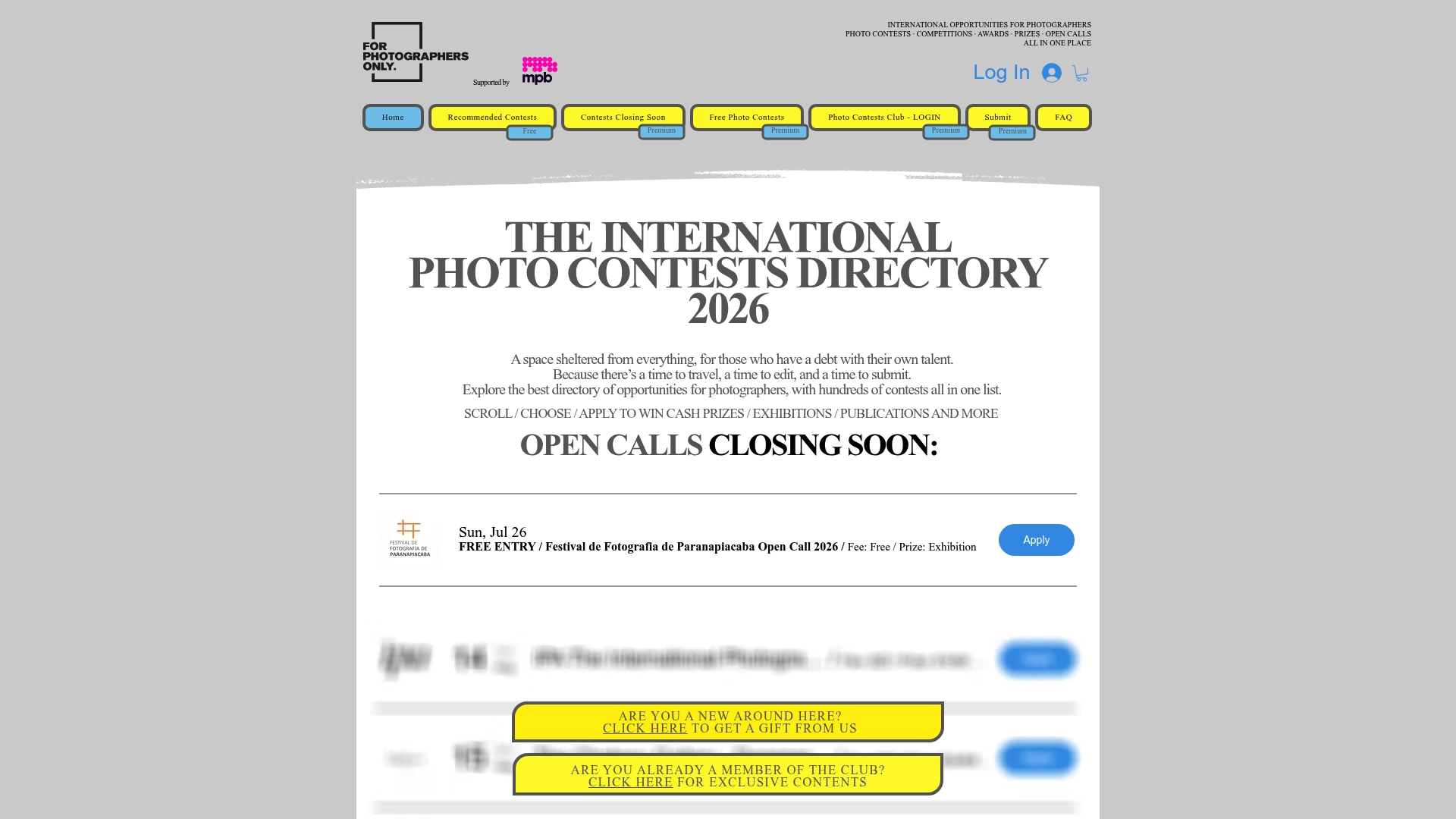
Subscribers get access to the full curated list, including current calls like the Creative Quarterly Competition, all vetted for fee transparency and legitimate exposure. If your work fits fine art or fellowship categories, opportunities like the Houston Center for Photography Annual Fellowship Awards are already listed and ready for review. Check the full contest directory today and see which upcoming deadlines fit your next project.
Frequently Asked Questions
What is the average entry fee for fine art photography contests? Most range from an approximate range for entry fees depending on category and whether you enter during the early, regular, or final deadline tier.
Can amateurs enter international photography contests alongside professionals? Yes, most major contests, including LensCulture and MUSE, welcome amateur, student, and professional entrants worldwide, though some categories separate divisions by experience level.
How many images should I submit for a series entry? Five to ten cohesive images generally works best. A tighter, well-sequenced edit tends to outperform a longer set with weaker internal consistency.
Do fine art photography awards require physical prints? Not usually for the initial entry, but winners selected for gallery exhibitions may need to ship physical prints, which adds cost beyond the entry fee.
How soon will I know if I won a photography contest? Notification windows typically run four to twelve weeks after the final deadline, though this varies by contest size and judging complexity.
Sources
Recommended