Experimental Photography Contests: Where to Enter and How

Experimental photography contests reward work that pushes past the conventional frame: cameraless images, alternative chemical processes, montage, hybrid media and conceptual series. The best ones for US and European photographers fall into three groups: open art awards that welcome experimental work, process-specific competitions, and festival open calls. All three are covered below, with real fees, prizes and file requirements from the 2026 cycle.
TL;DR
Experimental work is welcome in three kinds of contests: broad art awards, alternative-process competitions and analog or hybrid festival calls.
Fees in the 2026 cycle ranged from free (SCAN Tarragona) to about US$45 per entry, and prizes ranged from a €500 payment to US$3,500 for a first-place series.
Check the rules on AI, analog-only requirements and image rights before you pay a fee.
Prepare one set of files and one short artist statement, then adapt them to each contest’s pixel and word limits.
Deadlines recur on an annual pattern, so a calendar that tracks them saves more time than any single entry.
Table of Contents
What counts as experimental photography in a contest
Contests rarely define “experimental” with a single rule. Instead, they name the practices they welcome. The LensCulture Art Photography Awards 2026 invite conceptual and experimental projects, analog materials, montage, cameraless techniques and new forms, with no strict rules on creative approach. That is the broadest definition you will find.
At the other end sit process-specific competitions. The Soho Photo Gallery International Alternative Processes Competition accepts albumen, cyanotype, Van Dyke brown, platinum/palladium, gum bichromate, bromoil, salt print, tintype, ziatype, daguerreotype, image transfer, liquid emulsion, photogravure and chemigram. It excludes traditional silver gelatin prints, C-prints, digital prints and AI-generated work. If your practice lives in the darkroom or the chemistry tray, this is where the jury speaks your language.
Between the two are contests open to everything. The WideOpen: Excellence in Photography exhibition at The Dairy Barn Arts Center in Athens, Ohio, accepts experimental, documentary, photojournalism and fine art photography from photographers anywhere, with no thematic or stylistic restrictions. One Eyeland Open is likewise open to all genres, experimental photography included.

Examples of experimental photography that contests recognize
The clearest recent example comes from Europe. The Rotlicht Festival 2026 winners were chosen by a jury from 327 submissions from 44 countries. The Grand Prix went to Beihua Guo (USA) for Designated Ground Zeros, a project that uses the uranotype process, with uranium salts as the light-sensitive material. The material is part of the meaning of the work, which is what makes it a good model of experimental practice.
Other approaches that fit these contests include:
Cameraless work: photograms, chemigrams and luminograms, where light and chemistry meet without a lens.
Historical processes reinterpreted: cyanotype, tintype or platinum/palladium used for contemporary subjects.
Hybrid projects: photography combined with text, textile, sculpture, sound or video. The SCAN Tarragona call, for example, accepts primarily photographic projects that are hybridized with other creative languages.
Montage and image transfer: layered or physically reworked images.
Conceptual series: projects where the idea, the sequence and the material carry the argument.
Contests to know in the US and Europe
The table summarizes what the organizers published for their 2026 editions. Each runs on an annual rhythm, so treat the dates as a pattern and confirm the current schedule on the official page.
Contest | Best for | 2026 fee | Prize or outcome |
LensCulture Art Photography Awards | Conceptual, cameraless, mixed approaches | See the official page | Cash prizes and exhibition in New York |
Soho Photo Gallery Alternative Processes | Historical and chemical processes | US$45 for 1 to 5 images | Cash prizes and a gallery exhibition |
WideOpen (Dairy Barn) | Any style, theme-driven | $45 for up to 3 entries | Cash, camera kits, solo exhibition |
Rotlicht Festival | Analog and hybrid analog projects | €20 per project | Exhibition in Vienna, catalogue, reward |
One Eyeland Open | Any genre, monthly rounds | US$5 per image | Cash prizes of at least US$100 |
SCAN Tarragona Talent Latent | Photography hybridized with other languages | No fee | €500 payment per exhibited series |
Galician Prize of Contemporary Photography | Contemporary projects | €22 per project | Exhibition and/or book publication |
LensCulture Art Photography Awards
The 2026 cash prizes were $3,500 for first-place series, $2,000 for second and $1,000 for third. Single-image prizes were $2,000, $1,000 and $500, and 25 finalists were featured on the winners’ page. Winners were to be exhibited in New York during The Photography Show and covered in international press. Fees are non-refundable, and the deadline is final with no extensions, so enter early rather than on the last evening.
Soho Photo Gallery Alternative Processes
The 2026 competition was open to photographers aged 18 and older, excluding gallery members. The fee was US$45 for 1 to 5 images and US$5 for each additional image up to 15. Prizes were US$300 for first place, US$200 for second and US$100 for third, plus two honorable mentions. The juror was Amy Arbus, whose work is held in the collections of the Metropolitan Museum of Art and The New York Public Library. The exhibition ran in December with an opening reception, and the gallery’s commission on print sales during the show was 30%. The 2026 deadline fell in early October, which suggests an autumn call each year.
WideOpen at The Dairy Barn Arts Center
The 2026 fee was $45 for up to three entries, or $35 for Dairy Barn members. Submissions ran from June to late July, with the exhibition in autumn. The theme was “Light + Time,” and jurors evaluated technical skill, creativity and originality, concept and story, and design and composition. Prizes included the Terry and Lyntha Scott Eiler Award ($1,000), an Ohio University Alumni Award with a solo exhibition and lecture opportunity, and a Best in Show Sony camera kit valued at approximately $2,000. Age-based awards, an Innovation in Light & Time Award and Juror Awards of $150 each rounded out the list. Because the contest is themed, experimental photographers should read the theme as an invitation to concept-driven work.
Rotlicht Festival for Analog Photography
The 2026 open call ran from May to June, cost €20 per project and accepted only images or projects with at least one analog process. AI-created entries were disqualified unless AI was deliberately the theme. Submissions are judged individually and independently by a jury of international curators, festival directors and experts. Winners receive an exhibition at the Academy of Fine Arts in Vienna, a catalogue publication, a €250 reward and a €150 travel allowance. The Grand Prix winner adds a solo exhibition and a further €250. The jury has been led by Dr. Hanin Hannouch, president of the European Society for the History of Photography since 2025. We have listed several Rotlicht calls in our directory, including the Anthropocene: Hybrid Realities open call.
One Eyeland Open
One Eyeland charges US$5 per image and puts 50% of entry fees, less payment gateway commissions, into the prize pool. Up to 25 photographers receive cash prizes of at least US$100 each. The contest runs in monthly rounds. From the second month, the One Eyeland team prepares an editorial shortlist and the previous month’s winning photographers make the final choice, so your work is judged by peers.
SCAN Tarragona and the Galician Prize
Two European calls suit project-based work. The SCAN Talent Latent call had an April 2026 deadline and no entry fee. It asks for a zip file of up to 20 JPEG photographs, at least 1,300 pixels on the shortest side, with an embedded RGB profile, and pays €500, taxes included, for each exhibited series. The Galician Prize of Contemporary Photography (Outono Fotográfico) charged €22 per project, with a submission window from mid-August to mid-October 2026. Its jury prize consists of producing an exhibition and/or publishing a book, and entries may include up to 15 images of at least 3,000 pixels in JPG format.
How experimental work is judged
Experimental entries are rarely judged on technical polish alone. The WideOpen criteria show a typical balance: technical skill, originality, concept and story, and composition. Festival juries such as Rotlicht’s bring curators and historians who read the idea behind the material. Peer-judged rounds like One Eyeland’s reward work that communicates quickly to other photographers.
That has a practical consequence. A series with a clear conceptual thread and a consistent visual language will usually travel further than a collection of strong but unrelated images. Name the connection between the process and the subject, and sequence the images so that the connection builds.
Rules that matter before you pay a fee
Reading the rules takes ten minutes and can save a fee. Check these points in every call:
Process requirements. Rotlicht needs at least one analog process. Soho excludes digital prints and silver gelatin prints. Open awards have no such limit.
AI policy. Soho, Rotlicht and WideOpen all restrict AI. WideOpen prohibits generative AI work, and Rotlicht allows it only when AI is the stated theme.
Image rights. At WideOpen, artists retain all copyrights while granting the Dairy Barn rights to reproduce and distribute images in print and electronic media to promote the exhibition and its entrants.
Eligibility. Age limits, membership exclusions and geographic scope vary. WideOpen accepts entrants regardless of location, while Soho is for those 18 and older.
Refund and deadline policy. LensCulture fees are non-refundable and deadlines are final.
Match between juried and exhibited work. WideOpen requires accepted works to correspond precisely to the juried images, so do not submit a draft you cannot reproduce as a print.
Preparing your submission
File specifications differ, and a rejected upload is an avoidable loss. Build a master set at high resolution, then export per contest.
Contest | Format and size | Other requirements |
LensCulture | Jury reviews on screen only; no prints or CDs | |
WideOpen | Artist statement of 80 words or fewer | |
SCAN | JPEG zip, up to 20 images, 1,300 px minimum on the shortest side | Embedded RGB profile |
Galician Prize | JPG, up to 15 images, 3,000 px minimum | Project-based entry |
Write a short artist statement
With an 80-word limit at WideOpen, every sentence has to earn its place. State the idea, the process and why the process matters. For instance: what material did you use, what did it change, and what should the viewer notice? Avoid describing the images; the jury can see them.
Consider a review before you submit
LensCulture offers entries of five or more images an optional professional Submission Review for $25 from an industry specialist, with critical and constructive feedback. For a series you plan to enter in several contests, outside feedback on sequencing can be useful.
Building a yearly entry plan
Experimental contests follow a recognizable annual rhythm. Based on the 2026 cycle: spring for festival calls such as SCAN and Rotlicht, summer for WideOpen, late summer to autumn for the Galician Prize and Soho, and monthly rounds all year for One Eyeland. Check each official page for the current schedule, because organizers change dates and themes.

A sensible plan is to pick one broad award, one process-specific competition and one festival call per year, and to add free calls whenever your project fits. Start with the contests whose process rules match your work. Then widen to open awards where your concept is the strongest element.
Our perspective
Experimental photographers often work in the margins of the conventional contest calendar. A cyanotype series, a uranium-based print or a hybrid project does not fit every category, yet there are juries and festivals actively looking for exactly this kind of innovation. The difficulty is discovery. The calls are scattered across museums, galleries, festivals and online platforms, and each sets its own deadlines, fees and process rules. We believe the most valuable thing a photographer can have is a clear, chronological view of what is open now, so that energy goes into making the work rather than hunting for it. That is why we research, curate and publish international competitions in one continuously updated place. We do not organize contests ourselves; our role is to champion the opportunities, from major brands to lesser-known festivals that offer exceptional editorial visibility and exhibition value, and to let photographers decide which meeting points in the art calendar suit their vision. DARIO
Find open calls without the search
Our directory lists more than 320 active international photography contests, awards, calls, prizes and grants, including over 100 free-to-enter competitions, with deadlines, fees, prizes and genres shown for each. It is updated every week and presented chronologically on a single page. PhotoContestsClub costs €6 per month or €40 per year, and a free trial is offered.
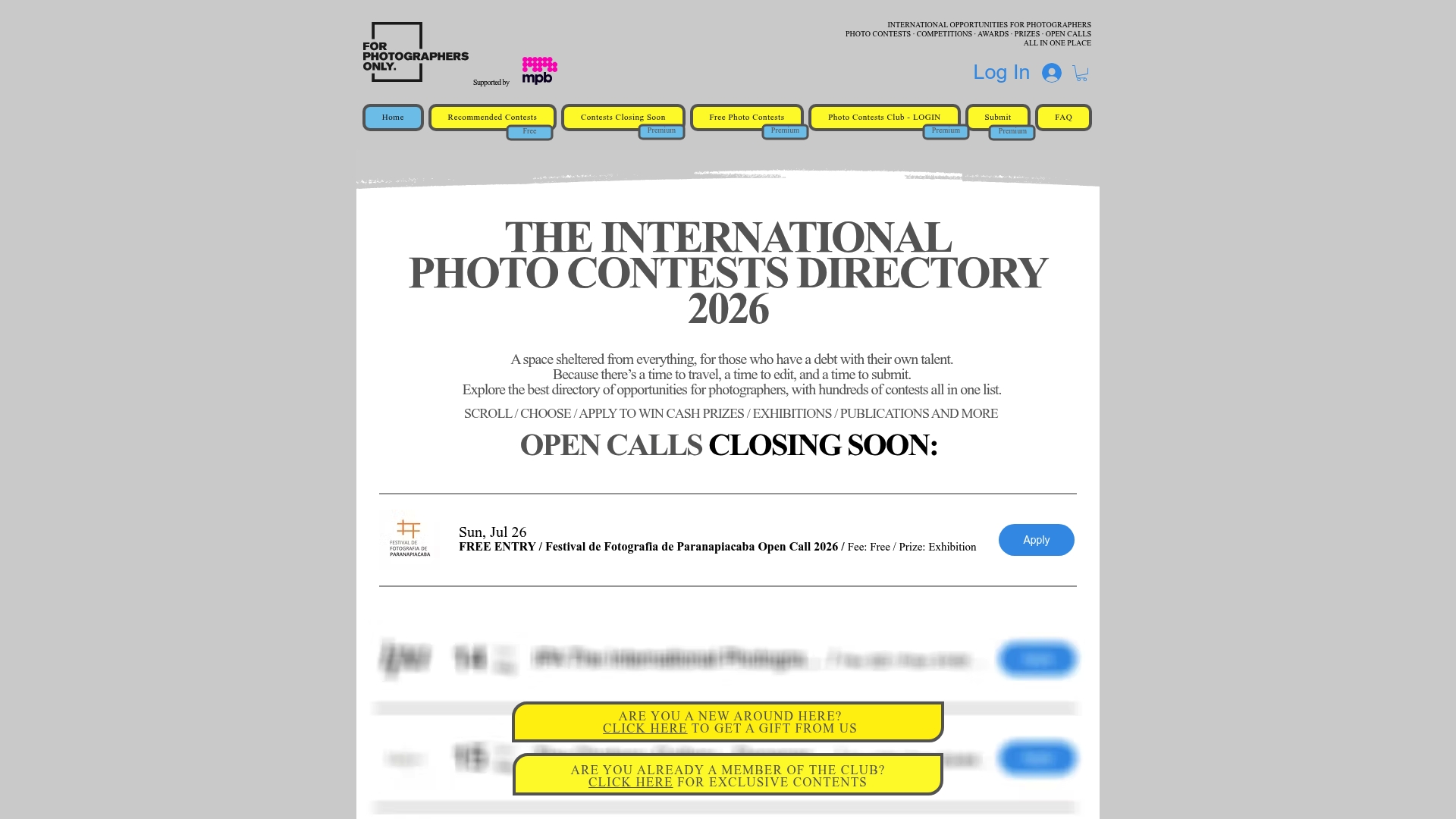
If analog and alternative processes are your focus, you can also browse examples we have featured, such as the AnalogueNOW! international open call and the Revela’T contemporary analog photography festival call. To see every current call, join PhotoContestsClub.
FAQ
What are some examples of experimental photography?
Examples include cameraless photograms and chemigrams, historical processes such as cyanotype and tintype, image transfer, montage and hybrid projects that combine photography with other media. The 2026 Rotlicht Grand Prix went to a project made with the uranotype process, using uranium salts as the light-sensitive material.
Do experimental photography contests accept digital work?
Many do, but not all. Open awards such as LensCulture and WideOpen welcome a wide range of approaches. Process-specific contests such as Soho’s Alternative Processes competition exclude digital prints, and Rotlicht requires at least one analog process.
Are there free experimental photography contests?
Yes. The SCAN Tarragona Talent Latent call had no entry fee in 2026 and paid €500 for each exhibited series. Our directory flags over 100 free-to-enter competitions, so you can filter your plan by cost.
Can I enter from the United States if the contest is in Europe?
Often you can. Rotlicht’s 2026 winners came from 44 countries, including a US Grand Prix winner. Always confirm eligibility and fee currency on the official rules page, since a few calls restrict entrants by age or membership.
Sources
Recommended