The Best Environmental Photography Awards to Enter in 2026
The leading environmental photography awards worth your attention right now are the Prince Albert II of Monaco Foundation Environmental Photography Award, the Sony World Photography Awards Sustainability Prize, Textile Exchange’s photography competition, Wildlife Photographer of the Year, World Press Photo’s environment and climate categories, LensCulture’s Earth and climate initiatives, the Siena International Photo Awards, and the International Photography Awards (IPA). Together, these contests represent the most credible international platforms for photographers working on conservation, climate, and ecological storytelling.
Your first move depends on your project format:
Single images, any nationality, low cost: Prince Albert II Foundation Environmental Photography Award (roughly 10,000 submissions annually, five category prizes of €1,000 each, and a €5,000 grand prize; submissions via Photocrowd)
Series or long-form project, SDG-aligned: Sony World Photography Awards Sustainability Prize ($5,000 cash plus Sony equipment)
Textile and regeneration stories, up to 25 images: Textile Exchange photography competition (commission valued at $10,000 plus $2,000 cash)
Wildlife and nature, strongest institutional prestige: Wildlife Photographer of the Year (Natural History Museum, London)
Documentary and climate reportage: World Press Photo environment categories
Mobile-first environmental work: IPPAWARDS (iPhone), Mobile Photography Awards, or the Siena Photo Awards mobile category
Prioritize by deadline imminence, then by whether the award guarantees exhibition or publication. The Prince Albert II award publishes a bilingual book and tours a physical exhibition, making it one of the highest-exposure free-to-enter contests in this space.
Key Takeaways
The most competitive environmental photography submissions pair strong visual craft with verifiable environmental context, submitted to awards whose stated mission matches the project’s intent.
Point | Details |
Top free-entry awards | Prince Albert II Foundation (€5,000 grand prize, touring exhibition, Skira book) and Sony Sustainability Prize ($5,000 + equipment) offer the best return at zero entry cost. |
Series vs. single image | Sony, Textile Exchange, and World Press Photo reward series of 5–25 images; Prince Albert II Foundation, Wildlife Photographer of the Year, and Siena favor single images. |
Jury priorities | Juries reward project depth, forensic or evidence-based documentation, novelty of story, and captions tied to verifiable conservation outcomes. |
Rights and licensing | Always read the rights clause before submitting; most reputable awards ask for non-exclusive promotional use only, but terms vary by edition. |
Forphotographersonly | The directory lists 320+ active contests with genre and fee filters, updated weekly, making it the fastest way to match your project to the right environmental award. |
Table of Contents
Which environmental photography awards should you know?
Prince Albert II of Monaco Foundation Environmental Photography Award
Launched in 2021 and organized by the Prince Albert II of Monaco Foundation, this annual contest has become one of the most respected eco-focused photography competitions globally. It selects 36 photographs for a touring exhibition and publishes a bilingual book through Skira. Five category winners each receive €1,000, and the grand prize carries €5,000, with the 2026 edition attracting a large number of submissions. Entries are submitted through Photocrowd, with a maximum of 5 images per category and 25 images total. A public vote and a students’ choice component run alongside the jury process. Rights and licensing terms are specified per edition on the official page. This award strongly favors single images with clear environmental context, though series entries are accepted within category limits.
Sony World Photography Awards — Sustainability Prize
Organized by the World Photography Organisation and supported by Sony, the Sustainability Prize targets series that address the United Nations Sustainable Development Goals. Winners receive $5,000, Sony digital imaging equipment, and promotion across World Photography Organisation channels. The award is part of the broader Sony World Photography Awards cycle, which opens entries in the fall and announces winners in spring. It favors project-based submissions with a clear narrative arc and measurable environmental or social impact. Recent winning series have addressed large-scale ecological restoration projects, demonstrating the jury’s preference for stories with global policy relevance.
Textile Exchange Photography Competition
This sector-specific contest, run in partnership with Atmos, seeks photo stories about regeneration in textiles and sustainable materials. The overall collaborative commission is valued at a significant amount, with an additional cash prize and exhibition at the Textile Exchange Conference. Entries of up to 25 images are accepted, and the competition intentionally commissions winners to produce further work, making it a meaningful career pathway for photographers working on industrial-environment and fashion-sustainability stories. Judges include sector specialists from both the textile and photography industries.
Wildlife Photographer of the Year
Organized by the Natural History Museum in London, Wildlife Photographer of the Year is the most institutionally prestigious nature photography competition in the world. It covers dozens of categories spanning mammals, plants, invertebrates, underwater life, and human-nature interaction. Winners are exhibited at the Natural History Museum and in a global touring show that reaches hundreds of venues annually. The competition accepts single images and awards cash prizes, with a published catalog accompanying each edition. Entry fees apply, and the contest typically opens in the fall for the following year’s cycle.
World Press Photo — Environment and Climate Categories
World Press Photo carries unmatched credibility in documentary photography. Its environment and climate categories reward long-form visual journalism, and winning or shortlisting here opens doors to editorial commissions at the highest level. The competition accepts single images, stories, and long-term projects, with a rigorous verification process that includes fact-checking captions and metadata. Entry is open to professional photographers, and fees apply. Winners are exhibited globally and featured in the World Press Photo book, one of the most widely distributed photography publications in the industry.
LensCulture Earth and Climate Competitions
LensCulture runs multiple annual open calls, including Earth Awards and climate-focused initiatives that welcome both emerging and established photographers. The platform offers strong editorial visibility through its website and social channels, and shortlisted photographers gain exposure to curators, editors, and gallery directors who actively scout LensCulture for new talent. Entry fees are moderate, and the platform accepts series and single images. LensCulture’s reach within the contemporary photography community makes it particularly valuable for photographers building an international profile.
Siena International Photo Awards
The Siena International Photo Awards includes nature and environment categories alongside wildlife, sport, and travel. The competition is known for its exhibition in Siena, Italy, and its strong media partnerships. It accepts single images and offers cash prizes and exhibition opportunities. A mobile photography category runs as part of the broader Siena Photo Awards ecosystem, making it one of the few major competitions that explicitly recognizes smartphone environmental photography. Entry fees apply, and the annual cycle typically opens in late summer.
International Photography Awards (IPA)
The IPA is a long-standing global competition with dedicated nature and environment categories, as well as a mobile photography division. It offers cash prizes, exhibition opportunities, and the Lucie Award recognition for top winners. The IPA accepts single images and series, with entry fees varying by category. Its global reach and media partnerships make it a strong platform for photographers seeking editorial visibility in the United States and internationally.
Mobile and Smartphone Environmental Photography
For photographers working primarily on mobile devices, several competitions explicitly welcome or specialize in smartphone imagery with environmental relevance:
IPPAWARDS: The most prestigious global contest exclusively for iPhone photography, with categories that include nature and environment
Mobile Photography Awards: The primary multi-smartphone award, covering all genres including nature and conservation
HONOR Magic Stories: Focuses on visual storytelling and low-light narrative work
OPPO Imagine IF: Strong prize pool for reportage and documentary stories
Xiaomi Imagery Awards: Rewards artistic and authored mobile photography
Samsung Galaxy Contest: Recognizes zoom capability and night photography
Huawei NEXT IMAGE: A long-running contest for conceptual and artistic mobile images
Sony World Photography Awards (Mobile): The mobile category within the world’s most prestigious photography prize
SPi Awards (Mobile): The global benchmark for mobile street photography
Siena Photo Awards (Mobile): Celebrates spontaneous and candid mobile captures
Minimalist Awards (Mobile): Dedicated to geometric purity and minimalist composition
ND Awards (Mobile): Evaluates mobile photography with a fine-art editorial approach
Fine Art Awards (Mobile): Rewards conceptual art, experimentation, and mobile post-production
Chromatic Awards: Covers color-focused mobile photography across genres
For environmental stories shot on mobile, IPPAWARDS, Mobile Photography Awards, and the Siena mobile category offer the clearest pathways to recognition.
Quick comparison: eligibility, format, fees, and prizes
Award | Eligibility | Accepted Format | Typical Entry Window | Fee Band | Headline Prize | Exposure | Submission Platform | Typical Rights |
Open globally | Single images (up to 5/category, 25 total) | Spring–Summer | Free | €5,000 grand prize; €1,000 per category | Touring exhibition, Skira book | Photocrowd | Non-exclusive, per edition terms | |
Sony World Photography — Sustainability Prize | Open globally | Series | Fall–Winter | Free | $5,000 + Sony equipment | WPO channels, exhibition | WPO portal | Promotional use by WPO |
Open globally | Photo story (up to 25 images) | Annual (check official page) | Free | $10,000 commission + $2,000 cash | Conference exhibition, publication | Direct submission | Commission terms per contract | |
Wildlife Photographer of the Year | Open globally | Single image | Fall | Medium | Cash prizes, catalog | NHM London + global tour | Direct submission | Non-exclusive, per edition terms |
World Press Photo — Environment | Professional photographers | Single, story, long-term project | Fall–Winter | Low | Cash, book, global exhibition | Global touring, WPP book | Direct submission | Non-exclusive, verification required |
LensCulture Earth/Climate | Open globally | Single image or series | Multiple annual rounds | Low–Medium | Cash, editorial exposure | LensCulture platform, curator access | LensCulture portal | Promotional use by LensCulture |
Siena International Photo Awards | Open globally | Single image | Late Summer | Medium | Cash prizes, exhibition | Siena exhibition, media partners | Direct submission | Non-exclusive |
IPA — Nature/Environment | Open globally | Single image or series | Spring–Summer | Medium | Cash, Lucie Award recognition | Exhibition, media coverage | IPA portal | Non-exclusive |
IPPAWARDS | iPhone users globally | Single image or series | Annual | Low–Medium | Cash, exhibition | Global media coverage | IPPAWARDS portal | Non-exclusive |
Mobile Photography Awards | All smartphones | Single image or series | Annual | Low | Cash, publication | Online gallery, publication | MPA portal | Non-exclusive |
Fee band legend: Free = no entry fee; Low = under $25; Medium = $25–$60; High = above $60.
Series-preference awards: Sony Sustainability Prize, Textile Exchange, World Press Photo long-term project category, and LensCulture. Single-image preference: Prince Albert II Foundation, Wildlife Photographer of the Year, Siena, IPA.
Pro Tip: Calendar the Prince Albert II Foundation award and the Sony World Photography Awards as your two anchor entries each year. Both are free or low-cost, offer guaranteed exhibition or publication, and carry institutional credibility that strengthens your portfolio regardless of outcome.
How do you choose which environmental awards to enter?
The decision comes down to four factors: project format, storytelling maturity, exposure goals, and budget. A clear framework prevents wasted entry fees and mismatched submissions.
1. Match your project format to the award’s preference
Start by identifying whether your work is a single image or a developed series. Awards like Wildlife Photographer of the Year and the Prince Albert II Foundation competition are built around single images with strong standalone impact. The Sony Sustainability Prize, Textile Exchange, and World Press Photo long-term project category explicitly reward series of 5–25 images that document an issue over time. Submitting a single image to a series-first competition, or vice versa, rarely succeeds.
2. Assess your storytelling maturity
A project with research, field notes, institutional collaborators, and verifiable captions is ready for World Press Photo or the Textile Exchange competition. A powerful single image with a compelling caption is the right fit for the Prince Albert II Foundation award or Siena. Be honest about where your project sits before committing entry fees.
3. Prioritize by exposure goal and cost
Use this quick matrix:
High-impact, low-cost targets: Prince Albert II Foundation (free, guaranteed exhibition and book), Sony Sustainability Prize (free, $5,000 prize and equipment)
High-cost, high-exposure bets: Wildlife Photographer of the Year, World Press Photo (fees apply, but institutional prestige is unmatched)
Mobile-category opportunities: IPPAWARDS, Mobile Photography Awards, Siena mobile category (low fees, growing recognition for phone-first environmental work)
4. Watch for red flags
Avoid awards that display these warning signs:
Overly broad categories that dilute the environmental focus and reduce your competitive edge
Restrictive rights or exclusivity clauses that limit your ability to license the same images elsewhere
No published exhibition or book outcome, meaning your work disappears after judging
Opaque judging with no named jurors or published criteria
Hidden fees that appear after initial submission (processing charges, print fees)
Forphotographersonly’s curated contest directory lists over 320 active competitions with fee, deadline, and genre filters. It makes it straightforward to cross-reference these red flags before committing to an entry. The wildlife photography competitions overview on the platform is a useful starting point for nature-focused photographers mapping their annual entry calendar.
What do juries actually look for, and how do you prepare?
Juries at leading environmental photography awards now consistently reward project-based visual storytelling that connects images to verifiable environmental context and measurable impact. A single striking image still wins categories, but the awards that carry the most career weight increasingly favor depth over spectacle.
The 2026 Prince Albert II Foundation grand prize winner, Britta Jaschinski, demonstrated this shift clearly: her winning work used ultraviolet imaging to reveal forensic evidence of wildlife crime, a technique that transformed documentary photography into investigative evidence. That approach, pairing visual craft with scientific methodology, is precisely what top juries are looking for.
What juries prioritize
Project depth: Series of 5–25 images that document an issue over time, not a single visit
Evidence and forensics: Where relevant, images that function as verifiable documentation, not just illustration
Novelty: Stories from overlooked geographies, underreported species, or unconventional visual approaches
Clarity of impact: A clear line between the images and a conservation outcome, policy change, or human element
Ethical sourcing: Consent documentation, no manipulation beyond standard processing, accurate metadata
File quality and technical standards: Minimum resolution requirements vary by award; always check the official brief
Practical submission checklist
Export files at the required resolution and color profile (sRGB is standard for most platforms)
Write captions that include location, date, species or subject, and one sentence of environmental context
Prepare a project statement of 150–300 words that explains your methodology, collaborators, timeline, and the measurable outcome your work addresses
Include institutional references where available (research partners, NGOs, published studies)
Verify that your metadata (EXIF data, copyright field, caption field) is complete before upload
Pro Tip: Pair your strongest image with a one-paragraph scientific or institutional reference in the caption. A caption that cites a conservation organization or a published study signals to jurors that your work is grounded in verifiable reality, not just aesthetic intent. This single step separates competitive submissions from technically excellent but contextually thin entries.
Aligning your submission’s narrative with the organizer’s mission also matters deeply. Science- and policy-oriented awards like the Prince Albert II Foundation and World Press Photo value human-nature interaction and solution-focused storytelling. Creative-focused awards like LensCulture may reward avant-garde visual approaches. Read the organizer’s stated mission before writing your project statement, and mirror their language and values in your submission.
What does entering multiple awards actually cost you?
Most photographers underestimate the time investment more than the financial cost. Here is a realistic picture of both.
Typical annual calendar rhythm
Fall (September–November): Wildlife Photographer of the Year, World Press Photo, and Sony World Photography Awards open entries
Winter (December–February): Submission windows close for most major awards; shortlists begin
Spring (March–May): Winners announced for Prince Albert II Foundation, Sony, and World Press Photo; exhibitions open
Summer (June–August): Siena International Photo Awards opens; LensCulture rounds run throughout the year
Budget snapshot by fee band
Free: Prince Albert II Foundation Environmental Photography Award, Sony Sustainability Prize
Low ($1–$25): LensCulture rounds, IPPAWARDS, Mobile Photography Awards
Medium ($25–$60): Wildlife Photographer of the Year, Siena, IPA, World Press Photo
High (above $60): Rare among reputable environmental awards; treat high fees as a red flag unless the prize and exhibition are clearly proportionate
Time investment per entry runs roughly 3–6 hours for a well-prepared single-image submission (caption writing, file preparation, platform registration) and 8–15 hours for a series submission with a full project statement. Batching submissions across multiple awards using the same project cuts that time significantly: write one strong project statement, then adapt it for each award’s word limit and thematic emphasis.
If shortlisted for a touring exhibition, budget for potential travel to opening events, though most awards do not require physical attendance. The photography grants guide on Forphotographersonly covers funding options that can offset travel and production costs for photographers at the shortlist stage.
The Prince Albert II Foundation award’s prize structure (€5,000 grand prize, €1,000 per category winner) provides a useful reference point for calibrating expectations: for a free-to-enter competition with guaranteed exhibition and book publication, the return on a well-prepared submission is substantial even at the shortlist level.
What does shortlisting or winning actually deliver?
The tangible outcomes from winning or shortlisting at a major environmental photography award extend well beyond the prize check.
Concrete deliverables
Cash grants: €1,000–€5,000 (Prince Albert II Foundation), $5,000 (Sony Sustainability Prize), $2,000 cash plus $10,000 commission (Textile Exchange)
Equipment: Sony digital imaging equipment for Sustainability Prize winners
Commissioned projects: Textile Exchange explicitly commissions winners to produce further work
Exhibitions: Touring shows (Wildlife Photographer of the Year reaches hundreds of venues globally; Prince Albert II Foundation tours internationally)
Book and catalog publication: Prince Albert II Foundation publishes a bilingual Skira book; Wildlife Photographer of the Year and World Press Photo both produce widely distributed catalogs
Media coverage: Major outlets including My Modern Met, Yale Environment 360, and The Guardian publish galleries and write-ups of winners, amplifying exposure far beyond the award’s own channels
Intangible outcomes
Shortlisting at Wildlife Photographer of the Year or World Press Photo carries reputational weight that opens editorial doors. Curators and picture editors actively follow these competitions, and a shortlist credit on your biography signals that your work has passed rigorous peer review. Yale Environment 360’s coverage of award winners reaches policy and academic audiences who commission documentary projects and fund conservation photography initiatives.
Downstream licensing opportunities also increase after award recognition. Images that appear in touring exhibitions attract licensing inquiries from publishers, NGOs, and educational institutions.
Pro Tip: The week your shortlist or win is announced, send a targeted press release to three to five picture editors at publications aligned with your subject matter. Include the award name, a high-resolution image, and a one-paragraph project description. Most photographers wait for editors to find them; the ones who reach out first convert recognition into commissions.
For photographers looking to amplify their online visibility after an award, SEO for photographers is worth exploring as a way to ensure that award recognition translates into search visibility and inbound inquiries.
An editor’s perspective on entering environmental awards
There is a pattern worth naming directly: photographers who enter environmental photography awards without reading the organizer’s mission statement almost always underperform. The difference between a shortlisted submission and a rejected one is rarely technical quality. It is usually alignment. A forensic wildlife crime image submitted to an award that celebrates ecological beauty will not resonate with the jury, regardless of how technically accomplished it is.
The awards covered here represent a genuine spectrum of values: scientific rigor (Prince Albert II Foundation, World Press Photo), sector-specific advocacy (Textile Exchange), institutional prestige (Wildlife Photographer of the Year), and editorial visibility (LensCulture, IPA). Matching your project to the right mission is the single highest-leverage decision you can make before hitting submit.
Forphotographersonly tracks over 320 active competitions, including more than 100 free-to-enter opportunities, updated weekly. The platform exists precisely to help photographers make that match efficiently, without spending hours cross-referencing official pages.
Forphotographersonly: your shortcut to the right contest
Tracking eight or more annual award cycles across different platforms, deadline formats, and fee structures takes real time. Forphotographersonly consolidates over 320 active photography contests into a single, continuously updated directory, including more than 100 free-to-enter competitions, so you spend your hours preparing submissions rather than hunting for them.
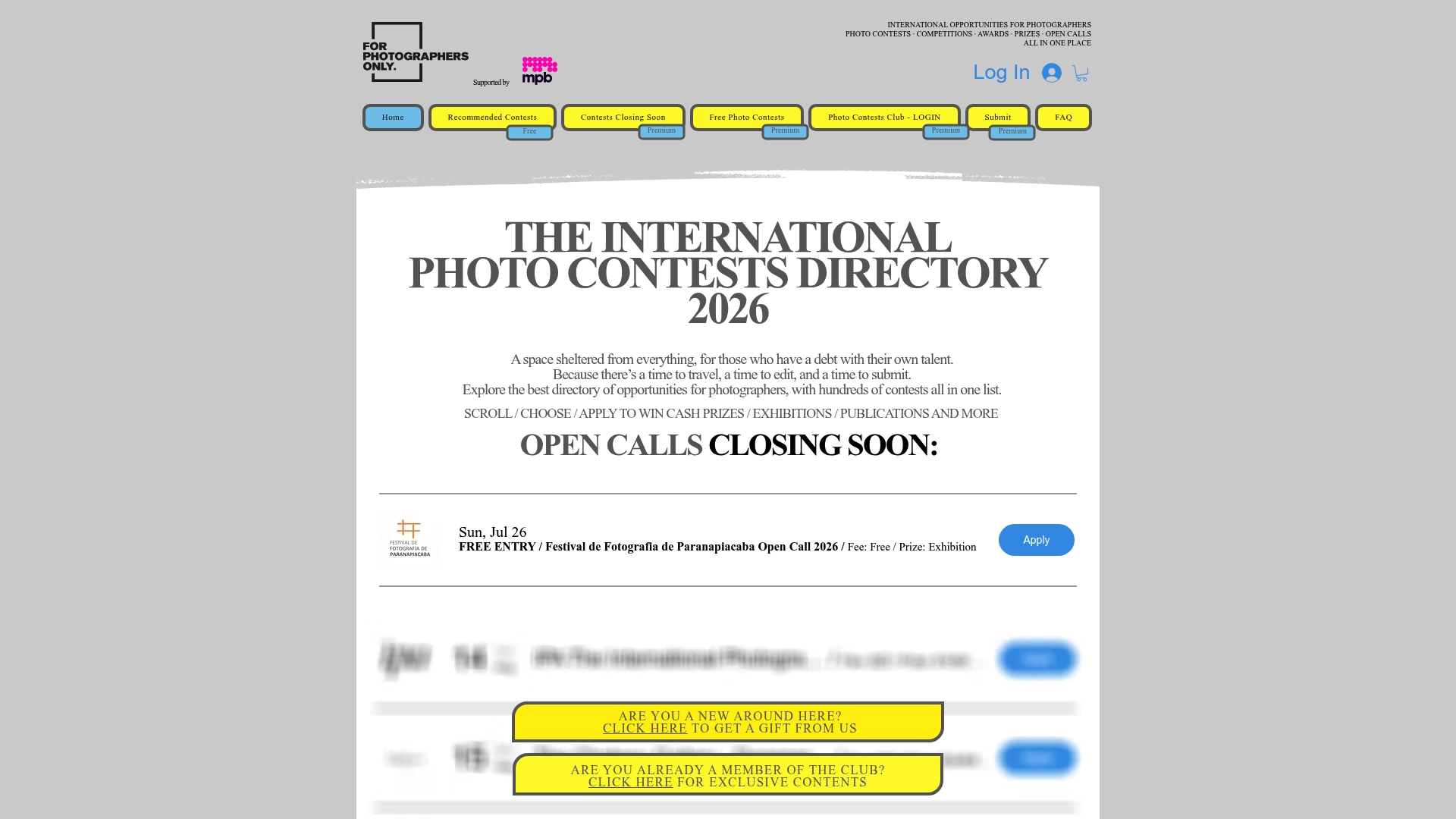
The directory filters by genre (nature, environment, documentary, mobile), fee band (free, low, medium), and deadline proximity, which means you can pull up every open environmental contest in under a minute. Weekly updates catch new calls and deadline changes before they slip past you. Members also get access to a monthly internal competition and a community of photographers navigating the same entry decisions.
Browse the nature photography contest listings or explore the full contest directory to find your next entry. At €6 per month, it is a straightforward trade for the hours it saves and the opportunities it surfaces.
Primary sources and competition homepages to bookmark
Always verify current rules, rights terms, and deadlines directly on each competition’s official page before submitting, as details change between editions.
Prince Albert II Foundation Environmental Photography Award — official entry page, prize details, and exhibition schedule
Prince Albert II Foundation 2025 Edition — platform details (Photocrowd), entry limits, and public vote information
Sony World Photography Awards — Sustainability Prize — World Photography Organisation’s official prize page
Textile Exchange Photography Competition — 2026 competition brief, prize structure, and submission guidelines
British Ecological Society — Capturing Ecology — ecology-focused competition with fee waivers for Global South entrants
PetaPixel — 2026 Environmental Photography Award coverage — reporting on 2026 winners and jury-rewarded techniques
Yale Environment 360 — Environmental Photography of the Year — editorial roundup amplifying winners to policy and academic audiences
My Modern Met — 2026 Environmental Photography Award Winners — international media coverage documenting shortlisted images and touring exhibition outcomes
Prince Albert II Foundation — 2026 Winners Announcement — official announcement with submission platform and rights information
Sources
Recommended