Entry Fee Waivers for Photography Contests: How to Ask

An entry fee waiver is an organizer’s decision to let you enter a photography competition without paying, or paying less, because the fee would keep you out. Waivers exist, but they are rarely advertised on the entry page. They sit in the rules, the FAQ or a single sentence near the payment step, and they are usually granted by email, before the deadline, to a limited number of people. The photographers who receive them are the ones who find the option early, ask politely and give the organizer what it needs to say yes.
This guide explains what a waiver is, who tends to qualify, how to write the request and what to do when the rules say nothing.
TL;DR
A waiver removes the fee entirely. A discount (early-bird, student, member) only lowers it, and free-entry contests charge nothing to anyone.
Waivers are usually case-by-case and limited in number, so ask early and before the deadline. Unpaid entries are generally not judged.
Typical qualifiers: students, photographers with limited means, members of underrepresented groups, and, in some UK and international contests, young entrants or residents of listed countries.
Your request should be short: who you are, which contest, why the fee is a barrier, and what evidence you can provide if asked.
Planning ahead is easier when fees, deadlines and free-entry contests sit on one page, which is what our directory is built for.
Table of Contents
What a waiver is, and how it differs from a discount or a free contest
These three things get mixed up, and the difference decides what you should ask for.
A waiver is granted to you personally. You contact the organizer, explain your situation, and if approved, the fee is removed. Phillips Mill, a Pennsylvania arts center, charges $48 for up to three exhibition images in its photography call and says its Photo Committee offers a limited number of basic entry-fee waivers to photographers with limited means.
A discount is a published price cut that you qualify for by category or timing. The Audubon Photography Awards, for example, charge $15 per photo or video in the adult division, with a discount code for student members of Audubon on Campus chapters. That is a lower fee, not a waiver. The International Photography Awards say all students are eligible for their student discount, that fees are in US dollars and that paid fees are not refunded, which is a good reason to confirm eligibility before you pay.
A free-entry contest charges nobody. Audubon’s youth division is free, and the National Wildlife Photo Contest lets entrants aged 13 to 17 enter at no cost. No request is needed.
If you want the full picture of what contests normally charge, our guide to photo contest entry fees sets out the usual ranges and what you get for them.

Who tends to qualify
Organizers set their own criteria, but the published examples fall into a few clear groups.
Students and young photographers
The Fairfield Museum and History Center’s IMAGES juried show charges a $10 per-image entry donation. Its rules say that active students under 24 for whom the cost is a barrier can email the curator to request a waiver. Student status is the most common qualifier in the United States, and a student ID or enrollment letter is the usual proof.
In the UK, the Natural History Museum’s Wildlife Photographer of the Year goes further. Its entry page explains that the £35 adult fee is waived for entrants aged 18 to 26 on the closing date. The museum’s own press release reports that free entry for that age group was followed by an 83.6% increase in entrants in that range. That is a useful sign that organizers value these waivers and keep them in place.
If you are still in school, our list of student photo competitions is a good place to start, and the AOP Student Awards listing shows the kind of student-focused opportunity worth tracking.
Photographers with limited means
Some organizers do not ask for a status at all, only for honesty about cost. The Photoville FENCE rules describe fee waivers on a case-by-case basis for photographers without access to credit cards or for whom the fee would be prohibitive, and applicants complete a linked form. The fee levels in those published rules were $30 for early entries and $35 for regular entries, which shows the scale of fee a waiver can remove. Check the current rules page for the latest figures.
L.A. Photo Curator’s “In Character” call charges $25 for three or six images and states that a limited number of fee waivers are available by email. Its rules also state that all requested information must reach the organizer before the contest deadline.

Members of underrepresented groups
Some waivers are routed through partner organizations. The Maine Media Workshops and College’s Arnold Newman Prize terms state that a select number of $65 application fee waivers are available through partner organizations, including Women Photograph, Diversify Photo, Black Women Photographers and others. Applicants must fit the profile of the organization they request the waiver from. If you belong to one of these communities, you may find the waiver comes through the community, not the contest.
Residents of listed regions
The Natural History Museum also waives the adult fee for residents of 114 countries in Africa, Central and South America and Southeast Asia, with evidence of residence provided on request. European and US photographers will not qualify under that rule, but it shows why you should always read a waiver clause to the end: eligibility can be geographic, age-based or both.
Calls with waivers built into the call
Public arts bodies sometimes say it outright. The California Arts Council’s TCG Gallery call, “The Art of Street Photography,” is open internationally to photographers and lens-based artists aged 18 and over, charges USD 15 for up to three photographs and states that fee waivers are available. Calls run by museums, arts councils and nonprofits are generally the most likely to say so.
How to find out whether a contest offers a waiver
There is no single label. Work through the same short routine for each contest.
Open the rules or terms page, not the landing page. Waiver language usually lives in the rules, the FAQ or the “how to enter” section.
Search the page for the words “waiver,” “waived,” “fee assistance,” “scholarship,” “financial need” and “barrier.” Organizers use all of them.
Look for a contact email. Many waivers are handled by a curator or contest coordinator, as in the Fairfield, Phillips Mill and L.A. Photo Curator examples above.
Check the fee structure. If early-bird, student or member pricing exists, you may not need a waiver at all.
Note the deadline and what happens on it. The National Wildlife Federation’s rules say that photos uploaded to an account are not entered if the fee is not paid by the entry deadline. Fairfield’s rules likewise say entries cannot be submitted without payment. A waiver approved after the deadline helps nobody.
This is where a single, organized list saves the most time. When fees, deadlines, prizes and genres are on one chronological page, you can see in a few minutes which contests are free, which are cheap and which are worth a waiver request. Our PhotoContestsClub gathers more than 320 active contests, including over 100 that are free to enter, and it is updated every week.
How to ask: a short, effective request
Organizers who offer waivers are usually small teams managing a limited budget. A brief, courteous, specific email gets the fastest answer.
What to include
The contest and category you want to enter, and how many images.
Who you are in one line: a student, an emerging photographer, a member of a named group, a resident of an eligible region.
Why the fee is a barrier, in one honest sentence. You do not need to share more than you are comfortable with.
What you can provide: a student ID, a membership confirmation, proof of residence. The Natural History Museum asks for evidence of residence on request, and the Arnold Newman Prize ties eligibility to the partner organization’s profile, so expect to confirm your status.
Your deadline awareness. Mention that you know the closing date and can send anything needed promptly.
A sample message
Subject: Fee waiver request, [Contest name] Hello, I am a [student at / photographer based in] [place] and would like to enter [category] with [number] images. The entry fee would be a barrier for me, and I noticed your rules mention fee waivers. I can send a [student ID / membership confirmation] if helpful. I understand the deadline is [date from the rules page] and will send anything you need before then. Thank you for considering this.
Send it from an email address that matches your name, and keep the portfolio link ready. Do not attach images unless asked.
When to ask
Ask as soon as you decide to enter, ideally a few weeks before the deadline. Waivers are described as limited, so late requests may find the allocation used. Early asking also leaves time for a second attempt or a plan B. Give the organizer a few working days to respond before following up once.
What to do if the answer is no, or the rules are silent
A missing waiver clause does not prove that no waiver exists, but it does mean the organizer has not set up a process. You have sensible options.
Write anyway, briefly. A polite email to the listed contact costs nothing. Frame it as a question: “Do you have any provision for entrants for whom the fee is a barrier?”
Look for the lower price you may already qualify for. Early-bird windows, student rates and member codes are published, require no approval and can be applied immediately. The Audubon student code and the International Photography Awards student discount above are examples.
Look at the free route. Over 100 of the contests in our directory charge no entry fee, and many are run by brands and institutions. If a paid contest turns you down, a free one with a comparable audience may serve the same goal.
Check the nonrefundable rule before paying. The International Photography Awards state that fees are not refunded once paid, and many contests work the same way. Be sure a category fits before you pay.
Keep the relationship. A courteous reply to a refusal, thanking the organizer, leaves a good impression for the next edition.
If you are new to competitions, our guide to photography contests for beginners explains how to choose categories and avoid fees that do not match your goals.
Which contests are worth a waiver request
A waiver is a favor from an organizer with a limited budget, so spend it where the payoff is real. Weigh each contest on four points.
Question | What to look for |
What is the prize? | Cash, exhibition, publication or portfolio exposure. Match it to your goal. |
Who judges? | Named curators, editors or institutions add credibility to a win or shortlist. |
What are the rights terms? | Read what the organizer may do with your images. Our guide to curated contests and rights checks covers this. |
What is the real cost? | Add the per-image fee, any extra categories and any exhibition printing costs. |
Juried shows, where a curator selects work for a gallery wall, often come with modest fees and a clear request process. Our guide to juried photography exhibitions explains how they work and what to expect after acceptance. Early-career photographers may also find the emerging photographer awards list a useful shortlist for where a limited number of waivers is best spent.
Our perspective
Every photographer we hear from wants the same thing: more of the right opportunities and fewer wasted entries. A fee waiver is a good example. It is a generous gesture from an organizer, but it only helps if you find it in time. We do not run contests. We research, curate and publish international competitions in one chronological page, so that deadlines, fees, prizes and genres are visible together. That order matters. When you can see which contests are free, which charge a modest fee and which close soon, you can decide where to spend your budget and where to write to an organizer with a request. More than 100 of the contests in our directory are free to enter. Pairing those with a few carefully chosen paid calls, and the occasional waiver request, lets a photographer build a serious record of exhibitions, publications and awards without carrying the cost of every entry. We built the directory so that discovering the world’s best photography opportunities takes minutes, not weeks, and so that time goes into the work and the portfolio. DARIO
One page for fees, deadlines and free-entry contests
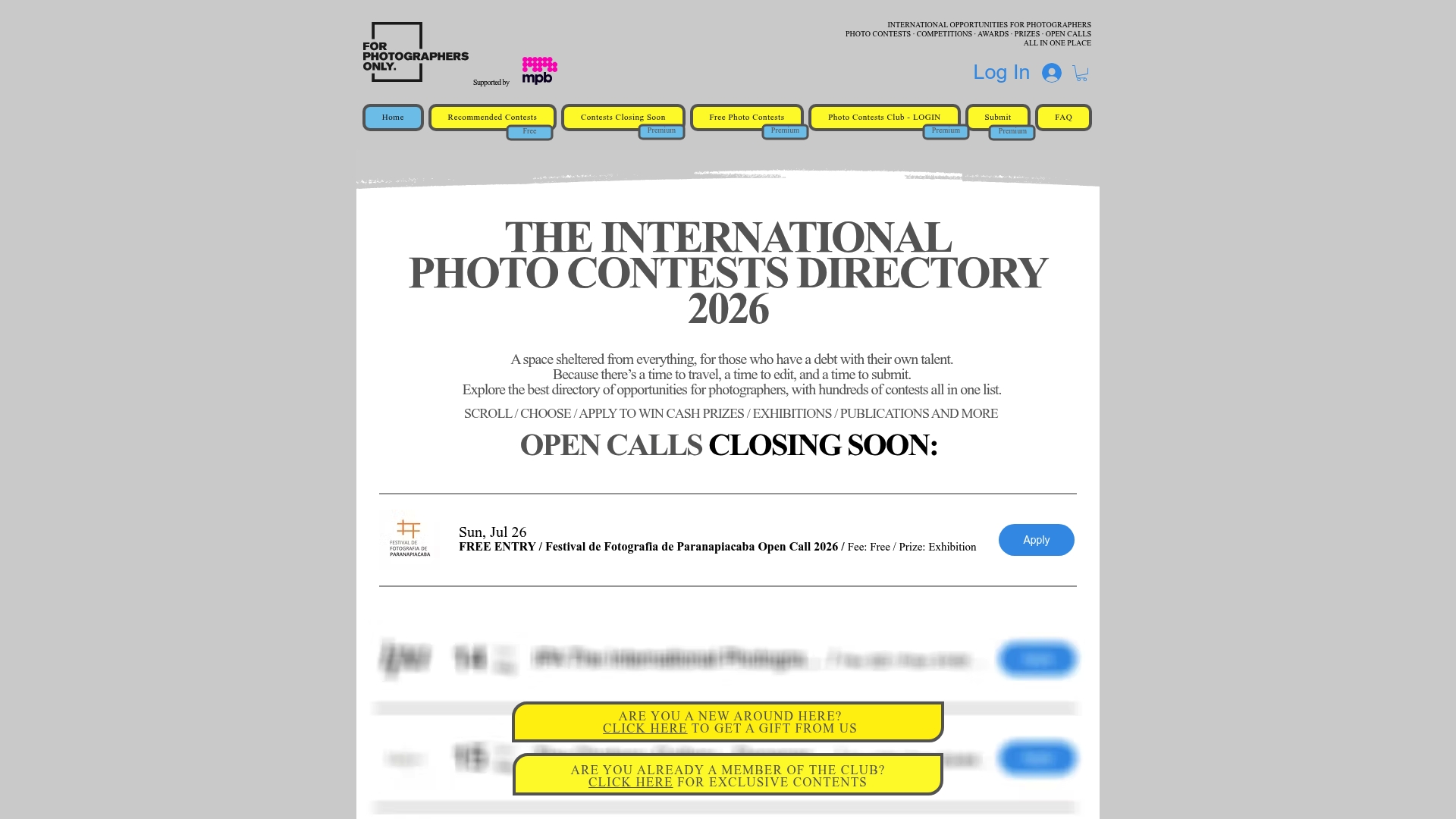
Our PhotoContestsClub is a continuously updated page of more than 320 active international photography contests, awards, calls, prizes and grants, listed chronologically with deadlines, fees, prizes and genres, and updated every week. Membership is €6 per month or €40 per year, and a free trial is offered. Members also join a photographer community and a monthly internal competition. See the plans and pricing or go straight to the contest directory.
If you prefer to browse a single opportunity first, listings such as the Houston Center for Photography fellowship awards and the Form Photo Award call show how each entry is presented.
FAQ
Is a fee waiver the same as a free contest?
No. A free contest charges nobody and needs no request. A waiver is granted to an individual who asks, usually by email, and organizers typically limit how many they approve. A discount, such as an early-bird or student rate, only reduces the fee.
Do I need to be a student to get a waiver?
Not always. Students are the most common group, as at Fairfield’s IMAGES show, but Phillips Mill and Photoville describe waivers for photographers with limited means or without access to a credit card. Others route waivers through partner organizations for specific communities. Read each contest’s rules for its criteria.
Will asking for a waiver hurt my chances of being selected?
The published rules we found treat the waiver as a separate, administrative request. Organizers who offer waivers invite them, and several state that entries are judged on the work. Keep the request short and polite, and send it before the deadline.
How early should I request a waiver?
As soon as you decide to enter. Waivers are described as limited in number, and unpaid entries are generally not accepted after the closing date. Allow a few working days for a reply and make sure any evidence an organizer asks for reaches them before the deadline.
What if the contest does not mention waivers?
Email the listed contact and ask whether any provision exists for entrants for whom the fee is a barrier. If the answer is no, look for a published discount you qualify for, or choose one of the many free-to-enter contests instead.
Sources
Recommended