Double Exposure Photo Contests: Where to Enter and What to Check

Double exposure photo contests do exist, but they are rarer than the genre’s popularity suggests. A handful of competitions run a dedicated double exposure theme. Many more accept double exposures inside a broader category, such as digital manipulation, altered reality or open. Others ban the technique outright. The skill is not only making a compelling layered image. It is matching that image to a contest whose rules actually welcome it.
This guide shows which kinds of contests accept double exposures, how the rules differ between in-camera and digital work, what entries typically cost, and how to protect your rights before you upload.
TL;DR
Dedicated double exposure contests are few. Most opportunities sit in open, digital manipulation, fine art or altered reality categories.
Rules split sharply between in-camera multiple exposures, digital compositing and collage. A technique allowed in one contest can disqualify you in the next.
Fees range from free to roughly $10 to $22 per image, so compare the cost with the prize and the image-use terms.
Read the rights clause before entering: seek a non-exclusive license, never a transfer of copyright.
A curated, weekly-updated directory saves hours of checking deadlines and rules by hand.
Table of Contents
What counts as a double exposure in a contest?
On film, a double exposure meant exposing one frame twice. Digital cameras can do this in-camera, and editing software can blend two files in layers. Contest organizers care deeply about which of these you used, because their rules are written around authenticity, not around the look of the final picture.
Three broad definitions appear again and again:
In-camera multiple exposure: several exposures recorded in a single frame by the camera’s own function.
Digital double exposure: two or more separate files blended in software, often with masks or blend modes.
Composite or collage: several images assembled into a new scene, sometimes with textures or added elements.
A contest that accepts the first may reject the second, and a contest that welcomes the third may be the natural home for your surreal portraits. Before you choose images, decide which of these three your work really is, and describe it honestly in the caption.
Contests that welcome double exposure work
Dedicated double exposure themes
The clearest example is the 35AWARDS Double Exposure contest, which accepts art portraits and surrealist compositions, including in-camera double exposures and digital compositing. Its published terms limit entries to three photos, make it free to enter, and require source images to be your own work. AI-generated images or parts are prohibited. Images should measure 1500 pixels on the longest side, carry no borders or watermarks, and avoid what the rules call mindless layering. Its rules also state that collages and composite images are not accepted, so a layered portrait needs to read as a true double exposure rather than a montage. The contest has run in seasonal editions, so check the page for the current entry window.

Digital manipulation and altered categories
Several long-established competitions give double exposure a home inside a wider category:
Black & White magazine’s Looking Back, Looking Forward contest. The 2027 edition names double exposure among the alternative digital techniques in its Digital Manipulation category. The published fee is $30 for two photographs, plus $10 for each additional image. Files are submitted as grayscale JPEGs at 300 ppi and 8 bits, 2100 pixels wide. Because the deadline for this edition falls within days, look at the contest page for the next call.
NANPA Showcase. The North American Nature Photography Association recognizes an Altered Reality category in which transformation is permitted, unlike its other categories, where no elements may be added. Our own listings cover the competition in detail: see the NANPA Nature Photography Showcase.
Nature’s Best Photography. Its guidelines permit in-camera multiple exposures as long as any manipulation is disclosed in the entry caption. We keep a listing for the Nature’s Best Photography International Awards.
Contests with conditions
Some competitions allow multiple exposures only in narrow circumstances:
The Professional Photographers of America International Photographic Competition is open to members only. Its rules allow multi-exposure images in the Landscape category when captured consecutively in the same place and time, subject to that category’s restrictions.
Close-up Photographer of the Year allows in-camera multiple exposures generally, while software-composited images and layered textures belong only in its Studio Art category.
The EuroNatur European nature contest allows multiple exposures only when the component images were taken in the same place and almost the same time, and it rejects composites built from separate images.
The Nordic Nature Photo Contest requires entrants to disclose multiple exposures and double exposures.
Contests that say no
Some organizers draw a hard line. The Vilnius Photo Circle does not accept double exposures, whether made in-camera or in post-production. Spain’s Beasaingo Hiria prohibits double exposure in its nature prize category but allows digital alteration in its Libre category, provided the photographic content stays dominant and nothing is AI-generated.
The lesson is consistent: a nature or documentary contest usually restricts the technique, while open, fine art and manipulation categories usually welcome it.
Quick comparison of the rules
Contest type | Typical stance on double exposure | What to check |
Dedicated double exposure theme | Welcomed, in-camera or digital | Own source images, no AI, no collage |
Digital manipulation category | Welcomed as an alternative technique | File specifications, caption disclosure |
Altered reality or studio art category | Welcomed, layers and textures allowed | Category definition |
Nature or wildlife categories | In-camera only, often same place and time | Disclosure, no composites |
Documentary and travel | Usually not accepted | Entire rulebook |
How to prepare a double exposure for submission
A strong layered image can still lose points on technical grounds. Work through this sequence.
Pick the category first. Match the image to the category before you edit it. NANPA advises matching the image to the category, understanding judging and eligibility, and protecting copyright before uploading.
Keep your source files. Contests such as Travel Photographer of the Year reserve the right to request original RAW files during final judging, and failing to provide them results in disqualification. Keep both layers of a double exposure, in original form.
Use only your own material. Each element should be your own photograph. Stock textures, borrowed skies and AI fill are common causes of rejection.
Resist the over-processed look. NANPA warns that over-saturation, over-sharpening, off-color images or excessive manipulation can lower scores. A double exposure succeeds when one image clarifies the other, not when the layers fight.
Size the file to the rules. Specifications vary, from 1500 pixels on the long side to 2100 pixels wide in grayscale. Export a fresh file for each contest rather than reusing one.
Write an honest caption. If the rules ask for disclosure, say whether the image is an in-camera multiple exposure or a digital blend, and what each layer is.
For a broader view of how rules about generated imagery affect layered work, read our guide on AI rules in photo contests.
What do double exposure contests cost?
Fees vary widely, and the pattern matters more than any single price. Dedicated themed contests are often free or low-cost. Prestigious magazine and association competitions charge per image. The figures below come from the organizers’ own pages.
Contest | Published fee |
35AWARDS Double Exposure | Free, up to three photos |
NANPA Showcase | $10 per image or $50 for six, membership required (2023 guidelines) |
Black & White Looking Back, Looking Forward 2027 | $30 for two photos, plus $10 per additional image |
Epson International Pano Awards 2027 |
Fees change from year to year, so confirm them on the organizer’s page. Popular Photography recommends comparing the entry fee with the prize and reading the terms that govern image use. If you are budgeting a year of entries, our guide to photo contest entry fees explains what to expect and what to pay, and our page of free photo contests is a good place to start without spending anything.
Eligibility: five things to confirm before you enter
Many disqualifications have nothing to do with image quality. Confirm these before paying a fee. Our guide to photo contest eligibility goes deeper.
Membership. Some contests are members-only. PPA’s competition is open only to members, and NANPA requires an active membership for Showcase entries.
Residency and region. EuroNatur’s contest was open to photographers whose main residence is in Europe. Audubon’s 2026 contest accepted legal residents of the 50 states, Washington, D.C., and Canada excluding Quebec.
Authorship. Images must be your own work. Surrey Photographic Association’s rules, for example, permit composite or montage images in certain categories only when every element is the photographer’s own.
Payment. In Beasaingo Hiria, entries without paid fees are not judged, and works that do not meet the stated requirements are automatically disqualified.
Image return. Beasaingo Hiria destroys entries that are neither prize-winning nor finalists after the competition, so do not submit your only copy.
Reading the rights clause
The fine print decides what happens to your image after you click submit. Organizers typically reserve some use of winning entries. TPOTY, for instance, does not claim copyright but reserves free reproduction and exhibition of entered images in connection with the awards. Beasaingo Hiria asks authors to grant rights to publish and disseminate winning and finalist images and use them to promote the contest, exhibition and future editions. NANPA’s fine-print guidance recommends seeking a reasonable, non-exclusive license rather than surrendering ownership or copyright, and an explicit promise of proper credit for any permitted use.
Two habits help. First, look for language that lets the organizer use your photograph even if you do not win. Second, check whether rights are broad enough to reproduce, modify or sublicense your work. If you shoot layered wildlife or nature imagery, the ethics of how you capture the source frames matter as well; this ethical wildlife photography guide is a thoughtful companion to the rights questions above.
How to tell a legitimate contest from a risky one
NANPA’s checklist is a reliable standard: read the prospectus and rules, verify deadlines and eligibility, check the judging criteria and the judges’ biographies, follow the technical specifications, confirm model releases where needed, and examine whether the contest asks for broad rights. A trustworthy organizer is specific. Audubon’s rules illustrate the level of detail to expect: they identify the sponsor, eligibility, entry period, fees, image requirements, judging-related conditions and prizes.

Warning signs include vague sponsors, no named judges, large fees against small prizes, and rights grabs that reach beyond promotion of the contest itself. Reputation is a screening factor too, as Popular Photography notes.
Our perspective
We do not run contests. We research, curate and publish them, and that vantage point has shaped how we think about experimental work like double exposure. The technique rewards imagination, yet the competitions that reward it are scattered across themed calls, manipulation categories and open sections, each with its own definition of what is allowed. A photographer who treats every contest as interchangeable will lose entries to rules, not to rivals.
Our advice is to build a small, deliberate plan. Choose a handful of contests whose categories honestly fit your layered work, keep your original files, caption with candor, and keep entry spending in proportion to prizes and exposure. The best contests are meeting points in the contemporary art calendar, where curators, editors and fellow artists see work that spark conversations about new ways of seeing the world. That is the exposure worth chasing, and it comes from precision more than volume.
For US-based photographers, our shortlist and directory of US photography competitions is a natural next step.
— DARIO
Find open contests without the hunt
Tracking deadlines, fees and technique rules across dozens of websites is slow work. PhotoContestsClub gathers more than 320 active international photography contests, including over 100 free to enter, on one continuously updated page, with deadlines, fees, prizes and genres listed in chronological order. It is updated every week. Membership is €6 per month or €40 per year, with a free trial available.
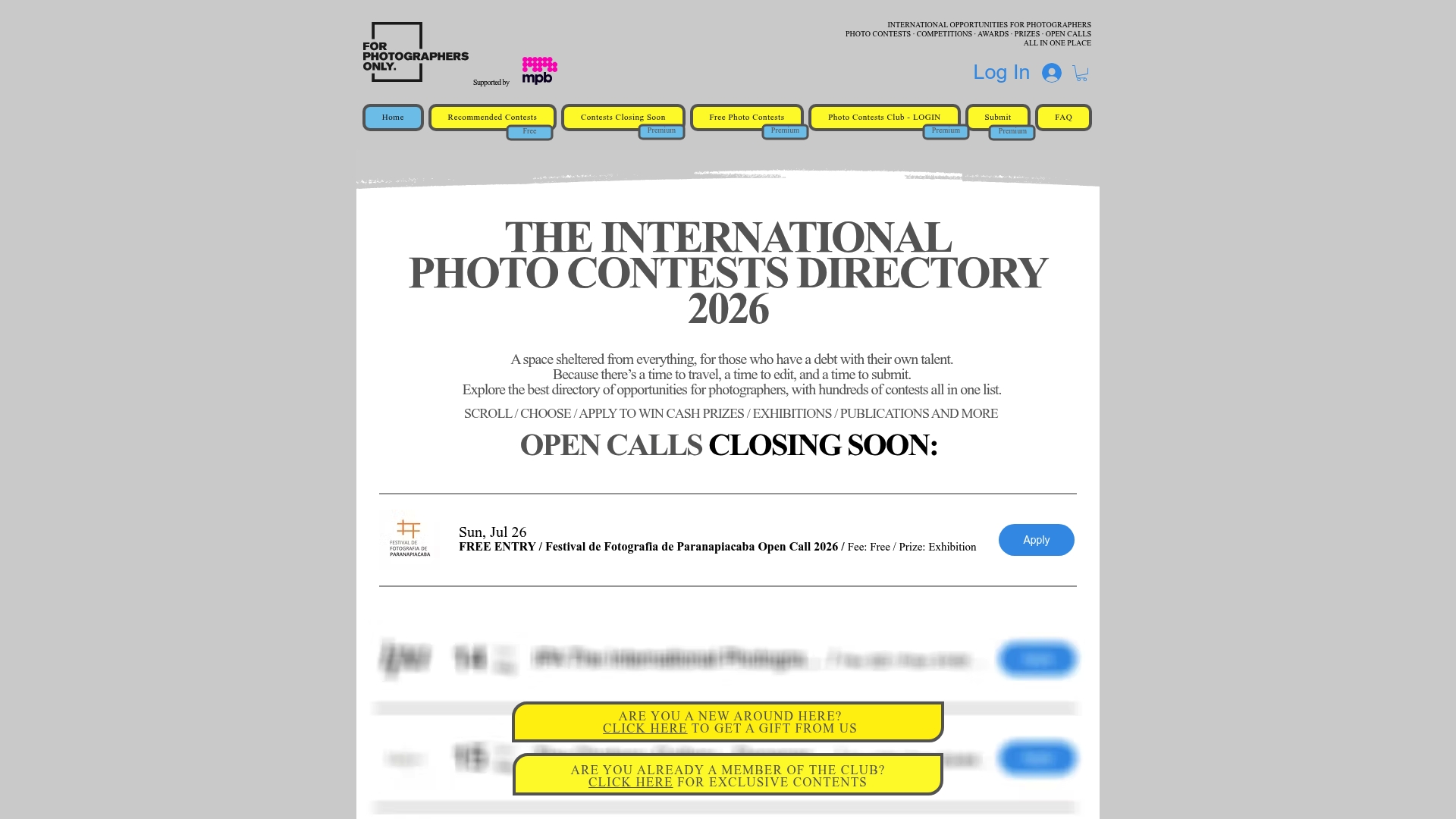
See the full list on the PhotoContestsClub page, or if you are already a member, use the renewal page.
FAQ
Are there contests only for double exposure photography?
Yes, but they are uncommon. 35AWARDS has run a dedicated Double Exposure contest that accepts both in-camera and digital work. Most other opportunities place double exposure inside categories such as digital manipulation, altered reality or open.
Can I enter a digitally blended double exposure into a nature contest?
Usually not. Many nature competitions allow only in-camera multiple exposures, often requiring the same place and almost the same time, and require disclosure. Digital blends and composites fit better in manipulation or fine art categories.
Do I need to keep my original files?
Yes. Some contests request RAW files or source images during final judging, and failure to supply them leads to disqualification. Keep every layer of a double exposure in original form.
Is it safe to enter if I do not win?
It depends on the rights clause. Some organizers reserve use of entries only for promotion of the contest, while others claim broader rights. Read the terms, look for non-exclusive licenses and credit requirements, and skip contests that ask for ownership.
Sources
Recommended