Dance Photography Competitions: Where to Enter and How to Win

Dance photography competitions are fewer and more specialized than general photo contests, but they reward exactly the work dance photographers already make: stage performances, parade street scenes, rehearsal studies and portraits of movement. Right now, the clearest U.S. options are the long-running Pas de Deux Photo competition and the annual Dance Parade Photo Contest in New York. Abroad, festivals and universities in Portugal, Mexico and Australia run calls that welcome dance imagery. Below you will find what each one asks for, what it pays, and how to read any call before you spend an entry fee.
TL;DR
Pas de Deux Photo is a U.S. dance photography competition with a contest period running from Nov. 1, 2026, to Nov. 30, 2027, so it suits photographers who want to build a series over time.
Dance Parade in New York runs an annual photo contest with cash prizes of $250, $150 and $75 in each of two categories.
Entry fees vary widely: $35 per single image at Pas de Deux, $55 per series, and free or low cost at community-based contests.
Before you enter, check three things: who may enter, what file specifications apply, and what license you grant the organizer.
A curated directory saves hours of searching, because dance calls are scattered across festivals, galleries, universities and general contests.
Table of Contents
Dance photography competitions worth entering
The table below summarizes the calls we reviewed from the organizers’ own pages. Dates and fees change from one edition to the next, so treat the figures as the most recent published terms and confirm them on the official page before you enter.
Competition | Based in | What it is | Entry cost | Recognition |
Pas de Deux Photo | United States | Dance photography competition with a long contest period | $35 per image, $55 per series | Judged awards, see terms |
Dance Parade Photo Contest | New York, United States | Two categories: Parade and DanceFest | See official page | $250, $150, $75 per category |
InShadow open call | Portugal | Festival call that includes a photography category | See the open call | Festival presentation |
Christa Cowrie contest (UNAM) | Mexico | Photography of dance in Mexico | Check the call | Recognition of dance documentation |
Josephine Ulrick and Win Schubert Photography Award (HOTA) | Australia | Photography award, not dance-only | 15 Australian dollars in 2026 | Finalist exhibition |
The first two are the most practical for readers in the United States. The others show what the international landscape looks like and where a dance series may find a second life.
Pas de Deux Photo
The Pas de Deux Photo terms and conditions describe a competition that runs from Nov. 1, 2026, through Nov. 30, 2027. Entries cost $35 per individual image, with discounted packages available, or $55 for a series. Because the window is long, you can shoot a season of recitals, company rehearsals or touring productions and then choose your strongest frames instead of rushing a single weekend’s work.
One rule matters for performance photographers: the Performance entries must show an actual performance and use its lighting, although photographer-controlled continuous lighting is allowed. In practice, that separates stage work from staged studio portraits, so decide which category your picture belongs in before you submit it.
Dance Parade Photo Contest
The Dance Parade photo contest is tied to a New York street festival and its DanceFest programming. It awards three winners in each of its two categories, Parade and DanceFest. First prize is $250, second is $150 and third is $75, and winners also receive a commemorative T-shirt or coffee mug. In the 2026 edition, file uploads closed on May 31 and winners were notified in mid-June. If the pattern holds, the call opens around the festival season and closes at the end of spring, but check the official page for the current schedule.
This is a good first dance contest. The subject is joyful and public, the categories are clear, and the prize money is meaningful for a community contest. Note that entrants sign off on the organization’s use of their images and videos for promotion, which is common for festival-linked contests.
Festivals and universities abroad
Portugal’s InShadow festival publishes an open call for 2026 that includes a photography category. Its FilmFreeway submission details are written for videodance, dance documentary and animation, so read the photography instructions carefully rather than assuming the film workflow applies.
In Mexico, UNAM’s Christa Cowrie contest aims to recognize photography of dance and the people who document and build its visual memory. The 2026 call required participants to be Mexican nationals or foreigners with legal residence in Mexico, so it is a model of what to look for rather than an open door for most U.S. photographers.
A third example comes from Ibero-America. The “Danzas en Tránsito” photography contest offered USD 1,000, USD 700 and USD 300 for first, second and third place in each category, but it was limited to residents of Ibero-American countries aged 18 and older. Calls like this tend to return, so a photographer with a body of dance work can watch for later editions.

Can photographers outside the U.S. enter?
Often yes, but never assume. Pas de Deux accepts amateur or professional photographers aged 18 or older, or the age of majority in their jurisdiction, and allows minors with parental consent. The same terms state that entry is void where prohibited or restricted by law. That last clause is easy to skip and matters if you live in a country with special rules on prize contests.
Regional calls are stricter. The Iber-Rutas and UNAM examples above tie eligibility to residence or nationality. If you are a European photographer, you will find many open international calls, but dance-specific ones often attach to a local festival and a local residency rule.
Our separate guide to photo contest eligibility walks through five checks that prevent disqualification, from age to previous publication to who owns the people and places in your frame.
Preparing your files
Dance images are often made in difficult light, so files need to survive scrutiny. Requirements differ, and two examples show the range.
Pas de Deux requires JPGs of at least 2 MB and no more than 20 MB. It recommends at least 3600 pixels on the long side at 300 dpi and specifies file-naming conventions, all in its terms.
Christa Cowrie asks for a minimum of 3200 pixels on the longest side, or 16x20 inches, sent digitally at 300 dpi, per the UNAM call.
A practical workflow follows from this. Export one master JPG at the long edge of at least 3600 pixels, then check its file size against the strictest limit you face. Rename files exactly as the organizer specifies, because a wrong filename can cost you an upload. If the contest asks for a watermarked or marked-up version, keep a clean original: our note on watermarks in photo contests explains how to make two exports and keep your original untouched.
Choosing the frame
Dance rewards timing more than most genres. The frames that tend to stand out share a few traits: a clear peak of movement, a readable gesture, controlled use of the stage light, and a background free of distractions such as exit signs or crew. For a series entry, vary scale and moment. Include a wide image that sets the space, a detail that shows texture or costume, and one decisive frame that carries the emotion.
How dance photography entries are judged
Pas de Deux publishes its first-round criteria: creativity and originality count for 40%, image quality for 40%, and story, theme and emotionality for 20%. That weighting tells you something useful. A technically perfect but familiar image has a ceiling, while an original angle or moment carries as much weight as sharpness.

Juried competitions in general are distinguished by their curated nature: panels of experts evaluate intentionality and artistic merit rather than technical skill alone, a point made in Andrew Bowen Studios’ description of juried photography competitions. For a practical rubric you can apply to your own selects, see our guide to photo contest judging criteria.
A simple self-edit before you submit:
Does the image show a single, clear idea about the dance, not just a dancer?
Is the moment of movement decisive, with limbs, fabric or hair at a deliberate point?
Is the file technically clean, with focus on the face or the leading line of the body?
Would the picture still work as a small thumbnail on a judge’s screen?
Rights and licensing: read before you pay
Dance work often includes identifiable performers, choreography and stage design, so rights questions are real. Three examples from the calls above show the range of terms.
Pas de Deux: entrants retain copyright, and winners authorize contest-related uses in perpetuity, per the terms.
Dance Parade: entrants sign off on the organization’s promotional use of their images and videos, according to the contest page.
HOTA’s Josephine Ulrick and Win Schubert Photography Award: artists retain copyright, and finalists grant a non-exclusive, royalty-free license for five years from the exhibition opening, as stated in the official terms. The 2026 entry fee was 15 Australian dollars, and submissions ran from July 6 to August 17.
The pattern is reassuring: reputable contests let you keep copyright and ask only for a license to promote the event. The details still differ in duration and scope, and perpetual authorization is a longer commitment than a five-year window. Our five-point contest checklist shows how to compare terms, and the guide on what you give up when you enter a photo covers copyright transfer in depth.
If your pictures show performers, also confirm whether you hold releases or whether the venue or company restricts photography. Dance competition and recital organizers can set their own rules for who may shoot and publish.
Prizes beyond cash
Cash is only one reason to enter. A dance series can earn a gallery wall, a festival screening or a magazine feature. Not every call pays out. DGPh’s 2026 Photo Slam call, for example, is non-competitive with no monetary prize and presents selected works on an LED wall and in an online slideshow. For a photographer building visibility among curators, that kind of presentation can still matter.
When you compare calls, weigh the following:
Cash: useful for funding the next project, but check whether it is split among categories.
Exhibition: a printed show gives you a gallery credit and sometimes a sales opportunity.
Publication: editorial visibility that you can cite in future submissions.
Portfolio credit: a shortlist or finalist mention still strengthens an artist statement.
If you are working with a series rather than single images, see our overview of portfolio photography awards, which covers options that judge a body of work.
A Perspective from our desk
Dance is one of the hardest subjects to compete with, because the best frame lasts a fraction of a second and the best opportunities are scattered. A parade contest in New York, a festival call in Lisbon and a university prize in Mexico City do not share a website, a calendar or a deadline logic. That is why we built our directory the way we did. We do not run contests; we research, curate and publish the strongest international calls in one chronological page, refreshed every week, and we mark the free-to-enter ones so that a photographer with a small budget can start without risk. Our view is that a dance photographer’s time belongs at the venue, in the edit and in the print, not in a search engine. A single reliable page of deadlines, fees, prizes and genres lets you decide quickly which calls deserve your best work, and which can wait for the next season. DARIO
Finding more dance calls without the search fatigue
Dance-only competitions are rare, which is why many dance photographers also enter genre-neutral calls that welcome movement, performance, portrait and documentary work. A well-chosen general contest may offer larger prizes and more editorial visibility than a niche one.
A reasonable strategy is to split your entries:
One or two dance-specific calls where your subject is the whole point.
Two or three open-theme or documentary calls where a strong dance series competes on storytelling.
One free-to-enter call to test a new edit at no cost.
If you are new to contests, start with photography contests for beginners or our list of amateur photo contests. When your goal is publication rather than prizes, our guide to getting published with curated contests and rights checks is the next step.
Photographers who shoot dance competitions for a living
A separate group searches for this keyword: photographers who shoot at dance competitions as event work, with pre-orders, on-site previews and online delivery for dancers and families. That is a service business, not a contest, and the demands are different: long days, fast turnaround and consistent quality across hundreds of routines. Entering photo contests with the best of that work is a practical way to show your artistic range beyond the sales gallery, and a dance series made outside the event setting can open doors to editorial and gallery audiences.
A short entry plan
List your best dance work from the last twelve months and group it into singles and potential series.
Check eligibility for age, residence and previous publication.
Compare fees and prizes. A $35 single entry is a different bet than a free call, so budget your total for the season.
Prepare master files at the strictest size and resolution you will meet, then rename them per each call.
Read the rights clause and note the length of any license.
Calendar the deadlines, with a buffer for upload problems, and confirm each date on the official page.
Keep every dance call in one place
The Photo Contests Club on our site gives you one continuously updated page of 320 to 330 active international contests, awards, calls, prizes and grants, with more than 100 free to enter. Each listing shows deadlines, fees, prizes and genres, and the page is refreshed every week. Membership is €6 per month or €40 per year, a free trial is offered, and members also get a photographer community and a monthly internal competition.
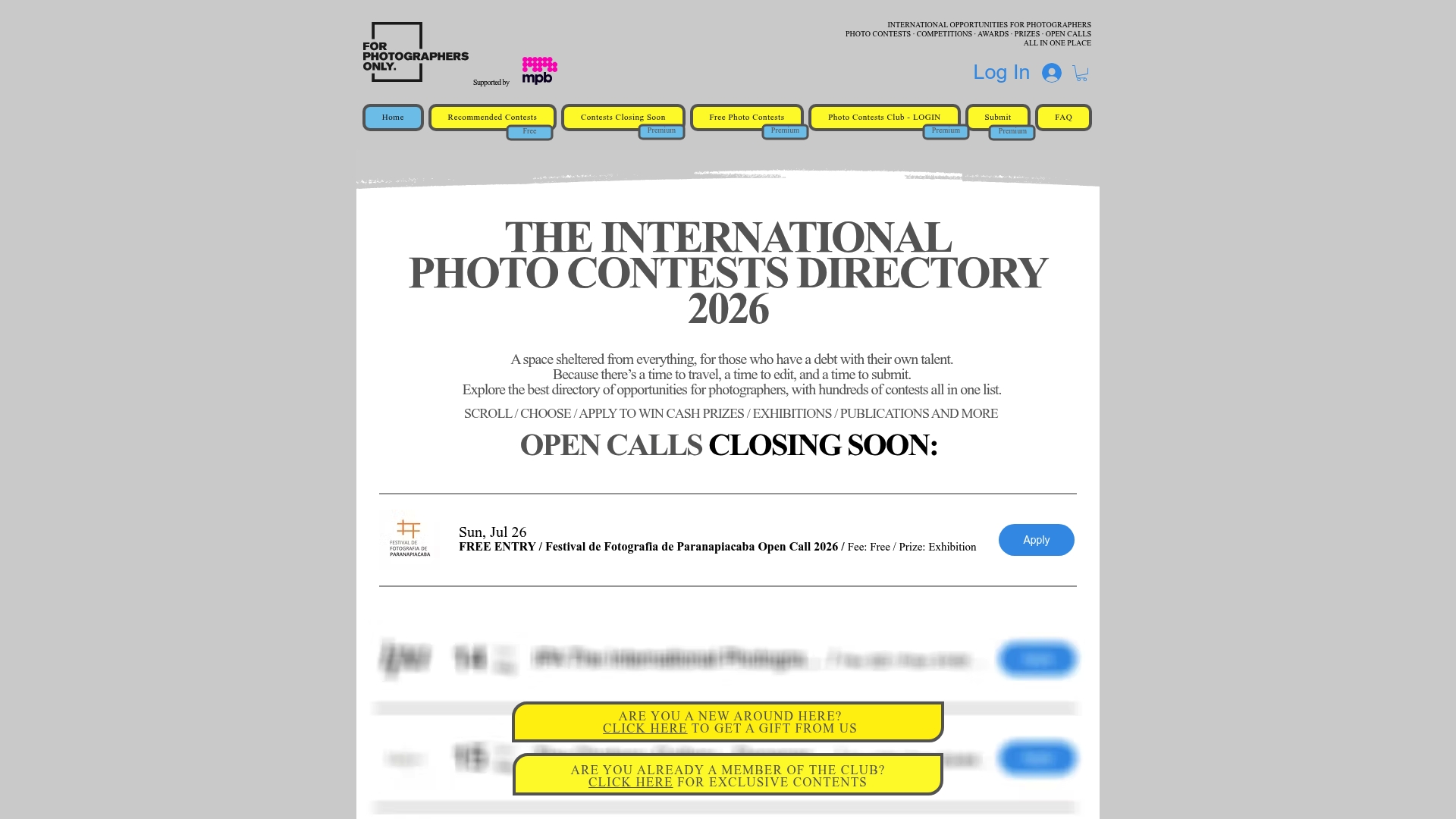
If you would rather compare before you commit, see the plans and pricing or open the PhotoContestsClub page to start your search for the next dance call.
FAQ
Are there free dance photography competitions?
Yes, though fees are common in dance-specific calls. Pas de Deux charges $35 per image, so budget for it. Our directory flags the more than 100 free-to-enter contests in the listings, and many general calls welcome dance and performance work at no cost.
Can I enter if I am under 18?
It depends on the contest. Pas de Deux accepts minors with parental consent, and adults must be 18 or the age of majority where they live. Other calls, such as the Ibero-American contest above, required entrants to be 18 or older, so read the eligibility clause every time.
Do I keep the copyright to my dance photos?
In the terms we reviewed, yes. Pas de Deux entrants retain copyright, and HOTA states that artists retain absolute copyright. The organizers ask for a license to promote the contest, and the length and scope vary, so check the clause before paying.
What file size should I prepare?
Aim for a JPG with the long side of at least 3600 pixels at 300 dpi. That meets Pas de Deux’s recommendation and exceeds the 3200-pixel minimum in the UNAM call. Then confirm the file size range and naming rules for each contest.
When do dance photo contests open and close?
Schedules differ. Pas de Deux has a long contest period through Nov. 30, 2027, while Dance Parade’s 2026 uploads closed on May 31. Check each organizer’s page for the current dates, since they change by edition.
Sources
Recommended