For Photographers: Creative Photo Awards for Exhibitions & Mentorships
Creative photography awards are international contests built to reward conceptual, manipulated, and fine-art imagery rather than straight documentary or news work. They suit photographers with an idea-led series, a distinctive visual voice, or a single image that pushes past technical competence into genuine artistic risk. If your portfolio leans experimental, the right entry can bring exhibition slots, mentorships, and press exposure that outlast any cash prize.
TL;DR:
Winning entries often demonstrate sustained conceptual thinking and cohesive narratives rather than isolated strong images, which juries prioritize.
Submission files must adhere strictly to technical specifications, with polished presentation indicating professionalism and seriousness.
The most valuable awards provide exposure through exhibitions and press, which can boost long-term career opportunities beyond immediate prize money.
Entry fees should be weighed against potential exposure, licensing terms, and how well the contest aligns with your artistic goals and style.
Prior research of past winners and judging panels ensures your work matches the contest’s aesthetic and conceptual preferences, increasing your chances of success.
Table of Contents
What Are Creative Photography Awards and How Do They Work?
Most creative-category contests split entries into recognizable buckets: fine art, manipulated or composite imagery, mixed media, and a broader open/creative division for work that resists easy labeling. Juries typically weigh three things: conceptual strength, narrative cohesion across a body of work, and technical execution that serves the idea rather than showing off for its own sake.
Prize structures vary widely, but the strongest awards bundle more than a check.
Cash prizes, ranging from a few hundred dollars to several thousand for top honors
Camera or lens equipment from sponsoring manufacturers
Paid commissions or assignments tied to the awarding organization
Mentorship sessions with established photographers or curators
Physical exhibition slots at festivals or galleries
Before submitting anywhere, read the usage and copyright clause closely. Reputable competitions ask only for a limited license to display and promote winning work; anything demanding broader rights transfer deserves a second look. Entry logistics tend to follow a familiar rhythm: fees per image or series, specific file resolution and color profile requirements, a submission deadline, and a judging window of several weeks to a few months before results post.
A Curated Shortlist of Notable Creative Photography Awards
Photographers chasing recognition for conceptual or manipulated work have a handful of contests worth prioritizing over the hundreds of generic competitions online.
Creative Photo Awards (Siena Awards): This is the flagship program for the term itself, running a Creative category with multiple subcategories and crowning an overall Creative Photographer of the Year. Winners get displayed in curated exhibitions across the festival’s touring territory, and the standout benefit is the Pangea Prize, a cross-category honor recognized alongside the main awards ceremony held in Siena, Italy. Eligibility is open internationally, and the fee structure follows a per-image or per-series model tied to a set annual deadline window.
LensCulture Art Photography Awards: Built for visionary, experimental work, this program emphasizes publication and festival exhibition over pure cash value. Winners in both series and single-image categories receive broad press and international festival exposure, including exhibition in New York. The entry process favors photographers who can articulate a clear artistic thesis, not just strong individual frames.
Sony World Photography Awards (Creative and Open categories): The Open competition includes creative and category-based divisions with some of the largest exhibition platforms in the industry. Winners have shown at Somerset House in London alongside sizeable cash prizes and global press pickup, making this one of the highest-visibility options for photographers willing to compete against a large international pool.
Fine Art Photography Awards (FAPA): Positioned squarely for fine-art practitioners, FAPA lists clear category deadlines and cash prizes for both professional and amateur divisions, with international eligibility and a fee scaled to category count.
MUSE Photography Awards: A fine-art-oriented program with categories spanning conceptual, abstract, and manipulated work, MUSE fits photographers looking for a mid-tier entry point before targeting the largest international stages.
How to Choose Which Creative Contests to Enter
Start with your actual goal, not the contest’s prestige. A photographer chasing gallery representation should prioritize exhibition-heavy awards over cash-only competitions; someone building a book deal or magazine pitch benefits more from publication-focused programs like LensCulture.
Match the prize structure to your career goal: exhibition, cash, publication, or mentorship
Research the jury and look at where past winners’ careers went afterward
Weigh the entry fee against the realistic exposure and licensing terms
Account for logistics: exhibition travel, print production requirements, and how the timeline fits your calendar
Jury credibility matters more than most photographers assume. A panel stacked with working curators and gallerists tends to reward work that photo editors also respond to, which is why checking a contest’s judging criteria before entering saves both money and disappointment.
Pro Tip: Search past winner galleries before you submit. If your work doesn’t visually rhyme with anything the jury has rewarded in the last two cycles, save the entry fee for a better-matched contest.
Judge-Backed Tips for a Competitive Creative Entry
Judges at high-level competitions consistently reward projects that show sustained thinking, not one strong frame surrounded by weaker ones.
Submit a cohesive series when the category allows it. A body of work with a clear visual or conceptual thread outperforms a scattered set of unrelated strong images, because juries prioritize narrative sustainment over isolated technical wins.
Prepare files exactly to spec. Correct resolution, color profile, and file naming aren’t formalities. Sloppy prep signals a rushed entry before a judge even studies the image.
Write a tight artist statement. Statements in the 100 to 150 word range that clearly state concept, method, and stakes consistently outperform long, diffuse explanations that bury the point.
Stagger your submissions across deadlines. Adapt single strong images for open categories while saving your tightest series for programs built around narrative work, and track multiple deadlines so you’re never rushing a submission at midnight.
Why Awards Matter Beyond the Prize Money
The most useful thing an award can offer is often invisible on the prize list itself. Some festivals curate full exhibitions from the entire submission pool, not only the winners circle.
Images that don’t win a prize can still be selected for exhibition across a festival’s touring territory. Entering, by itself, increases your odds of public exposure well beyond whatever the winners list shows.
That single fact changes how photographers should think about entry fees. A mentorship or a paid commission bundled into a prize package can carry more career weight than a one-time check, since it creates an ongoing relationship rather than a single transaction. For Photographers Only tracks roughly 320 to 330 active contests at any given time, including more than 100 free-to-enter opportunities, precisely because sorting signal from noise across hundreds of competitions eats hours most working photographers don’t have.
History and Background of the Creative Photo Awards
The Creative Photo Awards grew out of the Siena International Photo Awards, one of the longer-running festival competitions built around fine-art and conceptual photography rather than photojournalism. Siena established itself as a photography destination by pairing an annual awards ceremony with touring exhibitions, giving the festival a physical presence beyond a website and a winners announcement.
The Creative category emerged as photography itself shifted. As digital manipulation, composite imagery, and mixed-media techniques became mainstream tools rather than novelties, general photo contests struggled to judge conceptual work against documentary work using the same criteria. A landscape photograph and a heavily composited fine-art piece don’t compete fairly on the same rubric, and Siena’s organizers built a dedicated Creative division to solve exactly that problem.
The Pangea Prize followed as a cross-category recognition, meant to single out a body of work that transcends anyone subcategory’s boundaries. Today, the Creative Photo Awards function as a benchmark for what an international jury considers strong conceptual and fine-art work, and the award’s exhibition program has become as central to its reputation as the cash prizes themselves. Photographers researching where creative photography competitions come from will find Siena referenced constantly, because it helped define the category before other major contests followed with their own creative divisions.
Notable Past Winners and Their Work
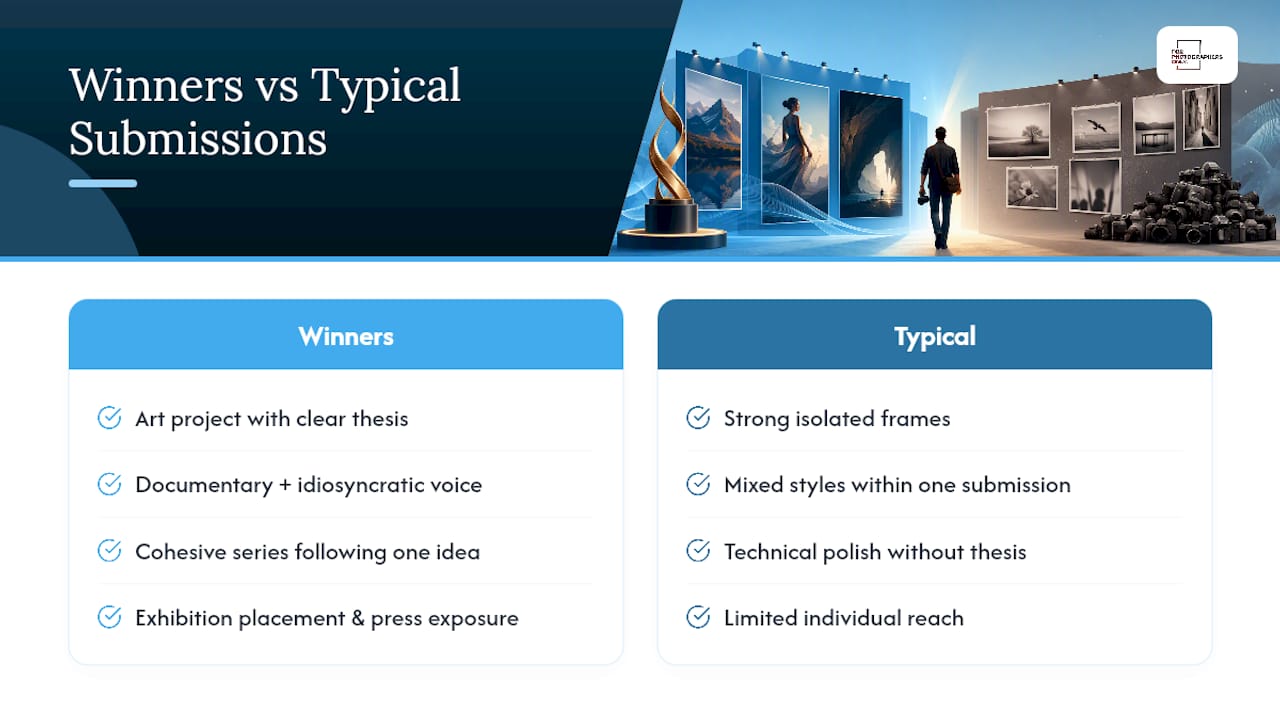
Winning entries in creative photography awards tend to share a trait that separates them from typical contest submissions: they read as art projects with a clear thesis, not as portfolios of unrelated strong frames. Retrospective looks at award-winning work from programs like LensCulture show that submissions blending documentary instincts with an idiosyncratic artistic voice tend to stand out most consistently to international juries, precisely because that combination is harder to fake than technical polish alone.
Sony World Photography Awards winners in Open and Creative divisions have ranged from heavily composited surreal imagery to stark single-frame conceptual work, and the 2026 overall winners received exhibition placement that put their work in front of gallery visitors and press outlets far beyond what a typical photographer’s individual reach could achieve. That exposure pattern repeats across the major creative-focused contests: winning work gets curated into physical shows, discussed in photography press, and used by the photographer as career-defining proof of concept for years afterward.
What separates a memorable winner from a forgettable one usually isn’t raw technical skill. It’s whether the work commits fully to an idea and follows it through a series, rather than hedging with a mix of styles inside one submission. Photographers studying past winner galleries before entering their own work will notice this pattern more than any single stylistic trend.
Benefits of Winning Beyond the Prize Itself
Cash is the easiest benefit to quantify, and also the least durable one. Networking access, exhibition history, and press mentions compound over a career in ways a check doesn’t.
A juried win puts a photographer’s name in front of curators, editors, and gallerists who might never have seen the work otherwise, and that introduction often outlasts the contest cycle itself. Exhibition placement, whether at a major festival or a smaller touring show, gives photographers a concrete credential to reference in gallery pitches, grant applications, and artist bios for years. Mentorship components, when a prize package includes them, create a working relationship with an established figure in the industry, and that relationship frequently produces more career opportunities than the original prize did.
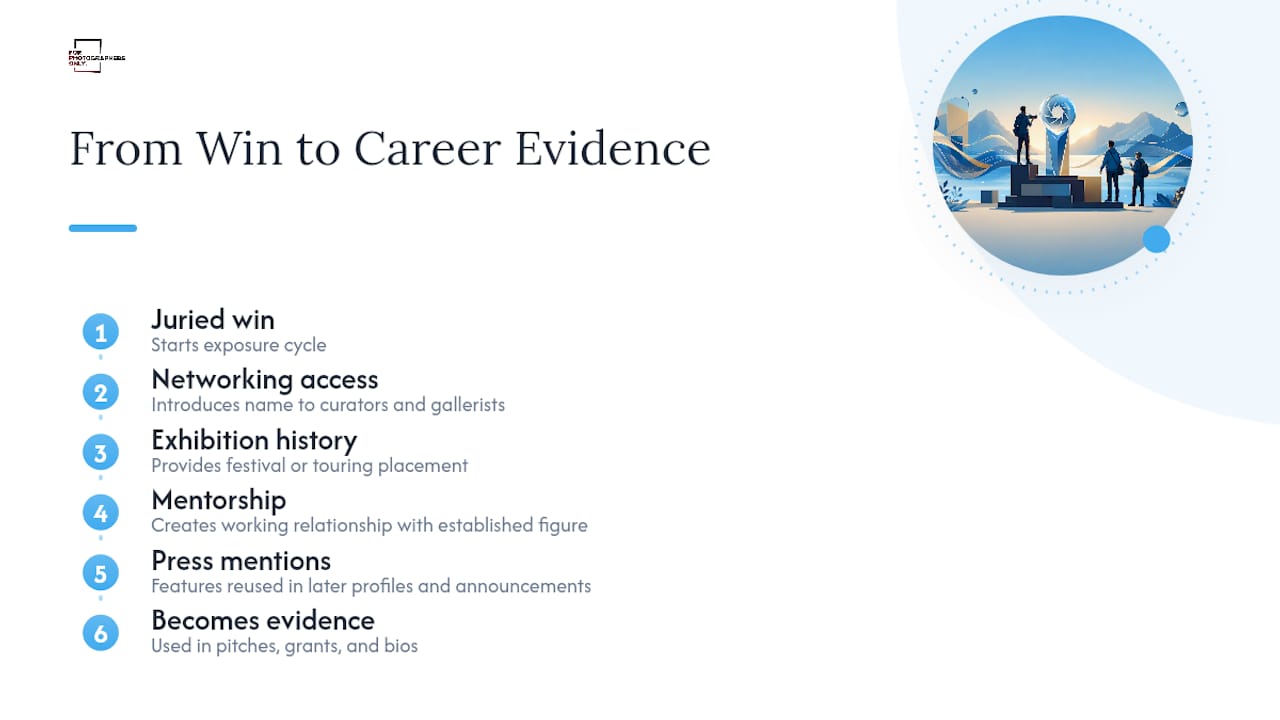
Press coverage tied to award wins also has a longer shelf life than most photographers expect. A feature tied to a Sony World or LensCulture win tends to get referenced in later profile pieces, gallery announcements, and even future contest bios, compounding the original exposure well past the initial announcement. None of this replaces steady client work or gallery representation, but it accelerates the path toward both, which is exactly why photographers building long-term careers treat award wins as career infrastructure rather than a one-time payout.
A Working Philosophy for Choosing and Preparing Entries
Enter the contest whose jury and prize structure match your actual next career step, not the one with the biggest name attached. A photographer chasing gallery representation gains more from an exhibition-heavy award than a cash-only one with a bigger check attached.
— DARIO
Find and Track Creative Awards Without the Guesswork
Forphotographersonly exists because sorting signal from noise across hundreds of contests shouldn’t cost photographers a weekend every month. The PhotoContestsClub subscription gives you one continuously updated page listing roughly 320 to 330 active international competitions, filterable down to the more than 100 free-to-enter options, so you can match a specific series to a specific contest instead of scrolling scattered festival websites one by one.
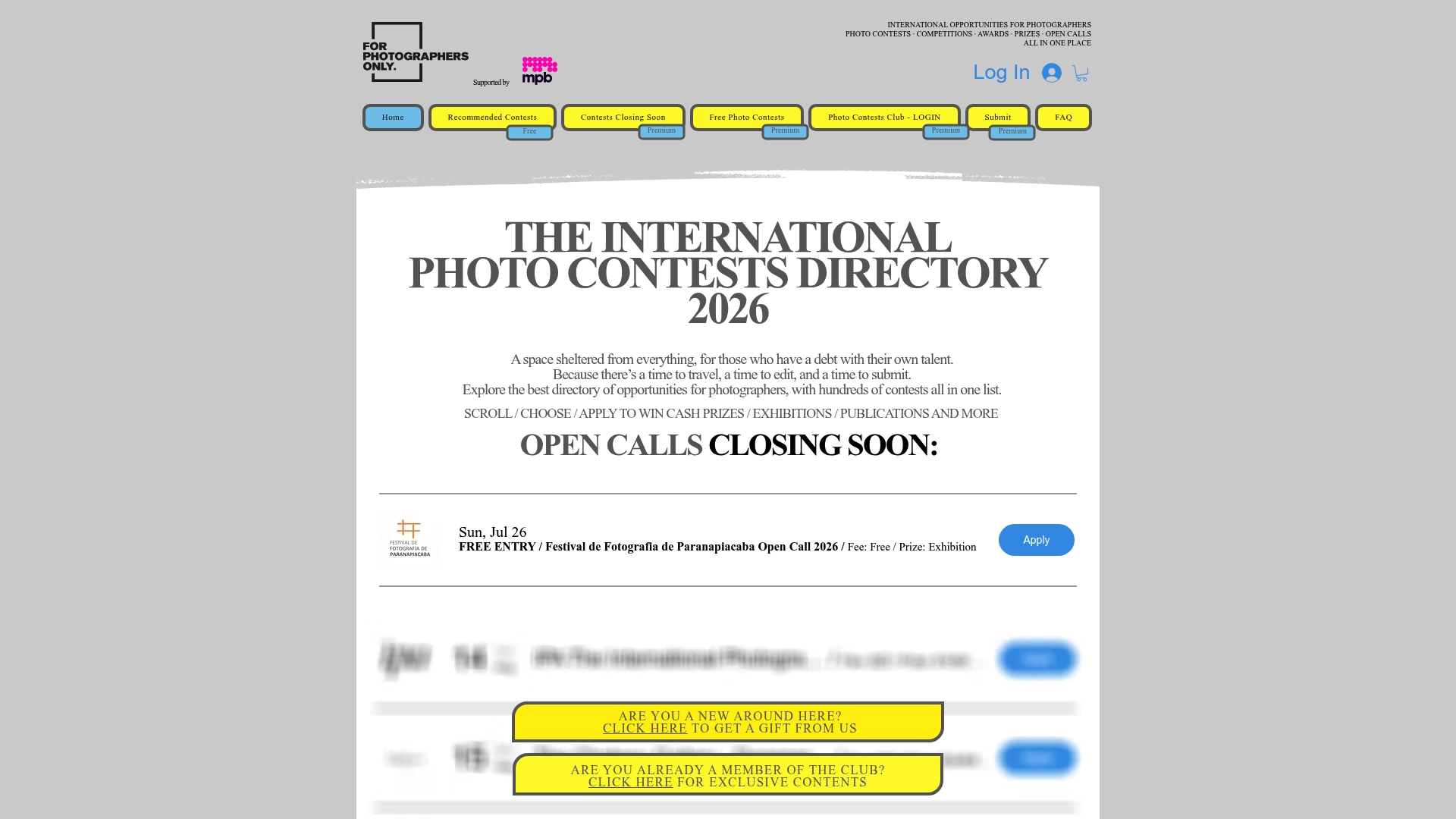
New listings post weekly, which matters most for creative and fine-art categories where deadlines cluster unpredictably across the calendar year. Instead of bookmarking a dozen contest homepages and checking each one manually, you scan a single curated list built specifically to surface opportunities like the Creative Photo Awards alongside smaller, lesser-known competitions worth your entry fee. Access runs $6 per month or $40 per year through the contests directory. Start there, filter to your category, and enter your strongest series before the next deadline closes.
Sources
FAQ
What Are the Top Photography Awards Worth Entering?
There’s no single definitive top ten, but the most consistently valuable creative-focused options include the Creative Photo Awards, LensCulture Art Photography Awards, and Sony World Photography Awards’ Open and Creative categories. Forphotographersonly’s contest directory tracks these alongside hundreds of other active options, updated weekly.
What Is the Most Prestigious Photography Award?
Prestige depends on category and goal rather than one universal answer, but the Sony World Photography Awards and Siena’s Creative Photo Awards both carry heavy international weight for creative and fine-art work. Both offer major exhibition placement that extends a winner’s visibility well past the announcement date.
What Is the 20 60 20 Rule in Photography?
This isn’t a recognized judging standard used by major creative photography awards, and definitions of it vary widely across photography forums and blogs. Rather than apply an unverified rule, focus on the criteria juries actually publish: concept, narrative cohesion, and technical execution.
What Are the Best Photo Contests to Enter in 2026?
The strongest 2026 picks for creative and conceptual work remain the Creative Photo Awards, LensCulture’s Art Photography Awards, and Sony World’s Open and Creative divisions, each offering exhibition or publication benefits beyond cash. For a fuller, continuously updated list matched to your specific genre, Forphotographersonly’s contests page filters by deadline, fee, and free-entry status.
How Do I Know if My Work Fits a Creative Category?
If your images rely on conceptual intent, manipulation, or a cohesive artistic thesis rather than documentary accuracy, they belong in creative or fine-art divisions rather than general photojournalism categories. Reviewing a contest’s judging rubric before submitting clarifies which category actually fits your series.
Recommended