Corporate Photo Contests: How Brand-Sponsored Competitions Work

Corporate photo contests are competitions run or funded by a company, brand or foundation, usually to gather compelling imagery around a theme, celebrate a cause or promote a product. For photographers they offer cash, equipment, commissions, exhibitions and editorial visibility. They also come with rules about rights, eligibility and file specifications that deserve a careful read before you press submit. This guide explains how these contests work, what the sponsors seek, and how to decide which ones deserve your strongest frames.
TL;DR
A corporate photo contest is sponsored by a brand or company, and its theme and prizes reflect that sponsor’s identity, from camera makers to wine houses to sustainability groups.
Prizes range from equipment and cash to paid commissions, gallery shows and publication, but fees, age limits and residence rules differ from contest to contest.
The most important line in any set of rules is the rights clause: some contests keep your copyright with you and license limited uses, while others ask for a broad, perpetual license.
Match the sponsor’s theme to work you already have, and read the technical requirements (file type, size, EXIF data, releases) before the deadline week.
A curated, chronological list of verified contests saves research time and helps you plan a year of entries.
Table of Contents
What counts as a corporate photo contest
A corporate photo contest has a business, brand or institution behind it, rather than a magazine, festival or independent collective. The sponsor may be a camera manufacturer, a beverage producer, a cosmetics group, an industry association or a nonprofit with corporate backing. The contest serves the sponsor’s goals: it builds a library of images, reinforces a mission, or connects the brand with the visual culture it cares about.
That difference shapes everything a photographer experiences. Themes are tied to the sponsor’s story. Prizes often involve the sponsor’s own products or events. The rules tend to be long, because the sponsor is a legal entity protecting its brand. And the exposure can be considerable, since a global company can place winning images in front of audiences that a small gallery call cannot reach.
Corporate contests sit alongside other categories you will meet on the same calendar: museum prizes, festival calls for entries, magazine awards and grants. Many photographers enter across all of them. What sets corporate contests apart is the commercial context, and that is worth understanding before you decide where to send your work.

The kinds of sponsors you will meet
Camera and imaging brands
Equipment makers run some of the best-known competitions in the field. The Sony World Photography Awards, organized by the World Photography Organisation, are free to enter. The Series competition accepts five to ten images and offers a $25,000 prize, Sony equipment, a solo exhibition and international media exposure. The Single Image competition offers $5,000, digital imaging equipment and international exposure, while the Student and Youth categories award equipment and global visibility.
Other brand-run contests are narrower. One US contest run in connection with Sony cameras requires that the photo be captured with a Sony camera during the contest period, with EXIF data embedded to prove it. That kind of condition is common when a manufacturer wants to showcase what its products can do.

Food, wine and lifestyle companies
Beverage and lifestyle brands often choose a theme that expresses their heritage. Dow’s fourth Black and White Photography Competition, announced by Symington Family Estates, uses the theme “Generations”, inviting monochrome interpretations of human relationships, time, memory, heritage, tradition and modernity. Entry is free and open worldwide to anyone over 18 with access to a camera. Prizes include a photographic experience in the Douro Valley, Port and a photography book, and shortlisted photographers are featured in a Porto exhibition and a commemorative book. Check the official page for the current entry window, since it changes with each edition.
Sustainability and industry organizations
Some of the most meaningful corporate contests come from industry bodies with a mission. The 2026 competition from Textile Exchange, in partnership with Atmos, sought photographers and filmmakers documenting regeneration in fashion, textiles and apparel. The overall winner received a $10,000 paid commission, publication and exhibition at the 2026 Textile Exchange Conference, and two runners-up received $2,000 each. A prize like that is closer to a professional assignment than a trophy, and it rewards photographers who can tell a story with documentary rigor.
Beauty and cause-driven campaigns
Corporate sponsors also fund contests built around a cause. The Estée Lauder Companies Pink Ribbon Photo Award 2026 accepted one photograph and a text of about 200 words from professional, amateur and student photographers of any nationality or residence, with the text relating to raising awareness about the fight against breast cancer. The Grand Prix du Jury was €10,000, and winners were announced at a ceremony during Paris Photo. The pairing of image and text is a good reminder that some sponsors want a point of view, not just a beautiful picture.
What corporate contests typically want to see
Themes fall into three broad groups.
Open genre categories. Large awards divide entries into familiar fields. The North American Nature Photography Association lists wildlife, birding, landscape, travel, portrait, monochrome, photojournalism, conservation, architecture, sports, macro, street, astrophotography and drone themes among the genres found across contests.
Sponsor-specific themes. A single idea, such as heritage or regeneration, interpreted through the sponsor’s lens. These reward photographers with a coherent body of work or the flexibility to shoot something new.
Product-linked briefs. The image must be made with a certain camera, or during a certain period, to prove the equipment’s capability.
NANPA’s guidance notes that themed competitions can help you curate existing work more objectively, and can prompt fresh shooting ideas when no image in your archive fits the brief. Both outcomes are valuable. A theme that sends you back into your archive often reveals a series you had not recognized, and a theme that sends you out with a camera keeps your practice moving.
Who can enter: eligibility to check first
Eligibility is where many entries fail before a judge ever sees them. Typical conditions include:
Age. Dow’s competition requires entrants to be over 18. The Taylor Wessing Photo Portrait Prize 2026, from the National Portrait Gallery in London, accepts photographers aged 18 or older. Youth categories reverse the logic: the Sony Youth competition requires entrants to be 19 or under on the closing date.
Residence and nationality. Some contests are worldwide. Others, like the US Sony-camera contest, apply age and residence limits.
Equipment and image date. Brand contests may require a specific camera or insist the picture be taken within the contest window.
Sponsor-related exclusions. Employees of the sponsor and their relatives are commonly excluded.
Professional status. The Pink Ribbon Photo Award welcomed professional, amateur and student photographers alike, which is typical of cause-driven campaigns.
For American photographers, a US-only contest may offer better odds because the pool is smaller. European photographers should note that many corporate contests based in Europe accept entries from anywhere, but a few restrict eligibility by region, so check the official rules each year.
How to submit: files, captions and releases
Technical requirements vary, but the same few items recur.
Requirement | Example from published rules |
File format | The US Sony-camera contest required JPEG or TIFF with EXIF data embedded |
File size and color space | Sony Youth images should be 1 to 5 MB in sRGB; Nature’s Best 2025 required JPEGs in RGB/sRGB between 500 KB and 3 MB |
Number of images | Sony Youth allows up to three; the Taylor Wessing prize 2026 allowed up to six; Series entries at Sony take five to ten |
Captions and camera data | Nature’s Best asked advancing entrants for captions and camera information, and for RAW files from DSLR or mirrorless entrants reaching the second round |
Releases | Required on request in the Sony-camera contest; required from selected exhibitors in the Taylor Wessing prize where models or minors appear |
Computer-generated content | Sony Youth states that computer-generated content cannot be the source image |
Two habits save a lot of stress. First, keep a master folder for each contest with correctly sized exports, a caption file and signed releases, so you are never rebuilding files on deadline day. Second, keep your RAW files and original metadata intact: several contests request them if you advance.
Entry fees, prizes and what you actually gain
Costs range from nothing to a modest fee. Sony’s awards and Dow’s competition are free to enter. Nature’s Best’s 2025 adult entry cost $30 for up to 25 images, with free youth entry. Fees often follow the number of images, so a smaller, tighter submission can be the efficient choice.
Prizes fall into four types:
Cash. Awards such as the €10,000 Grand Prix du Jury at the Pink Ribbon Photo Award or $5,000 for a Single Image win.
Equipment. Cameras, lenses and lighting from the sponsor.
Commissions. A paid assignment, like the $10,000 commission offered by Textile Exchange.
Visibility. Exhibitions, printed books and publication. A Porto exhibition, a conference showcase or a Paris Photo ceremony places your name among curators, editors and collectors.
That last category is often worth more than the cash. A shortlist credit from a respected sponsor strengthens a portfolio, a biography and a grant application. If you want to present those credits well, it helps to think about building a professional reputation through consistent, accurate communication of your achievements.
Rights: the clause that matters most
Every photographer should read the rights section line by line. Two published examples show how different the terms can be.
The US Sony-camera contest rules require the winner to grant an irrevocable, worldwide, royalty-free, sublicensable license for commercial use forever and to waive moral rights. That is a broad grant, and it suits only photographers who are comfortable with the sponsor using the image as it wishes.
By contrast, World Photography Organisation rules state that entrants retain copyright while granting a worldwide, non-exclusive, irrevocable license for up to three years for judging, exhibitions, books, websites, magazines, event promotion and related press use. Some gallery-device uses may remain perpetual and royalty-free, so exceptions deserve attention. It is a relatively bounded model: your copyright stays with you, and the promotional rights are licensed for a defined period and stated purposes.
A short checklist before you submit:
Does copyright remain with you?
Is the license exclusive or non-exclusive?
How long does it last, and does it apply to all entrants or only winners?
Which uses are covered: promotion of the contest only, or the sponsor’s commercial products too?
Do you hold releases for every identifiable person and any restricted property?
Is moral rights waiver required?
If an image is already earmarked for a book, a gallery contract or a stock agency, choose a contest whose license fits that plan.
Choosing which contests to enter
A smart entry strategy is selective. Corporate contests can draw large numbers of entries, so your time is best spent where the theme, the rights and the prize align with your goals.
Start with the work. Audit your archive and group images into series. Then look for contests whose themes match what you already have.
Weigh the prize against your goal. An emerging photographer building credits may prefer exhibition and publication. A working professional may value a paid commission.
Read the judging context. Know who the sponsor is and what visual culture it champions. Judges respond to work that understands the brief and still feels personal.
Budget for fees. Free contests are a smart foundation of any annual plan. Pay fees only when the prize and the exposure justify them.
Plan by calendar. Many corporate contests return annually, so you can predict next year’s cycle and build new work for it.
The curated list at For Photographers Only is organized to make this kind of planning simple. You can also browse individual examples on the site, such as the BBA Prizes & Gallery Photography Prize 2026 and the Photography 4 Humanity listing, to see how details like deadlines, fees and prizes are presented.
Photographers rarely lack talent. What they lack is time, and the hours spent hunting for the right competition are hours not spent shooting, editing or building a series. That is why we do not organize contests ourselves. We research, curate and publish international competitions from world-renowned brands and institutions such as Nikon, Canon, Leica and National Geographic, alongside niche contests and independent festivals that are often overlooked despite exceptional value. Corporate contests are meeting points in the contemporary art calendar: places where a brand’s story and a photographer’s vision can spark conversation. We believe the best way to approach them is with a plan. A single, chronological page of more than 320 active opportunities, including over 100 free-to-enter competitions and updated every week, lets you see the year at a glance, match themes to your portfolio and enter with confidence. Our mission is to make the best international opportunities easy to discover, accessible and organized in one place, so that emerging and established photographers can focus on the work that earns recognition. DARIO
Our perspective
Make your yearly contest plan
Here is a practical routine that keeps entries organized without consuming your calendar.
Monthly: review new listings, noting deadlines, fees, prizes and genres.
Quarterly: revisit your portfolio and pick two or three series to prepare for the coming round of contests.
Before each entry: read the rules for eligibility and the rights clause, confirm file specs, and prepare releases.
After each result: record outcomes and feedback, and update your biography with any shortlist or award credit.
Because many contests are annual, a spreadsheet of last year’s themes gives you a head start. Sponsors tend to keep a recognizable visual direction, so you can often anticipate what they will want to see next. If you are also looking for places to publish work outside competitions, the site’s contemporary photography resources and its list of 45+ contemporary art and photography websites can widen your reach.
Find verified contests in one place
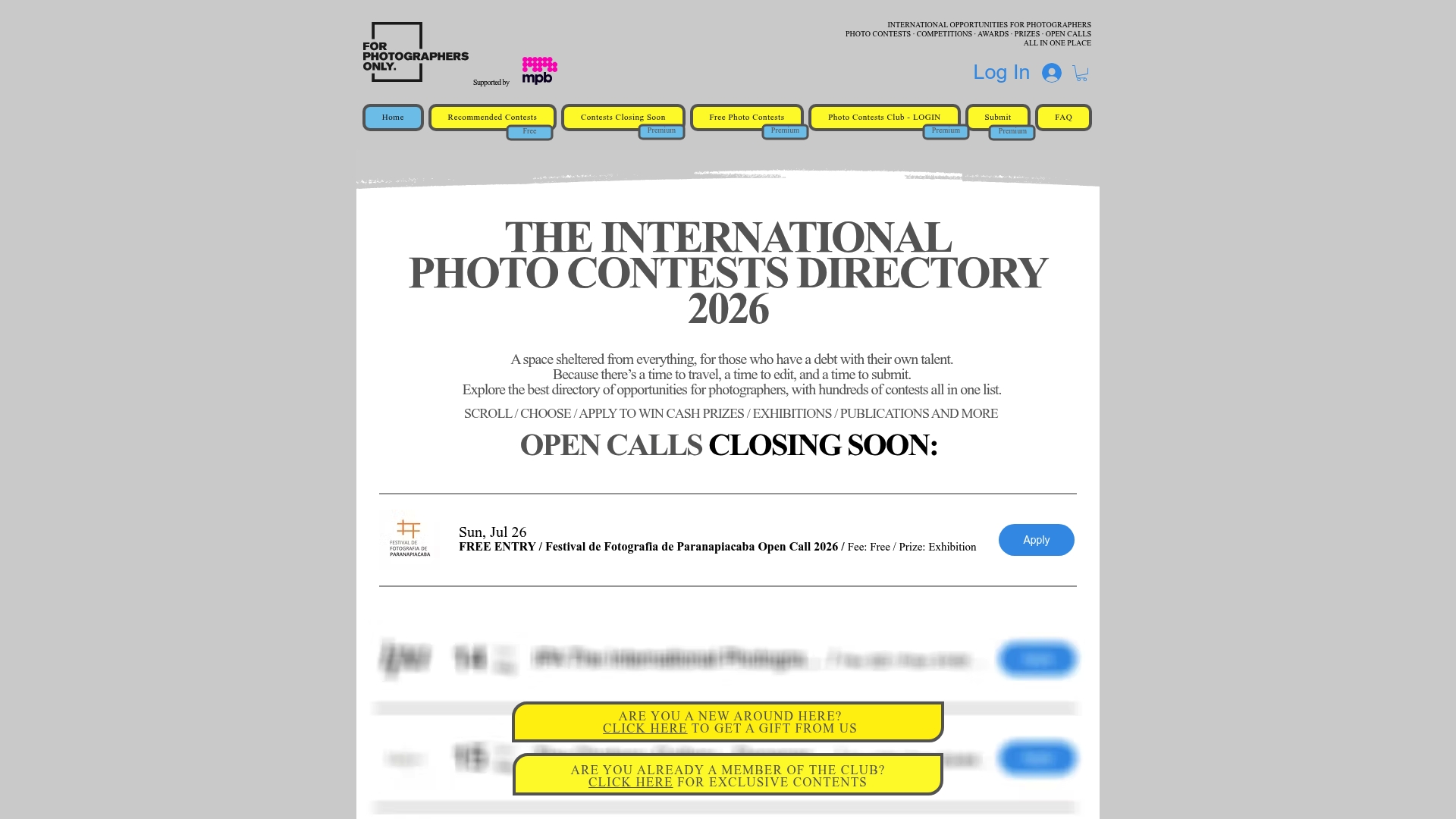
For Photographers Only publishes a continuously updated page of international photography contests, awards, calls, grants and prizes, with deadlines, fees, prizes and genres laid out chronologically. The PhotoContestsClub plan costs €6 per month or €40 per year, and a free trial is offered. Members also join a photographer community and a monthly internal competition.
See the full PhotoContestsClub page, or compare options on the plans and pricing page.
FAQ
Are corporate photo contests free to enter?
Many are. Sony World Photography Awards and Dow’s black-and-white competition are both free to enter, while others charge by the number of images, as Nature’s Best did with a $30 adult fee in 2025. Always confirm the current fee on the official rules page.
Do I lose my copyright if I win?
Not necessarily. Some organizers let you keep copyright and license limited uses for a set period, while others require a broad, perpetual commercial license from winners. The rights clause in the official rules tells you which model applies, so read it before you enter.
Can European photographers enter US corporate contests, and the other way around?
Often yes, since many sponsors accept entries worldwide, as Dow and the Pink Ribbon Photo Award do. Others set residence limits, so check the eligibility section of each contest’s rules.
What file specifications should I prepare?
Most ask for JPEG files in sRGB at a stated size range, such as 500 KB to 3 MB or 1 to 5 MB. Some also request embedded EXIF data, captions, RAW files if you advance, and model or property releases.
Sources
Recommended