Concert Photography: 5 Key Checks Before You Submit to Competitions

Serious music photographers should start with the Abbey Road Music Photography Awards and the International Photo Awards, then check community platforms like ViewBug for frequent, lower-barrier calls. Before preparing any entry, confirm three things: the eligibility and capture-date window, the file specifications, and the copyright or release rules. Once cleared, curate three to five images that share a coherent voice and write captions that reveal the story behind each frame.
TL;DR:
Most competitions restrict entries to images captured within a specified recent window, often the previous year, to ensure relevance and freshness.
Organizers usually require high-resolution files, ownership of copyright, and sometimes model releases, with strict verification processes that can disqualify unprepared entrants.
Curating three to five coherent images with accompanying captions that tell the story behind each shot significantly increases chances of standing out to judges.
Recognition from contests like the Abbey Road Awards or IPA can lead to exhibitions, press features, and festival programming, but rarely guarantees paid work without further outreach.
Staying updated on open calls requires a personal calendar tracking deadlines, fees, and licensing terms, as competitions vary widely in rules and submission periods.
Table of Contents
1. Prominent competitions music photographers should watch
The music photography world has grown its own ecosystem of competitions, each with a distinct culture, prize structure, and level of prestige. Knowing which ones align with your work saves entry fees and sharpens your submission strategy.
The Abbey Road Music Photography Awards sit at the top of that list. The competition runs open categories including Live Music, Festivals, and Emerging Photographer of the Year, and was free to enter for eligible entrants in 2026. It drew over 24,500 submissions from 42 countries, a scale that signals both its reach and the level of craft entrants bring. Most categories require that images be captured during the previous calendar year, and the awards pair recognition with exhibitions and festival programming tied to winners.
The International Photo Awards, known as IPA, offers a different kind of value: broad international visibility across a Concert and Performing Arts category that sits alongside dozens of other genres, giving concert work a chance to be seen by judges who evaluate the medium as a whole rather than a single niche.
Community and festival-run contests fill the gap between these flagship awards and everyday practice. Platforms such as ViewBug run recurring, genre-specific contests with community voting, and many festivals issue their own photo calls tied to accreditation or media access.
Abbey Road Music Photography Awards: open eligibility, annual cadence, prizes include exhibitions and festival tie-ins.
International Photo Awards (IPA): open to professionals and amateurs, annual cadence, prizes include cash and published recognition.
ViewBug and festival-run contests: rolling or seasonal cadence, prizes typically include exposure, features, and community recognition.
Each rewards a different kind of ambition: Abbey Road for depth within music photography specifically, IPA for cross-genre credibility, and community platforms for frequency and lower stakes.
2. What entry rules and judging panels actually require
Formal rules trip up more entrants than weak photography does. Before you invest time curating a submission, check these four areas.
Eligibility and capture dates. Most competitions restrict entries to images taken within a defined window, often the previous calendar year, to keep the competition current and prevent recycled portfolios.
File specs and permitted edits. Organizers set limits on image count, file format, resolution, and how much post-processing is acceptable, and they may request print-quality TIFF or JPEG files from winners after notification.
Copyright and releases. Entrants must generally own copyright to the image and secure model releases when subjects are clearly identifiable, a requirement that trips up entrants more often than any technical error.
Two-stage judging. A shortlisting panel narrows the field first, sometimes selecting only one image per entrant to advance, before a second judging panel evaluates originality, narrative, and technical execution.
Skipping any of these steps can mean disqualification regardless of how strong the photograph is.
3. How to build a submission that stands out to judges
Preparation separates entrants who get shortlisted from those who do not. The work happens well before you click submit.
Curate tightly. Choose three to five images that show range without losing a consistent voice, since judges scan hundreds of entries and reward coherence over volume.
Write editorial captions. A brief caption that explains why the moment mattered gives judges context a strong image alone cannot convey.
Protect your rights. Keep your original RAW files, confirm you hold copyright, and secure any required releases before you submit, since organizers may request originals during verification.
Export with care. Match the color profile, file naming, and size limits specified in the rules, and test your upload early rather than in the final hour before the deadline.
Track your submission. Save confirmation emails and fee receipts, and set a calendar reminder to check for shortlisting announcements.
Pro Tip: Treat your caption as a second creative decision, not an afterthought: it can tip a strong image into a shortlisted one.
4. What winners and finalists typically gain
Recognition takes different forms depending on the competition, and understanding the range helps you set realistic expectations before you enter.
Cash and gear prizes reward top placements in flagship contests like the Abbey Road Music Photography Awards.
Exhibitions and festival programming extend visibility well past the ceremony, with some awards tying winners to residencies and mentorships.
Publication and press features raise your profile among editors and festival organizers who scout new talent.
Contest wins rarely convert directly into paid assignments on their own, making Photography SEO Services an essential tool to be discovered and book more shoots. They work best as a credential you pair with deliberate outreach to editors, festival programmers, and artist management.
5. Where to find and track new competition calls
Staying current on open calls matters as much as preparing a strong entry. Several sources cover the space from different angles.
Official competition pages and newsletters give you the authoritative version of rules, deadlines, and category changes each cycle.
Curated directories like For Photographers Only aggregate hundreds of contests in one continuously updated page, sorted by deadline, saving the hours it takes to check dozens of sites individually.
Community channels, including photography forums, festival sites, and social feeds, often surface smaller or regional calls before they reach broader coverage.
The best practice is a personal contest calendar that tracks deadlines, entry fees, and licensing terms side by side, so you can budget for fees and avoid missing a closing date buried in a newsletter you skimmed weeks earlier.
6. A pre-submit checklist to avoid common disqualifications
Most rejected entries fail on technicalities rather than image quality. Run through this list before you hit submit.
Confirm the capture-date window and the closing time zone listed in the official rules.
Reread category-specific requirements, since a strong image entered in the wrong category is often disqualified outright.
Verify the entry fee has processed and that you used an accepted payment method.
Check file format, resolution, and size limits against your export settings.
Read the license terms carefully so you know exactly what rights you retain and what you grant the organizer.
7. Common challenges and ethical considerations
Concert photography competitions raise a few recurring tensions that photographers should think through before entering. Access is uneven: photographers with press credentials or tour relationships often capture angles and moments that general-admission shooters cannot, which shapes what wins even when judges try to weigh craft evenly.
Consent is another recurring issue. A striking crowd shot or a close-up of a performer can carry real privacy and release complications, especially when the subject is clearly identifiable and no release exists. Entrants sometimes submit images captured without accreditation or in violation of a venue’s photography policy, which can create legal exposure well beyond a disqualified entry.
Editing raises its own questions. Competitions increasingly specify how much post-processing is acceptable, and heavy compositing or added elements can cross from enhancement into fabrication, undermining the documentary value that makes concert photography compelling in the first place. Finally, entry fees deserve scrutiny: a contest charging a fee should offer transparent judging criteria, clear licensing terms, and a real judging panel, not just a submission funnel. Reading the terms before paying protects both your wallet and your rights to the image.

8. Sharpening technical skill for concert environments
Concert photography rewards technical fluency because the conditions rarely cooperate. Low light, fast-changing colored stage lighting, and constant motion demand decisions made in seconds rather than minutes.
Start with lighting. Stage lights swing from near darkness to blinding spotlights within a single song, so shooting in manual or aperture-priority mode with a wide aperture, often f/1.8 to f/2.8, gives you control that auto modes cannot match. Motion is the next challenge: a fast shutter speed freezes a guitarist mid-leap, while a deliberately slower one can convey the blur of a drummer’s arms in a way that feels true to the energy of the room. Neither choice is universally correct. The story you want to tell decides it.

Composition separates a technically sound photo from a memorable one. Watch for the moment a performer connects with the crowd, a beam of light catching smoke, or a raw expression between songs, and frame with the stage’s negative space rather than centering every subject. Shooting through the first three songs, the window most photo pits allow, forces discipline: you will not get a second chance at that angle, so anticipate the performer’s movement rather than reacting to it.
None of this replaces practice at small venues, where you can experiment with settings and composition without the pressure of a one-song access window.
9. Turning competition entries into career momentum
Entering a competition is a visibility event, not an endpoint. The photographers who benefit most treat each submission as one node in a larger networking effort rather than a standalone bet.
Shortlisting or winning gives you a credential worth using deliberately: mention it in pitches to editors, reference it in outreach to festival programmers, and add it to your portfolio’s credentials section where it carries real weight. Exhibitions and festival programming tied to awards, common with programs like the Abbey Road Music Photography Awards, also put your work in front of curators and industry figures you would not otherwise reach.
Professional organizations extend that reach further. Groups such as IFPO help photographers secure the media credentials that open access to higher-profile shows, while offering networking and legal resources that support a transition from contest recognition to paid editorial work. Credentials and contest wins work best together: one gets you into the venue, the other gets an editor to open your email.
Where contests fit in a long-term music photography career
Contests are a visibility tool, not a business plan. I treat them as one input among several: alongside targeted outreach to editors and venues, and alongside building the kind of professional credentials that get you credentialed at bigger shows. A win matters most when you use it, in a pitch, a bio, a festival application, rather than letting it sit on a webpage.
The photographers who benefit most track outcomes deliberately: which entries led to a follow-up email, which exhibition led to a new contact, which caption got quoted back to them by an editor. That’s the real return on entering.
— DARIO
How For Photographers Only helps you find the right calls
Once you know what to look for, the harder problem is keeping track of it all. A curated directory offers a continuously updated page listing hundreds of active international photography competitions, including many free-to-enter opportunities, refreshed frequently to help avoid outdated deadlines across multiple sites.
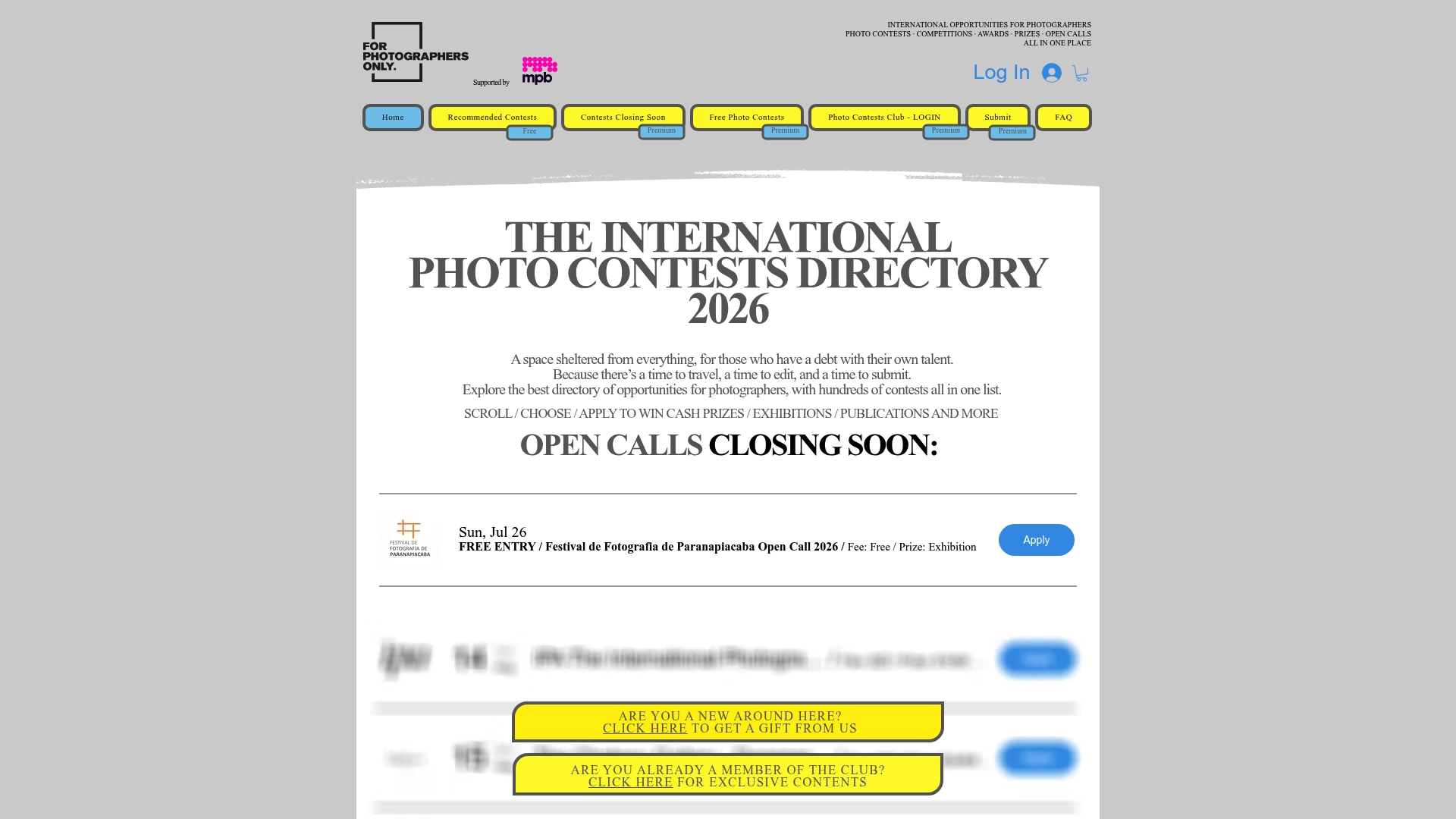
Filter by genre, fee, and deadline instead of searching contest by contest.
Track upcoming closing dates in one place rather than across scattered newsletters.
Access curated calls at €6 per month or €40 per year through PhotoContestsClub.
If you’re ready to stop hunting and start submitting, the current list of open calls is available now on the contest directory.
Sources
FAQ
How do I become a photographer for concerts?
Most concert photographers start by shooting small venues and local shows to build a portfolio, then pursue media credentials through professional bodies such as IFPO to gain access to larger events. Building relationships with venues, publicists, and artist management tends to matter more than any single credential.
How much money do concert photographers make?
Earnings vary widely depending on whether a photographer works freelance, on assignment for publications, or under contract with a tour, and no single figure applies across the field. Industry guidance points to networking, repeat clients, and diversified work such as touring contracts as more reliable income drivers than any one job or contest.
What is the 20 60 20 rule in photography?
Definitions of this rule vary across sources and it is not a formally documented industry standard, so treat any specific breakdown with caution. In general use, it refers to dividing a shoot’s coverage across wide, medium, and detail shots, a loose framework some photographers apply rather than a rule enforced by any competition.
How can I participate in a photography competition?
Start by confirming the competition’s eligibility window, file specifications, and rights requirements listed in its official terms, since these vary by contest and often decide who gets disqualified. Curate a small set of your strongest, most coherent images, write clear captions, and submit before the stated deadline through the organizer’s official entry page.
What makes the Abbey Road Music Photography Awards worth entering?
The Abbey Road Music Photography Awards run open categories such as Live Music and Emerging Photographer of the Year, were free to enter for eligible entrants in 2026, and drew over 24,500 submissions from 42 countries. Winners and shortlisted photographers often gain exhibitions and festival programming tied to the awards, extending exposure well beyond the ceremony.
Recommended