Cash, Shows, RAW/AI: Color Photography Contests 2026 for Photographers

If you want prize money, exhibition opportunities, or major publication exposure for color photography right now, start with a short list: Chromatic Photography Awards and International Color Awards for international recognition, reFocus and the 1839 Awards Color Photography Contest for cash plus press assets, and Sigma’s Power of F1.2 Photo Contest for a technical, thematic showcase. Each rewards a different goal, so the right entry depends on what you actually want from a win.
TL;DR:
Focus on contests that publicly verify judges’ credentials and have accessible winners galleries to ensure legitimacy before entry.
Prioritize entries that align with your goal, whether cash, publication, or exhibition, and carefully read licensing clauses to protect your rights.
Prepare your files according to specific contest rules, ensuring correct color space, embedded EXIF data, and retention of RAW files to avoid disqualification.
Reputable contests like Chromatic, International Color Awards, reFocus, and the 1839 Awards offer credible exposure and prizes, especially if they combine publication and exhibition opportunities.
Use tools like PhotoContestsClub to track open calls efficiently, focusing on credible contests with transparent rules and judging panels to maximize your chances.
Table of Contents
The top color photography contests to shortlist this year
Color photography has grown into its own competitive category, with contests built specifically around hue, saturation, and the emotional weight of a palette rather than treating color as an afterthought to composition. The seven names below cover the range photographers searching for reputable calls tend to compare.
Chromatic Photography Awards positions itself as an international, color-focused competition with a published winners gallery and rules page, making it a reasonable first stop for photographers building a broad color portfolio rather than chasing one narrow theme. International Color Awards takes a similar premise but leans harder into judged industry recognition, with categories judged by working professionals and an established showcase for past winners.
reFocus’s Color Photography Contest and the 1839 Awards Color Photography Contest both belong to organizers known for pairing cash prizes with exhibition slots and promotional assets for winners, including press releases, badges, and artist directory listings. The 1839 Awards’ 2025 Color Photography Contest named both a professional and non-professional overall winner along with 14 category winners, judged by a panel that included representatives from major art institutions and publications, a structure that gives entrants a way to verify the contest’s legitimacy before paying an entry fee.
Sigma’s Power of F1.2 Photo Contest sits apart from the rest. It is not a general color competition, it is a technical, lens-specific call that requires images shot at f/1.2 with embedded EXIF data, bans generative AI outright, and restricts eligibility to U.S. residents 18 and older, with prizes that include Sigma credit and exhibition opportunities. It rewards a specific skill rather than a broad body of work, so it fits photographers already shooting with Sigma’s fast primes.
Rounding out the group:
reFocus Awards Color Photography Contest shares reFocus’s model of cash prizes, exhibition access, and winner publicity packages within its color category.
For Photographers Only, PhotoContestsClub is not a contest itself but a curated directory of 320 to 330 active international photography contests, refreshed weekly, that surfaces calls like these before their deadlines pass.
Deadlines for annual contests shift year to year, so confirm the current open call dates directly on each organizer’s site before you prepare a submission.
Comparing entry fees, prizes, and rules side by side
Deadlines move annually and some organizers publish exact fees only once a cycle opens, so treat the table as a filtering tool, not a final answer. Confirm current dates and fees directly with the organizer before submitting.
Sigma’s contest stands out for enforcement, not scale: it requires embedded EXIF and bans generative AI outright, a level of technical verification most general color contests do not publish.
Where a cell reads “not publicly detailed,” the organizer has not listed that policy on its public rules page at the time of writing, which is itself worth noting before you submit unedited RAW files on faith. If cash matters most, reFocus and the 1839 Awards currently offer the clearest combination of prize money and press exposure. If exhibition and publication credibility matter more than a check, Chromatic and International Color Awards both lean on judged showcases and published winner galleries.

How to choose which contests deserve your entry fee
Not every reputable-looking contest deserves your time or your fee, and the difference usually shows up before you ever submit an image.
Start with your goal. Decide whether you want cash, a gallery credit, magazine publication, or simply a judged opinion on your work, since that choice narrows the list fast.
Read the licensing clause in full. Reputable organizers typically request a non-exclusive, royalty-free license to use your image for promotion while you keep copyright; anything broader deserves a second look.
Check the judging panel. A contest that names its judges, with real titles and institutions, is easier to verify than one that lists a generic “expert panel.”
Look for a public winners gallery. Past winners with visible names and images, like the 1839 Awards’ published winners list, confirm the contest actually awards what it promises.
Weigh the cost against the realistic outcome. A $30 fee for a shot at a group exhibition is a different bet than the same fee for a low-odds cash prize with no exposure attached.
Before entering, email the organizer with a short, specific question: ask about usage rights, whether exhibited prints are insured, who pays return shipping, and whether winning requires exclusivity that would block you from entering the same image elsewhere.
Pro Tip: Skip any contest that cannot show you a named judge, a public winners gallery, or a plainly written licensing clause, no matter how polished its entry page looks.
Red flags worth walking away from include vague or unlimited licensing language, no published rules page, fee structures that change after you have already paid, and any request to transfer copyright outright rather than license specific promotional use.
Preparing files that survive the submission process
Most disqualifications happen before judging even starts, over file specs rather than image quality.
Match the color space to the brief. Most contests ask for sRGB, though some fine-art competitions prefer Adobe RGB, so confirm before exporting.
Respect maximum dimensions and file size. Oversized files get rejected automatically by most submission portals.
Keep EXIF intact where required. Sigma’s contest, for instance, requires embedded EXIF data as proof the image was shot at f/1.2, so stripping metadata during export would disqualify an otherwise perfect entry.
Hold onto your RAW file. Contests are increasingly requiring RAW or original-file verification and can disqualify entries that cannot produce an original when asked.
Disclose AI use where it applies. Undisclosed generative AI editing is one of the fastest routes to disqualification once an organizer asks for verification.
A significant share of disqualifications trace back to missing RAW files or undisclosed AI edits rather than image quality, according to contest-submission guidance from Unique Photo, which means the safest habit is preparing your RAW alongside your export from the start.
For series submissions, sequence images so the strongest frame leads and the set reads as a coherent idea rather than a loose collection. Caption clearly, secure model and property releases before you submit rather than after a win is announced, and if a contest requires physical prints, package them exactly to spec and confirm insurance coverage during transit.
What a contest win actually gets you
A win rarely ends with the prize itself. What you do in the weeks after matters as much as the placement.
Cash prizes cover costs and validate the work, but they rarely open doors on their own.
Exhibition slots put your print in front of curators and collectors, which is where gallery and grant opportunities often start.
Publication credits carry long-term weight on a portfolio site or grant application, well after the contest itself is forgotten.
Press assets and badges that organizers like reFocus and 1839 Awards provide give you ready material for a press kit or social announcement, and professional photographers often rely on specialized Photography SEO Services | Be Discovered & Book More Shoots to amplify career benefits after a contest win.
Once a result is announced, request the full-resolution press kit, notify galleries or publications you already have relationships with, and use the win as supporting material for grant or residency applications, since several prestigious awards explicitly value prior recognition when reviewing new submissions. The gap between winning and exhibiting typically spans a few months, so use that window to line up your next application rather than waiting for the gallery to reach out first.
How this roundup was put together
For Photographers Only maintains a curated directory of 320 to 330 active international photography contests, refreshed weekly, listing deadlines, fees, and prize structures as organizers publish them. Contests earn a spot on the shortlist above because they publish clear rules, name a judging panel, and show a public winners gallery, the same verification standard recommended earlier in this guide.
The selection deliberately favors contests offering exhibition or publication alongside cash, since exposure tends to outlast the prize check. Author background:. Years contributing to For Photographers Only:.
Where to focus when your time and budget are limited
Enter fewer contests, chosen deliberately, rather than scattering entries across every open call. When budget and time are tight, I weigh a contest’s judging panel and winners gallery above its prize headline, since a modest cash prize backed by a credible exhibition tends to outperform a bigger check from an unverifiable organizer.
Watch two trends closing in on 2026: technical, theme-specific calls like Sigma’s f/1.2 contest are multiplying, and AI disclosure requirements are tightening fast enough that a policy you skimmed last year may already be stricter.
— DARIO
Save research time with PhotoContestsClub
Chasing deadlines across a dozen contest sites is its own job, and it is the exact problem PhotoContestsClub was built to remove. Instead of checking Chromatic, International Color Awards, reFocus, and every other organizer’s page separately, members get one continuously updated page listing 320 to 330 active contests worldwide, including more than 100 free-to-enter options.
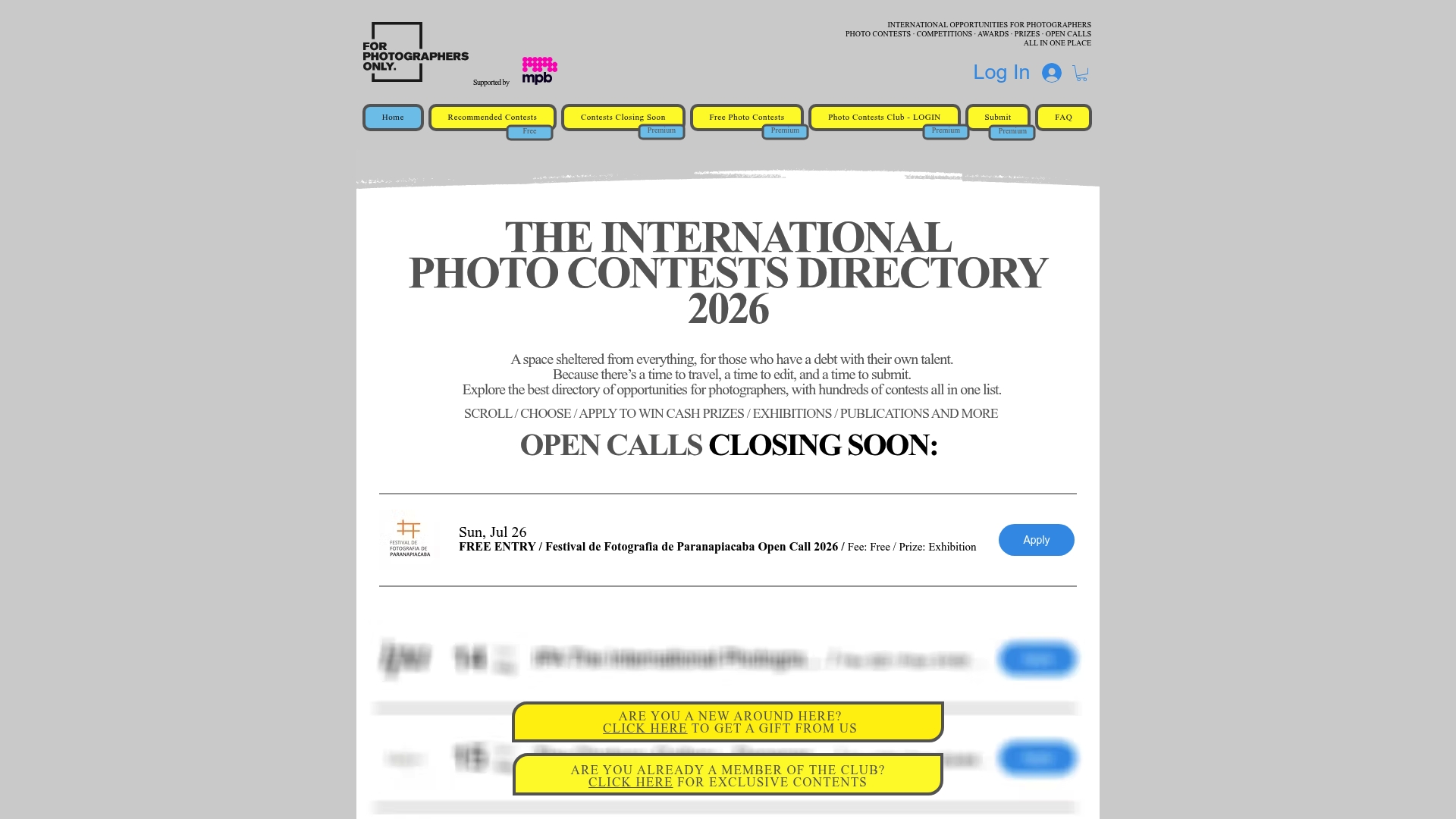
Membership flags which calls are free and which carry fees, so you can weigh cost against prize value before committing an entry fee anywhere. The directory updates weekly, which means a new color photography call or an approaching deadline surfaces without you having to hunt for it.
One page instead of dozens of organizer sites to track.
More than 100 free-to-enter contests included alongside paid ones.
Weekly updates so new calls and closing deadlines do not slip past you.
Membership runs €6 per month or €40 per year, which is less than most single contest entry fees. If finding reputable color photography contests before their deadlines close matters more than searching for them yourself, start with the PhotoContestsClub directory and see this year’s open calls.
Sources
FAQ
What photo contests are happening in 2026?
Reputable color-focused calls to check for 2026 include Chromatic Photography Awards, International Color Awards, reFocus’s Color Photography Contest, the 1839 Awards Color Photography Contest, and Sigma’s Power of F1.2 Photo Contest. Exact open dates shift annually, so confirm current deadlines on each organizer’s site or through a continuously updated directory like PhotoContestsClub.
What is the 20 60 20 rule in photography?
Definitions of this rule vary across photography communities and it is not a standard judging criterion referenced by the contests covered in this guide. Rather than rely on an unverified rule, focus on the published judging criteria each contest lists on its own rules page.
Are photo contests worth it?
Reputable contests that publish a named judging panel, a public winners gallery, and clear licensing terms can deliver cash, exhibition slots, or publication credit that carries real weight on a portfolio. Their value depends heavily on verifying those trust signals before you pay an entry fee, since unclear licensing or missing winner records are the clearest warning signs of a weaker contest.
Are there any free camera giveaways happening in 2026?
Some contests, including Sigma’s Power of F1.2 Photo Contest, are free to enter and offer gear credit rather than a giveaway in the traditional sense. Free-to-enter opportunities across genres, including gear-related prizes, are easiest to track through a regularly updated directory such as PhotoContestsClub, which lists more than 100 free contests at a time.
Recommended