Call for Photographers: Best Places to Find Open Calls Now
The best places to check right now for active photographer submissions are LensCulture, PhotoCalls on Instagram, the Society for Photographic Education (SPE) Calls for Entry page, and Forphotographersonly — a curated directory of hundreds of active international contests updated weekly. Each serves a distinct purpose in a photographer’s submission strategy:
LensCulture — international competitions with editorial exposure, cash prizes, and exhibition opportunities; accepts both singles and series across genres.
PhotoCalls (Instagram) — fast, social-media-aggregated roundups of open calls posted weekly; ideal for catching short-deadline opportunities before they close.
SPE Calls for Entry — academic and exhibition-focused listings from the Society for Photographic Education, particularly strong for emerging photographers and educators.
Forphotographersonly — a subscription-based, human-curated photo contests directory covering competitions from Nikon, Canon, National Geographic, and hundreds of independent festivals worldwide.
Pro Tip: Prepare one ready-to-submit export folder before you start browsing calls. Photographers who apply within the first week of a call opening often receive more editorial attention than last-minute submissions, and having files named consistently (e.g., First_Last_Title.jpg) prevents administrative rejections before a juror ever sees the work.
Table of Contents
Where do photographers find current, reliable calls for entry?
What should photographers expect for entry fees and timelines?
What do photographers actually gain from entering open calls?
How Forphotographersonly curates calls and why the listings can be trusted
Forphotographersonly: a curated shortcut to the world’s best open calls
Where do photographers find current, reliable calls for entry?
The most dependable sources fall into five categories, each with a different update rhythm and audience focus.
Curated directories
Forphotographersonly and similar subscription directories aggregate calls from dozens of organizers into a single, chronologically ordered page. The advantage is efficiency: instead of monitoring twenty separate festival websites, photographers check one place. Forphotographersonly’s listings cover everything from brand-sponsored contests run by Leica and National Geographic to independent gallery open calls and photobook prizes. Reliability signals to look for in any directory include a visible “last updated” date, published deadlines and fees on every listing, and a track record of past winners or featured exhibitions — all of which Forphotographersonly maintains through event pages and case studies.

Festival and competition sites
Major competitions publish their own calls directly. The LensCulture Street Photography Awards offer a free single-image entry option alongside tiered series entries, with cash prizes and a London exhibition for selected work. The International Photography Awards runs annual categories for professional, amateur, and student photographers, publishing winners in a printed annual. Checking these sites directly is worthwhile for flagship competitions, but tracking dozens of them manually is where curated directories save hours.

Institutional and museum calls
Museums, galleries, and photography organizations publish open calls on their own websites. The Griffin Museum of Photography, the Atlanta Photography Group, and the Photography Society of America each maintain dedicated Calls for Entry pages that update throughout the year. These tend to favor exhibition-ready projects and often carry lower fees than commercial competitions.
Social media roundup accounts
PhotoCalls on Instagram aggregates open calls from across the photography world into weekly posts. The format is fast and visual, making it easy to spot new opportunities. The trade-off is that context is thin — a single post rarely includes full eligibility details, so always click through to the organizer’s site before committing.
Trade journals and editorial open calls
Publications like Shots Magazine accept ongoing photographer submissions aligned with their editorial mission. Reading an organization’s mission statement before submitting is one of the most consistently recommended practices among editors: work that speaks directly to a publication’s stated focus has a measurably higher selection rate than generic submissions.
Quick triage approach: When a new listing appears, check four things in under two minutes — the deadline, the fee, the eligibility geography, and whether the organizer publishes past winners. If all four are clear, the call is worth a closer read.
What are the different types of calls for photographers?
Not every open call leads to the same outcome, and matching a project to the right call type is one of the most overlooked aspects of submission strategy.
Exhibition calls invite photographers to submit work for inclusion in a physical or virtual group show. The primary benefit is visibility within a gallery context, often with curatorial framing that adds credibility to the work. These suit photographers with cohesive, exhibition-ready bodies of work rather than isolated single images.
Publication and editorial features are calls from magazines, online platforms, and photobooks seeking work to publish. PhotoVogue’s regional Panoramas — open calls organized by geography and genre — offer publication alongside grant awards, making them hybrid opportunities that reward both emerging and mid-career photographers.
Single-image contests are the most accessible entry point. They accept one strong photograph judged on its own merits, with prizes ranging from cash to editorial features. LensCulture’s Street Photography Awards exemplify this format, offering free single-image entry with international exposure.
Body-of-work competitions require a series, typically 5–15 images, and judge the project as a whole. Eyeshot’s Open Call is a strong example: it accepts singles and series, adjusts fees by country GDP per capita, offers student and hardship waivers, and awards a fully funded book prize to one winning series.
Residencies provide time and space — often studio access, accommodation, and a stipend — in exchange for a proposed project. They suit photographers at a pivotal career moment who need uninterrupted time to develop a long-form project.
Grants and fellowships fund specific projects or recognize career achievement. Innovate Artist Grants and similar foundations support photographers whose work addresses social, cultural, or environmental themes. These typically require a project proposal, budget, and artist statement rather than a finished body of work.
Hybrid listings are increasingly common: a competition may offer publication plus an exhibition, or a residency may include a cash stipend. Read the prize language carefully — “publication” can mean a printed book, a digital feature, or a single social media post, and those outcomes carry very different professional weight.
How do you evaluate whether a call is worth submitting to?
The first question is always whether the call aligns with your current project and professional goals. If the answer is no, move on regardless of the prize value.
For calls that pass that initial filter, work through this framework quickly:
Eligibility and geography. Many calls restrict entry by nationality, residency, or career stage (emerging, student, professional). The APEC Photo Contest, for example, is open only to citizens or permanent residents of the 21 APEC member economies, including the United States. Submitting outside your eligibility category wastes the entry fee and the organizer’s time.
Singles vs. series. Confirm which formats are accepted before preparing files. Some calls accept only single images; others require a minimum of five. Submitting a series to a single-image call, or vice versa, typically results in disqualification.
Jury and organizer credibility. Named jurors with verifiable professional backgrounds signal a serious competition. Anonymous or vaguely described “expert panels” are a yellow flag. Published past winners and exhibition histories are the strongest credibility indicators.
Fee structure and waivers. Entry fees for single-image contests typically run free to modest amounts; series and monograph competitions tend to charge more. Eyeshot’s GDP-adjusted fee model is a thoughtful example of inclusive pricing. Always check whether student or hardship waivers are available before assuming a fee is fixed.
Rights and licensing terms. Some open calls claim non-exclusive promotional rights in perpetuity. That language is standard for promotional use, but calls that claim exclusive rights or the right to sublicense work commercially warrant careful scrutiny or avoidance.
Red flags worth noting: vague or missing juror information, perpetual exclusive licensing language, unusually high fees with no transparent benefit breakdown, and no published contact details for the organizer.
How do you prepare a competitive photography submission?
Start by creating two export folders before you open a single submission form: one containing your strongest single images at full resolution, and one containing your best series with consistent filenames and sequencing. Having these ready eliminates the rushed, last-minute editing that weakens entries.
Step-by-step submission checklist
Select the project. Choose work that speaks directly to the call’s theme or mission. Read the organizer’s About page before selecting images.
Edit the series ruthlessly. For a body-of-work submission, sequence matters more than any single technically perfect frame. A weak image breaks narrative flow and reduces the project’s overall impact.
Finalize image edits. Consistency in color grading and tonal range across a series signals professional intent to jurors.
Export to spec. Standard requirements: sRGB color space, JPEG format, 300 DPI for print calls or 72–96 DPI for digital, maximum long edge of 3,000–4,000 pixels, file size under 10 MB per image unless specified otherwise.
Name files correctly. Use the organizer’s requested format. When none is specified, First_Last_Title.jpg is the professional default. Organizers processing thousands of submissions often filter or delete unlabeled files before a juror reviews them.
Write the artist statement. For competitions, a two-to-three sentence blurb works: concept → why it matters → brief context. For monograph or residency submissions, aim for 150–300 words using the same structure expanded with one specific visual or thematic detail.
Complete the web form carefully. Fill every field, double-check captions, and confirm that embedded metadata matches the submission form entries.
Apply early. Submissions that arrive in the first half of an open call window tend to receive more considered attention than those filed in the final 48 hours.
Pro Tip: Include a one-line curator-facing pitch in the “additional notes” or “project description” field when one is available. Something like: “This series documents informal labor markets in post-industrial cities through available light.” Jurors read hundreds of statements; a single precise sentence that frames the work’s stakes can distinguish a project from technically similar entries.
Pro Tip: If a competition offers optional paid written feedback, consider it strategically for calls where the jurors are curators or editors you want to reach. The feedback itself is useful, but the secondary benefit is that your work receives a more extended review than a standard entry.
What should photographers expect for entry fees and timelines?
Fee structures
Free single-image entry options exist across the spectrum, from LensCulture’s Street Photography Awards to regional institutional calls. Series and monograph competitions typically charge more, and some include extras — written juror reviews, expedited judging, or printed catalogs — within the fee. Eyeshot’s open call adjusts fees by country GDP per capita and offers student and hardship waivers, a model that more competitions are beginning to adopt. Always look for waiver language in the FAQ or eligibility section; many organizers grant them on request even when not prominently advertised.
Typical timelines
Call type | Submission window | Jury review | Notification | Exhibition/publication |
Single-image contest | 4 weeks | 4–8 weeks | 2–4 weeks after close | 1–3 months post-notification |
Series competition | 6 weeks | 6 weeks | 4–8 weeks after close | 3–6 months post-notification |
Residency | 6 weeks | 8 weeks | 6 weeks after close | Residency start: 3 months out |
Editorial/publication call | Rolling or 4–8 weeks | 2–6 weeks | 2–4 weeks after close | 1–4 months post-notification |
Fotografiska Emerging’s themed open calls publish explicit deadline and notification dates, which makes scheduling straightforward. For overlapping deadlines, prioritize juried exhibition calls with fixed close dates over rolling publication opportunities, which can be revisited later.
What do photographers actually gain from entering open calls?
Winning is one outcome among many. The practical benefits of entering calls extend well beyond prize placement:
Editorial exposure — selected work appears on competition websites, social channels, and partner publications, reaching audiences a photographer’s own channels may not.
Juror feedback — paid review options and shortlist notifications give photographers a professional read on how their work lands with curators and editors.
Exhibition opportunities — group shows and festival inclusions build a verifiable exhibition history, which matters when applying to galleries or residencies.
Portfolio testing — the discipline of selecting and sequencing work for a specific call clarifies which projects are genuinely exhibition-ready.
Networking — open calls increasingly function as community-building tools; many organizations feature hundreds of entries online and use social channels to boost visibility for non-winning entrants.
Secondary outcomes — entries that reach shortlists or receive editorial features have led directly to paid commissions, gallery representation introductions, and book projects for photographers across career stages.
The realistic expectation is that most entries will not win. What they can do, consistently, is build visibility, sharpen editorial judgment, and create a record of serious professional engagement with the field.
How Forphotographersonly curates calls and why the listings can be trusted
Forphotographersonly operates on a human-curation model: every listing is researched, verified, and published by the platform’s curator, Dario, rather than aggregated algorithmically. Each week, the directory is checked and updated to reflect new deadlines, fee changes, and newly opened calls. A listing earns its place in the directory only when it meets clear criteria: published submission details, transparent rights language, verifiable organizer credentials, and a credible jury or selection process.
Subscribers access a continuously updated directory of hundreds of active contests, searchable by genre, deadline, and entry type, alongside a weekly newsletter and members-only opportunities not listed publicly. The platform’s coverage spans brand-sponsored competitions from Nikon, Canon, and Leica to independent festival calls and gallery open calls like the Carlotta Gallery “Dark Frames” exhibition and the Athens Photo World Award — both documented in detail on the platform’s event pages.
Editorial neutrality is maintained by keeping the directory focused on third-party competitions that Forphotographersonly does not organize. The platform’s role is discovery and curation, not promotion of its own contests.
Key Takeaways
The most effective approach to finding and winning calls for photographers is to monitor curated, regularly updated directories, evaluate each call against a clear framework, and submit prepared, mission-aligned work early in the open window.
Point | Details |
Start with trusted directories | Check Forphotographersonly, LensCulture, SPE, and PhotoCalls weekly for current open calls. |
Evaluate before you enter | Confirm eligibility, fee structure, rights terms, and jury credibility before preparing any submission. |
Prepare export sets in advance | Keep one single-image folder and one series folder ready to go, with correctly named files and consistent specs. |
Apply early and tailor the statement | Early submissions receive more attention; a two-to-three sentence artist statement framed around concept and context outperforms generic descriptions. |
Forphotographersonly as your base | The directory’s 320–330 curated, weekly-updated listings save hours of manual searching across dozens of organizer sites. |
The value of persistence in a competitive field
There is a tendency among photographers to treat open calls as lottery tickets — submit once, wait, move on if nothing happens. That framing misses what the process actually builds. Every call you enter forces a decision: which images represent the project, in what order, and why. That editorial discipline compounds over time. Photographers who submit consistently, across a range of call types, develop a sharper instinct for which work is ready and which still needs time.
The calls worth prioritizing are not always the ones with the largest prizes. A well-curated group exhibition at a respected gallery, a feature in a serious photography publication, or a residency that gives you three uninterrupted months to develop a project can do more for a career than a cash prize that arrives with no curatorial context. The most useful question to ask before any submission is not “Can I win this?” but “Does this call put my work in front of the right people?”
Forphotographersonly was built around exactly that logic: not just listing every competition that exists, but curating the ones where the exposure, the jury, and the organizer’s credibility make the entry genuinely worthwhile. If you want to spend less time searching and more time making work, that kind of curation is where the real value lies.
Forphotographersonly: a curated shortcut to the world’s best open calls
Searching for current photography calls across dozens of festival websites, Instagram accounts, and institutional pages takes hours every week. Forphotographersonly consolidates that work into a single, continuously updated directory — hundreds of active contests at any given time, including over 100 free-to-enter opportunities, organized chronologically so the most urgent deadlines are always visible first.
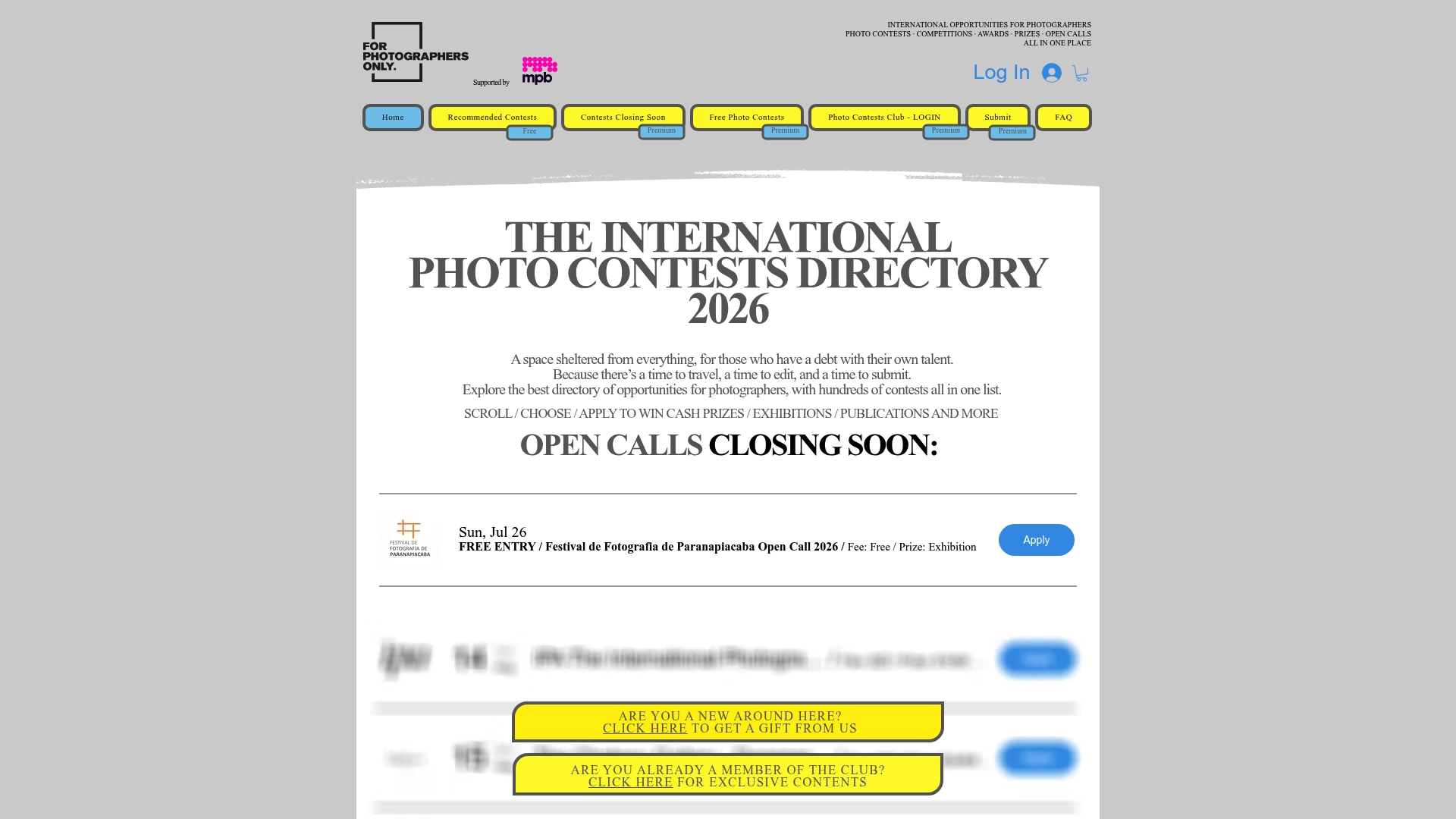
Members receive weekly updates as new calls open, access to members-only opportunities not listed publicly, and searchable filters by genre, deadline, and entry type. The directory covers competitions from Nikon, Canon, Leica, and National Geographic alongside independent festivals, gallery open calls, and photobook prizes that rarely appear on mainstream aggregators. For photographers who want to build their online discoverability alongside their competition record, the combination of consistent entries and a strong web presence compounds over time.
At €6 per month, a Forphotographersonly subscription costs less than a single entry fee for most competitions. Start your free trial and see the full directory today.
Primary resources to bookmark right now
LensCulture competitions — global editorial competitions with free single-image entry options; check when a new call cycle opens.
PhotoCalls (Instagram) — fast weekly roundups of open calls across all genres; follow for deadline alerts.
Eyeshot Open Call — series and monograph-focused with GDP-adjusted fees and a fully funded book prize; check annually.
PhotoVogue regional Panoramas — regionally focused editorial calls with publication and grant awards; check by your geography.
Fotografiska Emerging — themed open calls with explicit deadlines and notification dates; suited to emerging photographers.
SPE Calls for Entry — academic and exhibition-focused listings from the Society for Photographic Education; check at the start of each semester.
Forphotographersonly — curated directory of hundreds of active contests with weekly updates, member-only opportunities, and searchable filters; the most efficient single source for current calls.
To build a personal watchlist: create a dedicated browser folder with these bookmarks, set calendar reminders two weeks before each known deadline, and review the folder every Monday morning. That 15-minute weekly habit covers more ground than an hour of ad hoc searching.
Recommended