Boston Photography Contests: Local Calls and Where to Enter

Boston photography contests fall into three groups: competitions run by Massachusetts institutions, juried exhibitions in Boston galleries, and community or club contests that welcome images of the city and its landscapes. Some are open to anyone, some are limited to a university community or a regional federation, and only a few charge a fee. This guide sorts the main options by who can enter, what they accept, what they cost and what winning actually gets you.
TL;DR
Boston’s contest scene is small but varied: a nature contest from Mass Audubon, a juried gallery show at Panopticon Gallery, a camera club with regular digital competitions, and community contests tied to a university or a federation of clubs.
Eligibility differs sharply. Mass Audubon is open to all skill levels and ages, while the Boston University Global Programs contest is for the BU community.
Fees are rare in the local contests we reviewed. Panopticon’s First Look charges $40 for up to 10 images, or $30 for students with valid ID.
Read the format rules before you upload: file types, print requirements, AI restrictions and commission terms differ from contest to contest.
When you want to look beyond Boston, a curated international list saves hours of searching.
Table of Contents
What counts as a Boston photography contest
The phrase covers more than one thing, and the difference shapes where you spend your time.
Contests that invite photographs of Boston or Massachusetts. The City of Boston has run a photo contest and keeps a winners gallery, which includes images such as a Zakim Bridge sunset by a Mission Hill photographer. Mass Audubon’s annual contest asks for Massachusetts wildlife, plants and landscapes.
Contests run by Boston organizations. Panopticon Gallery’s First Look exhibition and the Boston Camera Club’s digital image competitions are examples. You do not have to photograph Boston, but the organizer is local.
Community contests with membership conditions. Boston University’s Global Programs contest is meant for students, faculty, staff and alumni. The GFWC Massachusetts photography contest belongs to a federation of women’s clubs.
A fourth category is the archive. Some of the older results you may find are historical. The Boston Globe, for instance, thanked hundreds of readers who submitted to its 2006 Reader Photo Contest, but that page is a record of a past event, not an open call. Check any contest you find for a current edition before you prepare files.
Mass Audubon Photo Contest: nature in Massachusetts
For many photographers who work outdoors, this is the most accessible entry point. According to the official rules, the contest is open to photographers of all skill levels and ages. Employees, board members and their immediate family members are excluded.
What it accepts: digital photographs of people in nature, and Massachusetts wildlife, plant life and landscapes.

How it runs: the rules describe a season that runs from June 1 through September 30. Treat that as the usual window, and confirm the current year’s dates on the official page before planning.
How it is judged: Mass Audubon staff review entries on originality, technical excellence, composition, impact and artistic merit. That list is a useful checklist for your own edit. If a frame is sharp but has no point of view, it will lose to one with a clear idea.
Prizes: the rules list shop gift certificates for adult winners, at $250, $100 and $50, with honorable mentions also recognized. These are not cash awards, so the value lies in recognition and in the credit line for your portfolio.
Because the season closes at the end of September, a practical approach is to shoot all summer and keep a running folder of candidates. Edit down to your strongest frames in August, not on the final day.
First Look at Panopticon Gallery: a juried exhibition in Boston
First Look is closer to a curated show than a classic contest. Panopticon Gallery’s First Look FAQ describes an annual juried exhibition in Boston with a submission deadline of December 29 at 11:59 pm EST. The date recurs each year, so check the page for the current cycle.
Cost: $40 for up to 10 images, with a discounted $30 fee for students with valid IDs.
What it accepts: a wide range of photographic work, including digital, film, traditional darkroom and experimental processes. That openness suits photographers who work in analog or mixed media and often find digital-only contests too narrow.
What to submit: the gallery recommends images that work together as a cohesive body of work. In practice, that means ten frames chosen for relationship and rhythm rather than your ten best individual pictures. A series of seven strong images beats ten that wander.
Terms to read: selected artists are considered for future exhibition opportunities, and the gallery retains a 50% commission on any sold work. A commission is standard for galleries, but you should know it before you price prints. If you are new to this format, our guide to juried photography exhibitions explains how juries select work, what the fees pay for, and how to read the fine print.
Boston Camera Club digital image competitions
The Boston Camera Club holds about six digital image competitions a year, usually over Zoom. Judges critique and award the images, and members may vote for favorites. That critique is the real prize: hearing a judge explain why an image works, in front of a room, is faster feedback than most online contests offer.
Technical specifications: the club recommends sRGB, with a maximum image size of 3,840×2,160 pixels and a file-size limit of 20.0 MB. Images are uploaded through the website.
Deadlines: the page gives the cutoff as 11:30 p.m. on the Saturday two weeks before the competition. The page does not state a competition fee, so ask the club about membership terms before you plan on entering.
For photographers who are still finding their voice, a club setting can be a better first step than a global competition with thousands of entries.
Boston University Global Programs Photo Contest
This is an annual contest launched in 2013 for the BU community: students, faculty, staff and alumni. Entries share the world through photographs, often around a theme. The 2026 edition drew 807 photos from 337 Terriers, narrowed to 16 finalists, with two winners: one chosen by judges and one by People’s Choice vote.

If you are part of the BU community, it is a friendly place to test travel and documentary images. If you are not, it is a good model of how a themed contest works. The page we reviewed does not state an entry fee, so check the official page for current terms.
GFWC Massachusetts Photography Contest
The 2026-2027 flier shows how paper-era rules persist in some local contests. It sets a postmark deadline in early March 2027 for all submissions, and it asks for both a digital file and an 8x10-inch print for judging. Files must be jpeg, jpg or png, and AI-generated photographs are explicitly prohibited.
Those requirements change your workflow. A print deadline means ordering and checking an 8x10 well before the postmark date, not on the last evening. And a ban on AI-generated images is a reminder to keep your original files and edit history available in case a judge asks.
Other local routes: calls to artists and city-themed work
Not every opportunity calls itself a contest. The Artists Group of Charlestown publishes calls to artists and suggests that photographers representing Boston look for local details, such as neighborhood traditions or everyday objects, rather than typical tourist landmarks. It is advice worth following for any city-themed entry. Judges have seen the skyline from the harbor many times. A shot of a corner store, a stoop or a seasonal ritual tells them something new.
Comparing Boston contests at a glance
Contest | Who can enter | Subject or format | Fee or cost | Prize or outcome |
Mass Audubon Photo Contest | All skill levels and ages (staff and board excluded) | Digital photos of Massachusetts nature and people in nature | See official rules | Shop gift certificates ($250, $100, $50 for adults) |
First Look, Panopticon Gallery | Photographers working in a wide range of processes | Cohesive body of work, up to 10 images | $40 ($30 for students) | Juried exhibition, consideration for future shows; 50% gallery commission on sales |
Boston Camera Club | Check club terms | Digital images, sRGB, 20.0 MB maximum | Not stated on the page reviewed | Judge critique and awards, member voting |
BU Global Programs Photo Contest | BU students, faculty, staff, alumni | Photographs, often themed | Not stated on the page reviewed | Judged winner and People’s Choice winner |
GFWC Massachusetts | Federation contest, see flier | Digital file plus 8x10 print; no AI images | See flier | See flier |
How to choose the right contest for your work
Before you pay or upload, run each contest through four questions.
Are you eligible? Read the first paragraph of the rules. Community contests limit entry by affiliation, and some exclude staff and family.
Does the subject fit? A Mass Audubon judge wants Massachusetts nature. A gallery jury wants a coherent series. A club judge wants images that teach the room something.
What do the terms say? Look for commission, usage rights, print requirements and AI rules. Never assume that entering grants no rights.
What do you gain? A critique, a gallery wall, a credit line and a gift certificate are very different outcomes. Choose the one that supports your next step.
If you are new to this, our primer on photography contests for beginners walks through entry fees, categories and common mistakes. Hobbyists will also find useful ideas in our list of amateur photo contests.
Preparing an entry that stands out
A few habits apply across all the contests above.
Edit to the rules, not to your taste. Mass Audubon names its criteria: originality, technical excellence, composition, impact and artistic merit. Score your shortlist against them.
Build sequences for juried shows. For First Look, choose images that speak to one another in tone, light and subject.
Export to spec. Use sRGB, respect pixel dimensions and file limits, and name files clearly. A rejected upload is an avoidable loss.
Keep a submission log. Record the contest, date, images, fee and result. After a year, it shows you which kinds of contests suit your work.
Write a short statement. Even when it is optional, two clear sentences about intent help a juror read your pictures the way you meant them.
Our perspective on local contests
We do not run photography contests. We research, curate and publish the best international competitions, and we see the same pattern every week: local opportunities are often the best starting point and the easiest to overlook. A Boston gallery call or a club critique rarely draws the thousands of entries that a global award attracts, which means your work is read more carefully and the feedback is more personal.
But a strong photographer’s year seldom stays local. The most useful portfolio mixes a few nearby contests, where relationships and critiques build skill, with a selection of international awards and grants that bring editorial visibility, exhibition and publication. The challenge is time. Deadlines, fees, genres and eligibility are scattered across hundreds of sites, and a missed date costs a year.
Our advice is simple. Pick one local contest as a goal each season, choose two or three international opportunities that fit the series you are already making, and enter fewer, better-prepared contests rather than many rushed ones. Treat each result, win or not, as information about how your work reads to curators.
— DARIO
Going beyond Boston with PhotoContestsClub
Local contests are a strong foundation. When you are ready to look further, PhotoContestsClub gives you one continuously updated page of more than 320 active international photography contests, awards, calls, prizes and grants, including over 100 that are free to enter. Listings are presented chronologically with deadlines, fees, prizes and genres, and they include competitions organized by names such as Nikon, Canon, Leica and National Geographic, along with niche contests and independent festivals.
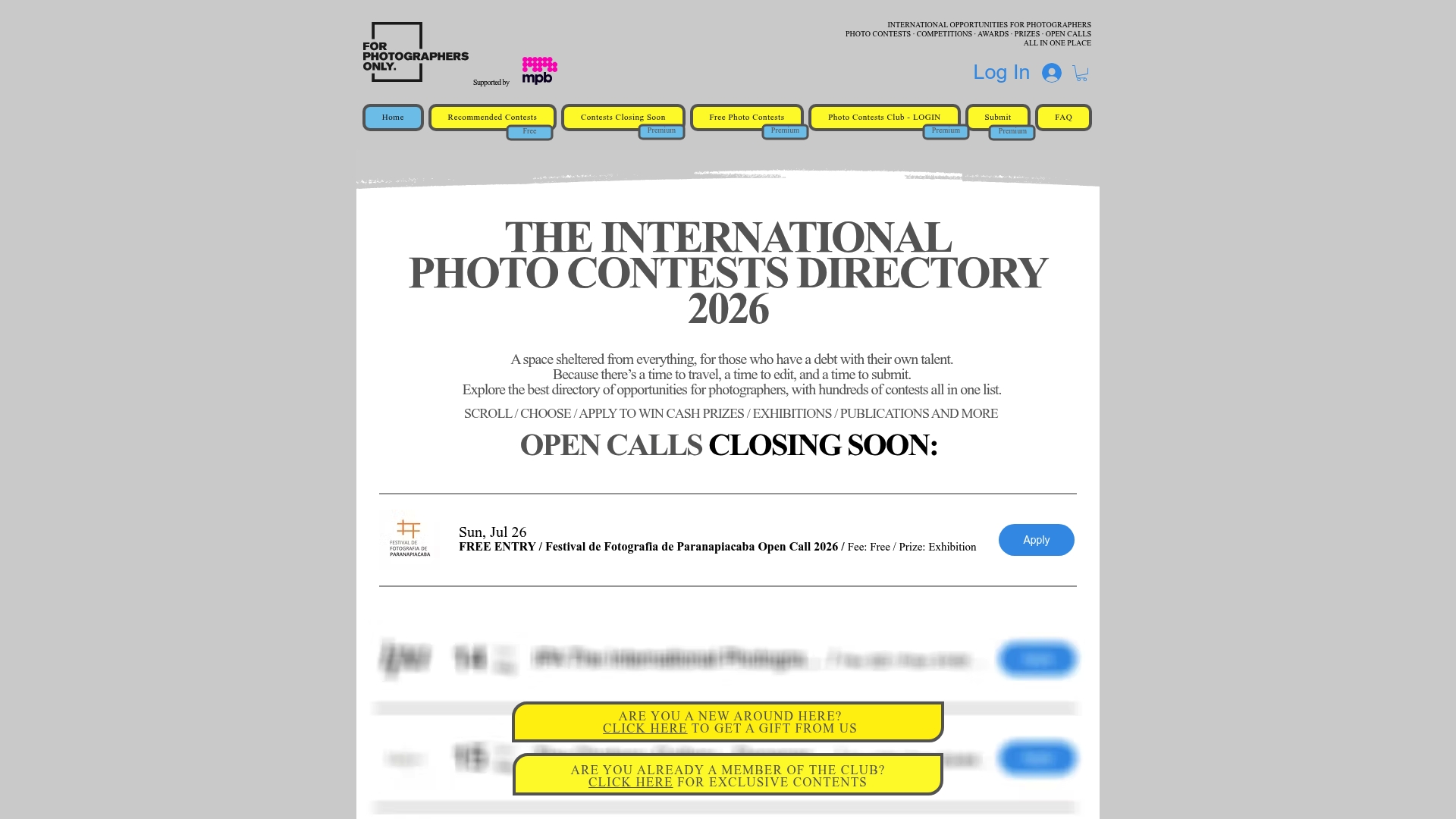
Membership costs €6 per month or €40 per year, and a free trial is available. Members also join a photographer community and a monthly internal competition. To compare your Boston options with national awards, start with our US photography competitions guide and our annual photography awards shortlist.
FAQ
Are there free photography contests in Boston?
Some are. The Mass Audubon rules and the Boston Camera Club page we reviewed do not state an entry fee, while First Look charges $40 for up to 10 images. Always confirm current terms on the organizer’s page, since fees and membership conditions can change between editions.
Do I have to live in Boston to enter?
Not always. Mass Audubon is open to photographers of all skill levels and ages, apart from staff, board members and their families. Others, such as the BU Global Programs contest, are meant for a specific community, so read the eligibility paragraph first.
Can I enter film or darkroom work?
Yes, in some cases. Panopticon Gallery’s First Look accepts digital, film, traditional darkroom and experimental processes. Mass Audubon, by contrast, asks for digital photographs, and the Boston Camera Club competitions use digital files.
Are AI-generated images allowed?
Not in the GFWC Massachusetts contest, whose rules explicitly prohibit them. Keep your originals and edit history for any contest, so you can answer a question about how an image was made.
Where can I find contests beyond Boston?
A curated directory is the quickest route. Our own US competitions guide and the PhotoContestsClub page collect deadlines, fees and genres in one place so you can match your series to the right opportunity.
Sources