Photographers: Black and White Photo Contests That Boost Exposure

The strongest international black and white photo contests to enter this year include the Sony World Photography Awards Single Image competition for free-entry global exposure, MonoVisions Photography Awards and reFocus Black & White Photo Contest for series-friendly formats, Monochrome Photography Awards for cash prizes and exhibition placement, and LensCulture’s Black & White Photography Awards for editorial discovery. Photographers who want to track all of these plus dozens more can use For Photographers Only as a curated shortcut to deadlines and fees.
TL;DR:
Enter contests with a clear goal, such as building visibility, winning cash, or gaining editorial exposure, and choose based on the reward structure.
Verify rights clauses, judging panels, and concrete promises of publication before paying any submission fees to avoid disqualification or disappointment.
Focus on format-specific requirements like file resolution, category fit, and clean naming to ensure entries meet contest standards and prevent automated rejections.
Use curated tools like For Photographers Only to track deadlines, fees, and rules across multiple competitions efficiently, saving time and avoiding missed opportunities.
Prioritize contests that offer meaningful exposure, such as gallery features or magazine coverage, rather than solely chasing large prize pools or reputation.
Table of Contents
What Are the Best Black and White Photography Competitions Right Now?
Every serious black and white photography competition asks for something slightly different, and the gap between them matters more than most photographers realize before their first rejection email arrives. Some reward a single decisive frame. Others want a conceptual series that holds together across five or eight images. A few care less about the prize money and more about who reviews your portfolio next.
Here’s how the major players actually stack up on the details that decide whether you should submit.
Black and White Photo Awards runs an international monochrome contest built around themed categories, from portraiture to architecture. Entry fees vary by category and deadline tier, and the payoff is a spot in an active winners gallery that judges and curators genuinely browse. This one suits photographers building online visibility fast, without waiting on a magazine’s editorial calendar.
Black & White Magazine contests, run by BandW Magazine (Ross Periodicals, Inc.), lean toward fine-art sensibility. Winners get featured inside the magazine itself, which carries more weight with gallery owners than a web badge ever will. If your portfolio is more “considered body of work” than “single striking shot,” this is the contest that rewards that patience.
One Shot Photo Contest, from Exposure One Awards, does exactly what its name promises: one image, judged on its own merits, with cash prizes and promotional assets built for winners to actually use. There’s no series-sequencing puzzle to solve here. You pick your best frame and let it stand alone.
Monochrome Photography Awards (Mono Awards) publishes its cash prizes and exhibition and publication opportunities directly on its site, which is rarer than it should be in this space. Organizers also maintain winners’ galleries with partner publication coverage, so a placement here tends to ripple outward into other outlets.
reFocus Black & White Photo Contest stands out for its format flexibility. The rules explicitly permit a series of two to five images judged together, alongside standalone single-image entries, and you can enter the same body of work across multiple categories judged independently. That’s an unusually generous structure for photographers still deciding whether their strongest work is a single frame or a short story.
MonoVisions Photography Awards goes further on series length. It defines a series as up to eight photographs sharing one concept, and publishes clear early and final deadline pricing for both single and series entries. Photographers working on longer documentary or conceptual projects will find more room to breathe here than almost anywhere else on this list.
B&W International Photo Awards keeps judging strictly monochrome across a set of themed categories, which means you’re never competing against a color image dressed up in grayscale. Life Framer’s Black & White Competition runs on a monthly cadence with rotating industry judges, which rewards photographers who’d rather enter small and often than wait a full year for one shot at recognition.
London Black and White Photography Awards and the separately organized Black And White International Photo Awards both add to the pool of monochrome-only judging routes worth checking directly for current fees and themes, since both update their categories periodically. Black & White Photography Contests, also under Ross Periodicals’ BandW Magazine umbrella, gives repeat entrants another publication-linked route beyond the flagship magazine contest.
For photographers trying to track all of this at once, a curated directory works differently. It doesn’t judge anything. It curates contests, tracks many active competitions including free-to-enter opportunities, and updates regularly so deadlines don’t slip past you unnoticed.
Pro Tip: Sony’s Open competition is free to enter and offers exhibition exposure alongside a notable top prize, which makes it a smart low-risk addition to any submission schedule even if monochrome isn’t its exclusive focus.
The scale gap between these contests is worth sitting with for a second: the Sony World Photography Awards received hundreds of thousands of entries across its categories, while a niche monochrome award might see a few thousand. Bigger isn’t automatically better for your odds, but it does mean bigger competitions demand a sharper, more distinctive visual idea to cut through the noise.
How Do You Choose Which Black and White Contests to Enter?
Not every contest deserves your entry fee, and running through a short checklist before you submit will save you more money than any editing trick will.
Define your goal first. Winning cash, getting editorial discovery, or building long-term exposure are three different aims, and separating them clarifies which contests deserve your entries and which ones just drain your budget.
Read the rights clause before anything else. Some organizers request usage rights for promotional purposes only; others ask for broader licensing. If a contest’s language is vague about how long they can use your image or where, that’s worth a direct email before you pay.
Check who’s actually judging. A jury of working photographers and curators means more than a panel of unnamed “editors.”
Confirm the exhibition or publication promise is specific. “Winners may be featured” is weaker than a named gallery, city, and date.
Run the arithmetic. A $35 entry fee against a $500 cash prize and a gallery show is a reasonable bet. A $60 fee against a certificate and a logo for your website is not.
Pro Tip: Keep a simple spreadsheet with entry fee, deadline, prize value, and rights terms for every contest you’re considering. Ten minutes of comparison shopping beats an impulsive submission every time.
Red flags worth walking away from: no named jury, no past winners published anywhere, and fee structures that increase sharply as the deadline approaches with no corresponding increase in prize value.
Preparing Black and White Entries That Actually Stand Out
Decide early whether you’re submitting a single image or a series, because the editing approach differs. A single entry needs to carry its full weight alone; a series needs internal rhythm and a reason the images belong together. reFocus caps series at two to five images, while MonoVisions allows up to eight sharing one concept, so check the cap before you finalize a sequence.
Technical basics matter more than they should have to: export at the resolution the contest specifies, respect JPEG file size limits, and convert to grayscale using a proper channel mixer rather than a flat desaturation, which tends to introduce banding in skies and shadows.
Keep concept statements tight. Many series categories cap statements around 150 to 300 characters, so write it before you’re rushed at the deadline.
Double-check sepia and toned images belong in the monochrome category specifically. Organizers often restrict sepia to monochrome sections only, not color categories.
Name your files cleanly and strip identifying metadata if the contest requires blind judging.
Pro Tip: If you want outside eyes on a submission before you commit an entry fee, LensCulture offers paid written reviews from working photographers, which can catch weaknesses you’ve stopped noticing.
How For Photographers Only Keeps Your Contest Search Current
Chasing deadlines across a dozen contest websites eats hours you could spend shooting instead. For Photographers Only solves that specific problem: the directory tracks more than 320 active international contests, over 100 of them free to enter, all updated weekly on one chronological page. You filter by deadline, fee, or theme instead of bookmarking a dozen separate sites and hoping you remember to check them.
Worth stating plainly: For Photographers Only doesn’t judge anything or run these contests. It researches and curates listings from external organizers, then presents them in one place so you never miss an early deadline for the sake of not knowing it existed.
What Do Judges Actually Look For When Scoring Entries?
Technical competence gets you into the room, but it rarely wins the room. Judges scanning hundreds or thousands of monochrome entries reward a clear subject, a decisive moment, or a genuinely distinctive way of seeing something ordinary. A technically flawless grayscale conversion with no strong visual idea behind it tends to lose to a rougher image with real point of view.
Composition and tonal control still count, particularly contrast handling and how well the image uses the absence of color rather than treating it as a limitation. Series entries face an added layer: jurors look for conceptual unity across the set, not just individually strong frames stitched together. A series where each image could stand alone but none of them speak to each other usually reads as a missed opportunity rather than a cohesive body of work.

Category fit matters more than photographers assume. Submitting a street photograph into a fine-art category, or a heavily staged portrait into a documentary category, often costs points before a judge even evaluates the image on its own terms. Read category descriptions literally, not aspirationally.
Editorial-leaning platforms like LensCulture add another wrinkle: editors may feature strong entries before jury decisions are finalized, which means visibility isn’t always contingent on winning outright.
Why Do Entries Get Disqualified or Rejected?
Most disqualifications have nothing to do with image quality and everything to do with reading instructions carelessly. Wrong file format tops the list: submitting a TIFF when a contest requires JPEG, or exceeding a stated megabyte limit, gets an entry bounced automatically in many automated submission systems before a human juror ever sees it.
Watermarks and visible signatures disqualify entries in nearly every contest that promises blind judging, since they undermine the anonymity the process depends on. Metadata containing your name embedded in a file can trigger the same problem even when the image itself looks clean.
Category mismatches cause quieter rejections. An image entered into a monochrome category that still carries a visible color tint, or a sepia-toned image entered where organizers restrict sepia to monochrome sections only, risks disqualification even if the photograph itself is strong.
Rights violations are the costliest mistake. Submitting an image you don’t fully own, or one containing a recognizable person without a release where required, can void your entry and, in serious cases, damage your standing with that organizer permanently. Series entries exceeding the stated image cap, whether that’s reFocus’s five-image limit or MonoVisions’ eight-image limit, get trimmed or rejected outright rather than judged as submitted.
What Happens Between Submission and Winner Announcement?
The timeline behind most black and white photo contests follows a predictable rhythm, even though the exact dates shift by organizer. An early-bird entry window opens first, typically carrying a lower fee, followed by a regular deadline at a higher rate, and sometimes a final late window at the highest price point. MonoVisions structures its fee tiers exactly this way, rewarding entrants who commit early.
Once the deadline closes, an initial screening round filters out entries with technical disqualifications, format violations, or category mismatches before any real judging begins. Surviving entries then move to the jury, which for contests with heavier reach can take several weeks given the entry volume involved, particularly for competitions processing hundreds of thousands of submissions across every category.

Shortlisting usually happens before final winner selection, giving organizers a chance to build anticipation and, in some cases, notify shortlisted photographers ahead of the public announcement. Final results get published on the contest’s own site and social channels, often paired with a winners’ gallery and, for higher-profile contests, coverage in partner publications or affiliated magazines.
Exhibition and publication follow separately, sometimes months after the announcement itself, since gallery scheduling and print magazine lead times rarely align neatly with a contest’s judging calendar. Patience matters here almost as much as the image quality that got you shortlisted in the first place.
Submitting to Several Contests Without Losing Your Mind
Running the same portfolio through multiple contests efficiently comes down to organization more than talent. Build one master folder of your strongest black and white images, properly converted and sized at your largest usable resolution, then export contest-specific versions from that master file rather than re-editing from scratch each time.
Track every deadline, fee, and rights clause in one running document, whether that’s a spreadsheet or a dedicated tracking tool. Missing a deadline because it lived only in your email inbox is the single most avoidable mistake serious entrants make.
Stagger your submissions across contest types deliberately: pair one free, high-reach contest like Sony’s Open competition with one or two paid, smaller monochrome-specific contests where your odds against the field are genuinely better. Reusing a strong single image across several eligible contests is standard practice, provided each contest’s rights terms don’t demand exclusivity.
Batch your writing tasks, too. Draft your concept statements and captions once, then adapt the wording slightly for each contest’s character limits rather than starting from a blank page every time. A curated directory that flags upcoming deadlines removes most of the manual tracking burden entirely, which is precisely the gap a resource like For Photographers Only is built to close.
What Contests Are Actually Worth to Your Career
Contests rarely make a career on their own, and treating a win as the finish line misses the point entirely. The real value shows up in editorial discovery, gallery introductions, and the small credibility boost a published win adds to a bio. Prize money is nice. It’s also the least durable benefit on the list.
Prioritize gallery and editorial pitching when you have a cohesive body of work ready for a direct conversation. Lean on contests when you need a structured deadline to finish that work, or when you want feedback from jurors you’d otherwise never reach. Persistence beats talent here more often than either photographers or contest organizers like to admit; the photographers who place consistently are usually the ones who entered five times before their first shortlist.
— DARIO
Get Every Deadline Without Hunting for It Yourself
Chasing contest deadlines across a dozen bookmarked pages costs photographers hours that could be spent shooting. Certain curated directories aim to solve that problem by providing a continuously updated page tracking hundreds of international contests, including many free to enter, refreshed frequently so nothing slips past unnoticed.
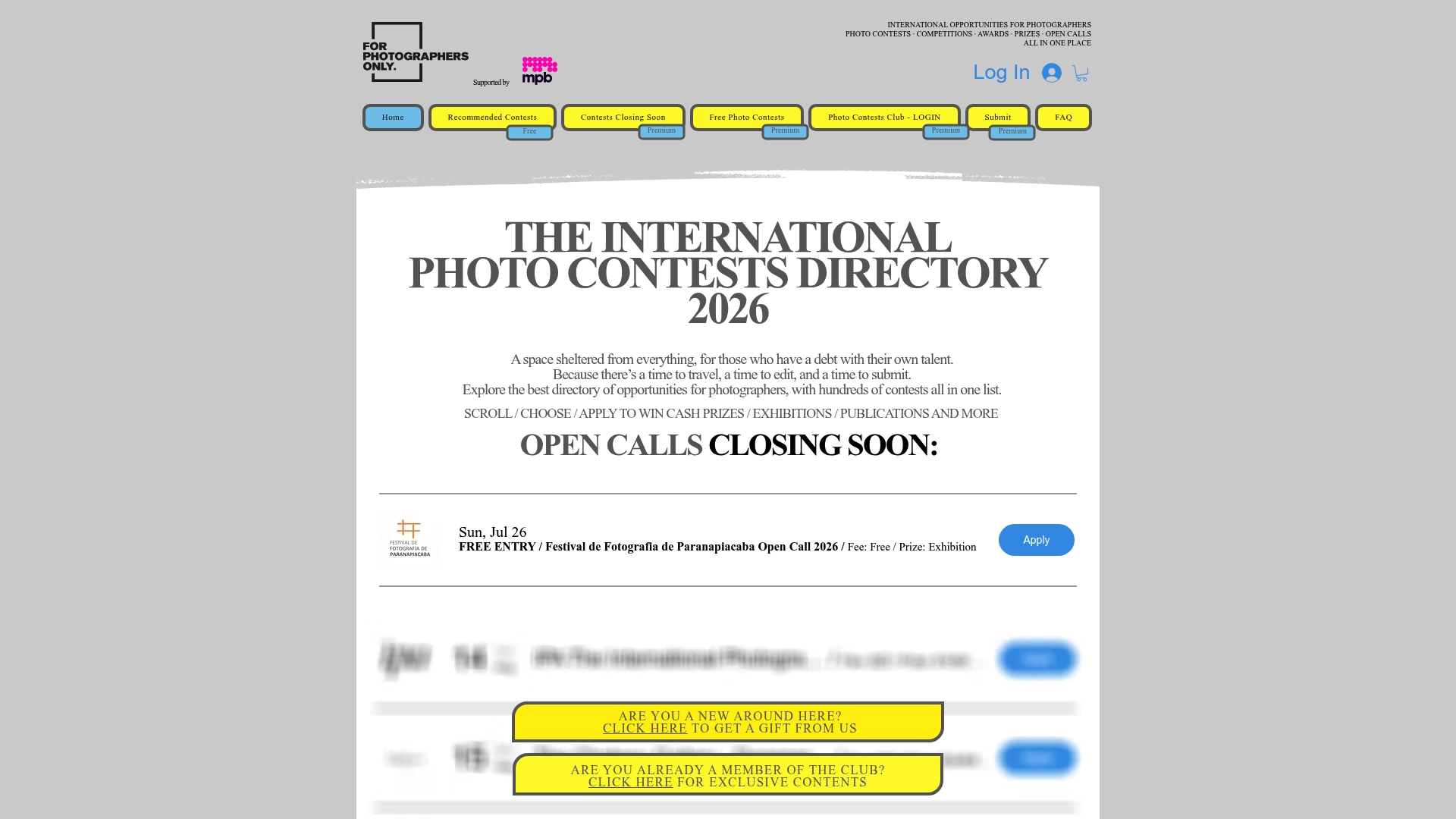
The PhotoContestsClub subscription gives you:
Weekly-updated access to the full curated contest list, not a static snapshot
Deadline visibility across free and paid opportunities in one chronological view
A shortlist built from real research, not a scraped aggregator feed
A low-cost way to stop missing early-bird pricing windows on contests you’d actually enter
Forphotographersonly doesn’t organize or judge any of these contests. It curates them from the organizers running them, then hands you one clean, chronological page to work from. Subscriptions run 6 € per month or 40 € per year, and you can check current listings on the contests page to see what’s open right now.
FAQ
What Are Some Competitions for Black and White Photography?
Leading options include the Sony World Photography Awards Single Image competition, MonoVisions Photography Awards, reFocus Black & White Photo Contest, Monochrome Photography Awards, and LensCulture’s Black & White Photography Awards. A curated directory tracks these and hundreds of other active contests in one place.
What Photo Contests Are Happening in 2026?
Most major black and white contests, including MonoVisions, reFocus, and the Sony World Photography Awards, run annual cycles with early and regular deadline tiers throughout the year. Checking a curated, weekly-updated source like For Photographers Only is the most efficient way to see which windows are currently open.
Are Photo Contests Worth It?
Contests are worth it when the entry fee is reasonable against the prize value and exposure offered, and when the organizer publishes a named jury and past winners. They’re less valuable purely for cash and far more valuable for editorial discovery, exhibition placement, and portfolio credibility over time.
Is There a Portrait Photo Competition Scheduled for 2026?
Several of the contests covered here, including Black and White Photo Awards and B&W International Photo Awards, run dedicated portrait categories within their broader monochrome competitions. Check each organizer’s current category list directly, since themes rotate between cycles.
Recommended