From $15 to $5,000: Bird Photography Awards Photographers Should Enter
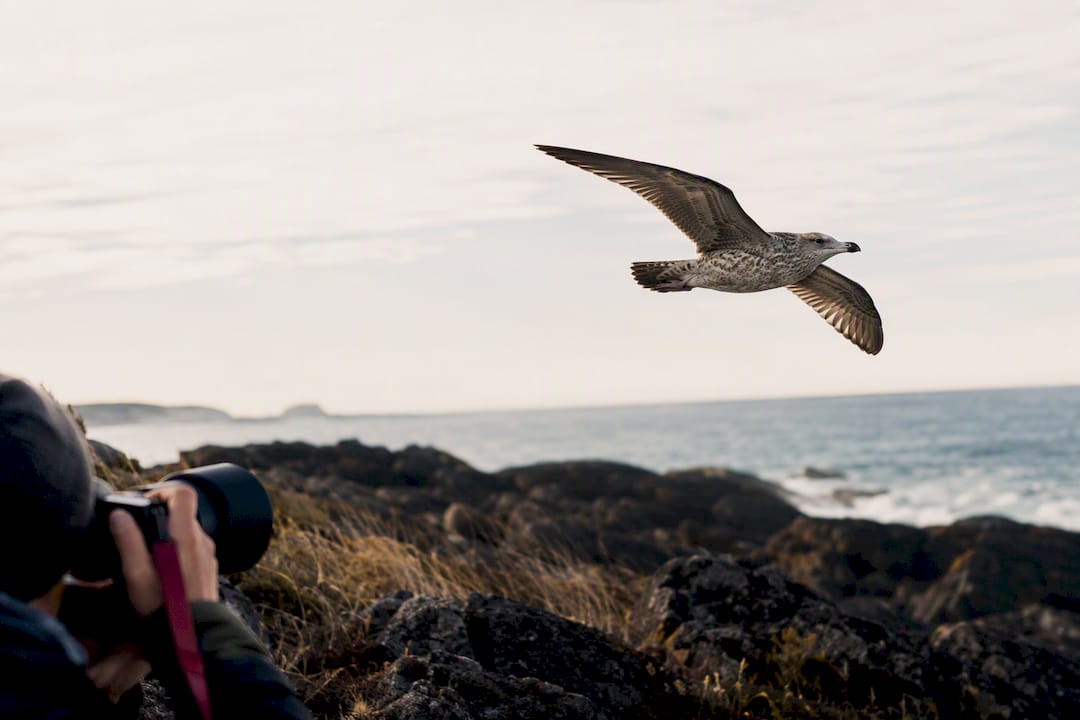
The strongest starting lineup for any bird photographer is the Audubon Photography Awards, Bird Photographer of the Year, the BirdNote photo contest, and a festival contest like the Delta Birding Festival. Together they cover the full spectrum, from a $15 entry fee and a shot at a $5,000 grand prize to international exhibition and publication. This guide walks through entry logistics, judging expectations, winners galleries, and how to actually prepare a submission that holds up.
TL;DR:
The largest prizes and most widespread exposure are offered by Audubon and Bird Photographer of the Year, with Audubon providing the biggest monetary rewards.
Deadlines vary significantly, with Audubon opening in January and others, like BPOTY and regional contests, operating on different schedules throughout the year.
Judges evaluate images based on technique, composition, originality, and storytelling, with strict ethics rules requiring honest behavior and habitat portrayal.
Successful entries are often the result of patience, behavioral capture, environmental context, and proper preparation, including location scouting and file compliance.
Study previous winners’ galleries and follow contest updates through centralized directories to improve chances and stay informed of opportunities.
Table of Contents
The Major Bird Photography Awards Worth Your Attention
Every contest rewards something slightly different, and picking the right one starts with matching your strongest images to the award built for them. Here’s how the field breaks down.
The Audubon Photography Awards is the benchmark for U.S. and Canadian entrants. It’s open to residents of the 50 states, D.C., and Canada, excluding Quebec, with an entry fee per image or video. The 2026 contest opened January 15, and prizes include a grand prize plus a voyage to Antarctica for the top winner. Categories typically span professional, amateur, youth, and video, and Audubon publishes a full winners feature each year through its magazine.
Bird Photographer of the Year (BPOTY) operates on a different scale entirely. It’s the leading international competition in this space, with entries arriving from photographers across dozens of countries and a published winners gallery that doubles as a study guide for anyone serious about the craft. BPOTY runs both single-image and portfolio categories, and the overall winner receives a cash prize along with the title.
The BirdNote photo contest takes a more community-driven approach. Its 2026 rules outlined two categories, General Bird Photography and Conservation Actions, with public voting determining the General category winners while judges handle Conservation Actions separately. That split matters: if your strongest image tells a conservation story rather than a purely aesthetic one, BirdNote gives it a dedicated lane.
Regional contests fill in the gaps. BirdLife Australia Photography Awards runs themed categories with sponsor involvement and a published code of ethical conduct, a useful model for photographers curious how regional organizations structure prizes and rules. Closer to home, the Delta Birding Festival runs its own U.S. festival contest, a smaller but genuine opportunity that often gets overlooked next to the bigger international names.
What separates these from a hundred smaller contests:
Audubon offers the largest single cash prize and mainstream editorial exposure.
BPOTY offers the widest international reach and a portfolio option for consistent bodies of work.
BirdNote rewards conservation storytelling with its own category.
BirdLife Australia and the Delta Birding Festival offer regional, lower-competition entry points for building a track record.
How to Enter: Deadlines, Categories, and Fees
Missing a submission window is the single most avoidable mistake in this field, and it happens constantly because contest calendars don’t align. Audubon opens its window on January 15 each year. BirdNote runs its submission period in early spring. BPOTY and regional contests each set their own calendars, often months apart. Treat every contest’s rules PDF as the actual source of truth, since dates and fees shift year to year.
A practical entry workflow looks like this:
Build a contest calendar the moment a new season opens, noting open dates, close dates, and announcement windows for each award you’re targeting.
Read the full rules PDF, not just the entry form, since categories, image counts, and eligibility restrictions vary widely between contests.
Confirm the fee structure directly on the contest site. Audubon charges $15 per image or video for individual entrants; other contests use portfolio pricing, early bird discounts, or fee waivers for youth categories.
Prepare release forms in advance if a contest requires proof of rights or model releases for any human subjects incidentally in frame.
Match your files to spec before the deadline week, checking resolution, file size, and metadata requirements so a technical rejection never costs you a strong image.
Categories generally fall into single image, portfolio or series, youth, and increasingly video. BPOTY’s portfolio format rewards a consistent, well sequenced body of work, while single-image categories live or die on one decisive frame. Decide which format actually suits your strongest material before you start uploading.
What Judges Actually Look For (and What Gets You Disqualified)
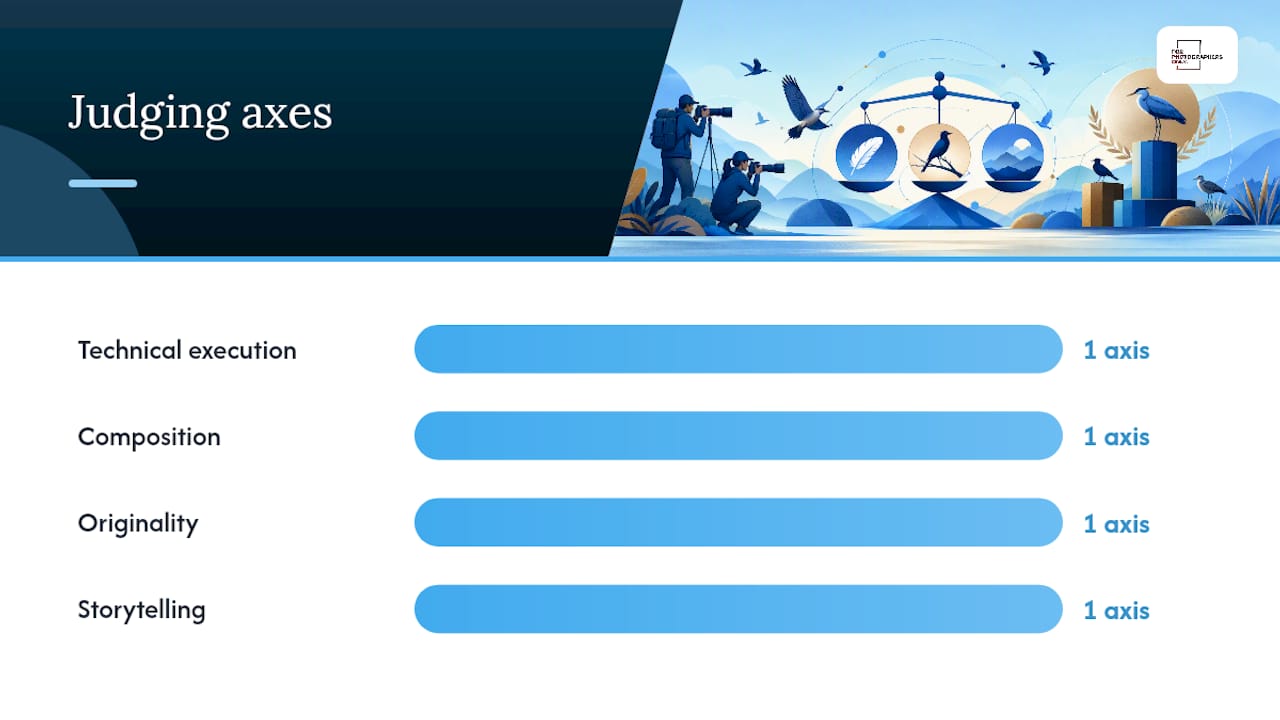
Judging panels across these awards tend to score along the same four axes: technical execution, composition, originality, and storytelling. BirdNote’s published criteria name all four explicitly, including “the story behind the image” as a distinct scoring factor, not an afterthought. Technical quality means sharp focus, clean exposure, and no distracting sensor artifacts. Composition and visual impact separate a competent record shot from an image that stops a judge mid-scroll. Originality rewards a genuinely fresh angle on a common species over a technically perfect but familiar pose.
Ethics rules sit alongside the scoring criteria, and they’re non-negotiable. Contest pages from BirdLife, Audubon, and BirdNote all include ethics statements prohibiting baiting, harassment of subjects, and misleading metadata, and entrants typically confirm compliance as part of submission. Expect limits on staged or captive-bird photography, and expect contests to ask you to withhold exact location data for endangered or sensitive species rather than publish coordinates that could invite disturbance.
Some quick markers of a contest worth your trust:
A published, named judge panel rather than an anonymous review process.
An explicit code of ethics, not a vague “play fair” line buried in fine print.
A downloadable rules PDF that spells out disqualification criteria.
Clarity on whether judging is anonymized or influenced by public voting, as with BirdNote’s General category.
Pro Tip: Write your caption before you second-guess it. Judges reading blind can’t infer behavior or context you didn’t state, and a precise, honest caption often does more for your score than another round of editing.
What Winning Images Actually Have in Common
Audubon’s own editors have made a point of saying that many award-winning photographs come from hours, days, or years of patience in the field, not a lucky pass with a long lens. That patience shows up as behavior: a courtship display, a hunting sequence, a fledgling’s first flight, captured with the bird clearly situated in its habitat rather than isolated against a blown-out background.
Editors reviewing recent Audubon winners describe a recurring pattern: the strongest entries pair a genuinely difficult behavioral moment with enough environmental context that the image reads as a complete story, not just a portrait.
That combination, technical polish plus narrative, shows up again and again across contests, and conservation-themed entries appear frequently among judges’ top selections. When you write your submission notes, describe the behavior and habitat context plainly. If the subject is a sensitive or rare species, keep exact coordinates out of any public-facing caption while still giving judges enough private context to understand what they’re looking at.
Preparing an Entry That Actually Competes
Start before you ever pick up the camera. Scout locations across seasons, learn migration timing for your target species, and keep a respectful distance that avoids flushing birds or disrupting nesting behavior. Contest ethics rules exist partly because judges can often tell when a shot was forced.
Once you have a shortlist of strong images, narrow it by asking three questions in order: does it have visual impact at first glance, does it tell a story a caption can support, and does it hold up at full resolution. Cut anything that fails the first question outright, no matter how technically clean it is.
Confirm your species ID and behavior notes before writing captions, since misidentification undermines credibility fast.
Decide how much location detail to share. Give judges habitat and behavioral context, but withhold precise GPS for sensitive or rare species.
Check file specs against the rules PDF for resolution, format, and maximum file size.
Gather any required release forms and proof of rights before the submission window closes.
Back up your raw files and finals separately, since some contests request originals if your entry advances.
Pro Tip: Keep a running folder of “contest-ready” edits year round instead of scrambling the week before a deadline. Your best frame from June might be exactly what a January deadline needs.
Where to Study Past Winners
The fastest way to calibrate your eye is to study the winners galleries directly. Audubon’s magazine feature often includes camera and lens details behind standout shots, useful for reverse-engineering gear and technique choices. BPOTY’s gallery does the same on an international scale, and BirdNote publishes its category winners alongside judge commentary.
Read the “behind the shot” notes for context on timing, gear, and field conditions.
Cross-reference EXIF data where published to understand focal length and exposure choices on winning frames.
Set a calendar reminder or follow contest social channels to catch entry openings before they close.
Browse editorial venues like Birdwatching Magazine for additional context on what publications value in bird imagery.
Why These Contests Matter More Than a Trophy
Contests give bird photographers something a personal portfolio can’t manufacture on its own: third-party validation from named judges, publication in outlets your work wouldn’t otherwise reach, and a public record of recognition that curators and editors take seriously, which can also be boosted through specialized Photography SEO Services to be discovered and book more shoots. That’s not vanity. It’s how editorial visibility actually compounds over a career.
What I’d push back on is the idea that entering once and losing means a contest wasn’t worth it. The patience Audubon’s editors describe in winning photographers applies just as much to the submission process itself. Track deadlines consistently, enter the contests that match your strongest work, and treat each cycle as data about where your images stand. That’s exactly the discipline a curated, weekly-updated directory like Forphotographersonly’s is built to support.
— DARIO
Track Every Bird Photography Deadline in One Place
Chasing contest deadlines across a dozen different websites is how strong entries get missed, not because the work wasn’t ready, but because nobody remembered the window was open. PhotoContestsClub solves that by putting every major opportunity, bird photography awards included, on one continuously updated page, filterable by genre and deadline, with free-to-enter contests flagged clearly.
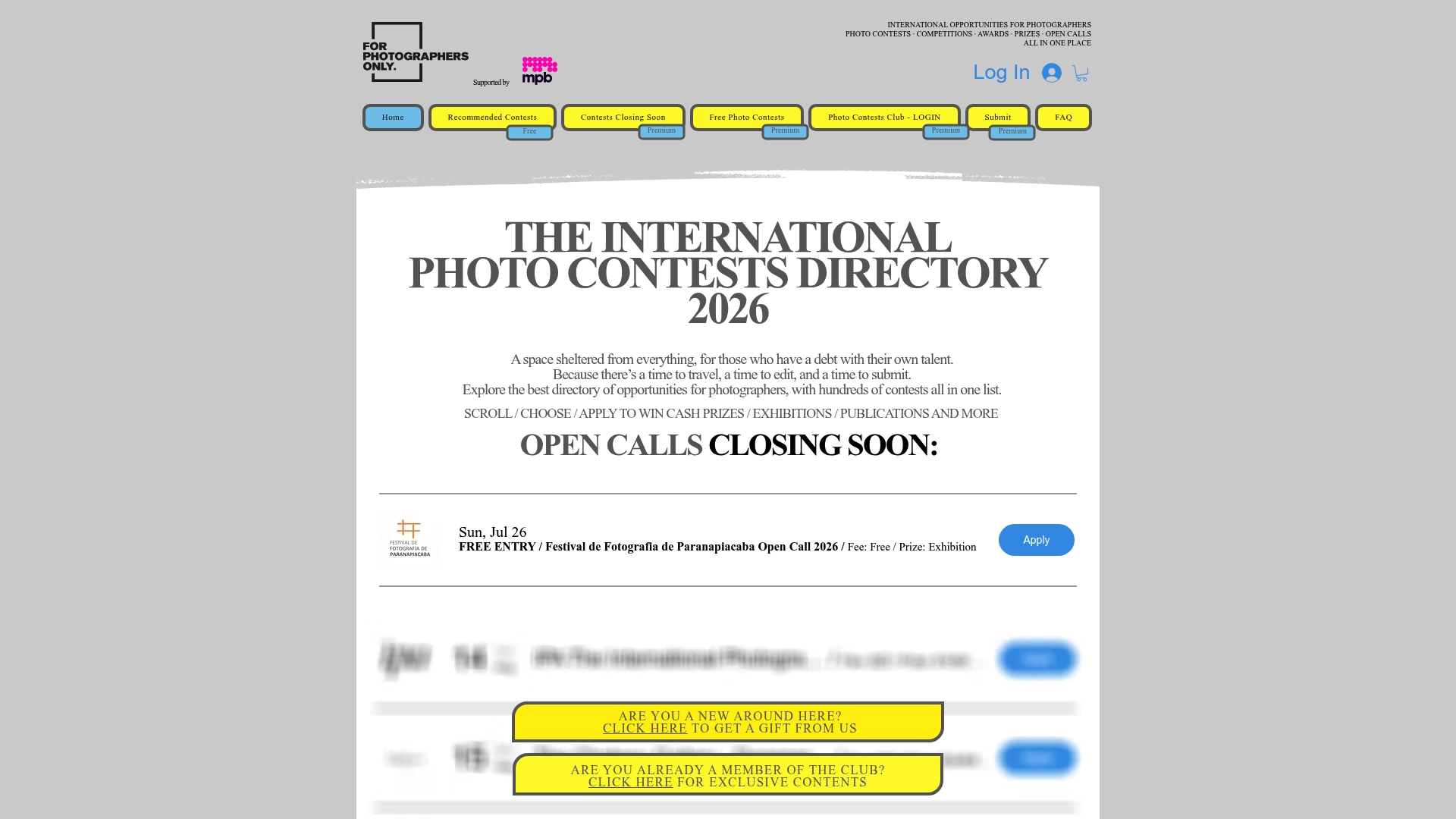
Instead of bookmarking Audubon, BPOTY, BirdNote, and every regional award separately, you check one regularly updated list covering hundreds of active photography competitions worldwide, including many free to enter. Subscriptions to access such directories are commonly available. If you want to build a real track record of recognition, exhibition, and publication over the next 12 months, explore the current contest list and start planning your next entry today.
Where to Verify Contest Rules and Winners
Bookmark the official sources directly rather than relying on secondhand summaries. The Audubon Photography Awards entry page, BPOTY’s winners gallery, and BirdNote’s contest rules each publish current fees, deadlines, and ethics statements straight from the organizers.
Audubon Photography Awards entry and rules page
Bird Photographer of the Year winners gallery
BirdNote annual photo contest rules
Delta Birding Festival contest coverage for U.S. festival entrants
Sources
FAQ
What Is the Entry Fee for the Audubon Photography Awards?
Audubon charges $15 per image or video for individual entrants from the U.S. and Canada, excluding Quebec. The contest opened January 15, 2026, with a $5,000 grand prize and an Antarctica voyage among the top awards.
How Are BirdNote Contest Winners Selected?
BirdNote uses a two-category system: General Bird Photography winners are chosen through public voting, while Conservation Actions winners are selected by judges. Both categories weigh technical quality, originality, composition, and the story behind the image.
Is Bird Photographer of the Year Open to Amateurs?
Yes. BPOTY accepts entries internationally across amateur and professional categories, plus single-image and portfolio formats, so photographers at any stage can enter.
How Do I Find New Bird Photography Contests as They Open?
The fastest way is a continuously updated directory rather than checking individual organizer sites. Forphotographersonly’s PhotoContestsClub updates its listings weekly and flags free-to-enter opportunities, available for $6 per month or $40 per year.
Do Contests Penalize Photographers for Baiting or Staging Birds?
Yes. Most major contests, including BirdLife Australia’s awards, publish explicit ethics statements prohibiting baiting, harassment, and staged captive subjects, and entrants must confirm compliance before submission.
Recommended