Photographers: Track 320 Astrophotography Competitions and Deadlines
If you’re chasing recognition for your night-sky work, five contests define the field right now: the ZWO Astronomy Photographer of the Year competition, Capture the Dark, the Astronomy Magazine Astrophotography Contest, the Astrophotography Prize, and Milky Way Photographer of the Year. This guide walks through their rules, deadlines, file and metadata requirements, and the technical habits that separate shortlisted images from the rest, with links to official pages so you can verify every detail before you submit.
TL;DR:
Most disqualifications occur due to missed capture date windows or metadata inaccuracies, not image quality, emphasizing the importance of following submission guidelines precisely.
Entering the correct category and providing honest, detailed processing disclosures are crucial, as judges scrutinize stacking artifacts, noise, and editing practices for authenticity.
Long-exposure deep-sky images require stacking and calibration, while planetary shots demand high frame-rate captures, highlighting different technical approaches for each category.
Successful entries often involve stable mounts, long integration times, and thorough documentation, as composition and signal-to-noise ratio heavily influence judging outcomes.
Building a strong portfolio depends on consistent submissions, studying winners’ work, and tracking contest feedback to refine techniques and storytelling over time.
Table of Contents
What Are the Top Astrophotography Competitions to Enter?
Every major astrophotography contest has its own personality. Some reward technical precision, some reward conservation storytelling, and some reward pure visual drama. Knowing which is which saves you from submitting the wrong image to the wrong call.
ZWO Astronomy Photographer of the Year, run by Royal Museums Greenwich, is the field’s most prestigious open competition. It splits entrants into adult and young categories, awards a top cash prize, and exhibits shortlisted work at the National Maritime Museum in Greenwich. International entrants regularly place, and the annual gallery doubles as one of the best free study resources available anywhere.
Capture the Dark, organized by DarkSky International, centers on responsible astrophotography and light-pollution advocacy. It runs People’s Choice voting alongside juried categories and occasionally adds pop-up themes tied to cultural moments, such as a past collaboration built around Star Trek.
Astronomy Magazine’s Astrophotography Contest asks for recent captures and detailed processing disclosures, including a Processing category that uses a shared Telescope Live dataset so every entrant works from identical raw data.
The Astrophotography Prize stands out for live judging replays and direct feedback from judges, plus exhibition placement at venues like Chabot Space & Science Center.
Milky Way Photographer of the Year rewards wide-field storytelling, favoring images that pair a striking galactic core with a strong foreground.
Each contest welcomes global entrants, though a handful cap total entries per photographer, so check the fine print before you submit your full portfolio.
How Do You Enter an Astrophotography Contest Correctly?
Most disqualifications have nothing to do with image quality. They happen because entrants skip a formatting rule, miss a metadata field, or submit a photo captured outside the eligible window. Follow this sequence before you hit submit:
Match the file spec. Contests typically want high-resolution JPEG or TIFF files, often capped at a specific megapixel or file-size limit, with clean file naming and no visible watermark.
Confirm the capture-date window. Many contests, including Astronomy Magazine’s, require images shot after a set date, sometimes January 1 of the prior year, so an older portfolio favorite may be flatly ineligible.
Fill out every metadata field honestly. Telescope or lens focal length, camera model, mount, exposure count, and processing software all belong in the submission form, not just the EXIF data embedded in the file.
Write a clear processing disclosure. Judges want to know exactly what you did between capture and final image, including any AI or machine-learning assisted noise reduction.
Check the fee structure. Entry fees vary by category and sometimes by number of images submitted, though several contests, including parts of Capture the Dark, offer free-entry categories worth checking first.
One rule catches more entrants than any other: submission metadata has to match your actual capture, since contest rules commonly require accurate technical disclosure covering telescope, camera, mount, and workflow, and a mismatch is grounds for disqualification even when the image itself is excellent.
What Categories Do Judges Actually Reward?
Category names sound similar across contests, but the images that win them differ sharply once you look closely. The RAStroPhoto competition run by the Royal Astronomical Society uses a structure that’s become close to an industry standard: Our Solar System, Deep Sky, Our Galaxy, Earth & Space, and Skyscapes, sometimes alongside a People and Space or Observing Astronomers category.
Deep Sky rewards long-integration targets like nebulae and galaxies, where stacking and calibration quality often decide the winner.
Our Solar System favors sharp planetary or lunar detail, usually the product of high frame-rate capture and careful stacking software.
Earth & Space / Skyscapes rewards composition just as much as astronomy, pairing a night sky with a compelling foreground.
Our Galaxy covers wide-field Milky Way work, where framing and light pollution management matter enormously.
Judges check for stacking artifacts, halos around stars, and inconsistent noise patterns before they even weigh composition. Originality and storytelling break ties among technically clean entries.
Pro Tip: Skyscape and Milky Way categories reward a strong foreground subject as much as the sky itself. Deep-sky categories reward signal-to-noise ratio above almost everything else, so scout your foreground for one and your integration time for the other.
What Do Winners Actually Get Beyond a Trophy?
Placing in a major contest pays off in more ways than a check. Cash prizes remain the headline, with ZWO Astronomy Photographer of the Year’s overall winner earning a substantial award, but the secondary benefits often matter more to a working photographer’s career.
Exhibition placement at institutions like the National Maritime Museum or Chabot Space & Science Center puts your name in front of curators and collectors you’d never reach otherwise.
Magazine publication, especially through outlets tied to Astronomy Magazine, generates the kind of editorial visibility that’s hard to buy.
Gallery inclusion alone, even without a cash prize, becomes portfolio material you can cite for years.
Community recognition through People’s Choice voting builds an audience that follows your future work.
Manage your expectations honestly: a shortlisting is a genuine credential, but it rarely converts to paid work overnight. Treat it as a compounding asset you add to your website and pitch materials.
What Gear and Processing Habits Do Winning Entries Share?
Winning images almost never come from a single lucky exposure. They come from stacking dozens or hundreds of frames to boost signal-to-noise ratio, then calibrating with dark, flat, and bias frames to strip out sensor noise and vignetting.
Stacking software like DeepSkyStacker, PixInsight, or Siril turns a noisy single frame into a clean composite, and most winners in Deep Sky categories use one of them.
Mounts and autoguiding matter more than camera body specs for long exposures; a stable equatorial mount with autoguiding often outperforms a newer camera on a shaky tripod.
Planning tools including PhotoPills, The Photographer’s Ephemeris, and FlightClub help entrants schedule shoots around galactic core visibility or eclipse timing months in advance, which practitioners consistently cite as a key advantage for seasonal and transient targets.
Processing discipline means documenting every step, since contests increasingly require entrants to declare AI or machine-learning noise reduction rather than let it hide silently in the workflow.
Pro Tip: A used mount with reliable tracking often beats a brand-new camera body for competition-grade results. Signal-to-noise ratio comes from integration time and stable tracking, not sensor generation.
How Should You Decide Which Contests to Enter?
Start by naming your actual goal, because the right contest changes depending on what you’re chasing. Cash-focused entrants should prioritize ZWO Astronomy Photographer of the Year and the Astrophotography Prize. Exposure-focused entrants should weight Capture the Dark and Milky Way Photographer of the Year for their audience reach and advocacy platform. Entrants still building technical range should treat Astronomy Magazine’s Processing category, with its shared dataset, as valuable practice regardless of outcome.
Confirm the deadline and submission window against your calendar.
Check entry limits per photographer and per category.
Verify the capture-date rule matches an image you already have or plan to shoot.
Review metadata and licensing terms before you submit.
Weigh the entry fee against the realistic exposure or prize value.
Contest | Entry fee | Deadline window | Who can enter | Entry limit |
Varies by category | Annual, opens mid-year | Global, adult and young categories | Multiple per category | |
Often free for some categories | Annual contest window | Global | Category-dependent | |
Astronomy Magazine Astrophotography Contest | Category-dependent | Annual | Global | Category-dependent |
Astrophotography Prize | Category-dependent | Annual | Global | Category-dependent |
Keep a simple submission calendar. Track which images you’ve submitted where, since resubmitting a previously entered photo to a new contest is common practice as long as it still meets that contest’s capture-date rule.
Who Judges These Contests, and What Are They Trained to Spot?
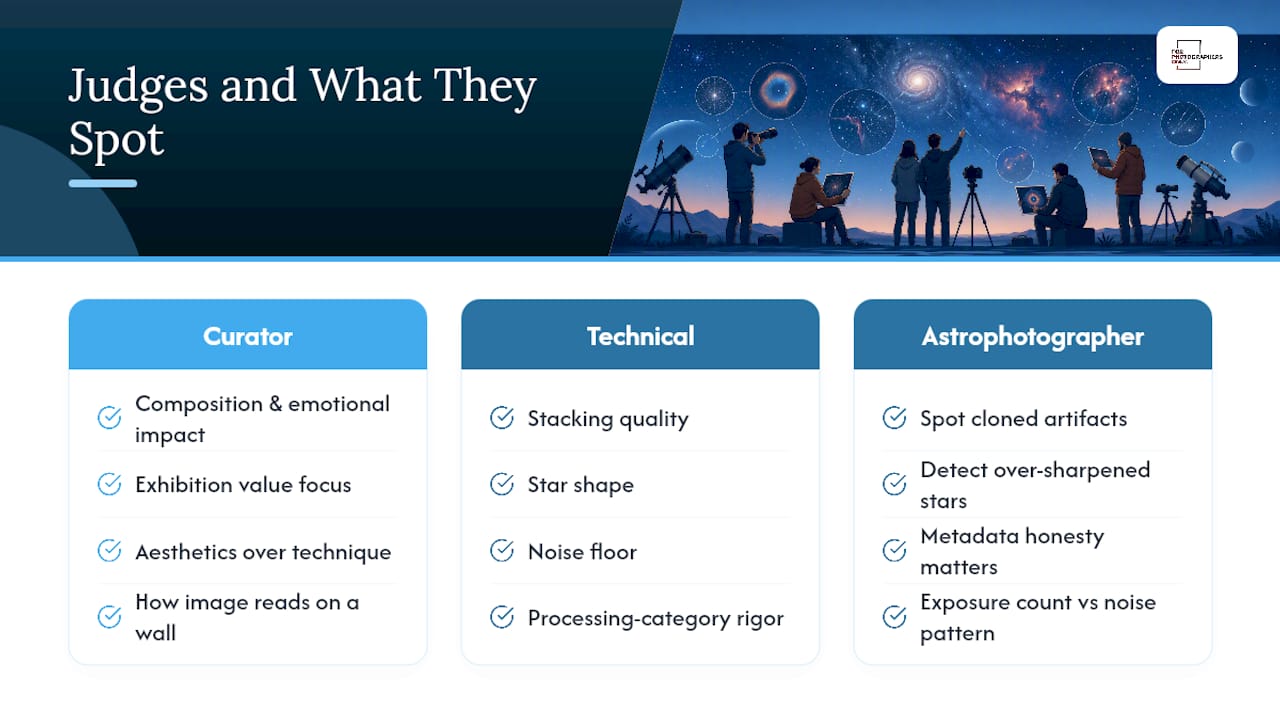
Judging panels typically combine working astrophotographers, museum curators, and magazine editors, which is why the same image can read differently across contests. A curator judging for exhibition value at a museum weighs composition and emotional impact heavily. A technical judge reviewing for a magazine’s Processing category scrutinizes stacking quality, star shape, and noise floor with far more rigor.
The Astrophotography Prize makes this visible by publishing live judging replays, letting entrants watch panelists debate an image’s merits in real time and hear the specific feedback that pushed one photo ahead of another. That transparency is rare in the photography contest world generally, and it’s worth watching even if you don’t enter that particular cycle, because the critique patterns repeat across contests.
Panels at contests like ZWO Astronomy Photographer of the Year tend to include practicing astrophotographers who can spot a cloned artifact or an over-sharpened star field instantly, since they’ve made and fixed the same mistakes themselves. That technical fluency is exactly why metadata honesty matters so much. A judge who has stacked a thousand deep-sky frames will notice when your claimed exposure count doesn’t match the noise pattern in the file. Studying a panel’s composition before you submit tells you a lot about what kind of image is likely to advance, and most contest sites list judge names and backgrounds directly on their rules pages.
What Contest Rules Most Often Disqualify an Entry?
Responsible astrophotography rules exist for a reason, and DarkSky International enforces them through an active moderation process built around its Principles of Responsible Astrophotography. Understanding what triggers disqualification protects work you’ve spent months capturing.
Visible watermarks or embedded copyright stamps are an almost universal disqualifier, since contests need a clean file for exhibition and publication use. Manipulated or missing EXIF metadata is nearly as common a problem, particularly when an entrant edits capture details to dodge a date-window restriction or exaggerate equipment specs. Composite images that blend multiple locations or fabricate sky elements not present in the original capture typically violate rules unless the contest explicitly allows composites in a labeled category.
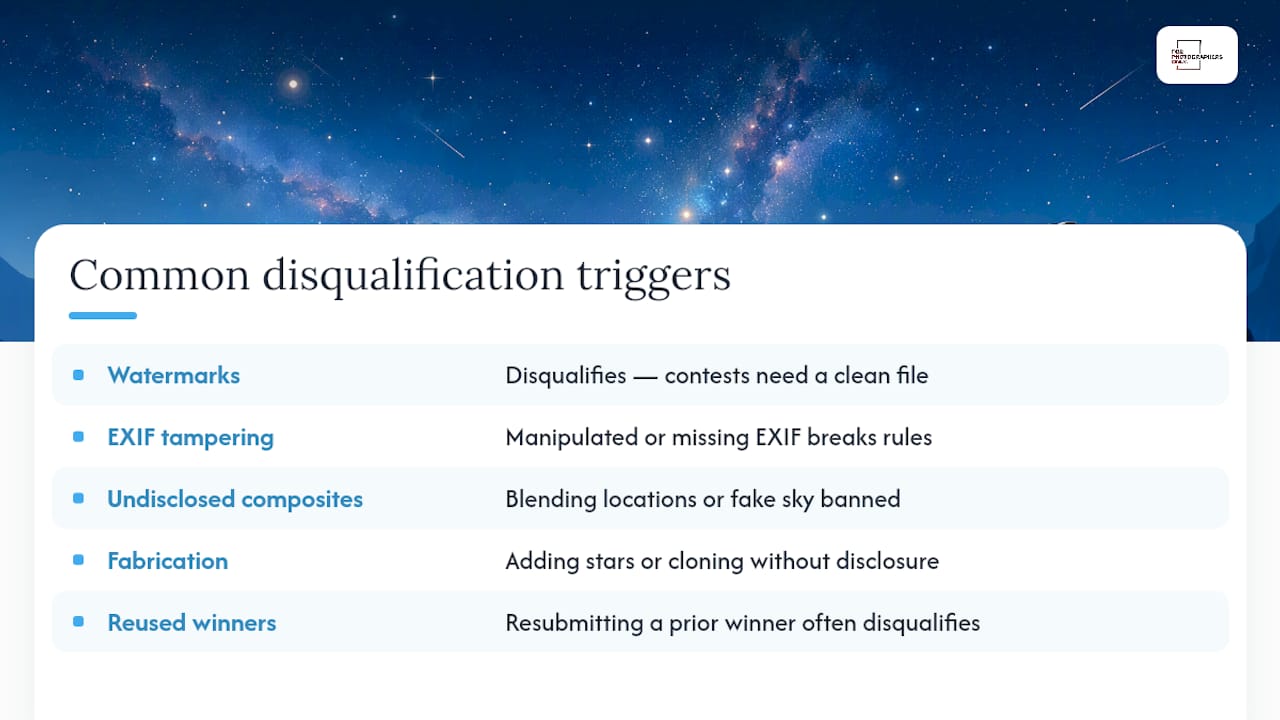
Excessive processing that crosses from enhancement into fabrication, such as adding stars that weren’t captured or cloning out satellite trails without disclosure, draws the same scrutiny. Several contests also disqualify entries that reuse a previous winning image from the same organizer, so read the eligibility section closely if you’re resubmitting a strong photo. When in doubt, over-disclose your processing steps rather than under-disclose them. A judge who sees a thorough, honest workflow note trusts the image more than one with a vague one-line description.
What Mistakes Cost Entrants the Most Placements?
The single most common mistake is submitting an image outside the eligible capture window, often because the entrant assumed an older favorite would qualify without checking the fine print. The second is skipping metadata fields, leaving telescope, camera, or processing details blank on the assumption that EXIF data embedded in the file will cover it, when contests explicitly want that information typed into the submission form.
Weak or missing image descriptions rank close behind. A judge reviewing hundreds of entries relies on your title, location, and a short story about the shot to understand context a bare image can’t convey on its own. Entering the wrong category is another frequent error, particularly submitting a heavily composited landscape into a strictly documentary deep-sky category, or the reverse.
Overprocessing is a subtler trap. Pushing saturation, star size, or noise reduction past a natural threshold reads as inexperience to a trained panel, even when the intent was to make the image “pop” for casual viewers. Finally, plenty of strong photographers simply enter too few contests, treating a single rejection as a verdict on their work rather than one panel’s preference on one day. The strongest portfolios come from entrants who submit consistently across multiple calls and refine based on feedback each time.
How Do Competition Entries Build a Lasting Portfolio?
Every shortlisting, even without a win, becomes evidence you can present to editors, galleries, and clients. The practical move is to treat each contest entry as a portfolio asset from the start: keep your original files, your processing notes, and your submission text organized so you can repurpose them for a personal website, a pitch email, or a future entry to a different contest.
Study the winner galleries from contests like ZWO Astronomy Photographer of the Year closely, since published EXIF data, framing choices, and processing notes from past winners function as a free education in what panels reward. Compare your rejected entries against shortlisted work in the same category to spot the gap in technical execution or storytelling.
Publication credits compound fastest when they’re documented consistently. A magazine feature such as those covered by BBC Sky at Night Magazine carries more professional weight when your website and social presence already show a pattern of contest recognition rather than a single isolated credit. Photographers who treat contests as a portfolio pipeline, entering multiple calls per year and tracking outcomes, tend to build recognizable bodies of work faster than those chasing one big win.
Where Is Astrophotography Competition Culture Heading Next?
Processing transparency is the clearest shift underway. Contests are moving from a general “no excessive editing” rule toward explicit AI and machine-learning disclosure requirements, a trend already visible in how Astronomy Magazine structures its Processing category around a shared dataset rather than trusting entrants’ raw files alone.
Responsible astrophotography themes are expanding too. Capture the Dark’s growth reflects a broader appetite for contests that pair visual competition with dark-sky advocacy, and pop-up categories tied to cultural moments, like past DarkSky collaborations, suggest organizers are experimenting with timely, campaign-driven calls rather than sticking to static annual categories.
Interactive judging is another emerging pattern. Live judging replays from the Astrophotography Prize give entrants a rare window into panel reasoning, and that kind of transparency is likely to spread as contests compete for entrant loyalty. Expect more contests to publish detailed feedback rather than a simple win or lose verdict, since entrants increasingly value the critique as much as the outcome. Wide-field storytelling categories, following the popularity of Milky Way Photographer of the Year, are also gaining ground relative to strict technical deep-sky categories, rewarding photographers who can combine a strong foreground narrative with a clean night sky.
Perspective From Forphotographersonly: Why Curated Deadlines Matter More Than Talent Alone
Talent gets you a strong image. A tracked deadline gets you into the contest at all. That’s the gap Forphotographersonly closes, curating over 320 active competitions weekly, with deadlines, fees, and exhibition flags attached, so entrants stop losing shortlist chances to a missed date rather than a missed shot.
— DARIO
Track Every Astrophotography Deadline in One Place
Chasing contest dates across five separate websites is how strong entries miss their window entirely. A service can put every major call, astrophotography included, on one continuously updated page with deadlines, fees, and exhibition details attached, so you check one source instead of multiple.

A directory can track hundreds of active competitions, including many free-to-enter opportunities, alongside brand-run contests and independent calls that rarely get attention despite real prize value. Beyond astrophotography specifically, the amateur photo contest roundup and calls like the IPA International Photography Awards show the range available to subscribers building a year-round submission calendar. For a partner perspective on turning contest recognition into bookings, photography SEO guidance explains how visibility compounds once you have credentials to point to.
Start a free trial and check the current Photography Life listing to see this week’s open astrophotography calls before their deadlines pass.
Sources
Recommended