Artist Statement Photography: Write One That Works

An artist statement in photography is defined as a concise written explanation of your work’s intent, process, and significance. It gives curators, judges, and audiences the context they cannot extract from the image alone. A strong statement does not describe what viewers can already see. It reveals the thinking behind the frame, the questions the work opens, and the reason the project exists at all. Most photographers treat it as an afterthought. The photographers who win contests and earn gallery placements treat it as a second artwork.
What is an artist statement in photography, and why does it matter?
An artist statement is a functional tool, not a piece of poetry or a biography. The Penn Journal of Arts and Sciences defines it as a document that adds clarity and depth to the work, leaving the reader with a sense of its direction or the questions it opens. That distinction matters. A statement that closes down interpretation with over-explanation does more harm than no statement at all.
Judges and curators read statements to understand intent. They want to know what you are making, how you are making it, and why it matters now. When a statement answers those three questions clearly, it supplements the visual work without competing with it. When it fails, it reads as either defensive or decorative, and both outcomes weaken the submission.
The standard industry term for this document is the “artist statement,” though photographers sometimes call it a “photography artist bio” or a “project statement” depending on the context. All three serve the same core function. The artist statement is the most widely recognized term across galleries, grant applications, and international contests.
What to include and avoid in a photography artist statement
The most effective statements answer three questions: what you make, how you work, and why it matters. Each element carries weight, and none should be skipped.
What to include:
The subject or medium you work in, stated plainly (“I photograph abandoned industrial sites in the American Midwest”)
Your process or approach, described in terms of intent rather than technique (“I work with long exposures to emphasize stillness rather than decay”)
The significance of the work: the questions it raises, the context it sits in, or the conversation it contributes to
Specific details that anchor the work to your unique perspective, such as a location, a community, or a recurring formal choice
Sequencing and process details that reveal the project’s shape and meaning
What to avoid:
Describing what is already visible in the images (“the photographs show light falling across empty rooms”)
Defending your creative choices (“I chose black and white because color felt distracting”)
Technical disclosures such as lighting setups or focal lengths, which are irrelevant to judges
Abstract themes like “memory” or “identity” unless they are tied to specific, visible elements of the work
Biographical details that belong in a CV, not a statement
Performative language that sounds impressive but says nothing (“I seek to interrogate the liminal space between presence and absence”)
Pro Tip: Read your statement aloud. If any sentence sounds like a caption for the image rather than a window into your thinking, cut it.
What is the ideal length and structure for a photography statement?
Length depends entirely on context, and getting it wrong costs you credibility. Judges spend under 30 seconds reviewing an image in a contest setting. A statement longer than 150 words reduces the likelihood it will be read at all. Brevity is a strategic advantage, not a compromise.
The three-paragraph structure works across both contexts. Each paragraph carries one job:
What the work is. Name the subject, medium, and scope. Be specific. “I document the daily rituals of fishing communities along the Louisiana Gulf Coast” is stronger than “I photograph people and their relationship with nature.”
How it is made. Describe your approach in terms of intent, not equipment. Explain what you do that another photographer would not do in the same location with the same subject.
Why it matters. Place the work in a larger context. This is where you connect the specific to the universal without abandoning the specific. The best statements create urgency around why the work exists now, without oversharing personal detail.
Context | Recommended length | Structure |
Photo contest submission | 2–4 sentences, under 150 words | Single tight paragraph covering intent and significance |
Portfolio or gallery submission | 150–300 words | Three paragraphs: what, how, why |
Grant application | 200–400 words | Three paragraphs plus project context and timeline |
Exhibition wall text | 50–100 words | One paragraph, accessible to a general audience |
Pro Tip: Write the full three-paragraph version first. Then cut it down to the contest version by keeping only the sentences that carry the most weight. You will always know what to cut when you have the full version in front of you.
How do you write a statement that is specific and authentic?
Generic statements are the most common failure in photography writing. A statement is too generic when it could apply to another artist’s work without changing a single word. That test is the most useful editing tool available.
Compare these two versions:
Version | Text | Problem or strength |
Vague | “I explore themes of memory and loss through intimate portraiture.” | Applies to thousands of photographers. No specific anchor. |
Specific | “I photograph elderly residents of a closing care home in rural Ohio, working over 18 months to record the relationships formed in shared spaces.” | Specific subject, location, duration, and formal approach. Impossible to transfer to another artist. |
Specificity comes from three sources. First, name the actual subject: a specific community, place, or recurring formal element. Second, describe what is unique about your process, not just that you “work intuitively” or “build trust with subjects.” Third, anchor abstract themes in visible or concrete elements of the work.
Authenticity follows from specificity. When the details are real and precise, the voice becomes yours automatically. Photographers who try to write in an “art world” register often produce statements that sound borrowed. Write the way you would explain the work to a thoughtful colleague who has never seen it. That voice is the right one.
Practical tips for drafting and revising your statement
The first draft of any artist statement is almost always too long, too vague, or too defensive. That is normal. The work happens in revision.
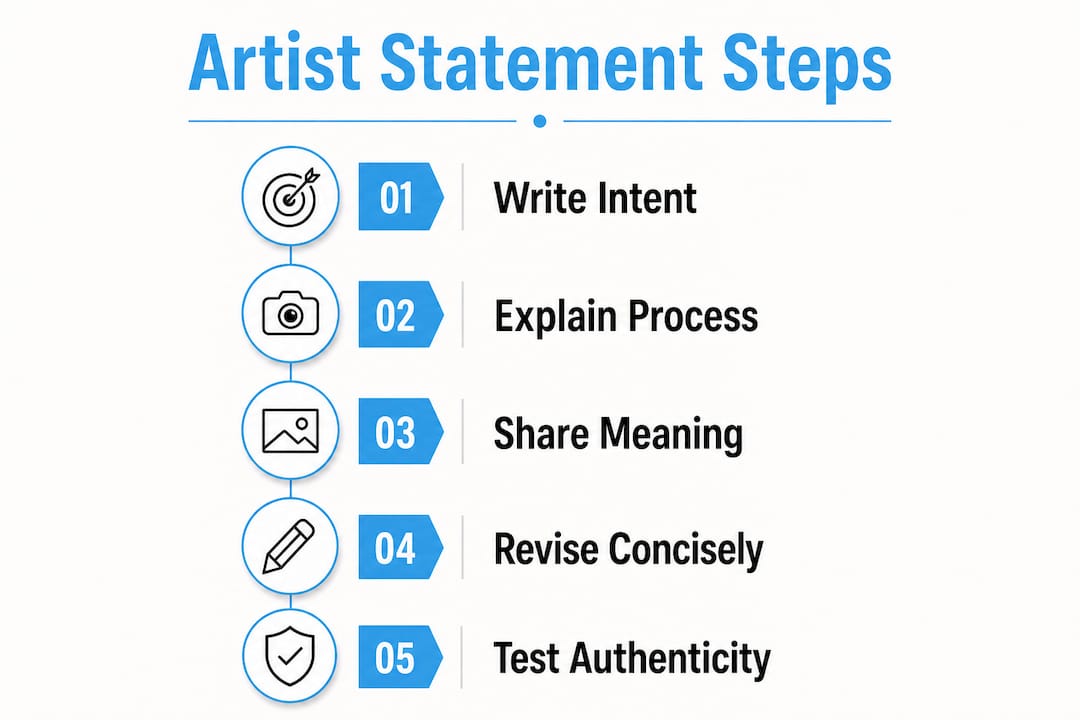
Write the first draft without editing. Get the ideas down in plain language, as if explaining the work to an intelligent stranger at a gallery opening. This approach produces clearer, more accessible statements than writing for an imagined curator.
Remove every sentence that describes only what is visible in the images. If the sentence worked as a caption, it does not belong in the statement.
Cut defensive language and technical disclosures entirely. Phrases like “I chose to shoot in natural light because…” signal insecurity, not authority.
Avoid opening sentences with “I find myself” or “I am drawn to.” These constructions reduce statement effectiveness and read as uncertain. Start with a direct claim about the work.
Read the final draft against the specificity test: could another photographer use this statement without changing it? If yes, revise until the answer is no.
When a contest does not require a statement, do not submit one. A weak statement is worse than no statement.
Clarity and honesty in writing signal intelligence to curators and judges more reliably than complex vocabulary. A direct, declarative sentence about your work outperforms three sentences of art-world prose every time.
Pro Tip: Give your revised statement to someone outside the photography world. If they can explain your work back to you after reading it, the statement is working. If they cannot, keep cutting.
Key Takeaways
A strong artist statement in photography answers what you make, how you work, and why it matters, in under 150 words for contests and 150–300 words for portfolios.
Point | Details |
Lead with intent, not description | State what the work is and why it exists, not what viewers can already see. |
Match length to context | Keep contest statements under 150 words; use 150–300 words for portfolio submissions. |
Test for specificity | If the statement applies to another artist’s work unchanged, it needs more concrete detail. |
Cut defensive language | Remove any sentence that explains or justifies a creative choice rather than revealing intent. |
Treat it as a living document | Update your statement each time your work shifts direction or focus. |
Why I think most photographers are writing their statements backwards
Most photographers write their artist statement after the work is finished, as a summary of what they made. That is the wrong starting point. The statement is most useful when it reflects the questions you were asking while making the work, not the conclusions you reached afterward.
I have reviewed hundreds of contest submissions over the years, and the statements that stand out share one quality: they make the reader feel the urgency of the project. Not urgency in a dramatic sense, but the sense that this particular photographer had to make this particular work, in this place, at this time. That quality cannot be manufactured in a summary. It comes from writing close to the process.
The other mistake I see constantly is treating the statement as permanent. Artist statements evolve as the work changes, and a statement written two years ago for a different body of work will undermine a current submission. Keep a working draft and update it every six months, or whenever you start a new project.
The photographers who struggle most with statements are often the ones with the most interesting work. They know the work too well to explain it simply. The discipline of writing a clear, honest statement forces a kind of clarity that actually improves the work itself. That is the part nobody tells you.
— DARIO
Forphotographersonly: where strong statements meet real opportunities
Writing a compelling artist statement is only half the equation. The other half is finding the right contests and exhibitions where that statement will be read by the people who matter.
Forphotographersonly is the leading directory of international photography competitions, featuring more than 320 active contests, including over 100 free-to-enter opportunities. The directory is updated every week, so photographers always have access to current deadlines and submission requirements, including the specific artist statement guidelines each contest demands. From Nikon and National Geographic competitions to independent festivals and gallery open calls, the full contest directory gives photographers a single place to find opportunities that reward strong, specific, and well-crafted submissions. For €6 per month, access every listing, updated continuously, with no searching required.
FAQ
What is an artist statement in photography?
An artist statement in photography is a short written document that explains the intent, process, and significance of your photographic work. It gives judges, curators, and audiences context that the images alone cannot provide.
How long should a photography artist statement be?
For contest submissions, keep the statement under 150 words, ideally 2–4 sentences. For portfolio or gallery submissions, 150–300 words organized in three paragraphs is the standard.
What should I avoid writing in my artist statement?
Avoid describing what is visible in the images, defending your creative choices, using technical details like camera settings, and relying on abstract themes like “memory” or “identity” without concrete anchors in the work.
How do I know if my statement is too generic?
Apply the transfer test: if another photographer could use your statement without changing a word, it is too generic. Add specific subjects, locations, durations, or process details that belong only to your work.
Do I always need to include an artist statement?
No. When a contest or submission does not require one, omit it. A weak or poorly written statement can reduce the impact of strong images, so only submit a statement when it genuinely adds context.
Recommended