Curated: 5 Annual Photography Awards for Photographers, Plus Deadlines
Annual photography awards are recurring international contests that recognize excellence in image making, offering photographers cash prizes, exhibitions, and publication credits each year. Start with five names worth checking first: Sony World Photography Awards, World Press Photo Contest, International Photography Awards (IPA), 35AWARDS, and Mobile Photography Awards. Confirm each contest’s eligibility and deadline, then track opening dates through a curated directory so nothing slips past you.
TL;DR:
Major awards differ in focus, with some emphasizing documentary storytelling like World Press Photo, and others celebrating creative experimentation, such as 35AWARDS.
Entry fees range from free at regional and mobile contests to over $50 for top-tier competitions, and building a strategic submission calendar improves chances of success.
Photographers should ensure licensing rights are limited and non-exclusive, and secure releases for recognizable subjects to avoid disqualification.
Winning or being shortlisted often leads to long-term career benefits through exhibitions, publications, and increased visibility among industry professionals.
Using curated directories for updates on deadlines and eligibility saves time and maximizes opportunities, especially when managing multiple contests simultaneously.
Table of Contents
The Major Annual Photography Awards Worth Your Attention
Every major award has its own personality, and matching your portfolio to the right one matters more than entering as many as possible. Some reward documentary rigor. Others celebrate experimentation on a phone screen. Here’s how the field breaks down.
Sony World Photography Awards runs a yearly cycle open to both amateurs and professionals, with Single Image and Series competitions. The Single Image category alone awards $5,000 to its winner, while prizes across the contest include Sony equipment, a London exhibition, and a spot in the official annual book. The organization has described its mission as extending relationships with winners well beyond the ceremony, using exposure and exhibitions to help develop careers over time.
World Press Photo Contest is the benchmark for photojournalism and documentary work. For its 2026 edition, the contest drew 57,376 photographs from 3,747 photographers across 141 countries, judged by independent regional and global juries. Winners appear in a flagship exhibition that tours internationally, giving selected work a publication.
International Photography Awards (IPA) separates entrants into professional, non-professional, and student categories, which levels the playing field for photographers at different career stages. IPA pairs its annual competition with festival events and a winners’ book, so recognition extends past a simple ranking. If you want to explore this contest’s current call for entries, the IPA 2026 open call breaks down category options.
35AWARDS welcomes amateurs and professionals into a multi-stage selection process that funnels down to a published annual catalogue. The award also runs themed contests with faster turnarounds between main cycles, letting you test niche work without waiting a full year.
Mobile Photography Awards dedicates itself entirely to images made on phones and tablets. It offers category-specific cash prizes and exhibitions across multiple cities, proving that gear-agnostic vision still commands serious attention.
Two more deserve a mention for range: APEC Photo Contest blends a jury award with public voting, giving photographers with strong social followings a shot at a Popular Choice prize of SGD 2,500. Eyeshot Open Call focuses on series and project work, and adjusts entry fees to income level by country, with hardship exemptions available.
Submission Formats, Fees, and a Realistic Entry Timeline
Getting technical details right often separates a shortlisted entry from a rejected one. Most contests specify minimum resolution, file format (usually JPEG), and strict limits on watermarks or borders. Series submissions typically require five to ten images with a consistent narrative thread, while single-image categories judge each frame independently.
Before you upload anything, work through this sequence:
Read the rulebook first. Every contest publishes eligibility rules covering capture dates, prior publication, and geographic restrictions.
Prepare metadata. Caption, location, and capture date fields are often mandatory, not optional.
Secure releases. Model and property releases are required whenever recognizable people or private property appear in the frame.
Check the fee structure. Entry fees range from free (many mobile and regional contests) to $50 or more per image for flagship professional categories, with early-bird pricing common.
Build a submission calendar. Mark the opening date, the fee-increase deadline, the final close, and the announcement date separately.
Pro Tip: When submitting a series, sequence matters as much as image quality. Jurors and editors judge thematic development across the full set, not just the strongest single frame, so order your images to build a narrative arc rather than front loading your best shot.
Free-entry exceptions exist even among major contests, particularly for student categories or regional themed calls. Membership-style pricing, where one fee covers multiple submissions, tends to reward photographers who enter several images per category rather than one at a time.
What Juries Actually Look for When Judging Entries
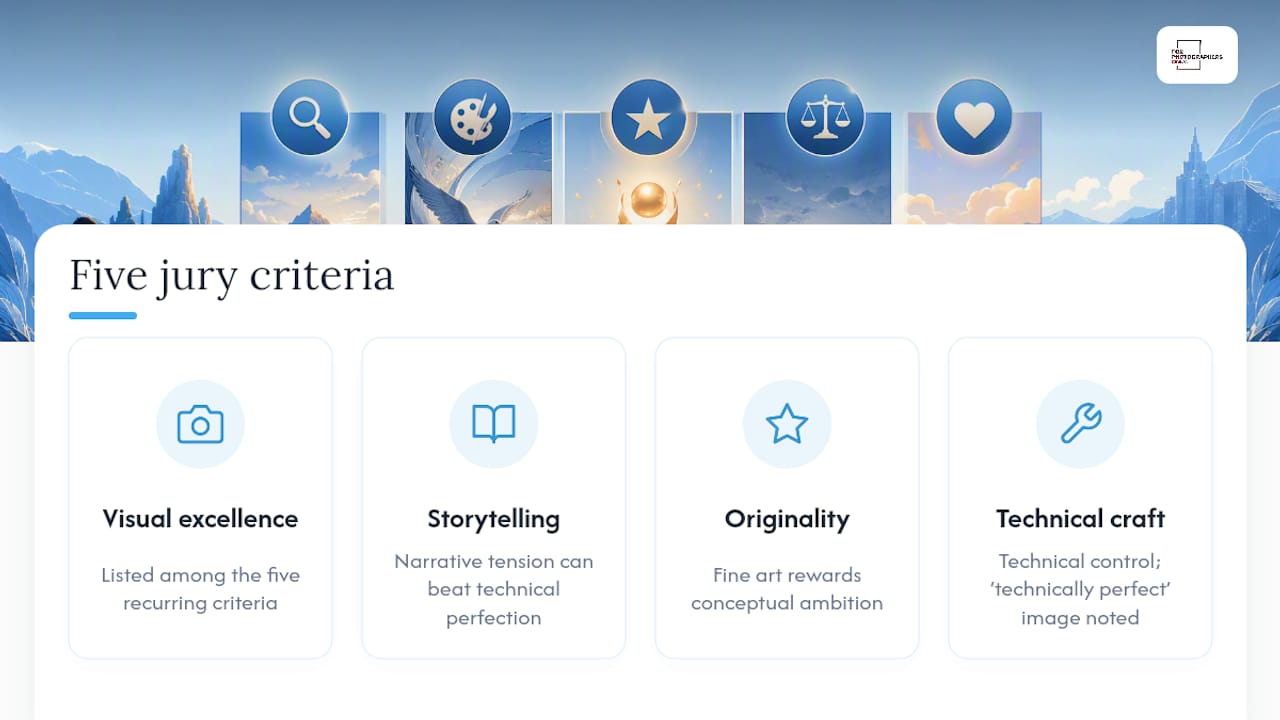
Jury panels weigh five recurring criteria: visual excellence, storytelling strength, originality, technical craft, and ethical handling of the subject. A technically perfect image with no narrative tension rarely beats a rougher frame that tells a clear story, particularly in documentary-leaning contests.
Most flagship awards run multi-stage judging. Preliminary rounds are frequently anonymous, meaning jurors see the image without the photographer’s name or country attached, which keeps early cuts focused on the work itself. Later stages bring in named panels, sometimes with public “open results” showing how each juror scored a finalist, a transparency practice that builds trust in contests that publish it.
Expectations shift by category. Documentary and photojournalism juries, the kind that judge World Press Photo, prioritize accuracy and context over stylization, an emphasis on storytelling and rigor that runs through high-volume photojournalism contests. Fine art categories reward conceptual ambition and technical control in equal measure. Mobile photography juries tend to reward resourcefulness, since the format itself limits equipment options. Reading a judging criteria breakdown before you shoot, not after, changes how you compose in the field.
What You Actually Gain by Entering
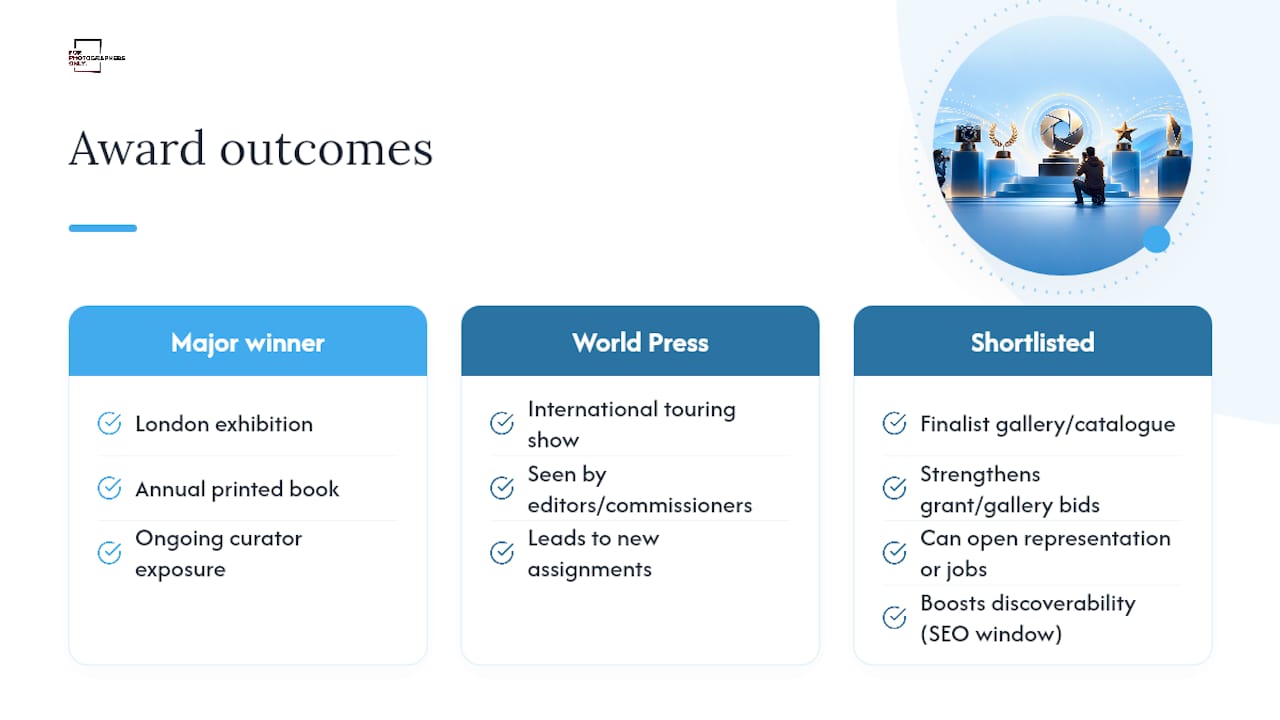
The payoff from a major award rarely stops at a check. Winners typically receive some combination of cash, equipment, gallery exhibitions, press coverage, inclusion in an annual book or catalogue, and occasionally mentoring or festival access.
Exposure and prize money don’t always carry equal weight, and knowing which one matters more for your goals should guide where you apply. Sony’s model pairs prize money with exhibition placement and book inclusion, a combination often more valuable long term than a cash prize alone, because galleries and books keep circulating your name after the ceremony ends. World Press Photo entrants gain something different entirely: a global media platform that reaches editors and commissioning bodies directly. If you’re building a documentary career, that exposure outweighs almost any prize purse.
Choosing the Right Awards for Your Work
Entering ten contests scattershot wastes both money and time. A tighter, deliberate approach produces better results.
Weigh these factors before committing to an entry fee:
Fit for your work. Does the contest’s history of winners resemble your style, subject, or format?
Audience and exposure type. Are you chasing editorial visibility, gallery placement, or industry credibility?
Fee-to-prize calculus. A $75 entry fee for a $500 prize pool makes less sense than a $20 fee feeding a well-funded exhibition program.
Jury reputation. Panels with recognized editors, curators, or working photographers tend to carry more weight with future clients.
Timeline fit. Does the entry window match when your best current work is actually ready?
Watch for red flags too: vague rights language that claims broad usage of your image forever, suspiciously inflated “thousands of winners” claims that dilute any single win’s meaning, and judging processes that never publish jurors’ names. A simple, repeatable process works well: shortlist three contests each quarter, tailor your strongest five to ten images to each one’s stated theme, and track every deadline in one place rather than across scattered bookmarks.
A Curated Directory Built to Save Photographers Time
Tracking dozens of annual contests across different organizers, currencies, and deadline formats is its own part-time job. Several directories fill this gap, offering curated, frequently updated listings of active international photography contests, including many free-to-enter options.
Listings may be curated from a mix of well-known organizers and smaller festivals alongside niche contests that rarely surface in a general search. Photographers who rely on a weekly-updated listing are more likely to enter multiple contests aligned with their actual goals, simply because they see the opportunities before the deadline passes rather than after.
Rather than researching each organizer’s site individually, checking a single, continuously updated page lets you filter by genre, fee structure, and deadline in minutes. That structure matters most for photographers juggling paid work alongside a submission calendar, where a missed deadline usually means waiting another full year for the next cycle.
Copyright and Usage Rights: What to Check Before You Submit
Read the rights section of every entry form before uploading a single frame. Reputable annual awards, including the ones covered here, request a limited, non-exclusive license: permission to display, print, and promote your winning or shortlisted image in exhibitions, books, press materials, and marketing tied to that specific contest cycle. You keep copyright. You can still sell, license, or publish the same image elsewhere.
Problems arise with contests that bury broader language deep in the fine print, granting themselves perpetual, exclusive, or worldwide commercial rights to use your image however they choose, indefinitely, with no additional compensation. That kind of clause effectively signs away control of the image, not just permission to display it once.
Before entering any contest, confirm three things: whether the license is exclusive or non-exclusive, whether it’s time-limited to the contest cycle or open-ended, and whether commercial use beyond promoting the contest itself is mentioned anywhere. If a model or recognizable private property appears in your frame, secure a signed release in advance. Most disqualifications tied to rights issues happen after the fact, when an unreleased subject objects to publication, not during the judging process itself. Keep release forms, capture metadata, and original raw files organized before you submit anything, since several contests request proof of authorship if a submission is challenged post-announcement.
Why Entries Get Disqualified or Rejected
Most rejections have nothing to do with image quality. They come down to overlooked technical or procedural details that a careful read of the rulebook would have caught.
The most common causes include: missing or incorrect metadata fields, images that were previously published or entered in a conflicting contest’s exclusivity window, file formats or resolutions that fall outside the stated specifications, and excessive post-processing that violates a documentary category’s manipulation limits. Watermarks, borders, or embedded signatures also trigger automatic disqualification in nearly every major contest, since judges need to view work without any identifying marks during anonymous rounds.
Missed deadlines account for a large share of would-be entries that never make it into judging at all, often because photographers underestimate time zone differences on a stated closing time. Incomplete releases for identifiable people or private property is another frequent issue, particularly in street photography and documentary categories where subjects didn’t explicitly consent to public exhibition. Reading each contest’s eligibility window for capture dates matters too. Many awards restrict entries to images captured within a specific one or two year period, and an otherwise stunning older photograph simply won’t qualify.
The fix is procedural, not artistic: build a checklist per contest covering format, metadata, releases, and capture-date eligibility, and run every submission through it before you upload.
How a Win or Shortlist Actually Changes a Career
Recognition from a major annual award rarely functions as a one-time headline. It compounds. A Sony World Photography Awards win places your work in a London exhibition and the official annual book, both of which continue generating exposure to curators, editors, and collectors long after the award ceremony ends, part of what the organization describes as extending relationships with winners to support career growth.
For photojournalists, a World Press Photo selection carries different currency entirely. The contest’s exhibition tours internationally and places winning work in front of editors and commissioning bodies who decide future assignments, which explains why so many documentary photographers treat this single award as a career milestone rather than one line on a resume.
Shortlisted photographers, not just outright winners, still benefit substantially. Inclusion in a finalist gallery or a printed catalogue, the kind IPA and 35AWARDS both produce annually, builds a public paper trail of recognition that strengthens future grant applications, gallery pitches, and editorial submissions. Several working photographers point to a single well-placed shortlist as the credential that opened the door to their first gallery representation or magazine assignment. Award recognition also feeds directly into discoverability. Photographers looking to convert that visibility into actual bookings often pair award credits with a dedicated SEO strategy for photographers, since a prize announcement drives search interest in your name for only a limited window after results go public.
Where Annual Awards Are Headed in 2026
Mobile-specific awards keep expanding their reach, and themed open calls are multiplying faster than traditional single-cycle contests, giving photographers more entry points throughout the year instead of one annual window. Juries are also shifting composition. Expect more international and locally rooted voices seated alongside established names, a change that broadens whose visual language gets rewarded.
Hybrid exhibition formats, pairing a physical gallery show with an extended online viewing room, now stretch a winning image’s shelf life well past opening night. Photographers who treat that online component as seriously as the print exhibition tend to see longer, more durable exposure from a single win.
— DARIO
Track Every Deadline Without the Guesswork
There are services that provide a single continuously updated page listing hundreds of active photography contests, including many free-to-enter opportunities, refreshed regularly to help track deadlines.
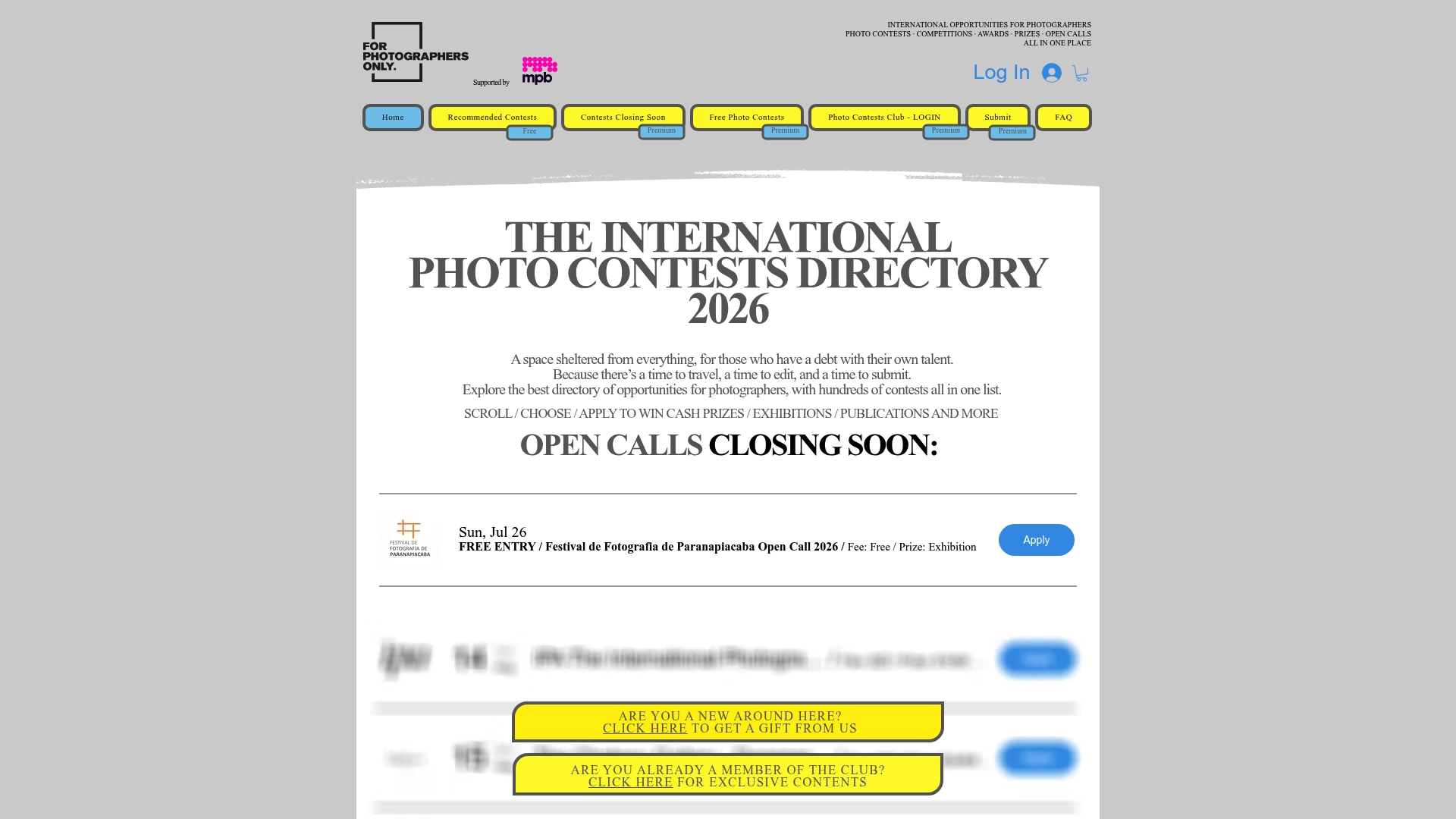
The PhotoContestsClub subscription runs €6 per month or €40 per year, covering full access to the entire curated list with filters by genre, fee, and deadline. Start with a free trial, build a personal calendar of the deadlines that matter to your portfolio, and shortlist three priority contests this week rather than scrolling through scattered search results. For photographers who want an editorial view of how award exposure translates into real opportunity, Photography Life offers additional context worth reading alongside your shortlist.
Sources
FAQ
What Is the Most Prestigious Award in Photography?
There’s no single universally agreed answer, but World Press Photo Contest and Sony World Photography Awards are widely considered the two most prestigious annual international awards, given their scale, jury rigor, and global exhibition reach. World Press Photo alone drew 57,376 photographs from 3,747 photographers in 141 countries for its 2026 edition.
What Are the Top Photography Awards to Enter Each Year?
The top annual photography awards include Sony World Photography Awards, World Press Photo Contest, International Photography Awards (IPA), 35AWARDS, and Mobile Photography Awards. Each targets a different niche, from documentary work to phone photography, so match your portfolio to the contest’s stated focus before entering.
What Awards Exist for Photography Besides the Major Global Contests?
Beyond the flagship international awards, regional contests like the APEC Photo Contest and project-focused open calls like Eyeshot offer additional routes to recognition, cash prizes, and publication. A curated directory tracking a large number of active contests helps surface these smaller but reputable opportunities that rarely appear in general search results.
How Much Does It Cost to Enter Annual Photography Awards?
Entry fees vary widely, from completely free categories at many mobile and regional contests to $50 or more per image at flagship professional-level awards. Forphotographersonly’s directory highlights many free-to-enter competitions specifically so cost doesn’t limit which contests you can pursue.
Can Entering Annual Photography Awards Actually Help My Career?
Yes. Winners and shortlisted photographers gain exhibition placement, publication in annual books or catalogues, and press exposure that continues generating opportunities well after results are announced. Sony World Photography Awards, for example, positions winners with ongoing career support through exhibitions and its annual book, while a World Press Photo selection can open doors directly with editors and commissioning bodies.
Recommended